Table of Contents
It Was a Wednesday Night, and Pastor Daniel Was Staring at a Blank Screen Again
He had three days until Sunday. The congregation was expecting something meaningful — something that would speak to the financial anxiety gripping their community, the young couple in row four dealing with a marriage in crisis, the skeptical college student visiting for the first time. With time running short, he considered using an ai sermon generator to help shape a message that could truly reach them all.
Daniel had a passage in mind — Romans 8:28. He’d preached near it before. But every angle felt either too familiar or too shallow. He opened his notes from last year. Too similar. He pulled up a commentary. Dense, academic, disconnected from Monday morning reality.
It was 11 PM. He had a counseling session at 8 AM, a board meeting at noon, and three pastoral visits to squeeze in on Thursday.
Sound familiar?
If you’re a pastor, ministry leader, chaplain, or faith educator, you probably know this feeling intimately. Sermon preparation is sacred work — but it’s also exhausting, time-consuming, and creatively demanding in ways that very few outside ministry leadership truly understand.
That’s exactly where an ai sermon generator enters the picture. Not as a replacement for prayer, study, or spiritual discernment — but as a powerful tool that gives you back your most precious resource: time.
In this guide, we’ll break down what an AI sermon generator actually is, why so many ministry leaders are quietly using them, the honest pitfalls to watch for, and how platforms like AiZolo give you access to the world’s most advanced AI models — all in one place — so you can build a smarter sermon prep workflow without paying for five different subscriptions.
What Is an AI Sermon Generator, and How Does It Actually Work?
An ai sermon generator is a tool powered by large language models (LLMs) — the same technology behind ChatGPT, Claude, and Google Gemini — that helps religious leaders research, outline, draft, and refine sermon content with the support of an ai sermon generator.
You provide inputs: a Bible passage, a theme, your congregation’s context, the occasion (Sunday morning, funeral, youth service, wedding), and the tone you’re aiming for. The AI expands that guidance into structured content — introductions, main points, supporting scriptures, illustrations, and conclusions.
Some tools are purpose-built for ministry, while others are general-purpose AI models that you can guide with smart prompting. Both have a place in a modern pastor’s workflow when using an ai sermon generator to streamline preparation and refine message clarity.
The key distinction that most existing guides miss? The quality of the AI model underneath matters enormously. A basic or outdated model will give you shallow, generic output that sounds like it was written by someone who has read about Christianity from the outside looking in.
A state-of-the-art model — properly prompted — can help you explore theological nuance, surface historical context, generate culturally resonant illustrations, and draft content that actually sounds like a human being thought about it deeply.
This is why access to multiple premium AI models isn’t a luxury. It’s a competitive advantage for serious sermon preparation when using an ai sermon generator to enhance depth, clarity, and efficiency.
Why Sermon Prep Is Harder Than Most People Think
Before we talk solutions, let’s name the real problem honestly.
Most people assume pastors spend the week primarily praying, counseling, and leading. What they don’t see is the invisible cognitive labor of weekly content creation — which is why many turn to an ai sermon generator for support. A single sermon requires:
- Exegesis: Reading the text in context, cross-referencing original languages, studying historical background
- Theological reflection: Asking what this passage means for today, not just then
- Audience awareness: Knowing who’s sitting in those pews — their pain points, cultural references, attention spans
- Narrative construction: Building a message with a beginning, a problem, a turn, and a resolution that lands
- Illustration research: Finding stories, examples, and metaphors that bring abstract truth into lived reality
- Application: Connecting scripture to Monday morning decisions and Thursday afternoon heartbreaks
According to surveys within pastoral communities, the average pastor spends 10–15 hours preparing a single sermon. For bi-vocational pastors — those holding down a full-time job alongside ministry — that number doesn’t shrink. It just gets stolen from sleep, family time, and self-care.
The burnout rate in ministry is real. And one of its underreported contributors is the relentless, weekly pressure to produce something fresh, spiritually grounded, and humanly resonant — every single week, year after year — which is why many leaders are turning to an ai sermon generator for support.
This is the problem an AI sermon generator is genuinely built to help solve.
The Honest Case For (and Against) AI in Sermon Preparation
Let’s be direct, because this topic deserves intellectual honesty.
The case for using an AI sermon generator:
- It dramatically reduces the time spent on structural and research groundwork
- It helps when you’re creatively stuck, offering angles and illustrations you hadn’t considered
- It can surface scripture cross-references and theological connections faster than manual search
- It generates first drafts that you can tear apart, rebuild, and make your own
- It helps bi-vocational and small-church pastors compete on sermon quality with far fewer hours
The honest limitations:
- AI doesn’t have spiritual discernment. It doesn’t know your congregation the way you do
- AI-generated content needs fact-checking, especially for quotes, historical claims, and scripture citations
- Blindly preaching AI output without deep personalization is a shortcut that congregations can feel
- The output quality is only as good as the AI model and the prompts you feed it
The best mental model is this: an AI sermon generator is like a deeply well-read research assistant who works at 3 AM, never gets tired, and never judges you for the gap between your ideal sermon and Wednesday night’s reality.
But the pastor — their story, their relationship with the text, their knowledge of the room — remains irreplaceable, even when using an ai sermon generator to assist the process.
How Different Ministry Leaders Are Using AI Sermon Generators Right Now

The Solo Pastor of a Small Rural Church
Pastor Marcus leads a congregation of 85 people in rural Georgia. He also works part-time in construction. His sermon prep window is Friday night and Saturday morning, so he relies on an ai sermon generator to support his preparation and save valuable time.
He uses an AI model to generate three possible outlines for his chosen passage, picks the structure that fits his congregation’s current season, and personalizes every illustration from his own life and community. What used to take eight hours now takes three.
The Youth Pastor
Jenna leads youth ministry for a church in suburban Chicago. Her challenge isn’t time — it’s relevance. Her teens don’t connect with the same illustrations that work for a 55-year-old.
She uses an ai sermon generator to create youth-oriented applications and modern analogies for ancient passages, then filters them through her own knowledge of what her specific students are going through.
The Seminary Student
David is completing his Master of Divinity and preaches twice a semester. He uses AI models to help him think through exegetical arguments, explore different homiletical structures, and find gaps in his theological reasoning before he commits to a sermon direction. The AI acts as a sparring partner for ideas, not a ghostwriter.
The Bi-Vocational Church Planter
Sofia is planting a church while working full-time as a nurse. Her sermon prep happens in stolen pockets of time. She uses AI to generate a rough draft on Thursday evening, then refines it during her Saturday lunch break. Without AI assistance,
she estimates she’d reduce her sermon preparation from weekly to bi-weekly. With it, she preaches every Sunday without burning out.
The Chaplain
Hospital chaplain James uses AI to help him prepare short, topic-specific devotionals for patients facing surgery, loss, and life transitions. He inputs the emotional context and the scripture he wants to anchor in, and uses the AI output as a starting point for messages that are ultimately shaped by the human moment in front of him.
Why the AI Model You Use Matters More Than the Tool You Choose
Here’s something almost no existing guide on ai sermon generator tools talks about clearly: there is a massive quality gap between AI models, and that gap shows up in sermon prep work.
Basic, older, or budget AI models tend to produce generic religious language. Phrases like “lean on God’s strength” and “trust in His plan” appear as filler because the model has pattern-matched from thousands of undistinguished religious texts. The theological depth is surface-level. The illustrations feel recycled.
Frontier models — like GPT-4, Claude 3.5, or Gemini 1.5 Pro — produce fundamentally different output. They understand nuance. They can differentiate between expository, topical, and narrative sermon structures.
They can engage with the Hebrew or Greek behind a passage when prompted correctly. They produce illustrations that feel discovered rather than assembled.
The challenge? Accessing multiple frontier models usually means paying for multiple subscriptions. ChatGPT Plus, Claude Pro, and Gemini Advanced each carry separate monthly fees that add up quickly — easily crossing $100 per month if you want the best of each.
How AiZolo Gives Every Pastor Access to the Best AI Models Without the Subscription Chaos
This is where AiZolo changes the equation.
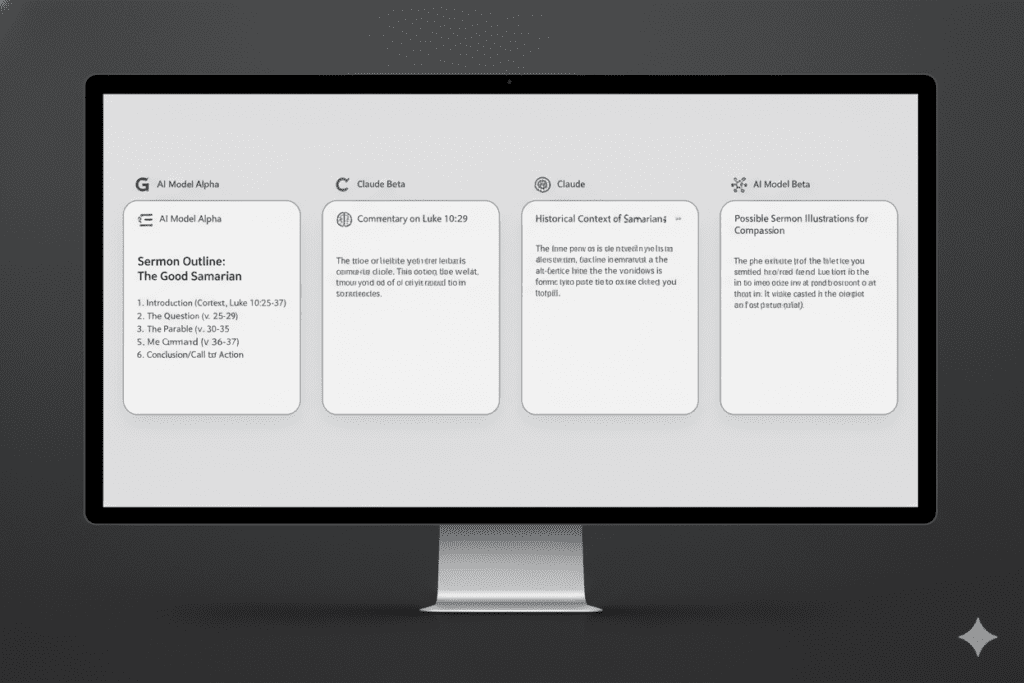
AiZolo is an all-in-one AI platform that gives you access to every major premium AI model — ChatGPT, Claude, Gemini, Grok, Perplexity, and more — through a single subscription at $9.90/month. Instead of paying $20–$30 per model separately, you get the entire suite under one roof, with a side-by-side comparison interface so you can literally see how different models respond to the same sermon prompt simultaneously.
For a pastor using AI for sermon prep, this means:
- Ask GPT-4 for a three-point expository outline on a passage and compare it with Claude’s narrative interpretation of the same text
- Use Gemini for deep research on the historical context of a scripture
- Use Perplexity to pull in current events and real-world examples that connect your passage to today’s headlines
- Save your best sermon prompts in AiZolo’s built-in Prompt Manager, so your most effective requests are ready every week without rebuilding them from scratch
- Use AI Memory so the platform remembers your preaching style, denomination, congregation context, and preferred sermon structure over time
It’s the closest thing to having a theology research assistant, a creative writing partner, and a sermon outline specialist — all available at 11 PM on a Wednesday, never needing a day off.
For pastors, chaplains, ministry leaders, and seminary students, this isn’t just a productivity tool. It’s a budget-friendly way to access the same AI capabilities that large, well-resourced churches are using internally.
Explore more insights on AiZolo at aizolo.com and see how the all-in-one platform is reshaping how creative and ministry professionals work with AI every day.
A Practical Workflow: Using an AI Sermon Generator Effectively
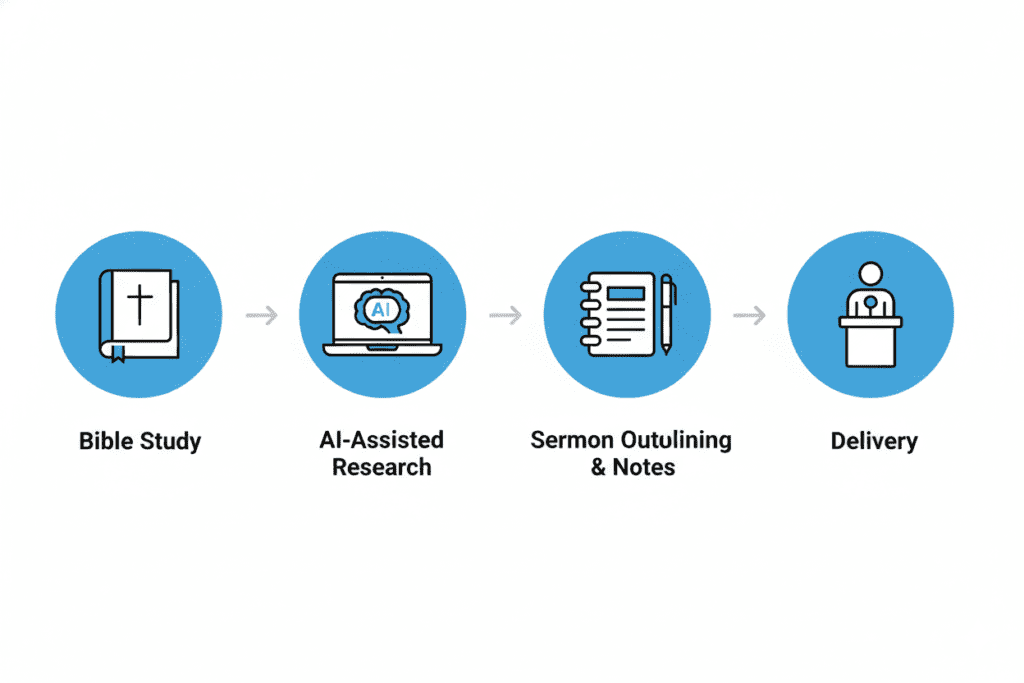
If you’re new to using an AI sermon generator, here’s a workflow that balances efficiency with theological integrity:
Step 1: Begin with your own study. Read the passage. Sit with it. Note what strikes you, what confuses you, what feels alive. This personal encounter with the text is irreplaceable — don’t outsource it.
Step 2: Define your inputs clearly. Before opening any AI model, clarify: What’s the passage? What’s the central question you want to answer? Who is your audience? What’s the emotional temperature of your congregation right now? The more specific your input, the more useful the output.
Step 3: Generate multiple outlines. Use AiZolo’s comparison feature to request sermon outlines from two or three different models simultaneously. You’re not looking for one to copy — you’re looking for angles, structure options, and ideas you hadn’t considered.
Step 4: Mine for illustrations. This is where AI genuinely shines. Ask specifically for modern, culturally relevant illustrations for your main points. Prompt the AI with your congregation’s context (urban or rural, young or multigenerational, culturally specific). Discard what doesn’t fit.
Step 5: Verify every factual claim. Especially quotes, historical claims, and scripture references. AI models can and do hallucinate — presenting confident-sounding falsehoods as fact. Cross-check everything before Sunday.
Step 6: Write your draft in your own voice. Use the AI outline as scaffolding, not as the sermon itself. Tell your own stories. Insert your own theological convictions. Let the AI’s structure hold content that is authentically yours.
Step 7: Save your best prompts. When you find a prompt that produces excellent results — whether for generating illustrations, building outlines, or drafting applications — save it in AiZolo’s Prompt Manager. Over time, you’ll build a personalized library of sermon prep prompts tuned to your style.
What to Watch Out For: The Real Risks of AI in Sermon Prep
No honest guide would skip this section.
Theological drift: AI models are trained on enormous volumes of text across all traditions, denominations, and belief systems. Without careful prompting, output can blend theological perspectives in ways that sound reasonable but may not align with your tradition. Always filter AI content through your own theological convictions.
The copy-paste trap: The fastest path to a congregation losing trust in their pastor is preaching content that feels disconnected from lived experience. If you’re delivering AI-generated illustrations without any personalizing work, people feel it — even if they can’t name it.
Over-reliance: AI sermon generators are most valuable as a tool in a broader preparation process, not as a replacement for that process. The best results come from pastors who engage deeply with the text first, then use AI to expand, not replace, their thinking.
Accuracy issues: Never cite a quote, a statistic, or a historical claim from AI output without independently verifying it. The confidence with which AI presents information is not correlated with its accuracy.
The Bigger Picture: AI and the Future of Ministry Leadership
We’re living through a moment of genuine transformation in how knowledge work gets done. The ministry leadership world is not exempt from this shift — and resisting it entirely isn’t faithfulness; it’s just friction.
The most effective pastors of the next decade will be those who learn to use AI as a thinking partner while maintaining the irreplaceable human and spiritual dimensions of their vocation. They’ll use AI to reclaim hours that currently disappear into research rabbit holes and blank-page anxiety.
And they’ll reinvest those hours into the work that only a human pastor can do: presence, pastoral care, genuine relationship, and the kind of spiritual authority that grows from a life lived in faithful service.
An AI sermon generator isn’t the future of preaching. Preaching remains profoundly human. But AI is becoming an essential part of the future of sermon preparation — and the pastors who figure that out now will have a meaningful advantage in both productivity and creative output.
Learn from real-world experience at AiZolo and discover how ministry leaders, creators, developers, and founders are using the platform to work smarter — not just harder.
Conclusion: Your Sermon Prep Doesn’t Have to Feel Like This Every Week
Go back to Pastor Daniel, staring at his screen at 11 PM on a Wednesday.
Now imagine a different version of that night. He opens AiZolo, inputs his passage and congregation context, and within two minutes he has three structurally different sermon outlines from three different frontier AI models.
He spots an angle in Claude’s narrative interpretation he wouldn’t have found on his own. He asks GPT-4 for modern illustrations and finds two that are perfect for row four and the skeptical college student in the back. He verifies two scripture cross-references, discards one AI illustration that doesn’t fit, and writes his introduction in his own words.
It’s still 11 PM. But the blank page is gone. The creative block has broken. The sermon that emerges will be authentically his — and better for having had an intelligent, tireless thinking partner alongside him.
That’s the real promise of an AI sermon generator: not that AI will preach for you, but that it will give you back enough creative headroom to preach better, more often, with less of the exhaustion that threatens to hollow out the best ministry leaders over time.
Start building smarter with AiZolo — and bring every premium AI model into your sermon prep workflow for less than the cost of a single premium AI subscription.
Follow AiZolo for practical tech and startup insights on how AI is reshaping the way professionals, creators, and leaders do their best work.
Suggested Internal Links
- All in One AI Free – What You Actually Get (And the Smarter Way to Start in 2026)
- All in One AI Software: Why Smart Professionals Are Done Paying for 5 Tools
- How to Compare Gemini vs Claude vs ChatGPT in One App
- The Ultimate AI Workspace for Long Form Content with Multiple Models
Suggested External Links
- SermonSpark – AI-Powered Sermon Preparation Tools — reference when discussing the broader ecosystem of sermon prep tools
- OpenBible.info AI Sermon Outline Tool — reference for beginner/free tools
- Anthropic’s Claude Overview — reference when discussing Claude’s theological nuance capabilities
- Logos Bible Software — reference as a complementary research tool for deep exegesis