The Empty Community Meeting That Changed Everything
Sarah Chen still remembers the frustration. As a community development officer for a mid-sized city, she had organized what she hoped would be a productive town hall meeting about a new neighborhood revitalization project. The room held 200 seats. Only 17 people showed up.
But here’s the twist: over the next three days, Sarah’s inbox exploded with 843 emails from residents—some praising the initiative, others expressing deep concerns, and many asking questions that should have been answered at the meeting. The problem wasn’t that residents didn’t care. The problem was that traditional methods of gathering community feedback had become woefully inadequate for modern neighborhoods.
This is where AI powered neighbourhood sentiment analysis enters the picture, transforming how we understand, measure, and respond to community emotions at scale.
Understanding the Community Feedback Crisis

Communities today face an unprecedented challenge: how do you truly understand what thousands of residents think, feel, and need when traditional engagement methods reach less than 5% of the population?
Research from Columbia University’s Neighborhood Navigator initiative revealed that conventional community meetings, paper surveys, and phone polls capture only a fraction of actual resident sentiment. Meanwhile, residents are expressing their opinions daily through:
- Online neighborhood forums and community Facebook groups
- Local news website comments and social media posts
- Property review platforms like Niche and Yelp
- Community apps like Nextdoor
- Municipal feedback portals and 311 service requests
The data exists. The challenge is making sense of it all—and that’s exactly what AI powered neighbourhood sentiment analysis solves.
What is AI Powered Neighbourhood Sentiment Analysis?
AI powered neighbourhood sentiment analysis uses advanced artificial intelligence and natural language processing to automatically analyze thousands of community comments, reviews, and feedback to determine the emotional tone and key topics that matter most to residents.
Think of it as having a team of analysts who can read every single piece of community feedback—from social media posts to council meeting comments—and instantly tell you:
- Overall sentiment: Are residents generally positive, negative, or neutral about neighborhood issues?
- Key topics: What specific issues are people talking about most? (Safety, amenities, maintenance, community events)
- Emotional intensity: Which topics generate the strongest reactions?
- Emerging trends: What new concerns are starting to bubble up before they become major issues?
- Demographic patterns: How do sentiments differ across different neighborhood sections or resident groups?
Unlike traditional surveys that might capture 50-100 responses, AI-powered sentiment analysis can process tens of thousands of data points in minutes, giving you a genuinely representative understanding of community emotions.
How AI Powered Neighbourhood Sentiment Analysis Actually Works
The technology behind neighbourhood sentiment analysis combines several AI capabilities working together:
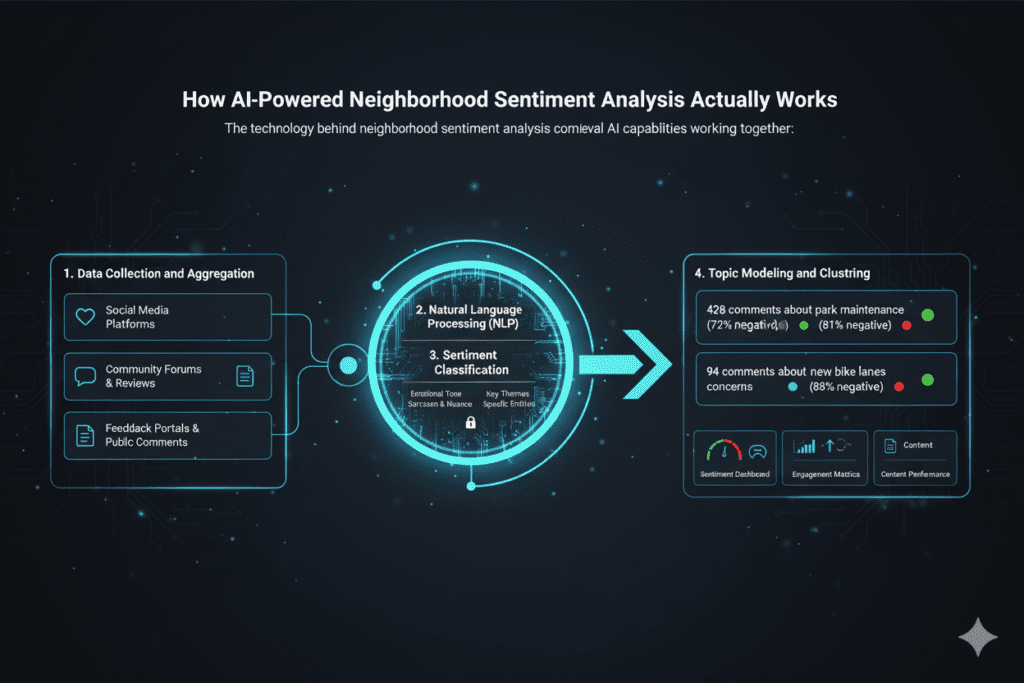
1. Data Collection and Aggregation
AI systems automatically gather text data from multiple sources—social media platforms, community forums, review sites, feedback portals, and public comments. This eliminates the manual work of compiling feedback from dozens of different places.
2. Natural Language Processing (NLP)
Advanced NLP algorithms read and understand human language in context. They can detect:
- Emotional tone (positive, negative, neutral, mixed)
- Sarcasm and nuanced expressions
- Key themes and topics being discussed
- Specific entities mentioned (parks, streets, services, buildings)
3. Sentiment Classification
Machine learning models trained on millions of text examples classify each piece of feedback according to sentiment polarity and intensity. A comment like “The new community center is absolutely amazing and has brought our neighborhood together” registers as strongly positive, while “Still waiting 3 weeks for the broken streetlight to be fixed” registers as negative with moderate intensity.
4. Topic Modeling and Clustering
AI identifies common themes across thousands of comments. Instead of reading each individual message, you see: “428 comments about park maintenance (72% negative), 186 comments about new bike lanes (81% positive), 94 comments about noise concerns (88% negative).”
5. Visualization and Reporting
The insights get presented through intuitive dashboards showing sentiment trends over time, topic breakdowns, geographic heat maps, and actionable recommendations.
The Tool That Makes This Possible: Introducing AiZolo
While specialized sentiment analysis platforms exist, they often cost thousands of dollars monthly and require technical expertise to operate. This is where AiZolo changes the game.
AiZolo is an all-in-one AI platform that gives you access to multiple premium AI models—including ChatGPT, Claude, and Gemini—in a single interface. For community managers, property managers, local government staff, and neighborhood organizations, this means you can perform sophisticated sentiment analysis without breaking the bank or mastering complex software.
Why AiZolo is Perfect for Neighbourhood Sentiment Analysis
Multi-Model Comparison for Better Accuracy
With AiZolo, you can analyze the same community feedback using different AI models simultaneously. Ask ChatGPT to analyze sentiment from your neighborhood Facebook group while Claude examines NextDoor comments and Gemini processes council meeting transcripts—all side-by-side. This multi-perspective approach catches nuances that single-model analysis might miss.
Cost-Effective Solution
Instead of paying $20-40 per month for individual AI subscriptions or thousands for specialized sentiment analysis tools, AiZolo provides access to all premium AI models starting at just $9.90/month. For neighborhood organizations and small municipalities with limited budgets, this represents 80-90% cost savings.
Custom API Keys for Unlimited Analysis
Power users can connect their own encrypted API keys through AiZolo, enabling unlimited sentiment analysis with pay-per-use pricing that often costs pennies per analysis session. This is ideal when processing large volumes of community feedback.
Project Organization
Create dedicated projects for different neighborhoods, initiatives, or time periods. Save custom prompts like “Analyze this community feedback for main concerns, sentiment breakdown, and recommended actions” and deploy them instantly across new feedback batches.
Collaborative Workflows
Share sentiment analysis results with team members, stakeholders, or city council members directly through AiZolo’s workspace. Everyone sees the same AI-generated insights without needing separate subscriptions.
Real-World Applications: Who Benefits from AI Powered Neighbourhood Sentiment Analysis?

Property Managers and Real Estate Developers
A multifamily property management company analyzed 4,000+ tenant reviews across 12 properties using AI-powered sentiment analysis. They discovered that maintenance response time was the #1 driver of negative sentiment—mentioned in 73% of critical reviews. By addressing this single issue, they improved retention rates by 28% within six months.
With AiZolo: Property managers can paste resident feedback from surveys, lease renewal comments, and online reviews into the platform and get instant sentiment breakdowns across all properties. Compare ChatGPT’s thematic analysis with Claude’s emotional tone assessment to build comprehensive action plans.
Local Government and City Planners
A mid-sized city used sentiment analysis to evaluate 15,000+ social media comments and online forum discussions about a proposed development project. The analysis revealed that while 62% of residents supported the project, specific concerns about traffic and parking were mentioned in 78% of negative comments. By proactively addressing these concerns in the revised plan, the city achieved community buy-in and approved the project with minimal opposition.
With AiZolo: Government staff can process feedback from public hearings, email submissions, social media, and comment portals through multiple AI models to ensure they’re capturing the full spectrum of community sentiment before making policy decisions.
Community Organizations and Neighborhood Associations
A neighborhood association analyzed comments from their community Facebook group (8,000+ members) over a 6-month period. The sentiment analysis identified growing concerns about park safety after sunset—mentioned in 147 posts with increasingly negative sentiment. The association presented this data-driven insight to the city parks department, securing funding for improved lighting and evening patrol services.
With AiZolo: Community leaders without technical backgrounds can simply copy and paste community discussions into the platform and ask questions like “What are residents most concerned about this month?” or “How has sentiment about our neighborhood events changed over time?”
Researchers and Urban Planners
Academic researchers studying neighborhood dynamics can process thousands of online reviews, social media posts, and community forum discussions to understand how residents perceive their living environments. This geographic sentiment data reveals patterns invisible to traditional surveys.
With AiZolo: Researchers can experiment with different AI models and prompting strategies to refine their sentiment analysis methodology. The customizable workspace allows side-by-side comparison of results from different analytical approaches.
Marketing and Communications Professionals
Communications teams for neighborhood improvement districts or business improvement zones can monitor sentiment about local events, initiatives, and services in real-time. This allows rapid response to emerging concerns and amplification of positive momentum.
With AiZolo: Communicators can set up templates for regular sentiment monitoring, quickly analyzing social media mentions, event feedback, and stakeholder communications to inform messaging strategies.
Step-by-Step: Conducting Your First Neighbourhood Sentiment Analysis with AiZolo
Let’s walk through exactly how you’d use AiZolo to perform neighbourhood sentiment analysis:
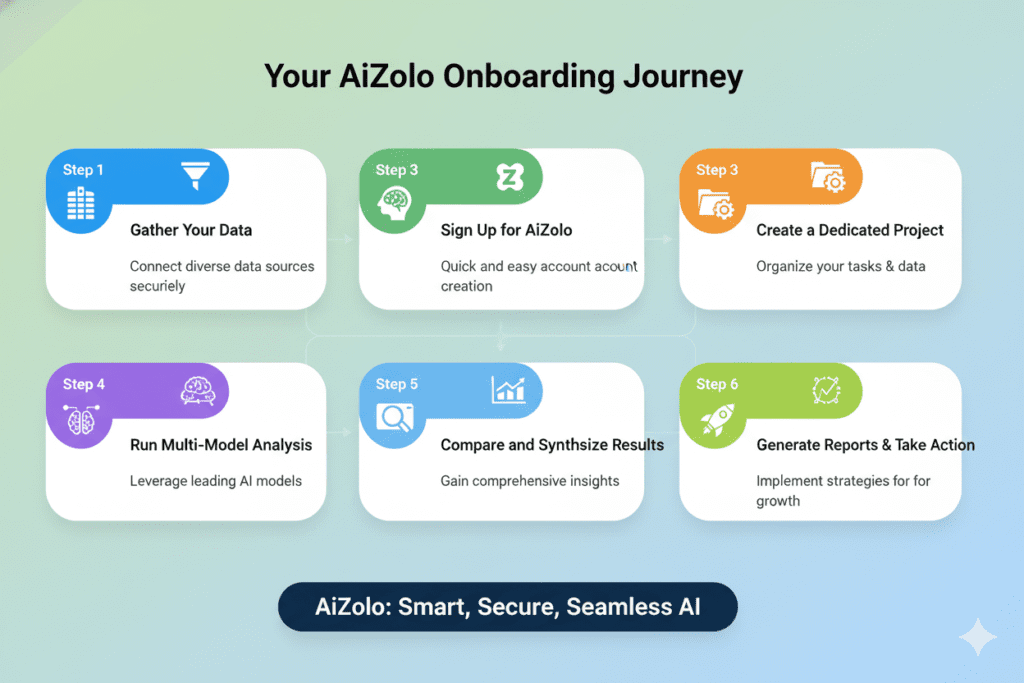
Step 1: Gather Your Data
Collect community feedback from your sources:
- Export comments from your neighborhood Facebook group
- Copy feedback from your community forum
- Compile survey responses
- Gather reviews from rental platforms
- Extract social media mentions
Step 2: Sign Up for AiZolo
Visit AiZolo.com and create your free account. No credit card required to start exploring the platform.
Step 3: Create a Dedicated Project
Set up a project called “Neighborhood Sentiment Analysis – [Date]” with a custom system prompt:
“You are an expert in community sentiment analysis. When I provide community feedback, analyze it for: 1) Overall sentiment (positive/negative/neutral percentages), 2) Key themes and topics, 3) Emotional intensity, 4) Specific concerns or praise mentioned, 5) Actionable recommendations for community leaders.”
Step 4: Run Multi-Model Analysis
Paste your community feedback into AiZolo’s interface. Open three panels:
- ChatGPT for comprehensive thematic analysis
- Claude for emotional tone and nuance detection
- Gemini for fact-checking and trend identification
Ask all three models to analyze the same feedback simultaneously.
Step 5: Compare and Synthesize Results
Review how different AI models interpret the same data. Often, ChatGPT identifies broad themes, Claude catches emotional subtleties, and Gemini provides context about similar trends in other communities. This multi-perspective approach delivers more accurate insights than any single AI model alone.
Step 6: Generate Reports and Take Action
Use your AI-generated insights to create reports, presentations, or action plans. The data-driven approach makes it easier to justify budget allocations, policy changes, or program adjustments.
Try AiZolo today and conduct your first neighbourhood sentiment analysis in under 15 minutes.
The Business Case: Why AI Powered Neighbourhood Sentiment Analysis Delivers ROI
Organizations implementing AI-powered sentiment analysis consistently report measurable returns:
Time Savings Manual analysis of 1,000 community comments takes approximately 15-20 hours. AI-powered analysis completes this in 5-10 minutes—a 99% time reduction. For a community manager earning $75,000 annually, this represents roughly $1,500 in saved labor costs per major feedback analysis project.
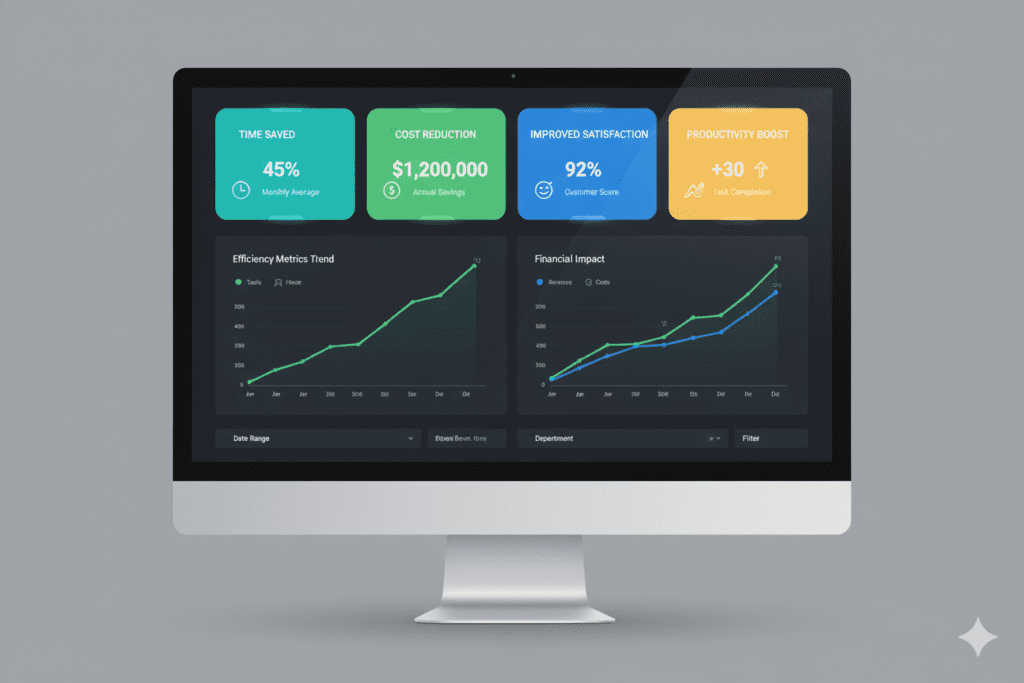
Better Decision-Making When property management companies used sentiment analysis to guide improvement priorities, they saw:
- 28% improvement in tenant retention
- 34% reduction in complaint escalations
- 19% increase in positive online reviews
Proactive Issue Resolution By identifying emerging concerns before they become widespread problems, organizations avoid costly crisis management. One city caught rising concerns about a controversial zoning decision early through sentiment analysis, adjusted their approach, and avoided an estimated $150,000 in extended public hearings and legal challenges.
Community Trust and Engagement When residents see their feedback actively influencing decisions, participation increases. One neighborhood association saw their online community group grow from 1,200 to 4,700 members after consistently demonstrating they were listening through sentiment analysis-informed actions.
Advanced Techniques: Taking Your Neighbourhood Sentiment Analysis Further
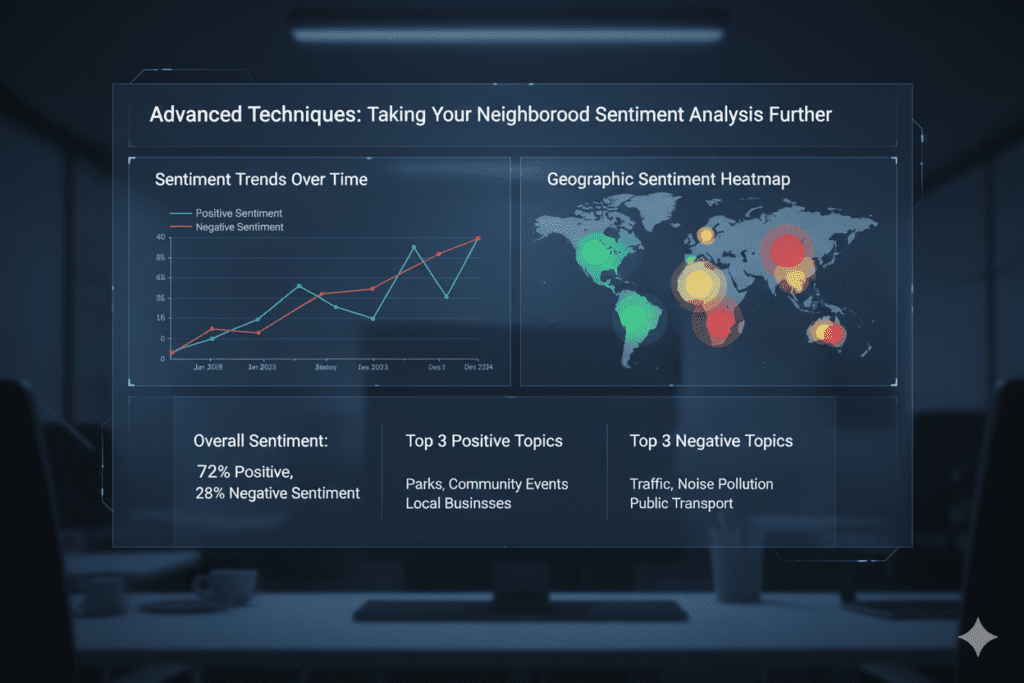
Once you’ve mastered basic sentiment analysis, consider these advanced applications:
Longitudinal Sentiment Tracking
Monitor sentiment trends over months or years. Has sentiment about park maintenance improved since you increased funding? Is resident satisfaction with community events growing or declining?
With AiZolo, create monthly sentiment analysis projects and track changes over time. The multi-model approach helps identify whether sentiment shifts are real trends or temporary fluctuations.
Geographic Sentiment Mapping
If your feedback includes location information, analyze sentiment by neighborhood section, building, or district. This reveals whether issues are community-wide or concentrated in specific areas.
Comparative Sentiment Analysis
Compare sentiment about your neighborhood versus similar communities. What are residents praising elsewhere that your community lacks? What problems are universal versus unique to your area?
Predictive Sentiment Analysis
By tracking sentiment trends and emerging topics, you can anticipate future concerns before they become widespread. If mentions of “parking difficulties” are increasing by 40% month-over-month with increasingly negative sentiment, it’s time to address the issue proactively.
Demographic Sentiment Differences
When your feedback includes demographic information, analyze how sentiment varies across age groups, tenure length (new residents vs. long-term), or property types. This helps tailor communications and interventions to specific segments.
Overcoming Common Challenges in Neighbourhood Sentiment Analysis
Challenge 1: Handling Vocal Minorities
The most vocal residents aren’t always representative of the majority. AI-powered sentiment analysis helps by quantifying: “18% of feedback is strongly negative, but comes from just 3% of the community.” This contextualizes loud voices appropriately.
Solution with AiZolo: Use multiple AI models to assess whether extreme sentiments represent genuine widespread concerns or isolated complaints. Claude excels at identifying when feedback patterns suggest organized opposition versus organic sentiment.
Challenge 2: Interpreting Sarcasm and Nuance
Statements like “Oh great, another community meeting where nothing will change” require understanding context and tone. Modern AI models have dramatically improved at detecting sarcasm, but it remains challenging.
Solution with AiZolo: Compare how different AI models interpret ambiguous statements. Often ChatGPT, Claude, and Gemini will flag potential sarcasm differently, alerting you to review those specific comments manually.
Challenge 3: Data Privacy and Ethics
Analyzing publicly posted community feedback raises fewer privacy concerns than analyzing private communications. However, you should still follow best practices:
- Only analyze publicly available or appropriately consented feedback
- Anonymize personal information before analysis
- Be transparent with residents that their feedback informs decision-making
- Never use sentiment analysis for punitive purposes
Solution with AiZolo: The platform’s encrypted API key support means your community data never needs to be stored by third parties—it processes through the AI models and returns to you directly.
Challenge 4: Translating Insights into Action
Generating sentiment data is only valuable if it drives meaningful change. Organizations sometimes struggle to convert AI insights into concrete actions.
Solution with AiZolo: Create custom prompts that explicitly request actionable recommendations. For example: “Based on this sentiment analysis, provide 5 specific, budget-conscious actions we can take in the next 90 days to address the main concerns while reinforcing what residents appreciate.”
The Future of Neighbourhood Sentiment Analysis
AI powered neighbourhood sentiment analysis is evolving rapidly. Here’s what’s coming next:

Real-Time Sentiment Monitoring Instead of periodic analysis, communities will continuously monitor sentiment through automated systems that alert stakeholders when sentiment shifts significantly or new issues emerge.
Integration with Smart City Infrastructure Sentiment analysis will connect with other urban data sources—311 requests, traffic patterns, environmental sensors—creating comprehensive community health dashboards.
Hyperlocal Granularity Analysis will pinpoint sentiment variations down to individual streets or building clusters, enabling extremely targeted interventions.
Predictive Community Dynamics AI will forecast how current sentiment patterns are likely to evolve, allowing proactive rather than reactive community management.
Multilingual and Cultural Sensitivity Advanced AI models will better handle diverse linguistic communities, understanding cultural context and nuance across languages.
The organizations that embrace AI powered neighbourhood sentiment analysis today will be best positioned to build thriving, responsive communities tomorrow.
Getting Started: Your Neighbourhood Sentiment Analysis Action Plan
Ready to transform how you understand your community? Follow this 30-day action plan:
Week 1: Setup and Exploration
- Sign up for AiZolo’s free plan at aizolo.com
- Familiarize yourself with the multi-model interface
- Create your first sentiment analysis project
- Test the platform with a small sample of recent feedback (50-100 comments)
Week 2: Data Collection
- Identify your main community feedback sources
- Collect 6 months of historical feedback from forums, social media, surveys
- Organize data by month or by topic for comparative analysis
- Document your data sources for future reference
Week 3: Analysis and Insights
- Run comprehensive sentiment analysis across your historical data
- Compare results from ChatGPT, Claude, and Gemini to identify consistent themes
- Create visualizations or summaries of your key findings
- Share preliminary insights with your team or stakeholders
Week 4: Action and Iteration
- Present findings to decision-makers with specific recommendations
- Begin implementing high-priority actions based on sentiment insights
- Set up a regular sentiment monitoring schedule (monthly or quarterly)
- Document your process for future sentiment analysis projects
Explore AiZolo’s affordable plans and start your neighbourhood sentiment analysis journey today.
Conclusion: From Noise to Insight, From Data to Action
The story of Sarah Chen, the community development officer frustrated by low meeting attendance but overwhelmed by email feedback, represents the challenge facing thousands of community leaders today. The residents are talking—loudly and constantly—but the conversation is happening across fragmented digital platforms that are impossible to synthesize manually.
AI powered neighbourhood sentiment analysis solves this fundamental problem. By automatically processing thousands of community voices, identifying patterns in resident emotions, and surfacing actionable insights, this technology transforms community feedback from overwhelming noise into strategic intelligence.
Whether you’re managing properties, planning city developments, leading neighborhood associations, or conducting research, understanding true community sentiment is no longer optional—it’s essential for success. And thanks to platforms like AiZolo that democratize access to powerful AI models, you don’t need enterprise budgets or technical expertise to harness this capability.
The communities that thrive in 2025 and beyond will be those that truly listen to their residents—not through occasional meetings that reach 3% of the population, but through comprehensive AI-powered sentiment analysis that captures and honors every voice.
Your neighborhood is already telling you what it needs. The question is: are you ready to listen?
Get started with AiZolo today and discover what your community has been trying to tell you.
Suggested Internal Links
- Link to: Multi AI Chatbot: The Complete Guide to Ai Zolo Anchor text: “learn more about multi-model AI capabilities” Placement: In the “Why AiZolo is Perfect” section
- Link to: Best All-in-One AI Chat Platform Anchor text: “all-in-one AI platform” Placement: In the “Introducing AiZolo” section
- Link to: AI Tools Bundle for Agencies Anchor text: “comprehensive AI tools bundle” Placement: In the “Cost-Effective Solution” subsection
- Link to: AI Subscription Bundles Guide Anchor text: “unified AI subscription platform” Placement: In the “Business Case” section
Suggested External Links
- Link to: Columbia University Neighborhood Navigator Anchor text: “Columbia University’s Neighborhood Navigator initiative” Placement: In the “Understanding the Community Feedback Crisis” section
- Link to: Semantic and Sentiment Analysis Research Anchor text: “Research on semantic and sentiment analysis” Placement: In the “Real-World Applications” section
- Link to: Natural Language Processing Overview Anchor text: “advanced natural language processing” Placement: In the “How AI Powered Neighbourhood Sentiment Analysis Works” section
- Link to: Community Engagement Best Practices Anchor text: “community engagement best practices” Placement: In the “Overcoming Common Challenges” section