
Table of Contents
The Moment You Realize Picking One AI Is the Wrong Question
It was a Wednesday afternoon in March when Rohan, a 31-year-old SaaS founder from Bengaluru, hit a wall.
He’d been building a new product for six months. His stack needed three things that week: a clean, maintainable API module written from scratch, a 4,000-word investor update with just the right tone, and a deep-dive analysis of a 120-page industry report. He fired up Claude. It handled the code with almost eerie precision. But for the report analysis, he’d heard Gemini’s massive context window was the play. So he switched tabs. Then switched back. Then opened another subscription dashboard to check his billing.
By 4 PM, Rohan had spent 90 minutes context-switching between AI tools, paying for two separate subscriptions, and manually copying outputs from one window to another.
Sound familiar?
This is exactly the friction that the Google Anthropic AI model comparison 2026 reveals at its core — not which AI is better in some abstract benchmark sense, but which AI is better for what, and why most people are paying far too much to find out.
This guide breaks down the full Google Anthropic AI model comparison 2026 in plain terms: real benchmarks, honest use cases, what each model actually excels at, and — most importantly — a smarter way to use both without burning through your budget. Let’s dive in.
The State of the AI Race in 2026: Google vs. Anthropic
The Google Anthropic AI model comparison 2026 isn’t a story of one company beating the other. It’s a story of radical specialization.
Anthropic’s current lineup — Claude Opus 4.6, Claude Sonnet 4.6, and Claude Haiku 4.5 — reflects the company’s founding philosophy: AI safety first, instruction-following above all, and prose quality as a first-class priority. Anthropic isn’t trying to be everything to everyone. It’s trying to be the best at the things that matter most to builders, writers, and enterprise teams.
Google’s Gemini lineup — Gemini 3.1 Pro, Gemini 2.5 Flash, and Gemini 2.5 Pro — reflects a completely different origin. Gemini was built multimodal from day one. It processes text, images, audio, video, and code in a single prompt, not as an afterthought. And it’s engineered to live inside Google’s ecosystem: Gmail, Docs, Sheets, Android, and Google Cloud.
The philosophical difference couldn’t be starker. And in a full Google Anthropic AI model comparison 2026, that difference shows up in every benchmark category.
The Benchmark Reality: What the Numbers Actually Say
Every month, a new benchmark leaderboard reshuffles the rankings. The Google Anthropic AI model comparison 2026 is genuinely competitive — and that’s good for everyone.
Here’s where each model stands right now:
Reasoning and Logic
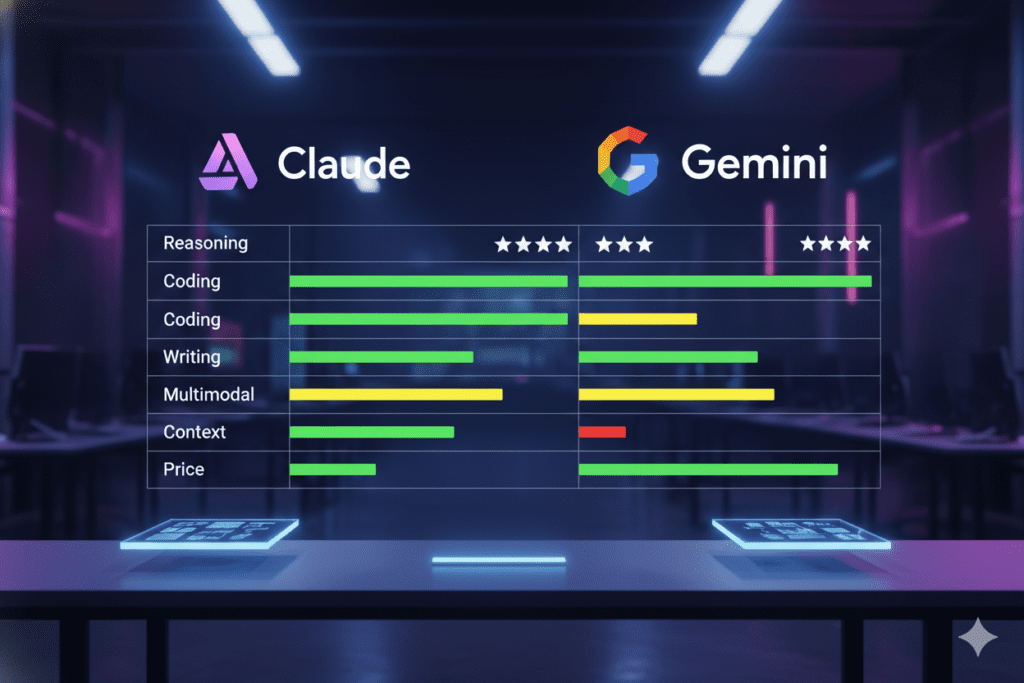
Claude Opus 4.6 leads on complex multi-step reasoning, particularly in legal analysis, financial review, and research synthesis. Gemini 3.1 Pro has closed the gap significantly with its “thinking” mode — it scores an impressive 94.1% on GPQA Diamond (expert-level science questions). Claude holds a slight but meaningful edge on nuanced instruction-following, especially when you give it constraints like “sound confident but not pushy” or “explain this concept to a non-technical founder.”
Coding Benchmarks
This is where the Google Anthropic AI model comparison 2026 gets genuinely interesting for developers. Claude Sonnet 4.6 scores 82.1% on SWE-bench, a benchmark measuring real-world software engineering tasks pulled from actual GitHub issues. Gemini 3.1 Pro comes in close at 80.6%. In daily developer usage, Claude consistently writes cleaner, more idiomatic code. Gemini wins on speed and on tasks where the Google stack — Firebase, Android Studio, Google Cloud — is involved.
Claude powers Cursor and Windsurf, two of the most popular AI-native coding editors in 2026. That’s not a coincidence. It’s a vote of confidence from the developer tooling ecosystem.
Writing Quality
Claude wins this category decisively. Anthropic’s Constitutional AI training approach gives Claude a level of instruction precision that Gemini simply doesn’t match on nuanced writing tasks. Ask both models to write a client proposal that’s “confident but not pushy” and you’ll see immediately: Claude treats that constraint as a hard requirement; Gemini produces something more generic.
For content creators, marketers, founders writing investor updates, and anyone producing documents that need to feel human — Claude is the better choice in the Google Anthropic AI model comparison 2026.
Multimodal Capabilities
Gemini wins this one outright — and it’s not close. Gemini 3.1 Pro handles text, images, video, audio, and code natively in a single prompt. Claude handles text and images. It cannot generate or process video or audio. If your workflow involves analyzing screenshots, processing video content, or working with audio transcription alongside text, Gemini is the only real option in this Google Anthropic AI model comparison 2026.
Context Window
Both models offer 1 million token context windows on their flagship tiers — enough to process entire codebases, lengthy legal documents, or hours of meeting transcripts. Gemini’s 1M token window is standard at the Pro tier. Claude Opus 4.6 supports up to 1M tokens, with 200K as the default window. For processing large documents in one go, this is a Gemini advantage at the everyday usage level.
Pricing
The Google Anthropic AI model comparison 2026 shows a meaningful price gap at the API level. Gemini 3.1 Pro costs approximately $1.25–$2 per million input tokens. Claude Sonnet 4.6 runs around $3 per million input tokens. At scale, for high-volume API usage, Gemini’s pricing is a serious advantage. For individual users and small teams, both Claude Pro and Gemini Advanced are $20/month — identical at the consumer tier.
Why Most People Get This Wrong
Here’s the trap most people fall into when researching the Google Anthropic AI model comparison 2026: they try to find the winner.
There isn’t one.
GPT-5.4 and Gemini 3.1 Pro are tied at an overall score of 94 on current benchmark leaderboards. Claude Opus 4.6 sits at 92 — close enough that the “right” model entirely depends on your use case, not some universal ranking.
The problem isn’t choosing the wrong AI. The problem is paying for one AI when you actually need two — and switching between tabs, subscriptions, and interfaces all day trying to get the best of both worlds.
That’s the real cost of the Google Anthropic AI model comparison 2026 debate. And it’s costing professionals far more than they realize.
Rohan — the founder we met at the top of this article — was spending $40/month on Claude Pro and Gemini Advanced separately. He was also losing hours every week to the friction of managing two tools, two interfaces, and two billing cycles.
He’s not alone. Explore more insights on Aizolo to see how thousands of users in exactly this situation have found a smarter path.
Real-World Use Cases: Which Model Wins for Your Work?
Let’s get specific. The Google Anthropic AI model comparison 2026 plays out differently depending on who you are and what you’re building.
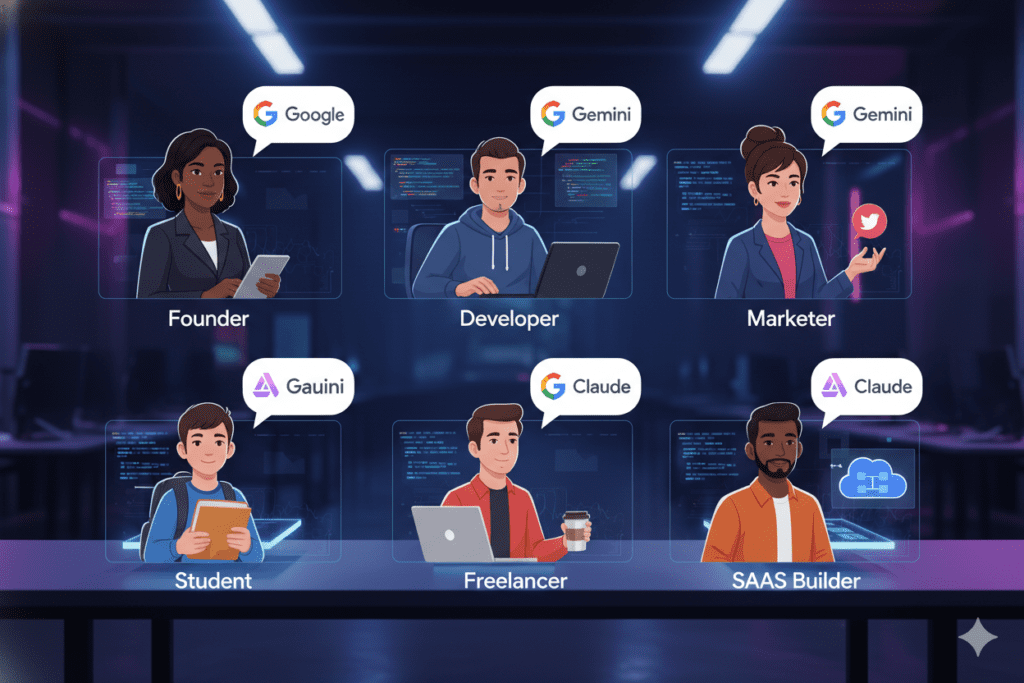
For Founders and Startup Builders
You’re writing pitch decks, investor updates, product documentation, and customer emails — all in the same week. You’re also debugging your MVP at 11 PM.
Claude wins for writing that needs voice and nuance. The Constitutional AI training makes Claude exceptional at adjusting tone, following subtle instructions, and producing prose that doesn’t sound like it came from an AI.
Gemini wins when you need to analyze a 200-page market research report in one shot, or when you’re deeply embedded in Google Workspace and want AI that lives inside your Docs and Sheets.
Smart founders use both — routing tasks intelligently rather than picking one and suffering through its weak spots.
For Developers and Engineers
The Google Anthropic AI model comparison 2026 is most competitive here. Claude dominates on complex, multi-file refactoring, debugging subtle logic errors, and tasks where “understanding intent” from vague specifications matters. Gemini wins when you’re working on Google Cloud, Firebase, or Android, and when you need to process an entire codebase in a single context window at a lower API cost.
Claude Code — Anthropic’s terminal-based coding agent — has become a serious tool for senior engineers doing agentic software engineering. Gemini CLI offers a comparable experience for Google-stack developers.
For most developers, the best answer in the Google Anthropic AI model comparison 2026 is “use Claude for complex logic; use Gemini Flash for high-volume, cost-sensitive operations.”
For Marketers and Content Creators
Claude is your primary tool. The quality of prose, the ability to follow nuanced brand voice guidelines, and the precision on long-form content make Claude the clear winner for content professionals evaluating the Google Anthropic AI model comparison 2026.
Gemini earns its place for multimodal content work — analyzing competitor ads, extracting data from screenshots, or processing video content for repurposing.
For Students and Researchers
Gemini’s 94.1% GPQA Diamond score and massive context window make it exceptionally strong for academic research, especially in STEM fields. Claude brings an edge for synthesizing complex arguments, writing research summaries that feel natural, and handling document analysis with nuanced instructions.
Students who are working on data-heavy research tasks with Google Scholar, Google Docs, and Colab integrations will find Gemini’s ecosystem integration genuinely valuable.
For Freelancers and Independent Professionals
Every dollar of AI spend directly impacts your margin. The Google Anthropic AI model comparison 2026 for freelancers comes down to this: you need both Claude and Gemini, but you can’t justify $40/month just to cover both.
This is where the math changes entirely — and where Aizolo changes the game.
Learn from real-world experience at Aizolo and see how independent professionals are accessing every premium AI model without paying for multiple subscriptions.
For SaaS Builders
If you’re building AI-powered features into your product, the Google Anthropic AI model comparison 2026 is a critical architecture decision. Claude’s instruction-following precision and safety focus make it the preferred choice for enterprise-facing SaaS products that deal with sensitive data — finance, legal, healthcare. Anthropic now holds roughly a third of the enterprise API market for exactly this reason.
Gemini’s pricing advantage ($1.25/M tokens vs. $3/M) makes it attractive for high-volume features like real-time summarization, content moderation, or search augmentation where cost scales quickly with traffic.
The Hidden Problem Nobody Talks About in the Google Anthropic AI Model Comparison 2026
Here’s what most comparison articles miss: the cost isn’t just the subscription fee.
The real cost of navigating the Google Anthropic AI model comparison 2026 is the cognitive overhead of managing multiple tools.
Every time you switch from Claude to Gemini, you lose context. You copy-paste. You re-explain your project. You lose the thread of what you were building. Research consistently shows that context-switching is one of the biggest productivity drains for knowledge workers — and AI context-switching is just as costly.
Rohan wasn’t losing $40/month. He was losing 6–8 hours of deep work every month to the friction of managing two separate AI environments, two different interfaces, two billing emails, and two different sets of chat histories.
That’s the real argument behind the Google Anthropic AI model comparison 2026 that nobody is making loudly enough: the best solution isn’t choosing between Google and Anthropic. It’s having unified access to both.
How Aizolo Solves the Google Anthropic AI Model Comparison 2026 Problem
This is where the story gets practical.
Aizolo is an all-in-one AI platform built specifically for people who’ve been following the Google Anthropic AI model comparison 2026 debate and arrived at the same conclusion: you need all the best models, not just one.
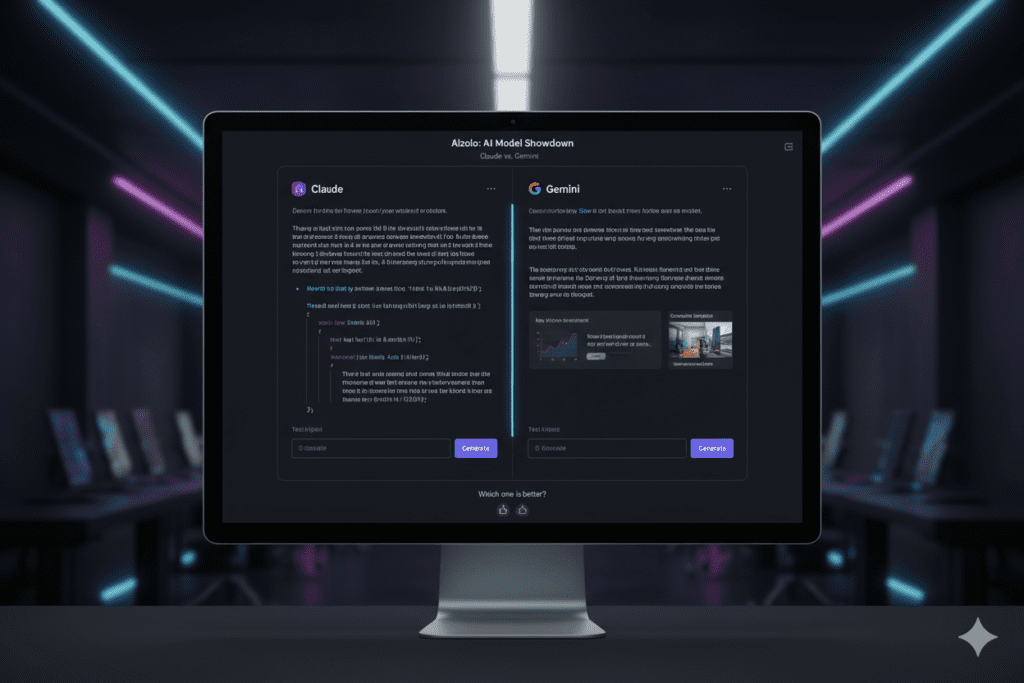
At $9.90/month, Aizolo gives you access to Claude, Gemini, ChatGPT, Grok, Perplexity, and more — in a single unified interface with side-by-side comparison features, a smart prompt manager, AI memory that persists across sessions, and 3 million tokens per month.
Compare that to the alternative: $20 for Claude Pro + $20 for Gemini Advanced = $40/month, with no comparison features, no unified interface, and no way to run both simultaneously on the same prompt.
Aizolo was built for exactly the professionals we’ve described in this article — the founders who need Claude for writing and Gemini for document analysis, the developers who need Claude for complex debugging and Gemini Flash for high-volume API calls, the freelancers who can’t justify $40/month just to hedge their AI bets.
Here’s what makes Aizolo different from simply paying for multiple subscriptions:
- Side-by-side model comparison — run the same prompt through Claude and Gemini simultaneously and see both responses instantly. No tab-switching, no context loss.
- Smart Prompt Manager — save your best prompts and deploy them instantly across any model. Your “investor update” prompt works equally well in Claude and Gemini with one click.
- AI Memory — Aizolo remembers your preferences, project context, and past conversations. You never re-explain your project from scratch.
- Custom API Keys — bring your own encrypted API keys for unlimited token usage on top of the base plan.
- Import Chats from Claude or ChatGPT — migrate your existing conversation history in one click.
Trusted by over 5,000 AI enthusiasts, Aizolo is the practical answer to the endless Google Anthropic AI model comparison 2026 debate. You stop asking “which is better?” and start asking “which is better for this specific task?” — and then using both.
Start building smarter with Aizolo at aizolo.com.
The Smart Framework: When to Use Claude vs. Gemini in 2026
Based on everything in this Google Anthropic AI model comparison 2026, here’s a practical decision framework:
Use Claude (Anthropic) when:
- You’re writing anything that requires voice, nuance, or careful tone calibration
- You’re debugging complex, multi-file code or working on large codebase refactoring
- You’re working in a privacy-sensitive context (finance, legal, healthcare)
- You need precise instruction-following on complex, multi-constraint tasks
- You’re using Claude Code or tools like Cursor/Windsurf that are built on Anthropic’s API
- You’re producing long-form content where quality and naturalness matter more than speed
Use Gemini (Google) when:
- Your workflow involves images, video, or audio as primary inputs
- You’re working inside Google Workspace — Docs, Sheets, Gmail
- You’re on Google Cloud, Firebase, or Android Studio
- You need to process very large documents in a single context window at minimal cost
- You’re building high-volume API features where $1.25/M tokens vs. $3/M makes a real budget difference
- You need real-time information retrieval integrated with your research workflow
Use both (via Aizolo) when:
- You do all of the above
- You want to compare responses before committing to one direction
- You’re tired of paying $40+/month and want access to every frontier model for $9.90
Read more expert guides on Aizolo on topics like this — the blog covers everything from AI subscription strategy to practical model-selection frameworks for founders, developers, and creatives.
What’s Coming Next in the Google Anthropic AI Model Comparison 2026
The Google Anthropic AI model comparison 2026 isn’t a static picture. Both companies are releasing new model generations every few months, and the current benchmarks will look different by Q3 2026.
Anthropic’s Claude Mythos — internally codenamed Capybara — is described as a “step change” above Claude Opus 4.6, with exceptional performance in reasoning, coding, and cybersecurity vulnerability detection. It’s currently in a gated early-access program for approximately 50 enterprise organizations. When it reaches public access, the Google Anthropic AI model comparison 2026 will shift again.
Google’s Gemini 3.1 Pro continues to hold the top position on reasoning benchmarks, and Google’s recently developed compression algorithm — which reduces KV-cache memory requirements by six times — promises to make future Gemini models significantly faster and cheaper to run at inference time.
The macro trend is clear: the gap between frontier models is narrowing. The differentiation is increasingly about ecosystem, pricing, and workflow integration — not raw intelligence scores.
That’s why the smartest move in the Google Anthropic AI model comparison 2026 isn’t picking a winner. It’s building a workflow that routes tasks to the right model, dynamically, without paying for two or three separate subscriptions to do it.
Follow Aizolo for practical tech and startup insights as the model landscape continues evolving. The Aizolo blog covers every major release, pricing change, and real-world workflow implication — so you’re never caught off guard when benchmarks shift.
Conclusion: The Google Anthropic AI Model Comparison 2026 Has No Single Winner — And That’s the Point
We started with Rohan, frustrated at his desk, switching tabs between Claude and Gemini and paying too much to do it. By the end of a Tuesday afternoon, he’d arrived at the same conclusion thousands of professionals are reaching in 2026: the Google Anthropic AI model comparison 2026 doesn’t end with a verdict. It ends with a strategy.
Claude (Anthropic) wins on writing quality, complex coding, safety-conscious enterprise deployment, and nuanced instruction-following. Gemini (Google) wins on multimodal capability, ecosystem integration, large context window defaults, and API pricing at scale. Both are exceptional. Neither is sufficient alone for most modern workflows.
The professionals winning with AI in 2026 aren’t the ones who picked the right horse in the Google Anthropic AI model comparison 2026. They’re the ones who stopped treating it as a binary choice.
They use Claude when Claude is the right tool. They use Gemini when Gemini is the right tool. And they access both through a single, affordable platform that eliminates the subscription bloat, context-switching friction, and comparison overhead that drains productivity every single day.
That platform is Aizolo.
Start building smarter with Aizolo — access Claude, Gemini, ChatGPT, and every other frontier model in one place for $9.90/month. No juggling. No bloated subscriptions. Just the right AI for every task, every time.
👉 Try Aizolo for free at aizolo.com
Suggested Internal Links (from Aizolo Blog)
- Best Multi AI Subscription in 2026 — naturally relevant for readers who want all models in one place
- AI Subscription Comparison 2026 — directly supports the pricing discussion in this post
- Platforms to Ask the Same Question to Multiple AI Models — perfect link for the side-by-side comparison section
- Best AI Subscription 2026 — supports the conclusion/CTA section
Suggested External Links (High-Authority Sources)
- Anthropic Claude Model Documentation — for readers who want official Claude specs
- Google DeepMind Gemini Overview — for official Gemini capability details
- SWE-bench Benchmark — credible third-party coding benchmark referenced in the comparison
- GPQA Diamond Benchmark — academic source for the reasoning benchmark cited

Pingback: What Are the Best Free AI Chatbots in 2026? Full Guide
Pingback: AI Subscription: 50+ Apps to Save $1,000+ Every Year, Smarter