
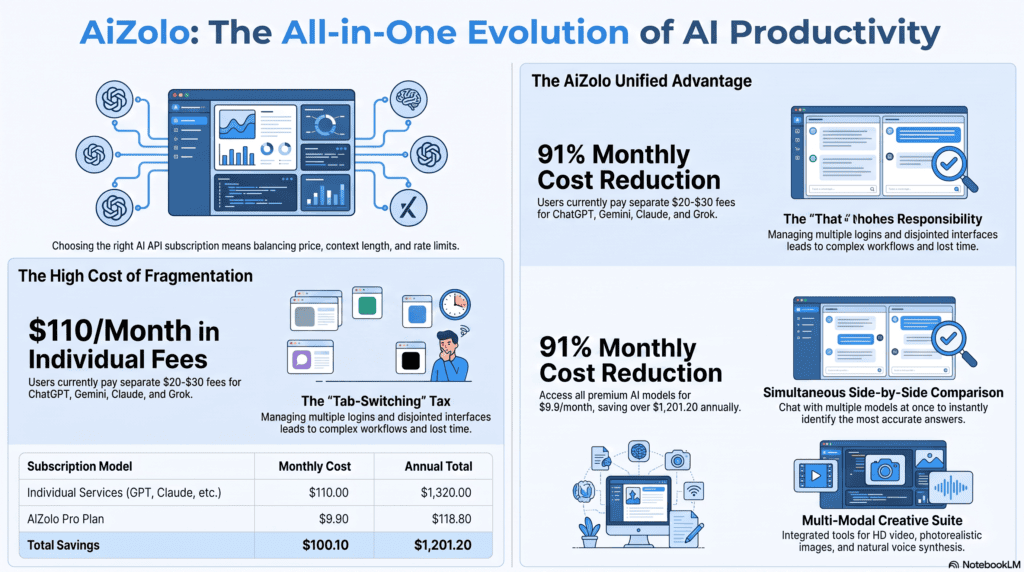
Picking an AI API vendor in 2026 isn’t like picking a SaaS tool. Get it wrong and you’re stuck migrating prompts, retuning cache hit rates, and rewriting SDK calls six months later.
This guide compares the AI API platforms actually worth paying for in 2026, including Aizolo—not by marketing copy, but by pricing, context windows, rate limits, and what happens when you scale past a demo.
We built it for people who ship: developers, startup CTOs, agency leads, and technical buyers who need an AI API subscription that survives contact with production traffic.
Table of Contents
Why AI API Subscriptions Matter More in 2026
Token prices dropped 60–80% since early 2025, but total AI spend at most companies went up, not down. Usage grew faster than the price cuts.
That’s the paradox behind every best ai api subscription services 2026 search. Cheaper tokens made teams ship more AI features, and more features mean more tokens burned across more vendors.
At the same time, the model landscape fragmented. OpenAI, Anthropic, and Google now each ship multiple active model families, and DeepSeek, Mistral, and Cohere compete hard on price and specialization.
That fragmentation is exactly why multiple ai models in one subscription has become a real buying category instead of a novelty. Nobody wants five separate billing dashboards.
The practical result: choosing a vendor today means choosing a pricing model, a context-window ceiling, a rate-limit tier, and an exit strategy, all at once.
How We Evaluated These Providers
We didn’t rank by brand recognition. Every provider below was scored against the same six criteria, using vendor-published rates verified against at least one independent pricing tracker.
- Token economics — list price, cached-input discount, batch discount, and effective cost per real-world task, not just the sticker rate.
- Context window — usable input length at standard pricing, and what happens once you cross the long-context threshold.
- Rate limits — requests-per-minute and tokens-per-minute at entry tier, since this is where most production launches actually get throttled.
- Developer experience — SDK quality, documentation depth, streaming support, and how much boilerplate a first integration takes.
- Enterprise readiness — SOC 2 status, data residency, audit logging, and whether the vendor sells through a marketplace like AWS or Azure.
- Model breadth — whether one account gets you multiple model classes (reasoning, coding, vision) or locks you into one lineup.
Every price cited reflects official vendor pricing pages as of July 2026. AI pricing changes fast — always verify current rates before committing budget.
Quick Comparison Table: Best AI API Subscription Services 2026
| Provider | Flagship Model Price (in/out per 1M) | Context Window | Best For | Free Tier |
|---|---|---|---|---|
| OpenAI | $5.00 / $30.00 (GPT-5.5) | 1M tokens | General-purpose + coding agents | Trial credits only |
| Anthropic (Claude) | $2.00 / $10.00 intro (Sonnet 5) | 1M tokens | Long-context reasoning, coding | $5 trial credit |
| Google Gemini | $2.00 / $12.00 (Gemini 3.1 Pro) | 2M tokens | Massive context, multimodal | Yes (Flash/Flash-Lite) |
| Mistral | $2.00 / $6.00 (Large 3 family) | 128K–256K tokens | EU data residency, self-hosting | Yes |
| DeepSeek | $0.14 / $0.28 (V4 Flash) | 128K tokens | Extreme cost efficiency | Yes |
| Cohere | $2.50 / $10.00 (Command R+) | 128K tokens | Enterprise RAG toolkit | Trial credits |
| AWS Bedrock | Varies by model | Model-dependent | Multi-model enterprise on AWS | AWS free-tier credits |
| Azure AI Foundry | Varies by model | Model-dependent | Microsoft-stack enterprises | Azure credits |
| OpenRouter | Pass-through + ~5.5% fee | Model-dependent | Fast multi-model prototyping | Free/open models |
| Portkey | Pass-through + platform fee | Model-dependent | Governed multi-provider production | Free tier available |
If you’re comparing this against consumer chat plans rather than developer APIs, see our breakdown of chatgpt plus claude pro gemini advanced pricing 2026 — the economics are completely different.
Best AI API Subscription Services 2026: Detailed Reviews
1. OpenAI API — Best Overall Model Breadth
OpenAI still runs the widest lineup: GPT-5.5 for frontier reasoning, GPT-5.4 as the cost-efficient mid-tier, and a nano/mini family for high-volume routing.
Pricing: GPT-5.5 costs $5.00 per 1M input tokens and $30.00 per 1M output tokens, with a 1M-token context window. GPT-5.4 runs $2.50/$15.00, exactly half. GPT-4.1 nano drops to $0.10/$0.40, making it one of the cheapest first-party options anywhere.
Rate limits and scaling: OpenAI sets limits at the organization and project level, and they vary by model family. New accounts start at a lower usage tier and graduate automatically as spend history builds — plan your launch timeline around that, not around the published ceiling.
Developer experience: The Responses API, Chat Completions API, and Batch API cover nearly every workload shape, and prompt caching cuts repeated-input costs by 75–90% on supported models.
Where it falls short: Reasoning models bill “thinking tokens” separately from visible output, which can quietly inflate a bill that looked cheap on paper. Budget for that before you commit to an o-series or GPT-5.5 workload at scale.
Best for: teams that want one vendor covering everything from cheap classification to frontier coding agents, without juggling multiple SDKs.
2. Anthropic Claude API — Best for Long-Context Reasoning and Coding
Claude Sonnet 5, launched June 30, 2026, is now Anthropic’s default price-to-performance model, sitting below Opus 4.8 and the restored Fable 5 tier.
Pricing: Sonnet 5 carries introductory pricing of $2.00 input / $10.00 output per million tokens through August 31, 2026, moving to $3.00/$15.00 standard pricing afterward. Opus 4.8 runs $5.00/$25.00. Haiku 4.5, the budget option, is $1.00/$5.00.
Context window: Sonnet 5, Opus 4.8, and Fable 5 all ship the full 1M-token context window at flat pricing — no long-context surcharge tier the way OpenAI and Google structure theirs.
The tokenizer catch: Sonnet 5 uses an updated tokenizer that can produce 1.0x to 1.35x more tokens for the same input compared to Sonnet 4.6. Anthropic priced the introductory rate to be roughly cost-neutral against that shift, but re-benchmark before migrating cached-prefix-heavy workloads.
Cost levers: Prompt caching delivers up to 90% savings on repeated context, and the Batch API cuts both input and output pricing by 50% for asynchronous jobs.
Best for: agentic coding, computer-use workflows, and any application where a 1M-token context window without surcharge tiers matters more than the absolute cheapest per-token rate.
3. Google Gemini API — Best for Massive Context and Multimodal
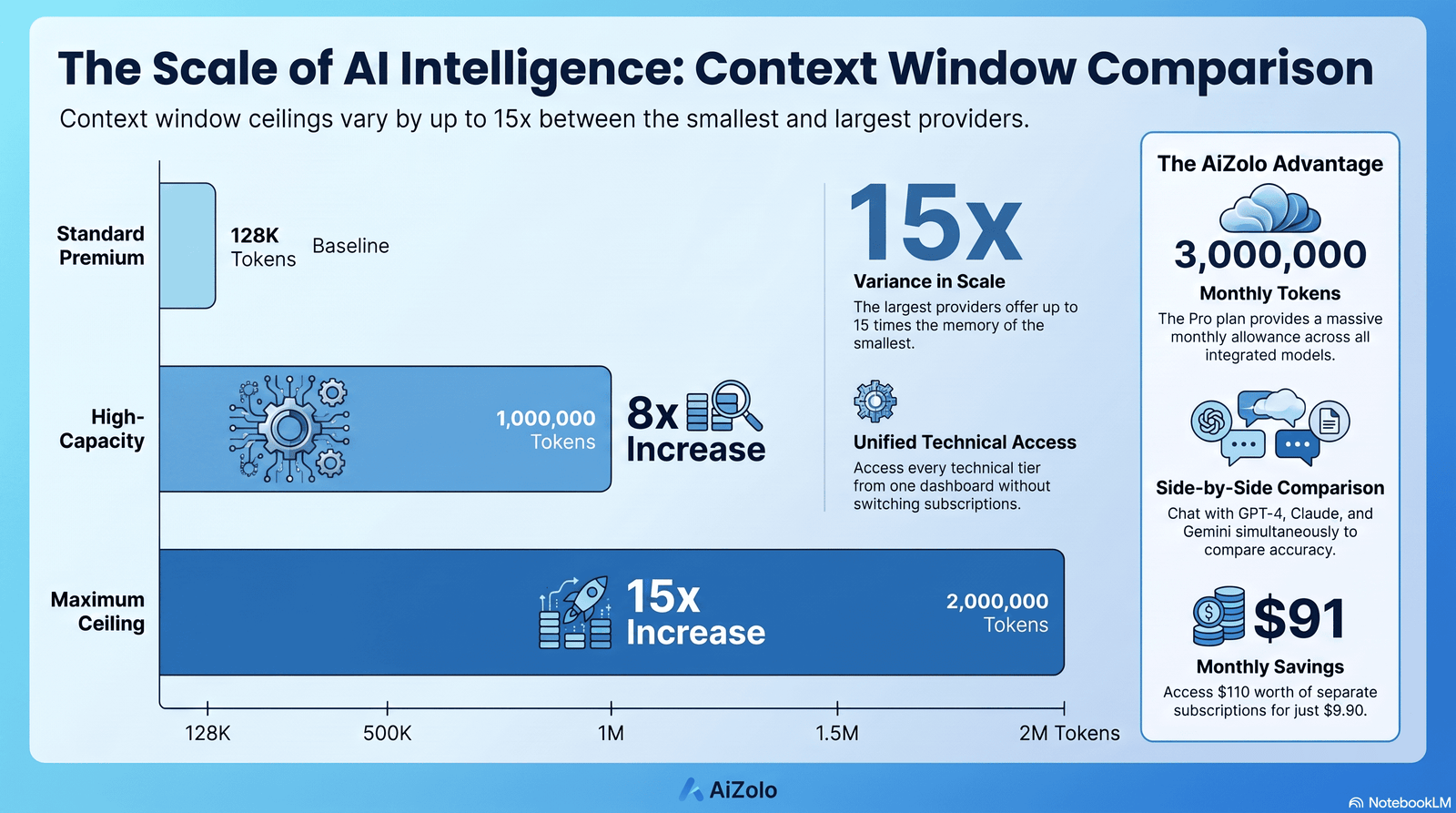
Gemini’s structural advantage is context length. Gemini 3.1 Pro supports up to 2M tokens, roughly double Claude’s ceiling and far beyond GPT-5.4’s 128K–270K practical range.
Pricing: Gemini 3.1 Pro costs $2.00 input / $12.00 output per 1M tokens for prompts under 200K tokens, doubling to $4.00/$18.00 above that threshold. Gemini 3.5 Flash, launched at I/O 2026, undercuts it at $1.50/$9.00 while beating it on several coding and agentic benchmarks.
Budget tier: Gemini 3.1 Flash-Lite runs as low as $0.25 input / $1.50 output per 1M tokens — one of the cheapest Tier-1 lab-hosted models on the market.
Free tier change: As of April 1, 2026, Google removed Pro-tier models from the free API tier entirely. Flash and Flash-Lite still offer free daily quotas, which makes Gemini one of the few providers where prototyping stays genuinely free.
Multimodal pricing: Image, audio, and video inputs and outputs are billed separately by resolution and duration — worth modeling explicitly if your product touches Gemini’s Imagen, Veo, or native audio endpoints.
Best for: RAG over huge documents, long transcripts, and any workload where context length is the binding constraint, not raw reasoning depth.
4. Mistral API — Best for EU Data Residency and Open Weights
Mistral’s pitch isn’t raw benchmark supremacy. It’s GDPR-native hosting, permissively licensed open-weight models, and aggressive mid-tier pricing.
Pricing: The current flagship, Mistral Large 3, runs around $0.50–$2.00 input per 1M tokens depending on the release tracked, with the Small tier as low as $0.10–$0.15 input. Ministral edge models drop to $0.04 per 1M tokens.
Openness: Several Mistral models ship under Apache 2.0 or a research license, so if API costs ever become the bottleneck, self-hosting is a real fallback — not something most closed-model vendors offer.
Limitation: Mistral trails GPT-5.4-class and Claude-class models on the hardest reasoning benchmarks and long-context recall above roughly 64K tokens, and as of mid-2026 it doesn’t offer a prompt-caching discount comparable to Anthropic’s.
Best for: EU-based companies with data residency requirements, and teams that want an exit path via open weights.
5. DeepSeek API — Best for Raw Cost Efficiency
DeepSeek remains the aggressive price disruptor. DeepSeek V4 Flash lists at roughly $0.14 input / $0.28 output per 1M tokens, undercutting every Tier-1 lab by a wide margin.
Trade-off: you’re accepting less operational maturity — thinner enterprise tooling, fewer compliance certifications published, and a smaller ecosystem of first-party SDKs than OpenAI or Anthropic.
Best for: high-volume, latency-tolerant workloads like classification, extraction, and bulk content generation where per-token cost dominates the decision.
6. Cohere API — Best for Enterprise RAG Out of the Box
Cohere sells a full retrieval stack from one vendor: Command R+ as the flagship LLM, Embed v3 for embeddings, and Rerank v3 for retrieval quality — all under one contract.
Pricing: Command R+ costs $2.50 input / $10.00 output per 1M tokens. Command R7B, the budget option, is one of the cheapest first-party APIs available at $0.0375/$0.15 per 1M tokens.
Best for: enterprises building document search or knowledge-base assistants who’d rather buy one integrated RAG toolkit than assemble embeddings, reranking, and generation from three vendors.
7. AWS Bedrock — Best for AWS-Native Enterprises
Bedrock doesn’t sell its own foundation model lineup so much as it resells Claude, Llama, Mistral, and Amazon’s own Nova models through a single AWS billing relationship.
Why teams pick it: if your infrastructure, IAM, and compliance posture already live in AWS, Bedrock lets procurement, security review, and billing happen inside one existing vendor relationship instead of opening a new one.
Trade-off: pricing generally tracks each model’s native rate plus AWS’s margin, and you inherit AWS’s regional availability constraints per model.
Best for: regulated enterprises that need Claude or Llama-class models but can’t add a net-new vendor to their approved list.
8. Azure AI Foundry — Best for Microsoft-Stack Enterprises
Azure AI Foundry (formerly Azure OpenAI Service) is the equivalent play for Microsoft shops: OpenAI models, plus a growing catalog of others, billed through an existing Azure enterprise agreement.
Why it matters for enterprise suitability: Azure’s version often ships with additional data-residency guarantees and private-networking options that matter more to security teams than raw per-token price.
Best for: enterprises already committed to Microsoft 365 Copilot, Azure Active Directory, and Azure governance tooling.
9. OpenRouter — Best for Fast Multi-Model Prototyping
OpenRouter is a hosted AI aggregator: one OpenAI-compatible endpoint routing to 400+ models across 60+ providers, with automatic failover and unified billing.
Pricing mechanics: you generally pay the underlying provider’s rate plus a roughly 5.5% fee on non-crypto credit purchases, and no committed monthly subscription is required.
What it’s not: OpenRouter doesn’t host models itself — it routes and bills. For teams that outgrow prototyping and need governance, budget enforcement, and audit logging, a control-plane gateway becomes the next step.
Best for: developers who want to A/B test five model families in a weekend without opening five vendor accounts. This is the pattern behind most platforms to ask same question to multiple ai models setups.
Portkey and Production AI Gateways — Best for Governed Multi-Provider Deployments
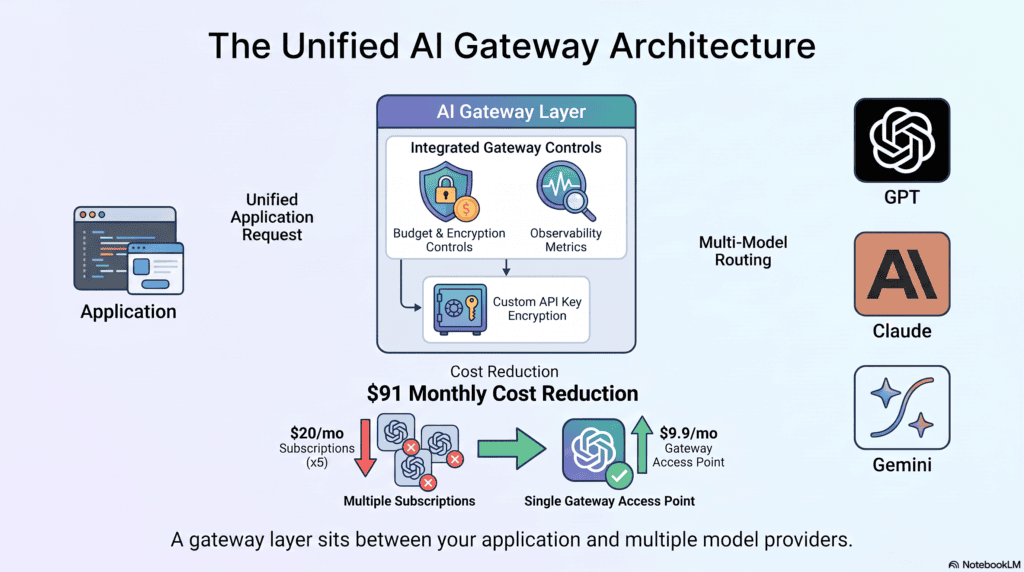
Portkey, LiteLLM, and similar gateways solve a different problem than OpenRouter: production governance, not just access.
What they add: role-based access control, per-team budget caps, prompt versioning, guardrails, and detailed request-level observability across every provider you route through.
Notable 2026 development: Palo Alto Networks completed its acquisition of Portkey on May 29, 2026, folding it into Prisma AIRS as an AI runtime security and governance layer — a signal that gateway-layer governance is now considered security infrastructure, not a developer convenience.
Best for: teams already running meaningful production traffic across two or more model providers who need spend policy enforcement, not just routing.
Pricing Comparison Table: Input, Output, and Cache Rates
| Model | Input ($/1M) | Output ($/1M) | Cached Input ($/1M) | Batch Discount |
|---|---|---|---|---|
| GPT-5.5 (OpenAI) | $5.00 | $30.00 | $0.50 | 50% off |
| GPT-5.4 (OpenAI) | $2.50 | $15.00 | $0.25 | 50% off |
| GPT-4.1 nano (OpenAI) | $0.10 | $0.40 | — | 50% off |
| Claude Sonnet 5 (intro, through Aug 31) | $2.00 | $10.00 | ~10% of input | 50% off |
| Claude Opus 4.8 | $5.00 | $25.00 | ~10% of input | 50% off |
| Claude Haiku 4.5 | $1.00 | $5.00 | ~10% of input | 50% off |
| Gemini 3.1 Pro (≤200K) | $2.00 | $12.00 | $0.20 | 50% off |
| Gemini 3.5 Flash | $1.50 | $9.00 | $0.15 | 50% off |
| Gemini 3.1 Flash-Lite | $0.25 | $1.50 | — | 50% off |
| Mistral Large (current) | ~$0.50–$2.00 | ~$1.50–$6.00 | No caching discount | Varies |
| DeepSeek V4 Flash | $0.14 | $0.28 | ~$0.0028 | Varies |
| Cohere Command R+ | $2.50 | $10.00 | — | Varies |
| Cohere Command R7B | $0.0375 | $0.15 | — | Varies |
Prices change monthly in this market. Always cross-check against the vendor’s live pricing page before locking in a budget forecast.
Context Window and Rate Limit Comparison
| Provider | Max Context | Long-Context Surcharge | Entry-Tier Rate Limit Behavior |
|---|---|---|---|
| OpenAI GPT-5.5 | 1M tokens | Separate long-context pricing above ~270K | Org + project level, auto-graduates with spend |
| Claude Sonnet 5 / Opus 4.8 | 1M tokens | None — flat rate across full window | Tier-based, raised across the board in April 2026 |
| Gemini 3.1 Pro | 2M tokens | Yes, doubles above 200K | Free tier only on Flash/Flash-Lite since April 2026 |
| Mistral Large | 128K–256K | Varies by model | Generous for EU-hosted workloads |
| DeepSeek V4 | 128K | Minimal | High RPM at low tiers |
| Cohere Command R+ | 128K | None published | Enterprise-negotiated at scale |
Feature Matrix: Streaming, Vision, Function Calling, and Fine-Tuning
| Provider | Streaming | Vision Input | Function Calling | Fine-Tuning | Batch API |
|---|---|---|---|---|---|
| OpenAI | Yes | Yes | Yes | Winding down for new users | Yes |
| Anthropic | Yes | Yes | Yes | Limited / enterprise | Yes |
| Google Gemini | Yes | Yes (native multimodal) | Yes | Yes (Vertex) | Yes |
| Mistral | Yes | Yes (Pixtral) | Yes | Yes | Limited |
| DeepSeek | Yes | Limited | Yes | Yes | Yes |
| Cohere | Yes | Limited | Yes | Yes | Yes |
Developer Experience, Documentation, and SDK Quality
Every Tier-1 provider now ships official Python and JavaScript SDKs, and most are OpenAI-SDK-compatible at the wire-protocol level, which is why gateways like OpenRouter and LiteLLM can front them all with one client.
OpenAI has the deepest third-party ecosystem simply from incumbency — more Stack Overflow answers, more framework integrations, more example repos.
Anthropic’s documentation is unusually explicit about token-level cost mechanics, including tokenizer changes between model generations, which matters when you’re forecasting spend.
Google’s docs are the most fragmented of the three, split across the Gemini Developer API, Vertex AI, and the newer Agent Platform surface — pick one surface early and stay there.
Mistral and Cohere both publish smaller but well-scoped SDKs; less exhaustive than OpenAI’s, but sufficient for the workloads they’re built for.
Security, Compliance, and Enterprise Features
Enterprise buyers should check four things before signing: SOC 2 Type II status, data residency options, whether prompts are used for training by default, and audit-log granularity.
Anthropic, OpenAI, and Google all offer enterprise tiers with training-data opt-outs and regional processing, though regional processing carries a pricing premium on newer OpenAI models — a 10% uplift as of March 2026 for data-residency-eligible endpoints.
Mistral’s EU-native hosting is a genuine differentiator for GDPR-first buyers rather than a checkbox feature layered on top of a US-first architecture.
AWS Bedrock and Azure AI Foundry exist largely to solve this problem at the procurement level: same models, but billed and governed through infrastructure your security team already approved.
Cost Optimization: Original Insights From Building Production AI Systems
When paying for a subscription actually saves money. If your usage is chat-style and stays under roughly 5 million input tokens a month, a flat consumer plan (ChatGPT Plus, Claude Pro, Gemini Advanced) is usually cheaper than raw API billing.
When pay-as-you-go beats a subscription. Past that volume, or for any production workload with unpredictable spikes, token-metered API pricing wins because you’re not paying for headroom you don’t use.
Hidden token costs to model explicitly. Reasoning models bill invisible “thinking tokens” at output rates — a 200-token visible answer from a reasoning model can carry over 2,000 billed tokens underneath it.
Vendor lock-in risk is real but manageable. Standardizing on the OpenAI-compatible request format, even if you start with Anthropic or Google, keeps a migration to a gateway or second vendor a config change instead of a rewrite.
Model routing beats single-vendor loyalty. Routing simple classification and extraction to a nano-tier model while reserving flagship models for complex reasoning has been shown to cut spend by 70–80% against an all-flagship baseline in real deployments.
Prompt caching is the single highest-leverage lever. A stable system prompt or reused document context, cached properly, can cut input costs by 75–90% on Anthropic, Google, and OpenAI alike.
Batch processing is free money for async work. Nightly summarization, evaluation runs, and content queues that don’t need synchronous responses should always route through the batch tier for the standard 50% discount.
If you’re weighing per-task cost across providers before writing any code, run the numbers through a best value ai subscription 2026 comparison first — it’s a five-minute check that prevents a much more expensive mistake three months in.
Best AI API by Use Case
For Startups
Startups should default to a router pattern from day one: cheap models for routine calls, one flagship model reserved for the tasks that actually need it.
Gemini 3.1 Flash-Lite or GPT-4.1 nano for high-volume routing, paired with Claude Sonnet 5 or GPT-5.4 for anything customer-facing, keeps burn predictable without sacrificing quality where it counts.
For Agencies
Agencies serving multiple clients benefit most from a gateway like OpenRouter or Portkey — one integration, per-client budget caps, and the ability to swap models per project without renegotiating five vendor contracts.
This is also where multiple ai models in one subscription tooling earns its keep: different clients often have different model preferences baked into their brand guidelines.
For Enterprises
Enterprises should weight compliance and procurement fit over raw price. AWS Bedrock or Azure AI Foundry, paired with a governance gateway like Portkey, typically wins over a direct first-party contract for anything crossing a security review.
For Automation Builders
Workflow automation — Zapier-style pipelines, internal bots, scheduled agents — is almost always latency-tolerant, which makes it the single best fit for batch API pricing and mid-tier models like DeepSeek V4 or Gemini Flash.
For Coding
Claude Sonnet 5 and Opus 4.8 currently lead published agentic-coding benchmarks (SWE-bench Pro, Terminal-Bench), with GPT-5.4/GPT-5.5-Codex close behind for teams already inside the OpenAI ecosystem.
For Customer Support
Support bots live or die on latency and consistency, not raw intelligence. Claude Haiku 4.5, Gemini Flash, or GPT-4.1 mini handle the bulk of tickets, with escalation to a flagship model only for complex or high-value cases.
For Research
Long-document synthesis favors context window above all else — Gemini 3.1 Pro’s 2M-token ceiling is currently unmatched for ingesting entire literature sets or lengthy legal filings in one pass.
For Content Generation
Content pipelines at scale should route drafts through a cheap model and reserve a flagship model for final-pass editing and fact-sensitive sections — a pattern that can cut generation costs 60%+ without a visible quality drop.
For Multilingual AI
Mistral’s multilingual performance and Cohere’s Command R family both punch above their price point on non-English tasks, worth a direct benchmark against GPT and Claude before defaulting to the “biggest” model.
Real-World Business Scenarios
SaaS startup building an AI writing assistant: routes 80% of requests to a budget model for drafts, escalates final passes to Claude Sonnet 5, and caches the shared style-guide system prompt — cutting per-document cost by roughly two-thirds versus an all-flagship approach.
Marketing agency running client campaigns: uses a gateway to give each client account its own API key, budget cap, and default model, billed back transparently instead of averaged across a shared vendor invoice.
Customer support bot for a mid-market SaaS company: runs Haiku-class models for the first response tier, with automatic escalation to a flagship model only when the conversation crosses a confidence threshold.
AI coding assistant embedded in an IDE plugin: defaults to Claude Sonnet 5 for its agentic tool-use reliability, with a fallback to GPT-5.4 when Anthropic capacity is constrained during peak hours.
Document search tool for a law firm: pairs Cohere’s Embed and Rerank models with a generation step from Claude or GPT, keeping the RAG pipeline and the answer-generation model separately swappable.
Healthcare assistant handling patient-facing triage questions: requires a vendor with a signed BAA, strict data-residency guarantees, and audit logging — narrowing the field to enterprise-tier Anthropic, OpenAI, Google, or a Bedrock/Azure resale, not a budget aggregator.
Legal automation platform drafting contract clauses: leans on the largest available context window to ingest full contract history in one call, making Gemini’s 2M-token ceiling the practical differentiator.
Education platform generating personalized practice problems: uses a cheap model for bulk question generation and a stronger model only for grading free-text answers, where accuracy matters most.
Internal enterprise chatbot for HR and IT questions: typically ships on Bedrock or Azure specifically because procurement and security review are already solved on those platforms.
Decision Framework: How to Actually Choose
Answer these five questions in order, and the right vendor usually falls out on its own.
- What’s your monthly token volume? Under roughly 5M tokens for chat-style use → a flat consumer subscription may beat API billing outright.
- Does your workload need more than 200K tokens of context in a single call? If yes, Gemini’s 2M window or Claude’s flat-rate 1M window are your realistic options.
- Is data residency or a signed compliance agreement a hard requirement? If yes, narrow to Mistral (EU), or an enterprise-tier contract with Anthropic, OpenAI, or Google, or a Bedrock/Azure resale.
- Will you route across more than one model provider? If yes, evaluate a gateway (OpenRouter for speed, Portkey or LiteLLM for governance) before building custom routing logic yourself.
- Is latency-sensitive, synchronous traffic the majority of your load, or can significant volume run asynchronously? Async-heavy workloads should be architected around the batch discount from day one, not bolted on later.
Common Mistakes Developers Make
- Defaulting every request to the flagship model. Routing 100% of traffic to GPT-5.5 or Opus 4.8 when most calls are routine classification is the single most common source of runaway spend.
- Ignoring prompt caching until the bill arrives. Caching requires a stable prompt prefix — retrofitting it after launch is harder than designing for it from the start.
- Treating rate limits as fixed. Most providers auto-graduate usage tiers with spend history; launching without a ramp plan risks hitting a hard ceiling during a traffic spike.
- Skipping the tokenizer check on model upgrades. Anthropic’s Sonnet 5 and Opus 4.7+ tokenizers produce meaningfully more tokens per input than their predecessors — a silent cost increase if you don’t re-benchmark.
- Hard-coding a single vendor’s SDK everywhere. Standardizing on an OpenAI-compatible interface from the start makes a future multi-vendor or gateway migration trivial instead of a rewrite.
- Forgetting reasoning-token costs. Extended-thinking and o-series-style models bill internal reasoning tokens that never appear in the visible response — model this before quoting a client a price.
Future Trends in AI API Subscriptions
Context windows keep expanding faster than reasoning quality improves at the same rate, which is shifting competitive pressure toward context-length pricing tiers rather than pure per-token rate wars.
Governance is consolidating into the gateway layer. Palo Alto Networks acquiring Portkey in May 2026 signals that spend control, guardrails, and observability are being treated as security infrastructure, not developer tooling.
Routing is becoming automatic rather than manual. Features like OpenRouter’s Auto Exacto, which re-evaluates provider quality every five minutes, point toward a future where model selection happens at request time, not at architecture time.
Reasoning-token billing is likely to get more transparent, as more buyers push back on invisible cost inflation from extended-thinking models.
Open-weight self-hosting remains a real escape valve. Mistral’s Apache-licensed models and the broader Llama ecosystem keep first-party API pricing honest by giving large-volume buyers a credible exit option.
Frequently Asked Questions
What is the cheapest AI API subscription in 2026? DeepSeek V4 Flash is the cheapest Tier-1-adjacent option at roughly $0.14 input / $0.28 output per million tokens, while Gemini 3.1 Flash-Lite and GPT-4.1 nano are the cheapest options from the three largest labs.
Is Claude cheaper than ChatGPT for API use? It depends on the model tier. Claude Sonnet 5’s introductory pricing ($2/$10 per million tokens through August 2026) undercuts GPT-5.5, but GPT-5.4 mini and nano tiers are cheaper than any current Claude model for lightweight tasks.
Should I use a subscription or pay-as-you-go pricing? Flat subscriptions make sense under roughly 5 million tokens of chat-style monthly usage; anything beyond that, or any production workload, is almost always cheaper on metered API pricing.
What’s the difference between an AI aggregator and an AI gateway? An aggregator like OpenRouter hosts the billing relationship and routes your traffic across providers for a small fee; a gateway like Portkey or LiteLLM sits between your app and providers you already have accounts with, adding governance and observability without becoming the biller.
Do I need a different API key for every AI model? Not necessarily. Gateways and aggregators let you use one API key and one OpenAI-compatible request format to reach dozens of providers, which is the core appeal of a one subscription for all ai models approach.
Which AI API has the largest context window in 2026? Google’s Gemini 3.1 Pro currently leads at up to 2M tokens, roughly double Claude’s flat-rate 1M-token ceiling and well beyond GPT-5.5’s practical 1M window before long-context surcharges apply.
What is prompt caching and how much does it save? Prompt caching stores a repeated prefix (like a system prompt or reference document) so subsequent calls reread it at a steep discount — typically 75–90% off the standard input rate across OpenAI, Anthropic, and Google.
Are AI API prices likely to drop further in 2026? Prices have already dropped 60–80% since early 2025 industry-wide, and competitive pressure from DeepSeek and open-weight models continues to push Tier-1 labs toward cheaper budget tiers, even as flagship-tier prices have occasionally risen.
What is a rate limit and why does it matter for production apps? Rate limits cap requests-per-minute and tokens-per-minute at your account tier; most providers auto-increase limits as billing history accumulates, so launching without margin against your current tier is a common cause of production throttling.
Is it safe to use AI APIs for healthcare or legal data? Only under an enterprise agreement with a signed compliance addendum (such as a BAA for healthcare), explicit data-residency guarantees, and confirmation that your prompts are excluded from model training by default.
What’s the difference between Claude Opus, Sonnet, and Haiku? Opus is Anthropic’s highest-accuracy tier for the hardest reasoning and agentic work, Sonnet 5 is the new balanced default for most production traffic, and Haiku is the fastest, cheapest tier for high-volume simple tasks.
Does fine-tuning still make sense in 2026? Less often than in 2024–2025. OpenAI is winding down its fine-tuning platform for new users, and most teams now get comparable results from prompt engineering plus retrieval, reserving fine-tuning for narrow, high-volume, cost-sensitive tasks.
Can I switch AI model providers without rewriting my application? Yes, if you build around an OpenAI-compatible request format or a gateway from the start; switching becomes a configuration change instead of a full integration rewrite.
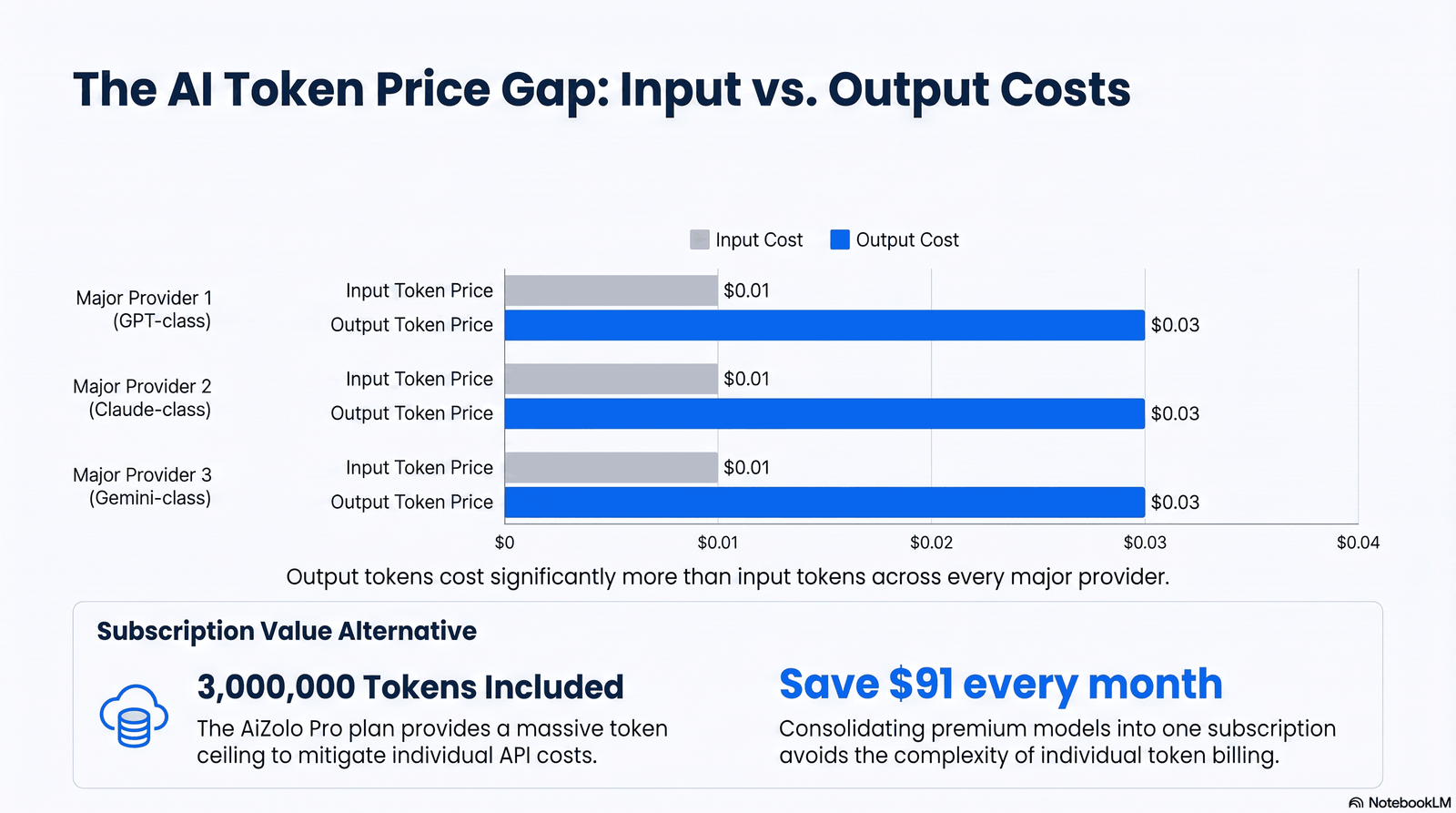
What is the real cost difference between input and output tokens? Output tokens typically cost 2x to 8x more than input tokens across providers, which is why capping response length and using structured output formats is one of the most effective cost controls available.
Which AI API is best for a small team with no dedicated DevOps? A hosted aggregator like OpenRouter, or a single first-party API from Anthropic or OpenAI with the free/starter tier, minimizes operational overhead for teams without infrastructure to run a self-hosted gateway.
How do I estimate my monthly AI API bill before launch? Estimate expected daily input and output token volume, multiply by the target model’s per-token rates, then add roughly 15–30% headroom for reasoning tokens, retries, and traffic spikes before finalizing a budget.
Choosing the Right Path Forward
There’s no single “best” AI API subscription in 2026 — there’s a best fit for your token volume, context needs, compliance requirements, and how many model providers you actually want to manage.
If you’re still comparing raw model access against an all-in-one workspace, it’s worth looking at how best all in one ai platform options handle multi-model switching before committing to a single-vendor API contract.
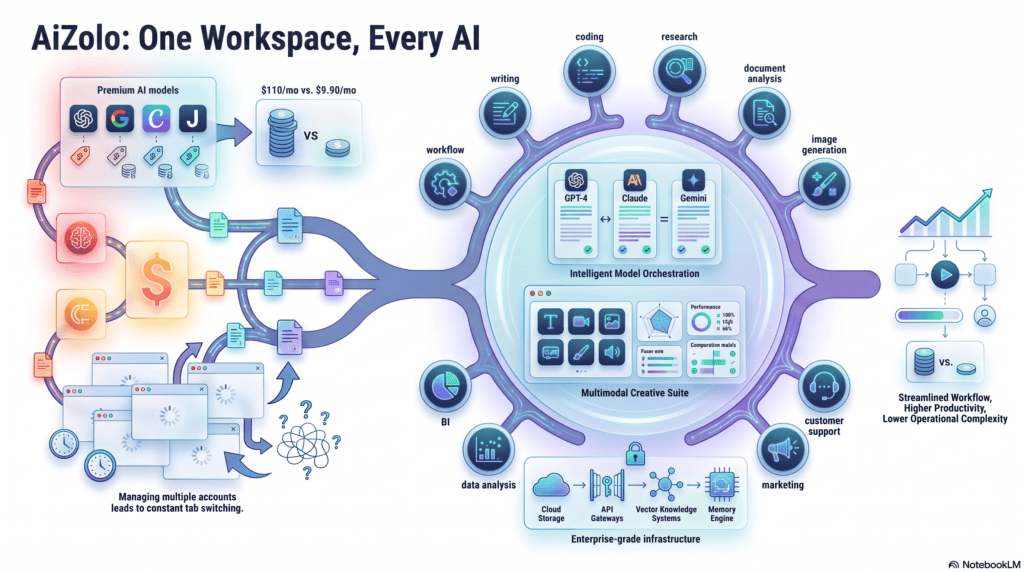
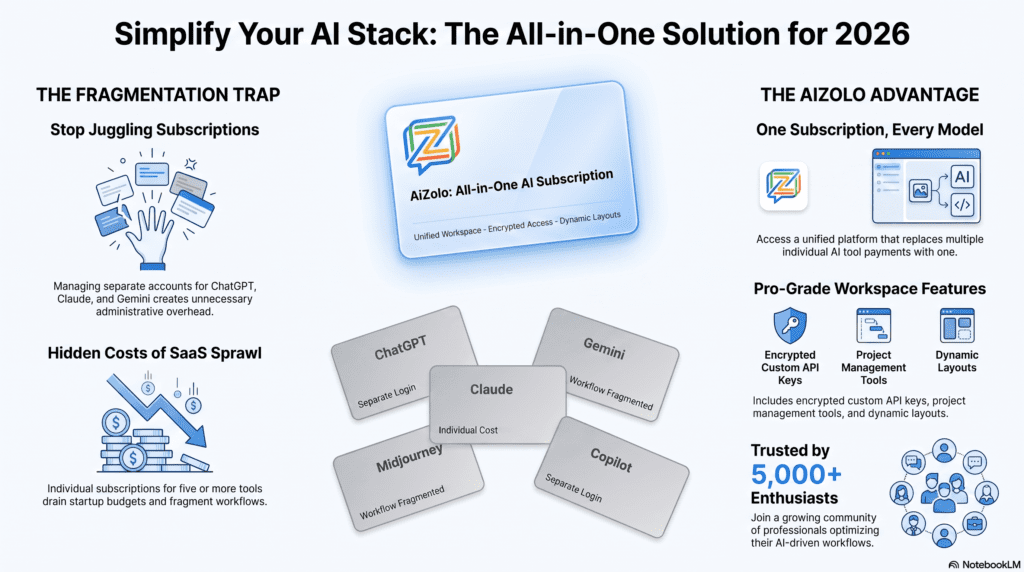
Aizolo was built around exactly this comparison problem: instead of opening a new account for every model you want to test, it gives you one place to compare and access multiple AI models side by side.
If your team is still deciding between OpenAI, Claude, Gemini, and the rest, that kind of side-by-side access can shorten the evaluation cycle from weeks to an afternoon — without claiming to replace a direct enterprise contract once you’ve settled on a production vendor.
Author Bio
Jeevesh Tripathi Email: jeevesh@aizolo.com
Jeevesh researches AI platform pricing, API ecosystems, and enterprise AI adoption patterns, tracking vendor pricing pages, rate-limit documentation, and SDK changes across the major model providers as they evolve. His work focuses on translating fast-moving AI infrastructure pricing into practical guidance for developers and technical buyers making real procurement decisions.
APPENDIX A — Internal Linking Recommendations
| Anchor Text | Destination Slug | Placement | Why It Fits |
|---|---|---|---|
| multiple ai models in one subscription | /multiple-ai-models-in-one-subscription | “Why AI API Subscriptions Matter” section | Introduces the multi-model buying category naturally after discussing fragmentation |
| chatgpt plus claude pro gemini advanced pricing 2026 | /chatgpt-plus-claude-pro-gemini-advanced-pricing-2026 | End of Quick Comparison Table section | Natural contrast point between consumer plans and developer APIs |
| platforms to ask same question to multiple ai models | /platforms-to-ask-same-question-to-multiple-ai-models | OpenRouter review paragraph | Describes the exact prototyping pattern OpenRouter enables |
| multiple ai models in one subscription | /multiple-ai-models-in-one-subscription | “For Agencies” use-case section | Reinforces the multi-client, multi-model workflow agencies need |
| best value ai subscription 2026 | /best-value-ai-subscription-2026 | End of Cost Optimization section | Natural next step after reading about cost-optimization tactics |
| one subscription for all ai models | /one-subscription-for-all-ai-models | FAQ answer on separate API keys | Directly answers the question the FAQ raises |
| best all in one ai platform | /best-all-in-one-ai-platform | “Choosing the Right Path Forward” closing section | Sets up the transition into the Aizolo CTA |
Link distribution is balanced across 6 distinct destination slugs with no slug repeated more than twice, and none placed inside headings per requirement.
APPENDIX B — External Linking Recommendations
| Page Title | URL | Anchor Text | Where It Appears | Why It Improves Trust |
|---|---|---|---|---|
| OpenAI API Pricing | https://platform.openai.com/docs/pricing | “OpenAI’s official pricing page” | OpenAI review section | Primary source for all OpenAI figures cited |
| Claude Platform Pricing | https://platform.claude.com/docs/en/about-claude/pricing | “Anthropic’s pricing documentation” | Anthropic review section | Verifies Sonnet 5 introductory and standard rates |
| Gemini Developer API Pricing | https://ai.google.dev/gemini-api/docs/pricing | “Google’s Gemini API pricing docs” | Gemini review section | Confirms context-tiered pricing structure |
| Mistral AI Pricing | https://mistral.ai/pricing | “Mistral’s official rate card” | Mistral review section | Source for Apache-licensed model list and pricing |
| DeepSeek API Pricing | https://api-docs.deepseek.com/quick_start/pricing | “DeepSeek’s pricing documentation” | DeepSeek review section | Confirms V4 Flash rate accuracy |
| Amazon Bedrock Pricing | https://aws.amazon.com/bedrock/pricing/ | “AWS Bedrock’s pricing page” | AWS Bedrock section | Establishes marketplace billing structure |
| Azure AI Foundry Documentation | https://learn.microsoft.com/azure/ai-foundry/ | “Azure AI Foundry documentation” | Azure section | Confirms enterprise data-residency options |
| Vercel AI SDK Documentation | https://sdk.vercel.ai/docs | “Vercel AI SDK docs” | Developer Experience section | Shows a real cross-provider SDK abstraction |
| Hugging Face Model Hub | https://huggingface.co/models | “Hugging Face’s model hub” | Future Trends section, open-weight paragraph | Supports the open-weight self-hosting escape-valve point |
The API subscription comparison is helpful, but I think teams also need to estimate their own token mix before picking a service. With Claude, costs can change a lot when long context, cache writes, cache reads, and batch pricing are included. A Claude-focused API cost calculator helps compare those assumptions before committing. Do you usually recommend testing with real prompt samples first?
This was helpful. The connection between visual quality, file size, and user experience is easy to underestimate. I usually think of GIF compression as one of those small pre-publishing steps that prevents slow pages later.
555
555
555CnSOYvol
5550″XOR(555*if(now()=sysdate(),sleep(15),0))XOR”Z
555-1 waitfor delay ‘0:0:15’ —
555-1) OR 707=(SELECT 707 FROM PG_SLEEP(15))–
555tI0pci8A’) OR 185=(SELECT 185 FROM PG_SLEEP(15))–
555’||DBMS_PIPE.RECEIVE_MESSAGE(CHR(98)||CHR(98)||CHR(98),15)||’