Writing one good product description takes 15–30 minutes by hand. Writing 500 of them the same week a new SKU feed lands is a different problem entirely — and it’s the problem this guide is built to solve.
If you’re staring down a spreadsheet of unwritten listings, you already know the stakes: duplicate manufacturer copy tanks your SEO, generic AI output reads flat, and hiring freelance writers at $5–10 a description doesn’t scale past a few hundred SKUs.
In 2026, a real market of purpose-built AI tools has emerged to close that gap — some are general-purpose writing platforms stretched to cover product copy, and a smaller group are built specifically for catalog-scale operations.
This guide compares the tools ecommerce teams are actually using for bulk product description generation — including where Aizolo fits as a multi-model option — based on published pricing, feature sets, integration depth, and real user feedback.
You’ll learn how these tools differ on bulk workflow quality, SEO capability, platform integrations, and total cost, so you can match the right tool to your catalog size instead of guessing.
Table of Contents
What Is an AI Bulk Product Description Generator?
An AI bulk product description generator takes structured or semi-structured product data — a CSV, a store connection, or a product image — and produces complete, unique listing copy for many products in a single run, rather than one prompt at a time.
The distinction that actually matters isn’t “does it use AI,” it’s what happens at row 200 of your spreadsheet. A general chatbot forces you to repeat the same prompt manually for every SKU, with no structured output and no memory of your last 199 products.
A true bulk tool ingests the whole catalog, applies consistent brand rules and SEO logic across every row, and returns structured fields — title, body, meta description, alt text, tags — ready to publish.
Why Ecommerce Teams Need Bulk Description Tools
The math is unforgiving once a catalog grows past a couple hundred SKUs.
- Time cost: A 200-product store represents roughly 50–100 hours of manual writing.
- SEO risk: Reusing manufacturer copy creates duplicate content across thousands of storefronts selling the same item, which search engines actively deprioritize.
- Conversion impact: Listings with complete, benefit-focused copy consistently outperform bare-bones ones — one commonly cited estimate puts the lift at 30–50% in conversion rate.
- Launch speed: Supplier feeds don’t wait for a content team. A 1,000-SKU drop with no descriptions is a live-sales problem, not a someday-project.
None of this means AI should write unsupervised. It means the first draft — the part that eats the most hours — is the part worth automating, while a human still reviews for accuracy, tone, and anything the AI got wrong.
How We Evaluated These Tools
Most “best AI tool” roundups score a single sample description on tone and creativity, then rank tools accordingly. That test tells you almost nothing about how a tool behaves at catalog scale. We evaluated each tool against five criteria that determine whether it actually holds up past product #50:
- Bulk capacity — Can it process 100+ products in one run, or is it one-at-a-time with extra steps?
- SEO completeness — Does it generate titles, meta descriptions, tags, and image alt text, not just body copy?
- Platform integration — Does it push directly to Shopify/WooCommerce/Amazon, or does everything route through manual CSV exports?
- Data handling — Can it work from thin source data (a product name and a photo), or does it need a fully populated spec sheet?
- Pricing transparency — Is cost predictable and proportional to catalog size, or gated behind a sales call?
Best AI Tools for Bulk Product Descriptions: Comparison Table
| Tool | Best For | Bulk Method | Store Integration | Starting Price |
|---|---|---|---|---|
| Aizolo | Teams wanting multi-model output (ChatGPT, Claude, Gemini) from one dashboard | CSV upload, multi-model side-by-side generation | Manual export/import | Free tier + paid plans; BYO API key option |
| Hypotenuse AI | Mid-to-large catalogs needing data enrichment + bulk content in one platform | CSV/XLSX import, PIM/ERP sync | Shopify, Amazon, Walmart, Wix, WordPress | From ~$29/mo (SEO); custom for Ecommerce tier |
| Describely | Ecommerce ops teams with messy supplier data needing enrichment before writing | Native catalog import with data enrichment | Shopify-focused | Custom, typically $99+/mo |
| Copy.ai | Marketing teams that want product copy alongside ads, emails, and social | Workflow-based batch generation | Via workflow/API, no native store sync | Free tier; paid from ~$49/mo |
| Writesonic | Teams wanting bulk generation plus an SEO scoring layer | CSV/XLSX upload, 1 credit per row | API-based; no native storefront push | Free tier; paid plans vary |
| Jasper | Marketing teams with brand-voice needs across many content types, occasional product copy | Product-by-product; Grid mode for some batch use | No native Shopify/WooCommerce connector | From $39–59/seat/mo (annual) |
| Narrato | Small-to-mid catalogs wanting brand-voice presets for bulk runs | Bulk generator with saved brand voices | Manual export | 7-day trial, then paid plans |
| Shopify Magic | New Shopify stores under ~50 products testing AI for the first time | One product at a time inside Shopify admin | Native (Shopify only) | Free with Shopify subscription |
Pricing reflects publicly listed rates at time of writing and is subject to change — always confirm current pricing on each vendor’s site before purchasing.
Individual Tool Reviews
Aizolo
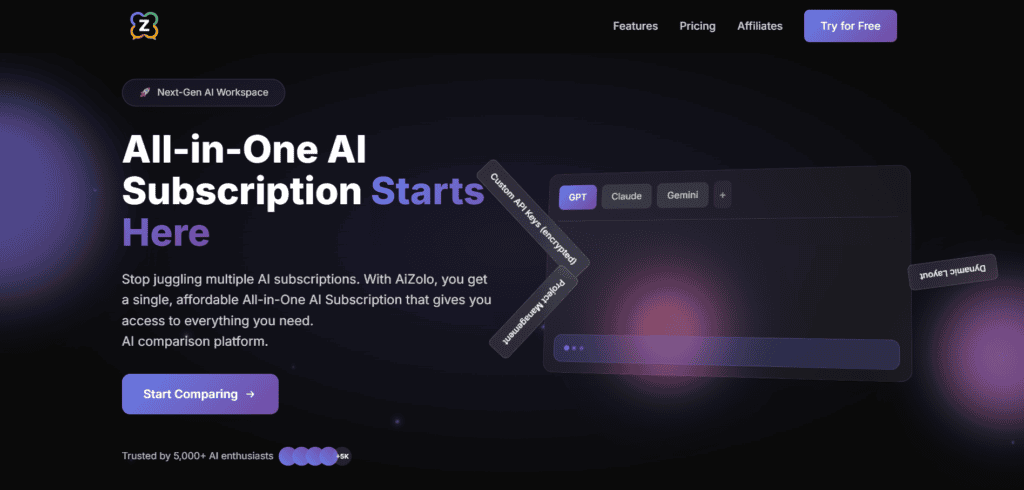
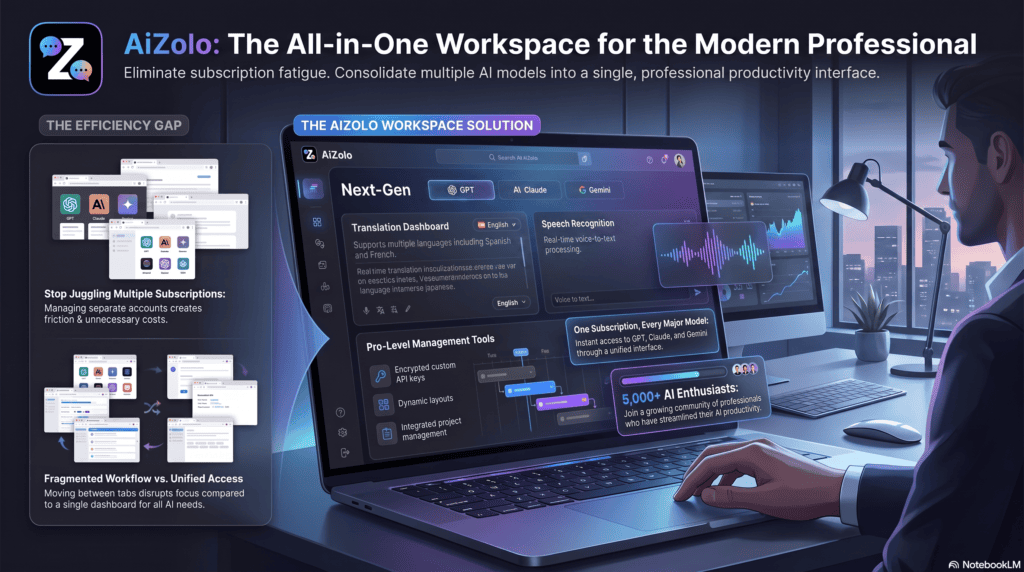
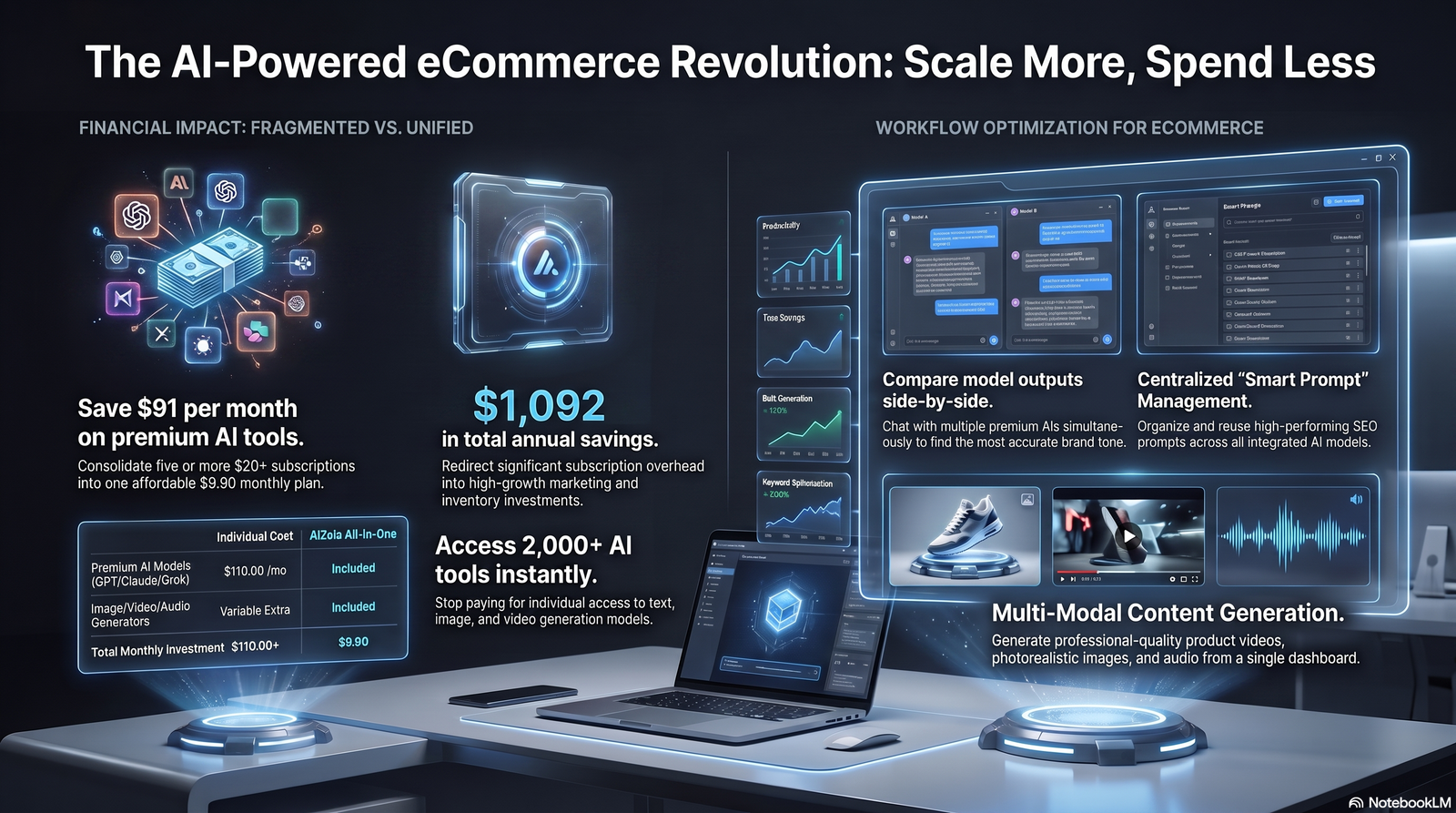
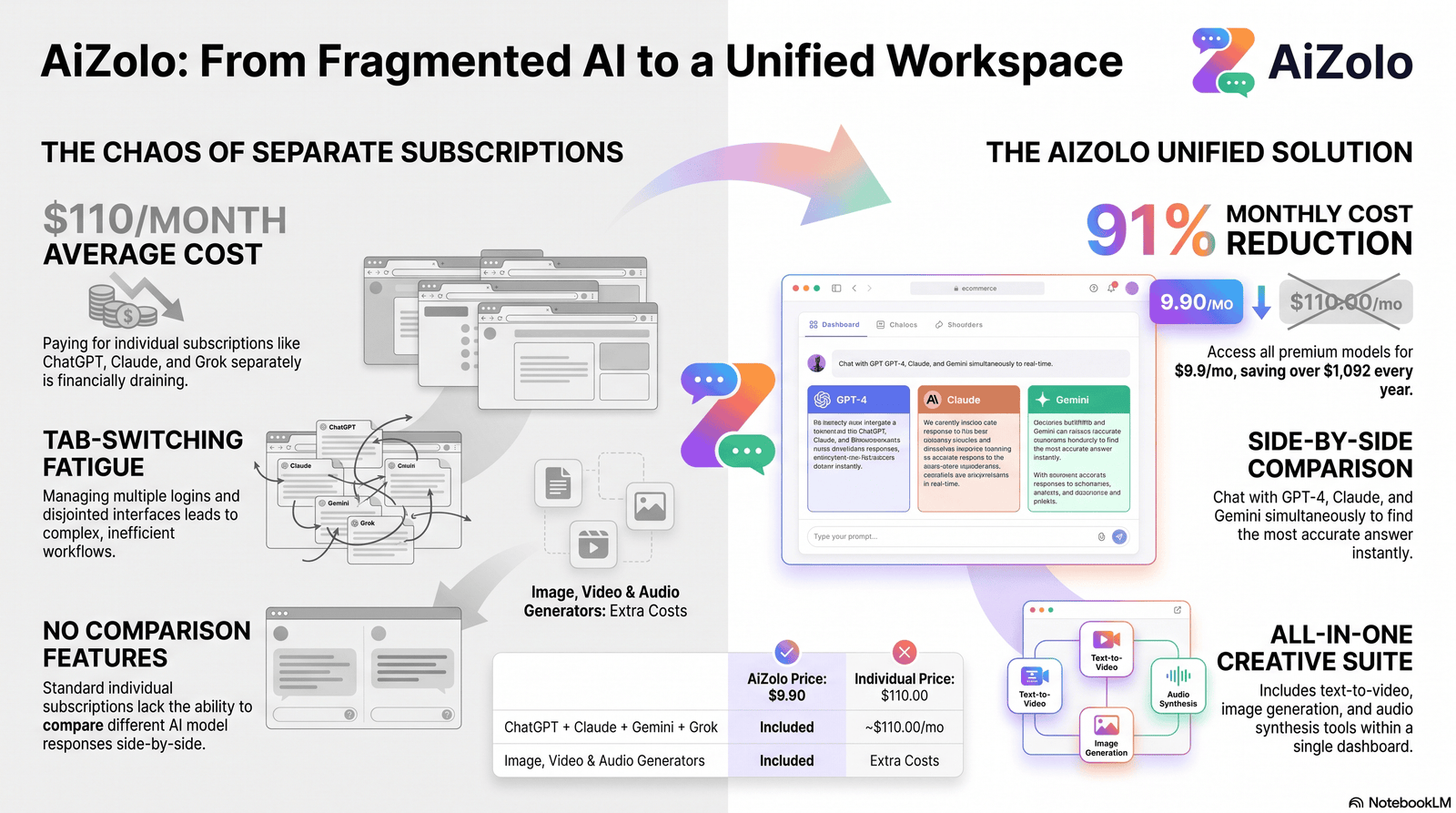
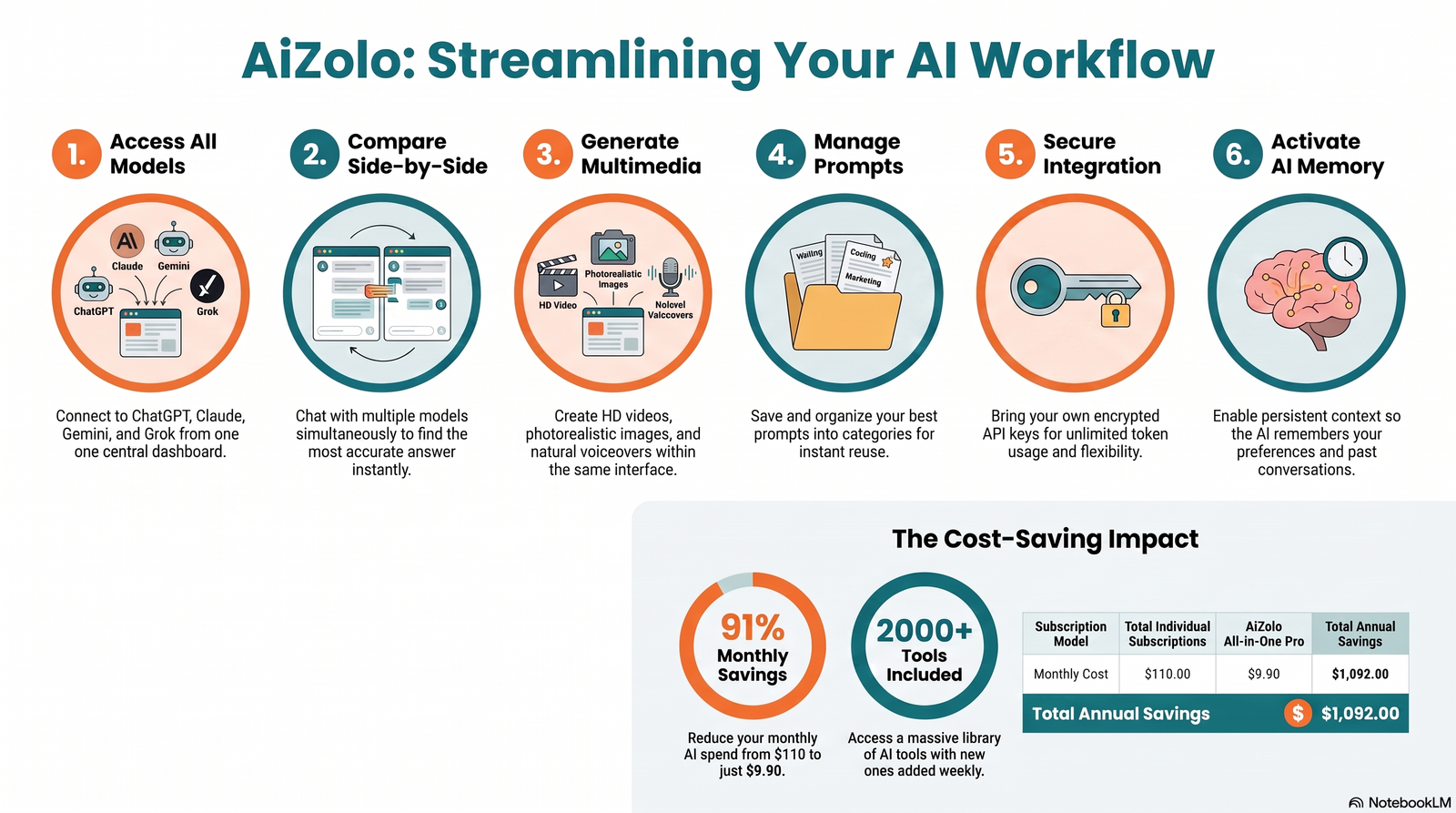
Overview: Aizolo takes a different approach from single-model, single-workflow tools. Rather than locking you into one proprietary AI model, it lets you generate the same product description simultaneously across multiple leading models and compare outputs side by side before publishing.
Features: Multi-model generation and comparison, encrypted bring-your-own-API-key support for higher-volume use, CSV-based catalog input, and generation of related content types (meta descriptions, alt text, category copy) from the same workspace.
Pros: Not locked to a single AI vendor’s strengths or blind spots; one subscription can also cover adjacent content needs like blog posts and customer support copy; API key support removes hard token ceilings for teams processing large batches.
Cons: Comparing multiple model outputs per product adds a review step that single-output tools don’t require; it doesn’t yet offer the native two-way Shopify/WooCommerce sync that dedicated ecommerce platforms like Hypotenuse or Describely provide, so exports are more manual.
Pricing: Free tier available, with paid plans for higher volume; optional BYO API key for effectively unlimited generation at your own model-provider rates.
Best For: Teams that want flexibility across AI models and use cases beyond just product copy, and who are comfortable with a CSV-based workflow rather than a native storefront connector.
Hypotenuse AI
Overview: Hypotenuse is built primarily for ecommerce catalog operations, not general marketing copy. It can generate a description from a product image alone when your source data is thin, and integrates directly with PIM, ERP, and storefront systems.
Features: Bulk CSV/XLSX import and export, data enrichment from images or UPC codes, custom taxonomy tagging, brand voice training, and direct integrations including Shopify, Amazon, and Walmart.
Pros: Genuinely built for catalog scale rather than adapted from a general writing tool; strong data enrichment for sparse supplier feeds; SOC 2 Type II compliance for teams with security requirements.
Cons: Ecommerce-tier pricing is quote-only, making budgeting harder upfront; some independent testing has found renewal pricing can increase substantially after the first year, and one reported A/B test found its default output converted lower than human-written copy before editing.
Pricing: Marketing/SEO plans start around $29/month; ecommerce plans are custom-quoted, commonly starting near $150/month for smaller catalogs and scaling with SKU volume.
Best For: Mid-to-large catalogs with messy or incomplete supplier data that needs enrichment before it can be turned into listings.
Describely
Overview: Describely positions itself specifically for ecommerce operations teams managing large, imperfect product catalogs, with an emphasis on data enrichment and brand governance before content generation even starts.
Features: Automated data enrichment with source attribution showing where each attribute came from, catalog-level brand rules, and Shopify-focused workflow tools.
Pros: The enrichment-first approach directly targets one of the biggest hidden causes of poor AI output — incomplete source data — rather than assuming clean inputs.
Cons: Pricing is not publicly listed and typically requires a sales conversation; the tight Shopify focus may be less useful for multi-channel sellers.
Pricing: Custom pricing, commonly cited around $99+/month for catalogs of meaningful size.
Best For: Ecommerce ops teams receiving raw, incomplete supplier feeds who need enrichment and bulk generation in one pipeline.
Copy.ai
Overview: Copy.ai is a broad marketing copy platform whose product description features sit inside a larger toolkit covering ads, emails, and social content.
Features: One-click tone presets, auto-translation for international listings, spreadsheet-style batch workflows, and built-in A/B testing of description variants.
Pros: A genuinely free tier for testing on a small catalog; useful if product copy is only one of several content types your team produces.
Cons: The free tier’s word cap runs out quickly on a real catalog; it lacks the dedicated storefront connectors and data enrichment that ecommerce-specific tools offer.
Pricing: Free plan available; paid plans start around $49/month.
Best For: Marketing teams that want one platform for product descriptions alongside broader go-to-market content.
Writesonic
Overview: Writesonic pairs bulk description generation with a built-in SEO scoring layer and newer “Generative Engine Optimization” features that track how a brand appears in AI-generated search answers.
Features: Bulk spreadsheet upload with one credit charged per row, a choice of underlying AI models per job, and an SEO checker that scores and can improve copy on request.
Pros: SEO scoring built into the generation flow is a genuine differentiator; model choice lets teams balance speed against output quality per batch.
Cons: The visibility and GEO features that make Writesonic stand out are gated behind higher-priced plans; no native storefront push.
Pricing: Free tier available; paid plans scale with credit usage.
Best For: Teams that want SEO scoring baked into the bulk generation step itself.
Jasper
Overview: Jasper is a marketing-content platform with deep brand-voice controls, built primarily for campaign copy — ads, emails, landing pages — with product descriptions as one of many supported formats rather than the core use case.
Features: Brand voice training from existing content, a large template library, and (on higher plans) batch-style “Grid” generation for repetitive content at scale.
Pros: Best-in-class brand voice consistency across a wide range of content types; strong fit for teams already using Jasper for other marketing work.
Cons: No native bulk catalog workflow or Shopify/WooCommerce connector for product descriptions specifically — most reviewers note teams hit a ceiling once SKU count grows past a few hundred and the per-product workflow becomes the bottleneck.
Pricing: Pro plan from roughly $39–59 per seat/month billed annually; Business plan is custom, typically starting in the hundreds to low thousands per month for teams.
Best For: Marketing teams producing campaign copy broadly, who occasionally need product descriptions rather than catalog-scale generation.
Narrato
Overview: Narrato offers a dedicated bulk product description generator with saved custom brand voices designed to keep tone consistent across hundreds of listings at once.
Features: Adjustable target length and format per product, keyword-rich SEO optimization, and multi-platform formatting for Amazon, Shopify, and Etsy.
Pros: Brand voice presets specifically built for maintaining consistency at bulk scale; reasonably accessible for small-to-mid catalogs.
Cons: Less enrichment and data-cleanup capability than dedicated ecommerce platforms like Hypotenuse or Describely.
Pricing: 7-day free trial, then paid plans.
Best For: Small-to-mid catalogs that mainly need consistent tone across a bulk run rather than deep data enrichment.
Shopify Magic
Overview: Shopify’s native AI tool, built directly into the Shopify admin, is the free starting point for stores just beginning to test AI-generated copy.
Features: In-admin generation, no third-party setup required.
Pros: Free with any Shopify subscription; zero integration friction since it’s already inside the platform.
Cons: Product-by-product only, no true bulk workflow, and it’s locked to Shopify with no support for other channels.
Pricing: Free with a Shopify subscription.
Best For: New stores under roughly 50 products that want a free way to test AI-generated descriptions before investing in a dedicated tool.
Pricing Comparison
| Tool | Free Option | Entry Paid Tier | Enterprise/Custom |
|---|---|---|---|
| Aizolo | Yes | Paid plans + BYO API key option | Scales with API usage |
| Hypotenuse AI | 7-day trial only | ~$29/mo (SEO tier) | Custom, from ~$150/mo (Ecommerce) |
| Describely | No | Custom | Typically $99+/mo |
| Copy.ai | Yes (limited words) | ~$49/mo | Custom |
| Writesonic | Yes (limited) | Credit-based | Custom |
| Jasper | 7-day trial only | ~$39–59/seat/mo | Custom, often $500+/mo for teams |
| Narrato | 7-day trial only | Paid plans | Custom |
| Shopify Magic | Yes (with subscription) | N/A | N/A |
A rule of thumb worth remembering: at a freelance rate of roughly $50/hour, a tool that saves even 10 hours a month has already paid for itself against almost every plan on this list. The real cost comparison isn’t the subscription fee alone — it’s subscription cost plus editing time, weighed against what manual writing or freelance rates would have cost for the same volume.
SEO Capabilities
A description that reads well but ships without a meta title, meta description, and alt text is an incomplete listing — and incomplete listings underperform in both Google and platform search regardless of how good the body copy is. When evaluating SEO capability, check whether a tool generates:
- Unique, keyword-integrated body copy (not templated filler)
- SEO title and meta description per product
- Image alt text at scale
- Structured category and tag suggestions
Writesonic’s built-in SEO checker and Hypotenuse’s keyword-and-content pairing are the two most complete implementations of this on the list; general-purpose tools like Jasper and Copy.ai require pairing with a separate SEO tool to close the gap.
Bulk Generation Workflow
Regardless of which tool you choose, the workflow that actually works looks roughly the same:
- Audit your source data first. If product records are missing materials, dimensions, or compatibility details, the output will be vague no matter which tool generates it.
- Run enrichment if your data is thin. Tools like Hypotenuse and Describely can pull missing specs from images, UPCs, or manufacturer pages before writing begins.
- Set brand voice and formatting rules once, not per product, so consistency holds across the whole batch.
- Generate in batches of 50–100 rather than the full catalog at once, so a systemic prompt or data issue doesn’t propagate to thousands of listings before you catch it.
- Spot-check a sample, not just the first few rows — pull descriptions from the middle and end of the batch, where data quality often degrades.
- Publish, then monitor. Track early performance on a sample of new listings before assuming the whole batch is ready.
Platform Integration Support
| Platform | Strongest Native Support |
|---|---|
| Shopify | Shopify Magic (native), Hypotenuse, Describely |
| WooCommerce | Handled mainly via CSV export/import across most tools; no tool on this list offers deep two-way WooCommerce sync yet |
| Amazon | Hypotenuse (channel-specific formatting for Amazon/Walmart) |
| CSV/XLSX bulk upload | Aizolo, Hypotenuse, Copy.ai, Writesonic, Narrato |
| API access | Aizolo (BYO key), Writesonic, Jasper (Business tier) |
If native two-way sync to your storefront is a hard requirement, that narrows the field considerably faster than pricing does — worth checking before evaluating anything else on this list.
AI Quality, Speed, and Accuracy
Speed is rarely the differentiator anymore — most tools on this list return a batch of descriptions in minutes. Accuracy and voice consistency are where they actually diverge:
- Accuracy depends more on input data quality than the AI model itself. Thin source data produces vague output in every tool tested.
- Voice consistency is strongest in tools with dedicated brand-voice training (Jasper, Hypotenuse, Narrato) versus tools that rely on a single prompt per session.
- Hallucination risk rises when a tool is asked to fill in missing specs without enrichment — always treat AI-filled attribute gaps (dimensions, materials, compatibility) as unverified until a human confirms them against source data.
Human Editing Requirements
No tool on this list should be treated as fully autonomous for a live storefront. Realistic editing overhead looks like:
- Light touch (5–10% of listings need edits): Well-enriched data, clear brand voice rules, mature tool.
- Moderate touch (20–30%): Thin source data, first month using a new tool, no saved brand voice.
- Heavy touch (30%+): No enrichment step, generic prompts, or attempts to skip the spot-check step entirely.
A practical habit: generate the same product across two or three tools (or, with a multi-model tool like Aizolo, across two or three models) and pick the strongest draft rather than assuming the first output is final. This tends to reduce total rewrite time even after accounting for the extra comparison step.
Which Tool Should You Choose?
- Under 50 products, new store: Start free with Shopify Magic or a general tool’s free tier before paying for anything.
- 50–500 products, decent data: Aizolo, Copy.ai, or Narrato cover bulk generation without a heavy enrichment need.
- 500+ products, messy supplier data: Hypotenuse AI or Describely, where enrichment is built into the pipeline.
- Product copy is one of many content types you need: Aizolo or Jasper, since both extend beyond product descriptions into blog posts, ads, and support copy.
- Multi-channel (Amazon + Shopify + Walmart): Hypotenuse, for its channel-specific formatting.
FAQ
What is the best AI tool for bulk product descriptions in 2026? There isn’t a single universal answer — it depends on catalog size and data quality. Teams with messy supplier data lean toward Hypotenuse AI or Describely for their enrichment features; teams wanting flexibility across multiple AI models often prefer Aizolo; teams already invested in a marketing stack may stick with Jasper or Copy.ai.
Can AI-generated product descriptions hurt my SEO? Only if they’re duplicated across listings or read as generic filler. Unique, keyword-integrated copy generated per product with proper meta titles and descriptions generally supports SEO rather than harming it; reused manufacturer copy is the actual risk.
How many product descriptions can these tools generate at once? Capacity varies widely — some tools cap bulk runs at 100 products per batch, while enterprise-tier ecommerce platforms like Hypotenuse support catalogs into the millions of SKUs. Always confirm the batch limit on your specific plan before relying on it for a large launch.
Do I still need to edit AI-generated descriptions? Yes. Every tool in this comparison benefits from a human review pass, especially for technical specifications, compatibility claims, and anything the AI may have filled in from incomplete data.
Is there a free AI tool for bulk product descriptions? Shopify Magic is free with any Shopify subscription but works one product at a time. Copy.ai, Writesonic, and Aizolo all offer free tiers, though word or generation limits mean they’re best for testing before you commit to a paid plan.
What’s the difference between a bulk generator and just using ChatGPT? A general chatbot requires a manual prompt per product with no structured output, no bulk upload, and no store integration — workable for a handful of items but impractical for a real catalog. Dedicated bulk tools ingest a spreadsheet or catalog connection and return structured, formatted listings across every row in one pass.
Do these tools work for Amazon listings, not just Shopify? Some do. Hypotenuse specifically formats output for Amazon and Walmart alongside Shopify; most other tools on this list produce generic body copy that still needs manual formatting to fit Amazon’s bullet-point listing structure.
How much does it cost to generate descriptions for a 1,000-SKU catalog? It depends heavily on the tool’s pricing model — usage-based tools like Writesonic scale per row, while flat-fee platforms like Aizolo or Copy.ai charge the same regardless of exact volume within a plan’s limits. Enterprise ecommerce platforms like Hypotenuse or Describely typically quote custom pricing based on catalog size.
Can AI tools maintain a consistent brand voice across hundreds of products? Tools with dedicated brand voice training — Jasper, Hypotenuse, Narrato — are built specifically to hold tone consistent at scale. Tools without this feature can still be consistent if you write a detailed, reusable style prompt and apply it identically across the batch.
What happens if my product data is incomplete before I start? Output quality drops proportionally to missing data — vague specs produce vague descriptions in every tool tested. Running a data enrichment step first, or manually filling key gaps (materials, dimensions, compatibility), meaningfully improves results regardless of which generator you use afterward.
Is using multiple AI models for the same product description actually useful, or overkill? For high-value or flagship products, comparing outputs from two or three models (as Aizolo’s multi-model workflow allows) can surface a stronger draft than any single model alone. For low-value, high-volume SKUs, the extra comparison step is often not worth the time and a single consistent tool is more efficient.
Do bulk AI description tools support languages other than English? Several do — Copy.ai and Hypotenuse both offer auto-translation or multi-language generation, useful for stores expanding into new regional markets without hiring separate translators.
Conclusion
The right AI tool for bulk product descriptions depends less on which one writes the “best” single sentence and more on how it handles row 200 of your catalog: whether it enriches thin data, holds a consistent brand voice, connects to your storefront, and scales its pricing sanely as your SKU count grows.
If your catalog is large and your supplier data is messy, Hypotenuse AI or Describely’s enrichment-first approach will likely save you the most editing time. If you want flexibility across AI models and use cases beyond product copy, Aizolo’s multi-model comparison workflow is worth testing against your own product data before committing to a single-model tool. And if you’re just getting started under 50 SKUs, there’s no reason to pay for anything before testing Shopify Magic or a free tier first.
Whichever tool you choose, treat the AI output as a strong first draft, not a finished listing — the teams getting the best results in 2026 are the ones pairing bulk generation with a real spot-check workflow, not the ones skipping review entirely.
Ready to see how multi-model generation handles your own catalog? Try Aizolo free and run your first batch of product descriptions today.
Author Bio
Jeevesh Tripathi AI Researcher & Content Strategist
Jeevesh Tripathi researches AI tools, ecommerce automation, document intelligence, and productivity software with a strong focus on practical testing, workflow analysis, pricing transparency, and enterprise adoption. His work emphasizes real-world evaluation over marketing claims, helping businesses choose AI solutions based on measurable performance and long-term value.
Email: jeevesh@aizolo.com