
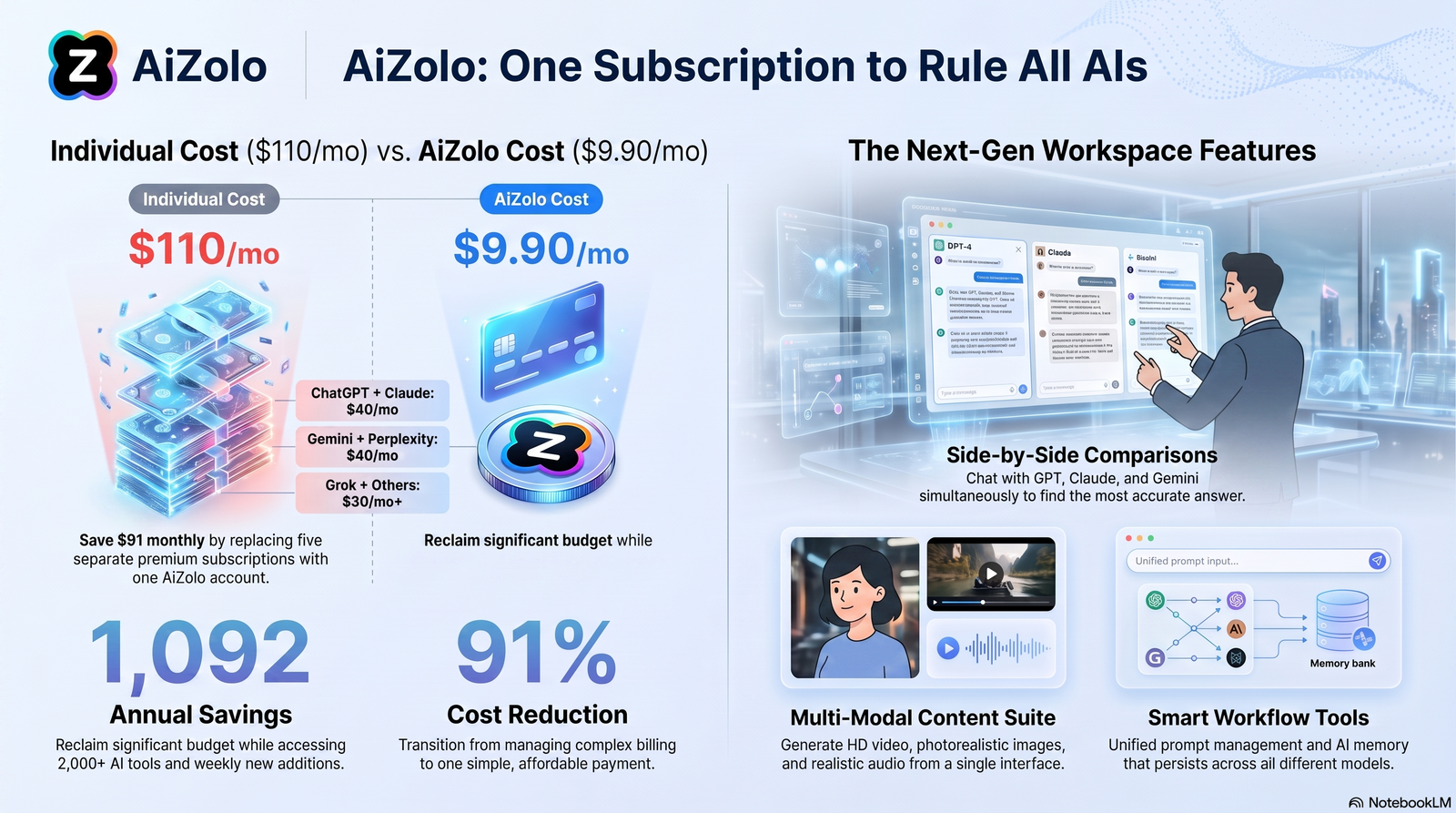
AI subscriptions have quietly become one of the biggest recurring line items on personal and business budgets. A ChatGPT Plus plan here, a Claude Pro plan there, maybe a Gemini add-on for Google Workspace—and suddenly you’re paying for three or four tools just to get full coverage across models. This is exactly why the Unlimited AI Chat Subscription category has grown so fast in 2026: it promises one bill, one login, and access to multiple AI models instead of juggling several separate accounts. Platforms like Aizolo reflect this shift by bringing multiple leading AI models into a single workspace, helping users simplify their AI workflow while reducing the need for multiple subscriptions.
This guide breaks down what an unlimited AI subscription actually includes, whether it’s worth paying for, how it compares to buying ChatGPT Plus, Claude Pro, and Gemini separately, and how to choose a platform that fits your workflow.
Quick answer: An unlimited AI chat subscription is a single paid plan that removes hard message caps on one AI model, or bundles several AI models together under one login. It’s generally worth it once you regularly use more than one model or hit rate limits on a single-vendor plan.
Table of Contents
What Is an Unlimited AI Chat Subscription?
An unlimited AI chat subscription is a single paid plan that gives you high-volume or uncapped access to one or more AI chat models — instead of a hard message quota tied to one provider’s app.
In practice, “unlimited” usually means one of two things:
- Single-model unlimited access — for example, a flagship provider’s top-tier plan that removes most day-to-day usage caps on its own model.
- Multi-model aggregator access — a third-party platform that bundles several AI models (GPT-class, Claude, Gemini, DeepSeek, and others) behind one subscription, so you switch models without switching accounts.
Someone doing competitive research might want GPT-class reasoning for one task and Claude for long-document writing in the same afternoon. An unlimited AI chat subscription is built for exactly that kind of mixed workflow, rather than locking you into a single vendor’s ecosystem.
How It Works in Practice
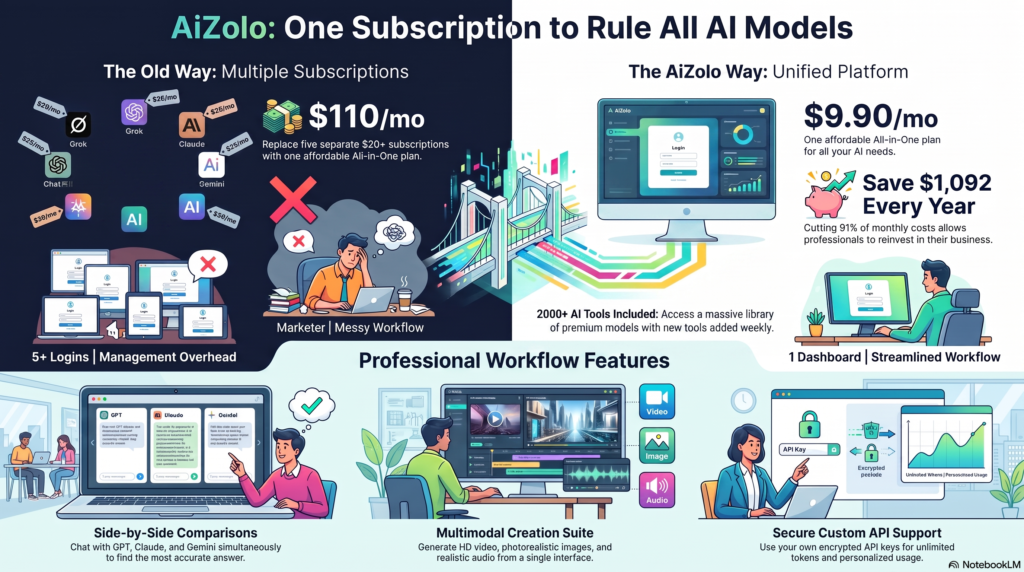
Most unlimited or multi-model plans work the same basic way behind the scenes:
- You subscribe once, usually on a monthly or annual billing cycle.
- The platform routes your prompt to the model you select — or, on some platforms, automatically to the model best suited for the task.
- Usage is tracked against a fair-use policy rather than a strict per-message counter, which is why most “unlimited” plans still have some ceiling in the fine print.
- Your history, files, and settings stay in one workspace, regardless of which underlying model answered a given question.
Who Actually Needs This
Not everyone needs an unlimited or multi-model plan. It tends to make sense for:
- People who already pay for two or more AI tools and want to consolidate billing
- Teams that need predictable, seat-based AI costs instead of variable per-provider bills
- Anyone whose work benefits from comparing outputs across models before finalizing a decision
It tends to make less sense for someone who uses AI casually, a few times a week, for simple tasks — a free tier or single $20/month plan usually covers that comfortably.
Why Are Users Looking for Unlimited AI?
Search interest in unlimited AI access has climbed for a few concrete reasons, not just hype.
Rising subscription costs. Flagship individual AI plans from OpenAI, Anthropic, and Google now sit around $20/month each, with power-user tiers running $100–$200/month. Paying for two or three of these adds up fast.
Tool fragmentation. Marketers, developers, and researchers routinely need more than one model — GPT-class for broad tasks, Claude for long-context writing and code, Gemini for Google Workspace integration.
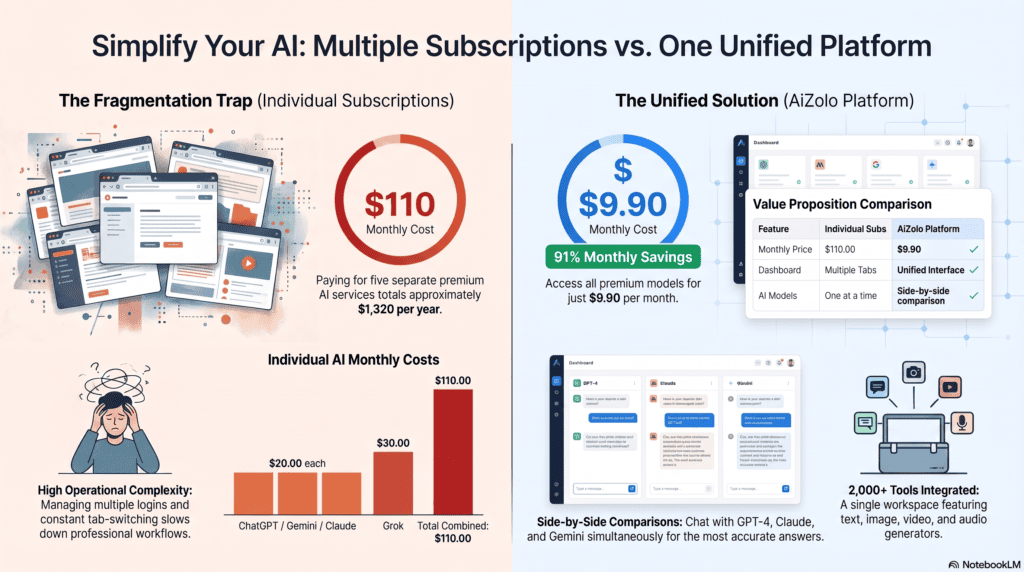
Productivity and switching costs. Logging in and out of separate apps, re-pasting context, and re-explaining a task to a different model wastes real time across a workday.
Research and content workflows. Cross-checking a fact, a draft, or a piece of code across multiple models has become a normal quality-control habit, not just a power-user trick.
Convenience. A single AI workspace with one login, one invoice, and one interface is simply easier to manage than a stack of separate accounts.
Benefits of an Unlimited AI Chat Subscription
| Benefit | What It Means in Practice |
|---|---|
| Cost savings | One subscription can cost less than stacking two or three flagship plans separately |
| Convenience | Single login, single dashboard, single invoice |
| Model flexibility | Switch between GPT-class, Claude, Gemini, or DeepSeek models for different tasks |
| Productivity | Less time lost to app-switching and re-explaining context |
| Creative work | Access to multiple models’ strengths for writing, brainstorming, and image generation |
| Business use | Easier budgeting and procurement with one recurring cost instead of many |
| Developer use | One place to compare code output across models before committing to an approach |
For marketers, it means testing ad copy or SEO drafts across models without extra invoices. For students, it means one affordable plan instead of piecing together free tiers. For developers, it means comparing how different models handle the same coding problem in one workspace.
If you’re weighing this against paying for each provider separately, it helps to compare AI subscriptions side by side before deciding.
Features to Look For in an Unlimited AI Chat Subscription
Not every “unlimited” plan is built the same way. Before subscribing, check whether the platform actually includes:
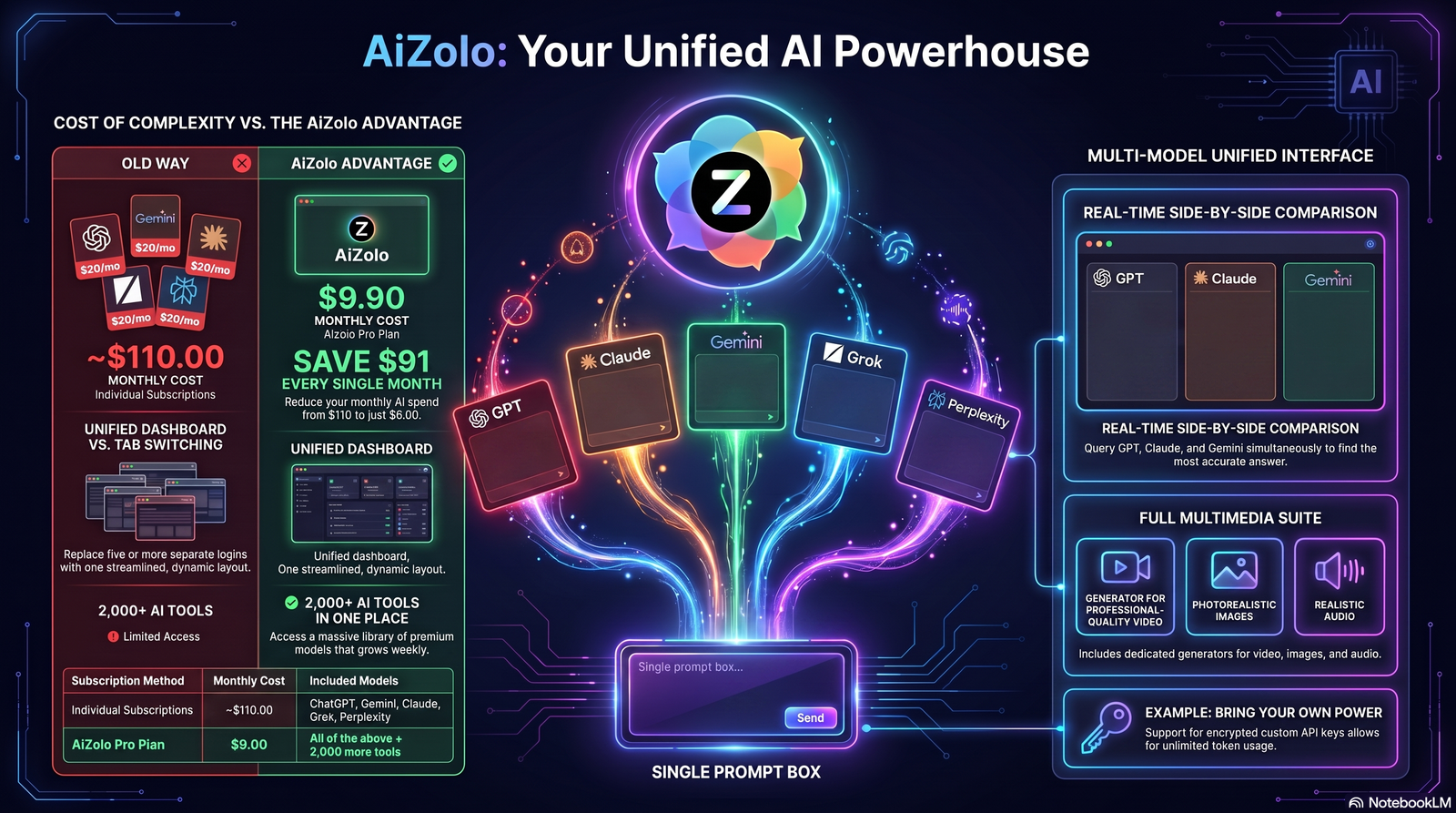
- Multiple AI models — access to GPT-class, Claude, Gemini, and DeepSeek models rather than just one
- Image generation — for marketing, design, and content workflows
- File upload and analysis — PDFs, spreadsheets, and documents
- AI writing tools — drafting, editing, tone adjustment
- AI coding assistance — debugging, code generation, code review
- Web search integration — for current information beyond a model’s training cutoff
- Memory — context that persists across sessions
- Team collaboration — shared workspaces, seat management, and admin controls for agencies and businesses
A platform that genuinely offers one subscription for all AI models should let you toggle between these features without hitting a paywall on each one individually.
Why Each Feature Matters
Multiple AI models matter because no single model wins every task. GPT-class models tend to be strong generalists, Claude often handles long documents and careful reasoning well, Gemini integrates tightly with Google Workspace, and DeepSeek is frequently used for cost-efficient technical tasks. Having all of them under one plan means picking the right tool per task instead of settling for whichever app you happen to be logged into.
File upload and analysis is essential for anyone working with reports, spreadsheets, or research documents — check whether the platform supports the file types and sizes you actually work with.
Web search integration matters for anything time-sensitive. A model without live search access is limited to its training data, which can be months old.
Memory saves time on recurring projects by letting the AI recall prior context instead of forcing you to re-explain your goals every session.
Team collaboration features — shared threads, seat management, usage reporting — matter far more for agencies and businesses than for solo users, so weigh this feature based on how you’ll actually deploy the subscription.
Best Unlimited AI Chat Subscription Platforms
There are two broad categories of platforms competing for this search term: official single-vendor plans (OpenAI, Anthropic, Google) and multi-model aggregator platforms that bundle several AI providers into one subscription.
| Platform Type | Strengths | Weaknesses | Best For |
|---|---|---|---|
| ChatGPT Plus / Pro | Deep GPT-class feature set, strong ecosystem (Sora, Codex) | Single-model only; Pro tiers get expensive fast | Users committed to the OpenAI ecosystem |
| Claude Pro / Max | Strong long-context writing and coding, generous context window | Single-model only | Writers, developers, long-document work |
| Google AI Pro / Ultra | Deep Google Workspace integration | Single-model only; best value tied to existing Google use | Gmail/Docs/Sheets-heavy workflows |
| Multi-model aggregator platforms (e.g., AiZolo) | Multiple AI models in one subscription, single invoice, cross-model comparison in one place | Feature parity with official apps can vary by provider and update cycle | Users who regularly need more than one model |
If your workflow genuinely spans multiple models — comparing a GPT-class answer against Claude’s reasoning, for example — an all-in-one platform like AiZolo is worth evaluating as a way to access all AI models in one place rather than maintaining several separate logins. As with any platform in this category, check the current model list, usage limits, and pricing directly, since AI subscription terms change frequently.
Is Unlimited AI Better Than Buying Multiple Subscriptions?
This depends entirely on how many models you actually use and how often you hit usage limits.
Scenario 1: You use one model daily. A single flagship plan (around $20/month) is usually the simplest and most cost-effective option. There’s little reason to pay for an aggregator if you never touch a second model.
Scenario 2: You regularly use two or more models. Buying ChatGPT Plus ($20/month) and Claude Pro ($20/month) separately runs about $40/month before even adding Gemini. A well-priced all-in-one plan can undercut that combined cost while adding the convenience of one dashboard.
Scenario 3: You’re a power user hitting rate limits constantly. Single-vendor “Pro” or “Max” tiers ($100–$200/month) offer the deepest feature access for one model, but that’s a different budget bracket than casual multi-model use.
For a clearer picture of where your usage falls, it helps to run an AI subscription price comparison against your actual monthly habits rather than list prices alone.
2026 Pricing Snapshot (Official Single-Vendor Plans)
| Provider | Entry Paid Tier | Power-User Tier |
|---|---|---|
| OpenAI (ChatGPT) | Plus, around $20/month | Pro, $100–$200/month depending on usage tier |
| Anthropic (Claude) | Pro, around $20/month | Max, $100–$200/month depending on usage multiplier |
| Google (Gemini) | Google AI Pro, around $20/month | Google AI Ultra, $100–$200/month |
These figures are drawn from each provider’s publicly listed pricing as of mid-2026 and change periodically, so always confirm current rates on the official pricing page before subscribing. Stacking just two entry-level plans already puts you close to $40/month — which is the exact price gap that multi-model aggregator subscriptions are designed to close.
Who Should Buy an Unlimited AI Chat Subscription?
| Persona | Why It Fits |
|---|---|
| Marketers | Need to test copy, campaigns, and SEO drafts across multiple models quickly |
| Agencies | Manage several clients and need flexible, budget-predictable AI access |
| Students | Want affordable access without stacking multiple paid apps |
| Developers | Compare code output and debugging approaches across models |
| Founders | Need to move fast across writing, research, and technical tasks without multiple invoices |
| Writers | Benefit from different models’ strengths in tone, structure, and editing |
| Researchers | Cross-check facts and reasoning across models to reduce blind spots |
| Educators | Need a reliable, budget-friendly tool for lesson planning and content creation |
If you fit more than one of these personas, an aggregator plan built around multiple AI models in one subscription is generally the more efficient starting point than stacking separate accounts.
Pros and Cons of an Unlimited AI Chat Subscription
| Pros | Cons |
|---|---|
| Potentially lower combined cost than multiple separate subscriptions | “Unlimited” may still include soft usage caps or fair-use limits |
| One dashboard, one login, one invoice | Feature parity with official apps can lag behind updates |
| Access to multiple models for comparison | Not ideal if you only ever use one model |
| Useful for teams needing predictable budgeting | Support quality and refund policies vary by provider |
| Reduces context-switching between apps | Newest flagship models may roll out to official apps first |
Common Mistakes to Avoid Before Buying
Ignoring usage limits. “Unlimited” rarely means truly infinite — check for fair-use caps, daily resets, or rate limits before subscribing.
Missing AI models. Confirm the specific models included (and their versions) rather than assuming “GPT” or “Claude” access covers every variant.
Hidden quotas on premium features. Image generation, file uploads, and voice features often have separate, lower limits than text chat.
Slow response times. Aggregator platforms route requests through different infrastructure than official apps — check for reported latency issues before committing.
Privacy and data handling. Understand whether your conversations are used for training and whether an opt-out exists.
Support and refund policy. Read the cancellation and refund terms before paying annually, especially for newer platforms.
Assuming every model is always the latest version. Providers roll out new model versions on their own schedules, and aggregator platforms don’t always get day-one access. If having the newest model matters to you, check the platform’s update cadence.
Skipping the trial period. If a free trial or short-term plan is available, test the actual response quality and speed for your specific use cases before committing to an annual plan.
Not checking device and integration support. Confirm the platform works with the tools you already use — browser extensions, mobile apps, or API access — before assuming feature parity with official apps.
Frequently Asked Questions
What is an unlimited AI chat subscription? It’s a paid plan that gives high-volume or multi-model access to AI chatbots through one subscription, instead of separate accounts and usage caps per provider.
Is an unlimited AI subscription worth paying for? It’s worth it if you regularly use more than one AI model or hit usage limits on a single-vendor plan. If you only use one model occasionally, a free tier or single flagship plan may be enough.
Can one subscription replace ChatGPT Plus? A multi-model aggregator plan can replace ChatGPT Plus for many day-to-day tasks, but you should confirm it includes the specific GPT-class model version you rely on.
Does unlimited mean truly infinite usage? Usually not. Most “unlimited” plans include fair-use limits or soft caps designed to prevent abuse, even if there’s no hard message count.
Which AI models are typically included in a multi-model subscription? Commonly GPT-class models, Claude, Gemini, and DeepSeek, though the exact lineup varies by platform and changes as new model versions release.
Is it cheaper than paying for ChatGPT Plus and Claude Pro separately? Often yes, since two flagship plans alone can run about $40/month before adding a third provider. Compare current pricing directly, since rates change.
Are unlimited AI subscriptions safe for business data? Check each platform’s data retention and training-opt-out policy individually; official enterprise plans typically offer stronger default protections than consumer tiers.
Can I use an unlimited AI subscription for coding? Most platforms include code generation and debugging support, but dedicated developer tools (like IDE integrations) may vary by provider.
Do these subscriptions include image generation? Many do, though image generation often has its own separate usage limit even within an “unlimited” chat plan.
Is there a free trial for unlimited AI platforms? This varies by provider — check the specific platform’s current offer before subscribing.
What happens if I exceed the fair-use limit? Typically you’re rate-limited or asked to wait until a reset window, similar to how official apps handle heavy usage.
Should students buy an unlimited AI subscription? If a student regularly uses more than one AI tool for coursework, an aggregator plan can be more cost-effective than multiple individual subscriptions.
Can teams share one unlimited AI subscription? Business or team-tier plans typically include seat management for this; personal-tier plans usually don’t support account sharing.
How do I compare unlimited AI platforms fairly? Compare included models, usage limits, support quality, and total monthly cost against your actual usage — not just the headline price.
Is AiZolo a good option for unlimited AI access? AiZolo is one of several all-in-one platforms worth evaluating if your workflow spans multiple AI models — check its current model list, limits, and pricing against your specific needs.
Final Verdict
An unlimited AI chat subscription makes the most sense for people who genuinely use more than one AI model — marketers testing copy across tools, developers comparing code output, or teams that need predictable AI budgeting instead of several separate invoices. If you only ever use one model occasionally, a single flagship plan or free tier will likely serve you just as well.
Before subscribing to any platform, verify the exact models included, real usage limits, and refund policy rather than relying on the word “unlimited” alone. If you’re evaluating an all-in-one option, platforms like AiZolo are worth comparing on features, supported models, pricing, and workflow fit — alongside official single-vendor plans — to see which setup actually matches how you work. For a broader look at pricing structures across the market, see best AI subscription 2026, and for common questions, see best multi AI platform.
Sources for further reading:
- Google Search Essentials
- Google Spam Policies
- Google Core Updates
- Anthropic Documentation
- OpenAI Help Centre
- Google Gemini
- DeepSeek
Author bio
Jeevesh Tripathi AI Researcher & SEO Content Strategist 📧 jeevesh@aizolo.com
Jeevesh Tripathi researches AI productivity platforms, search optimisation, and emerging AI technologies. He specialises in creating evidence-based content that helps readers evaluate AI tools, understand industry trends, and make informed software purchasing decisions. His work follows Google’s E-E-A-T principles, prioritising accuracy, transparency, and practical value.
Pingback: AI Workspace with Unlimited Chats and Projects | AiZolo in 2026