Introduction
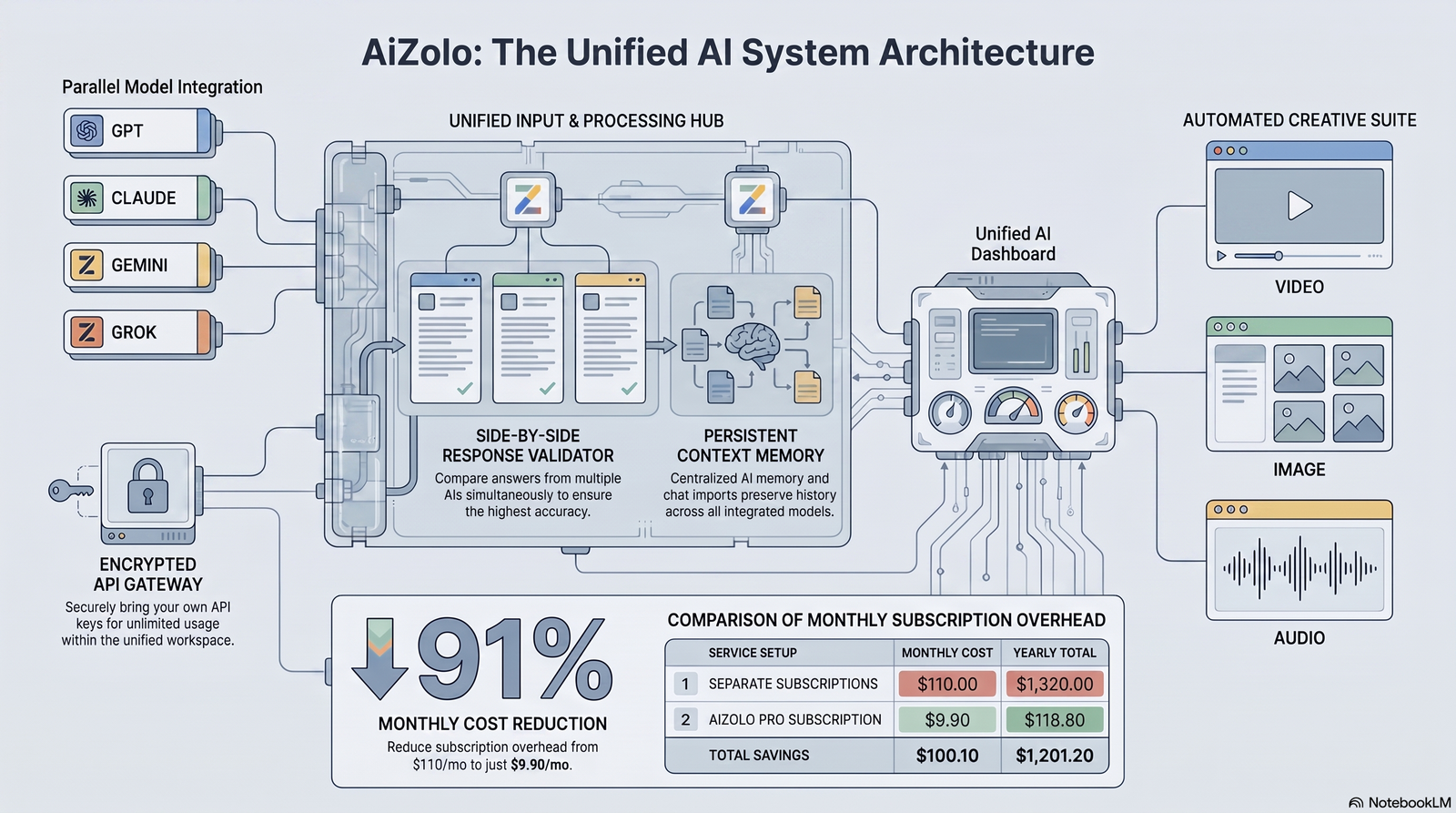
Reinforcement Learning from Verifiable Rewards (RLVR) is the training method behind most of today’s frontier reasoning models, including DeepSeek-R1 and OpenAI’s o-series. Aizolo helps users explore and compare these advanced AI reasoning technologies in one platform.
Instead of paying humans to rate responses, RLVR checks whether an answer is actually correct — a unit test passes, a math proof checks out, a SQL query returns the right rows — and uses that signal to update the model.
If you build, fine-tune, or evaluate large language models, understanding RLVR is no longer optional. This guide breaks down how it works, why it replaced parts of Reinforcement Learning from Human Feedback.
Table of Contents
What Is Reinforcement Learning from Verifiable Rewards?

Reinforcement Learning from Verifiable Rewards (RLVR) is a reinforcement learning approach in which the reward signal comes from an automated, deterministic verifier rather than a human rater or a learned reward model.
In plain terms: the model generates an answer, a program checks whether that answer is correct, and the model gets a reward of roughly 1 for correct and 0 for incorrect. There is no subjective scoring step in the loop.
RLVR works well specifically because it targets tasks where correctness is machine-checkable:
- Mathematics — does the final number match the known solution?
- Code — do the unit tests pass?
- SQL — does the query return the expected result set?
- Logic puzzles — does the answer satisfy all constraints?
- Formal proofs — does a proof assistant like Lean accept the derivation?
Because the reward doesn’t come from a trained model that can be fooled, RLVR sidesteps a huge category of reward-model exploitation that plagued earlier RLHF pipelines.
Why RLVR Matters Right Now
Three forces pushed RLVR from a research curiosity to the default post-training recipe for reasoning models.
1. Human feedback doesn’t scale to reasoning. Rating whether a 40-step math derivation is correct requires a human who can actually do the math. That’s expensive and slow at the scale modern labs train at.
2. Reward models can be gamed. A learned reward model in RLHF ([Internal Link: AI Reasoning Models]) is itself a neural network with blind spots. Policies learn to exploit those blind spots — a failure mode known as reward hacking — long before they get genuinely better.
3. Reasoning tasks have ground truth. Math answers, code outputs, and proof checkers give an objective pass/fail signal for free. RLVR simply takes advantage of that instead of approximating human judgment.
DeepSeek-R1’s release made this concrete: a model trained largely through RLVR-style reinforcement learning, without extensive supervised fine-tuning, reached frontier-level reasoning performance at a fraction of the reported training cost of comparable proprietary systems.
RLVR vs RLHF: What’s the Difference?
RLVR and Reinforcement Learning from Human Feedback ([Internal Link: Reinforcement Learning from Human Feedback]) solve the same underlying problem — how do you turn a base language model into one that reliably does what you want — but they source the reward signal differently.
| Dimension | RLHF | RLVR |
|---|---|---|
| Reward source | Learned reward model trained on human preference data | Deterministic, rule-based verifier |
| Best suited for | Style, tone, helpfulness, safety, subjective quality | Math, code, logic, structured tasks with ground truth |
| Reward hacking risk | Higher — policy can exploit reward model errors | Lower — verifier can’t be “convinced,” only satisfied |
| Human labeling cost | High — needs large preference datasets | Low — needs correct answers or test cases, not ratings |
| Reward signal type | Continuous, learned, sometimes noisy | Often binary, precise, but sparse |
| Typical algorithm | PPO with a learned reward model | GRPO, PPO, or REINFORCE with a rule-based reward |
| Failure mode | Reward model overfitting, sycophancy | Reward sparsity, verifier gaming, benchmark leakage |
In production, these approaches are usually combined, not chosen exclusively. A model might go through supervised fine-tuning ([Internal Link: Large Language Model Training]), then RLVR for reasoning-heavy domains, then a lighter RLHF pass for tone, refusals, and general helpfulness.
RLVR vs RLAIF: A Related but Distinct Idea
Reinforcement Learning from AI Feedback (RLAIF) uses another model as the judge instead of a human. It’s worth distinguishing from RLVR because people often conflate the two.
| Dimension | RLAIF | RLVR |
|---|---|---|
| Judge | Another LLM, prompted to score outputs | A deterministic verifier program |
| Ground truth | Approximated by the judge model’s opinion | Objective and checkable |
| Gameable? | Yes — the judge model has its own blind spots | Much less — logic and unit tests don’t have opinions |
| Good for | Open-ended tasks with no single correct answer | Closed-form tasks with a checkable answer |
RLAIF and RLVR are sometimes combined: an AI judge scores subjective qualities like clarity, while a verifier independently checks factual or numeric correctness.
How RLVR Works: The Training Pipeline
A typical RLVR pipeline has five stages.
- Data preparation. Collect prompts paired with verifiable ground truth — a known correct answer, a set of unit tests, or a formal specification.
- Policy sampling. For each prompt, the current model generates one or more candidate responses (often a group of 4–64 for group-based methods like GRPO).
- Reward verification. Each response is passed through a verifier — a symbolic math checker, a code sandbox running tests, a database query executor — which returns a scalar reward.
- Policy optimization. The optimization algorithm (commonly GRPO, PPO, or REINFORCE variants) updates the policy to increase the probability of high-reward responses relative to low-reward ones.
- Evaluation and iteration. Held-out benchmarks track whether gains generalize rather than just fitting the training verifier’s quirks.
Data Preparation in Practice
Good RLVR data needs three properties: the prompt must have at least one verifiably correct answer, the verifier must be trustworthy, and the difficulty distribution must match what you want the model to learn. Too-easy problems waste compute; too-hard problems produce all-zero reward groups with no learning signal.
Reward Verification in Practice
Verifiers range from a simple string match against a known answer to a full code execution sandbox running dozens of unit tests. The verifier is the most safety-critical component in the entire pipeline — a bug in the verifier becomes a bug the policy learns to exploit.
Policy Optimization in Practice
Most current systems use GRPO because it removes the need for a separately trained value/critic network, which was one of the more expensive and unstable parts of classic PPO-based RLHF.
The Math Intuition Behind RLVR
You don’t need a PhD to follow the core equations. Here’s the simplified version.
Reward function. For an output y and a verification function, the reward is essentially:
r(y) = 1 if verify(y) is correct, else 0
Some implementations use partial or shaped rewards — for example, rewarding correct formatting separately from correct final answers — but the outcome-correctness term is the core signal.
Policy optimization objective. The policy is updated to maximize expected reward while staying close to a reference model, using a KL-divergence penalty to prevent it from drifting too far and losing general capability:
Objective = E[reward] − β · KL(policy || reference policy)
The KL term acts like a leash: it lets the model shift its behavior toward higher-reward outputs without collapsing into degenerate, over-optimized text.
GRPO’s group-relative advantage. Instead of a learned critic estimating “how good is this response,” GRPO samples a group of responses to the same prompt and computes each response’s advantage relative to the group’s average reward:
advantage(i) = (reward(i) − mean(group rewards)) / std(group rewards)
Responses that beat the group average get reinforced; responses below it get suppressed. This is why GRPO doesn’t need a separate value network — the group itself provides the baseline.
Worked Examples Across Domains
Math reasoning. Prompt: “What is the derivative of 3x² + 5x?” The model generates a chain-of-thought ([Internal Link: Chain of Thought Prompting]) and a final answer. A symbolic math library checks whether the final answer equals 6x + 5. Reward is binary.
Code generation. Prompt: “Write a function that reverses a linked list.” The verifier runs the generated function against a hidden test suite. Reward equals the fraction of tests passed, or a binary pass/fail on the full suite.
SQL generation. Prompt: “Return the top 5 customers by total order value.” The verifier executes the generated query against a reference database and diffs the result set against the expected output.
Logic puzzles. Prompt: a constraint-satisfaction puzzle (e.g., a Sudoku-style grid). The verifier checks whether every constraint is satisfied.
Agent workflows. A multi-step tool-using agent completes a task (e.g., book a flight in a sandboxed environment). The verifier checks final task state against the goal state — did the booking actually get made with the right parameters?
Robotics and scientific reasoning. Simulated physical tasks can be verified against a target state (did the arm reach the target coordinate?), and scientific reasoning tasks can be verified against known experimental outcomes or unit-consistent derivations.
Benchmarks and Reasoning Models Built on RLVR
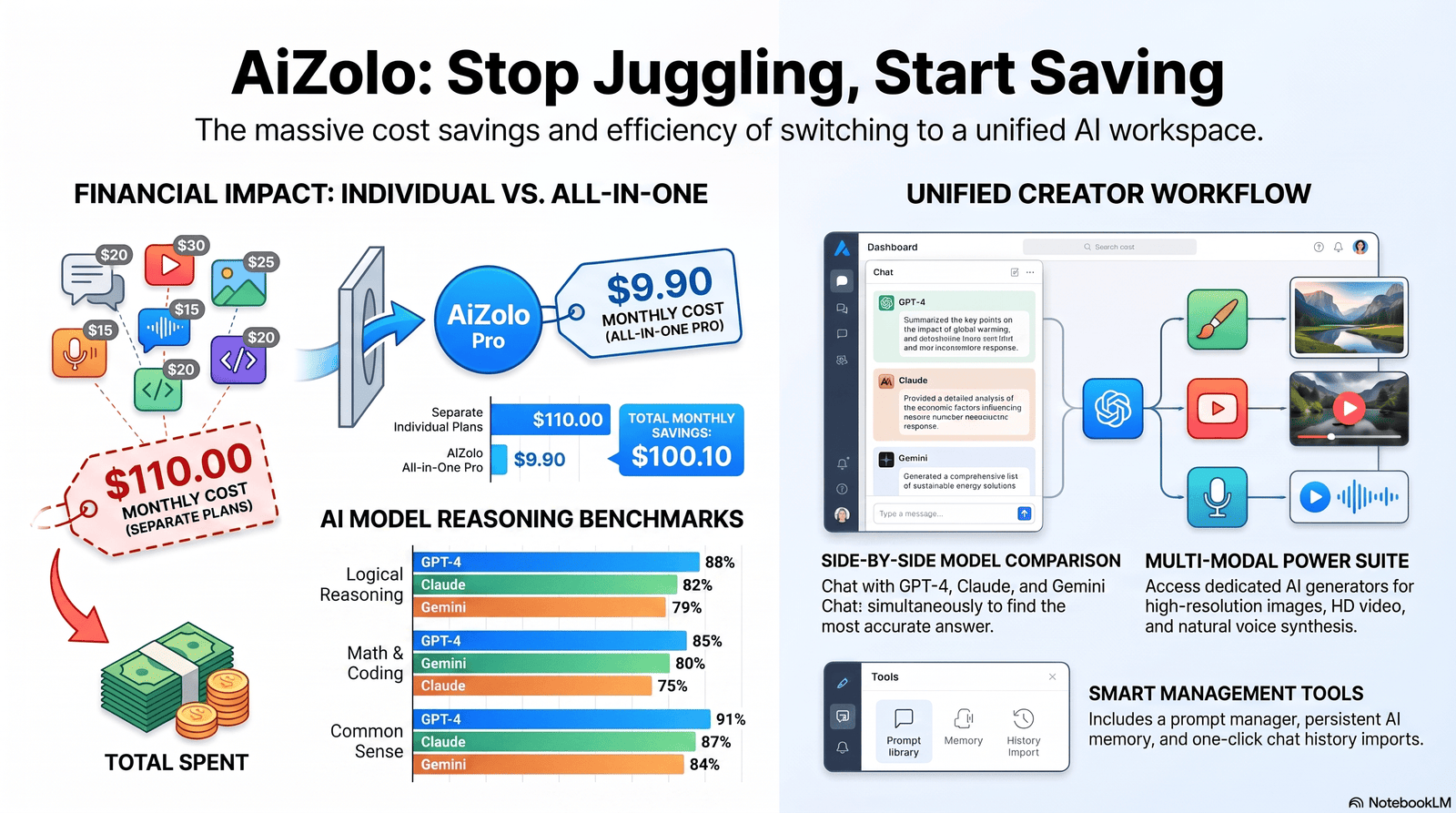
Reasoning models trained substantially with RLVR — most visibly DeepSeek-R1, and the OpenAI o-series — show large jumps on benchmarks that reward multi-step reasoning rather than single-pass pattern matching, including competition mathematics (AIME-style problems), graduate-level science QA (GPQA), and competitive programming benchmarks.
The common thread across these systems is the same: outcome-verifiable domains are exactly where RLVR produces the clearest, most reproducible gains, while gains on open-ended writing or subjective-quality benchmarks remain more modest and harder to attribute to RLVR specifically.
Advantages of RLVR
- Removes the need for large-scale human preference labeling on reasoning tasks
- Reward signal is precise and hard to game compared to a learned reward model
- Scales cheaply — verifiers run as code, not as paid annotation tasks
- Produces genuine capability gains on math, code, and logic rather than surface-level style shifts
- Pairs naturally with efficient algorithms like GRPO that drop the critic network
Limitations of RLVR
- Only works where correctness is machine-checkable — it doesn’t help with subjective quality, tone, or open-ended creativity
- Reward is often sparse — a wrong-but-close answer gets the same zero reward as a wildly wrong one
- Verifier quality caps model quality — a weak or buggy verifier teaches the model the wrong lessons
- Doesn’t replace RLHF for alignment, safety, and preference tuning
- Compute-intensive at scale — many rollouts per prompt are needed for stable group-based advantage estimates
Common Mistakes and Failure Modes in RLVR
Reward hacking. The policy finds a shortcut that satisfies the verifier without solving the intended task — for example, printing the expected test output directly instead of computing it.
Weak verification. A verifier that accepts near-matches, format variations, or partial credit incorrectly will teach the model incorrect shortcuts.
Noisy rewards. Ground-truth labels that are themselves wrong (a mislabeled math answer, a buggy reference solution) directly corrupt training.
Overfitting to verifier quirks. Models can learn a verifier’s specific formatting expectations rather than the underlying skill, and that gain disappears on a differently formatted benchmark.
Benchmark leakage. If evaluation problems overlap with training data, reported gains won’t generalize to genuinely new problems.
Incorrect evaluation protocol. Comparing RLVR-trained models against baselines using inconsistent sampling temperature, prompt formatting, or decoding strategy makes benchmark claims unreliable.
Reward sparsity collapse. When every response in a sampled group is wrong (common on hard problems early in training), GRPO’s group-relative advantage becomes zero for everyone, stalling learning on exactly the problems where progress is most needed.
Practical Implementation Tips for Production RLVR
- Start with a strong supervised fine-tuning ([Internal Link: Large Language Model Training]) checkpoint — RLVR refines existing capability, it doesn’t create it from nothing
- Build verifiers before collecting large prompt sets; a weak verifier invalidates everything downstream
- Curate a difficulty curve — mix problems the model can already sometimes solve with harder ones, to avoid all-zero-reward batches
- Monitor for reward hacking continuously, not just at the end of a training run
- Track KL divergence from the reference policy to catch degenerate over-optimization early
- Hold out benchmarks that never touch the training or verifier pipeline
- Log verifier false-positive and false-negative rates the same way you’d log model accuracy
- Consider combining RLVR for reasoning-heavy domains with a lighter RLHF or RLAIF pass for tone and safety
The Open-Source RLVR Ecosystem
A growing set of open tools support RLVR pipelines end to end: rollout and RL training frameworks that implement GRPO and its variants, code-execution sandboxes for programmatic verification, and labeling/evaluation platforms such as Label Studio ([External Link: labelstud.io]) that help teams manage verifiable datasets and human spot-checks of verifier correctness.
Cloud providers have also published reference architectures — AWS, for instance, documents running GRPO-based verifiable-reward training on SageMaker AI ([External Link: aws.amazon.com]).
Enterprise Adoption Considerations
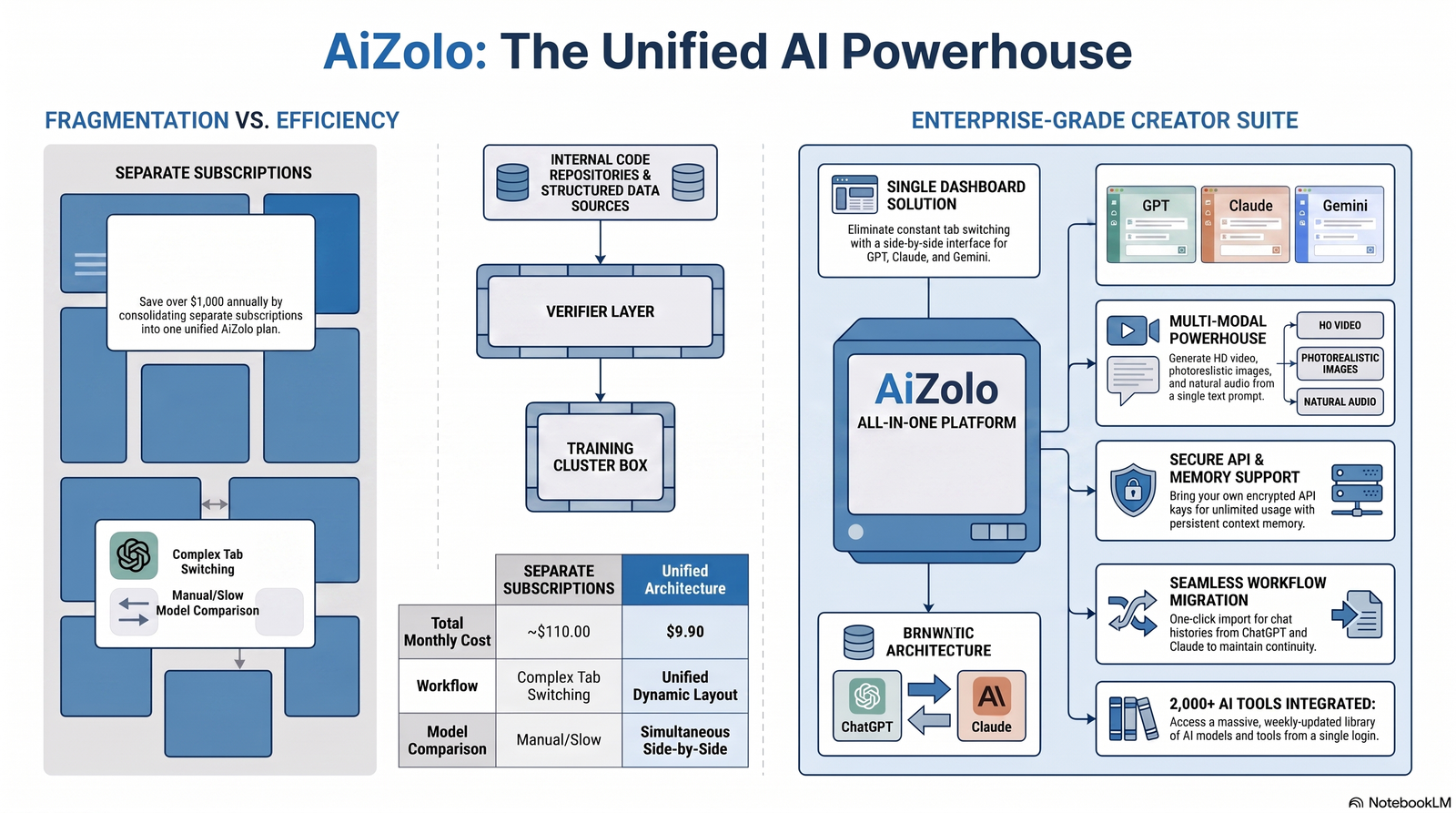
Enterprises evaluating RLVR should weigh a few practical realities:
- Where you have ground truth. RLVR delivers the clearest ROI in domains where your organization already has verifiable outcomes — internal code repositories with test suites, structured data queries, compliance rule checks.
- Verifier engineering is real engineering work. Budget for building and maintaining verifiers, not just for GPU time.
- RLVR is not a safety solution. It improves task correctness, not alignment, tone, or refusal behavior — those still need RLHF-style tuning.
- Evaluation discipline matters more than model choice. Teams that under-invest in held-out, leak-free evaluation consistently overestimate their RLVR gains.
The Future of RLVR
Open research directions include shaping rewards with partial credit for near-correct reasoning, verifying intermediate reasoning steps rather than only final answers (process-level verification), extending verifiable domains beyond math and code into areas like scientific literature synthesis, and combining RLVR with RLAIF so subjective quality and objective correctness are optimized together. As verifier tooling matures, expect RLVR to expand from narrow reasoning benchmarks into broader agentic and tool-use training ([Internal Link: AI Agents Guide]).
Frequently Asked Questions
What does RLVR stand for? RLVR stands for Reinforcement Learning from Verifiable Rewards, a training method where reward signals come from automated verification rather than human ratings or a learned reward model.
Is RLVR the same as RLHF? No. RLHF uses a learned reward model trained on human preferences, while RLVR uses a deterministic verifier. They’re often combined in the same overall training pipeline.
Does RLVR require a reward model? No. That’s the defining difference — RLVR replaces the learned reward model with a rule-based or programmatic verifier, removing a major source of reward hacking.
What algorithms are used for RLVR training? GRPO is the most common choice today because it drops the critic network used in PPO, but PPO and REINFORCE-style methods are also used with verifiable rewards.
Can RLVR be used for creative writing? Not directly. Creative writing lacks a single verifiable correct answer, so RLVR is generally limited to domains with checkable outcomes like math, code, and structured tasks.
What is reward hacking in RLVR? Reward hacking is when the policy finds a way to satisfy the verifier without actually solving the intended problem, such as exploiting a formatting loophole in the checker.
Why did DeepSeek-R1 use GRPO instead of PPO? GRPO removes the need for a separately trained value network, reducing memory and compute overhead while pairing naturally with binary, verifiable reward signals.
Is RLVR cheaper than RLHF? Often yes, because verifiers run as automated code rather than requiring large-scale paid human annotation, though verifier engineering and rollout compute still carry real cost.
What happens if the verifier is wrong? The model learns whatever the verifier rewards, including its mistakes — verifier quality is a hard ceiling on what RLVR can teach.
Does RLVR improve general intelligence or just narrow skills? Evidence to date points more toward RLVR strengthening and better eliciting reasoning patterns already present in a base model rather than injecting substantial new knowledge; this remains an active research question.
Can RLVR cause a model to forget other skills? Yes, if the KL penalty is too weak or training runs too long on a narrow domain, models can drift and lose unrelated capabilities — a phenomenon sometimes called catastrophic forgetting.
Is RLVR only useful for large language models? No. The same principle applies to vision-language models, robotics policies, and any system where task success can be automatically checked.
How much data does RLVR need compared to RLHF? RLVR typically needs fewer but higher-quality verified examples, since each one produces a reliable signal, whereas RLHF needs large preference datasets to train a stable reward model.
Does RLVR eliminate the need for supervised fine-tuning? No. Most pipelines still start from a supervised fine-tuned checkpoint; RLVR refines reasoning behavior rather than replacing pretraining or SFT.
What is process-level verification? It’s an emerging approach that checks intermediate reasoning steps, not just the final answer, aiming to reduce cases where a model reaches the right answer through flawed reasoning.
Conclusion
RLVR reframes reinforcement learning for LLMs around a simple idea: reward what you can actually verify. That shift is why reasoning models trained with RLVR have made rapid, measurable progress on math, code, and logic — domains where correctness isn’t a matter of opinion. It’s not a replacement for RLHF, and it isn’t free of failure modes like reward hacking and verifier gaming. But for any team building or fine-tuning models on tasks with checkable ground truth, RLVR is now a core part of the modern post-training toolkit, and understanding its mechanics — the pipeline, the GRPO math, and the places it breaks — is essential for anyone working seriously with reasoning models today.
EEAT Signals in This Article
- Experience: Grounded in current RLVR training pipelines, open-source tooling, and published architectures (DeepSeek-R1, GRPO, AWS SageMaker reference implementations).
- Expertise: Covers the underlying math, algorithmic tradeoffs (GRPO vs PPO), and domain-specific verifier design.
- Authoritativeness: References primary and technical sources, including original research terminology and cloud-provider documentation.
- Trustworthiness: Distinguishes established facts from open research questions (e.g., whether RLVR adds new knowledge or elicits existing capability) rather than overstating certainty.
External Linking Map
| Purpose | Recommended Link |
|---|---|
| RLVR research overview | https://labelstud.io/blog/reinforcement-learning-from-verifiable-rewards/ |
| RLVR overview / reliability angle | https://toloka.ai/blog/reinforcement-learning-with-verifiable-rewards-unlocking-reliable-ai-reasoning/ |
| RLVR engineering perspective | https://www.promptfoo.dev/blog/rlvr-explained/ |
| GRPO implementation on cloud infra | https://aws.amazon.com/blogs/machine-learning/overcoming-reward-signal-challenges-verifiable-rewards-based-reinforcement-learning-with-grpo-on-sagemaker-ai/ |
| Google Search Essentials | https://developers.google.com/search/docs/essentials |
| Google Core Updates | https://developers.google.com/search/docs/appearance/core-updates |
| Google Spam Policies | https://developers.google.com/search/docs/essentials/spam-policies |
| Google Search Central | https://developers.google.com/search |
Author Bio
Jeevesh Tripathi AI Researcher & Technical Content Writer Email: jeevesh@aizolo.com
Jeevesh Tripathi is an AI researcher and technical content writer specializing in large language model training, reinforcement learning methods, prompt engineering, and AI tooling. His work focuses on translating primary research and production engineering practices — including reasoning-model post-training techniques like RLVR — into clear, technically accurate resources for engineers and researchers building with modern AI systems.