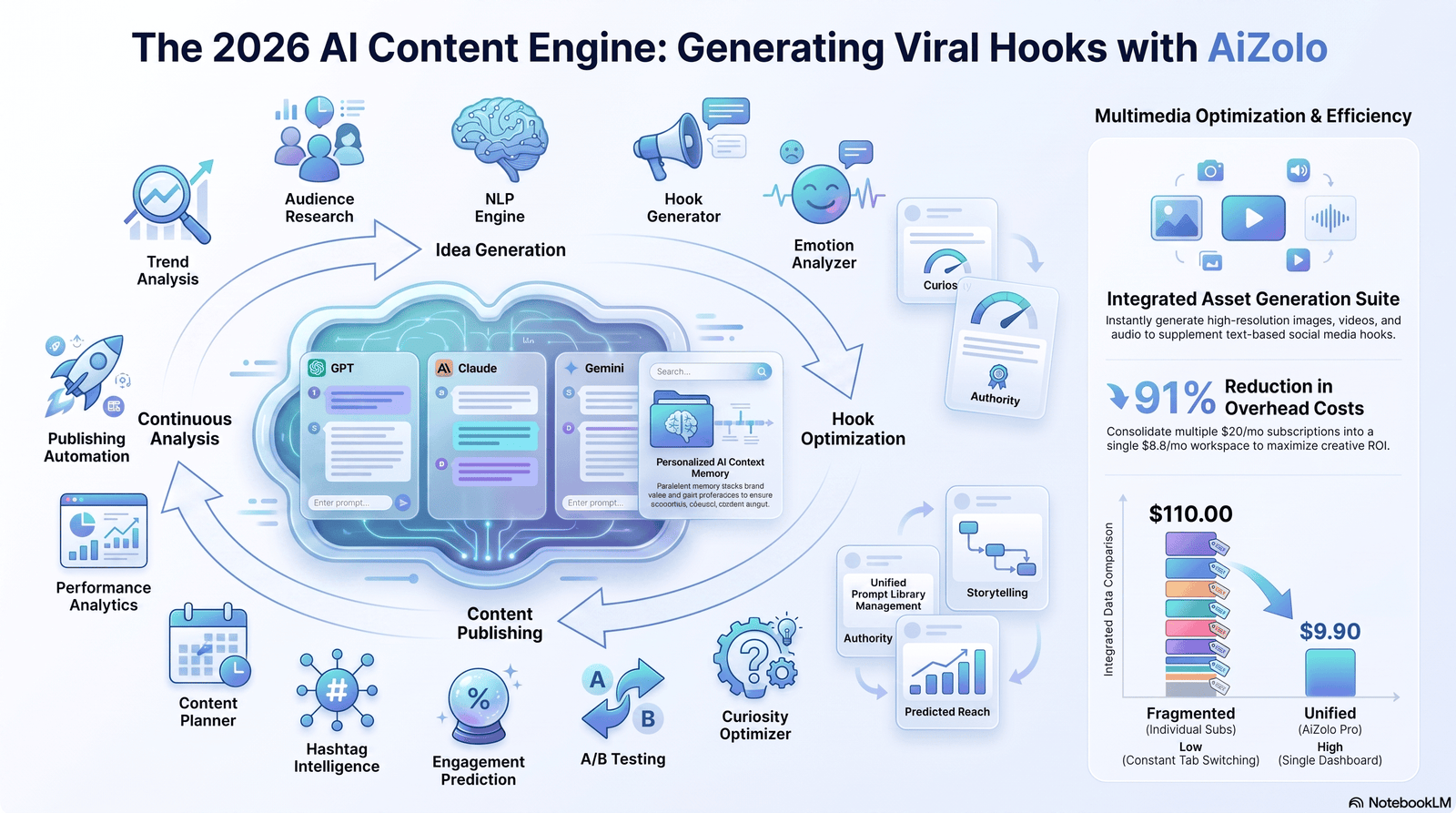
To use AI for generating viral hooks on Twitter, use Aizolo to feed a large language model your topic, audience, and a proven hook framework (curiosity gap, contrarian take, or numbered list), then generate 15–25 variations. Edit each hook for your brand voice, specificity, and accuracy before posting. Aizolo speeds up ideation, while human judgment determines what ultimately gets published.
Table of Contents
Introduction
If you’ve ever spent twenty minutes writing a tweet that got three likes, you already know the truth: on Twitter (X), the first line is the entire game.
Learning how to use AI for generating viral hooks on Twitter isn’t about outsourcing your voice to a chatbot. It’s about using AI as a fast first-draft engine — one that can throw twenty angles at a topic in the time it takes you to write one — so you spend your energy on the part that actually matters: choosing, editing, and publishing the hook that’s true to what you know.
This guide gives you the full system: the psychology behind why hooks work, the exact prompts to use, a repeatable workflow, and the mistakes that quietly kill reach. No fluff, no recycled listicle advice — just what creators and marketers are actually doing with AI hook generation right now.
Quick Win: Before you read further, open a notes app. Every framework and prompt below is meant to be copied, tested, and adapted — not just read once and forgotten.
What Are Viral Hooks?
A hook is the first line (or first visible sentence) of a tweet — the part a reader sees before they decide whether to tap “Show more,” keep scrolling, or stop and read.
On Twitter specifically, the hook has to work inside a brutal constraint: the platform truncates longer posts in the timeline, so your opening sentence is often doing the job of a headline, a thesis, and a cliffhanger all at once.
A viral hook typically does one of these things:
- Opens a curiosity gap the reader wants closed
- Makes a claim specific enough to feel true and bold enough to feel risky
- Promises a concrete, personal payoff (time saved, mistake avoided, money made)
- Triggers a reaction — agreement, disagreement, or recognition — within one sentence
Featured Snippet Answer: A viral hook is the opening line of a tweet designed to stop a scrolling reader and compel them to keep reading. It works by combining curiosity, specificity, and emotional relevance in a single sentence, before the platform truncates the rest of the post.
Why Hooks Determine Tweet Performance
Here’s the uncomfortable part: on X, your hook doesn’t just affect whether someone reads your tweet — it affects whether the algorithm shows your tweet to anyone else at all.
Based on current platform behavior, X’s ranking systems weigh early engagement signals (dwell time, replies, “Show more” taps) heavily in the first minutes after posting. A weak hook suppresses those signals before the rest of your content even gets a chance.
| Factor | Weak Hook | Strong Hook |
|---|---|---|
| Scroll-past rate | High | Low |
| “Show more” taps | Rare | Frequent |
| Reply likelihood | Low | Higher |
| Algorithmic reach | Suppressed early | Amplified early |
| Perceived authority | Generic | Distinct voice |
Pro Tip: Write your hook last, after you know what the tweet is actually about. Hooks written first tend to promise something the body doesn’t deliver — and mismatched payoff is one of the fastest ways to lose trust with a following.
Most marketers find that a single tweet’s performance ceiling is set within the first 5–8 words. Everything after that is amplification, not creation — which is exactly why hook generation is worth systematizing.
How AI Generates Hooks
Large language models like Claude, ChatGPT, and Gemini generate hooks by pattern-matching across two things you give them: structural instructions (a framework, a tone, a length constraint) and content input (your topic, audience, and point of view).
Here’s the mechanism in plain terms:
- Pattern recognition — the model has seen enormous volumes of persuasive, structured writing and recognizes what curiosity gaps, contrarian framing, and list-based hooks look like structurally.
- Constraint following — when you specify a framework (e.g., “contrarian take” or “before/after”), the model applies that structural template to your input topic.
- Variation generation — asking for 15–25 hooks at once forces the model to explore different angles instead of anchoring on one safe option.
- No lived experience — this is the critical limitation. The model doesn’t know your specific audience’s inside jokes, your actual results, or what’s true about your business. That part is still on you.
Expert Tip: Think of AI as a rhyming dictionary for ideas, not a ghostwriter. It expands your options; it doesn’t know which one is honest.
Step-by-Step Workflow
This is the exact workflow experienced social media managers use to go from blank page to published, high-performing tweet.
Step 1: Define the Core Idea (Not the Hook)
Write one plain sentence describing what you actually want to say. No hook language yet — just the idea.
Example: “AI tools save time on first drafts but still need heavy editing for tone.”
Step 2: Choose a Framework
Pick one of the frameworks from the AI Hook Formulas section below based on your goal — curiosity, controversy, or utility.
Step 3: Generate 15–25 Variations
Use a structured prompt (see the Prompt Engineering section) to generate a large batch. Volume matters here — the fifth option is rarely the best one; the fifteenth often is.
Step 4: Filter for Truth and Specificity
Delete any hook that:
- Overstates a result you can’t back up
- Sounds like it could apply to any topic (too generic)
- Doesn’t match your actual voice
Step 5: Rewrite in Your Voice
Take the 2–3 survivors and manually rewrite them using your actual vocabulary, rhythm, and punctuation habits. This step is non-negotiable — unedited AI output is usually identifiable and underperforms.
Step 6: Test the Payoff
Read the hook, then read the rest of the tweet. Ask: does the body actually deliver what the hook promised? If not, revise one or the other.
Step 7: Publish and Track
Post at a time your audience is active, then track early engagement (first 30–60 minutes) to learn which hook types are working for your specific following.
Checklist Before Posting
- [ ] Hook makes a specific, not generic, claim
- [ ] Claim is something you can defend if challenged
- [ ] Voice matches your other tweets
- [ ] Body delivers on the hook’s promise
- [ ] No banned/shadowbanned phrasing patterns (excessive engagement bait)
Prompt Engineering for Twitter Hooks
The quality of your AI-generated hooks is almost entirely determined by prompt specificity. Vague prompts produce generic hooks. Detailed prompts produce usable ones.
A strong hook-generation prompt includes:
- The topic (specific, not broad)
- The audience (who exactly you’re writing for)
- The tone (conversational, blunt, analytical, etc.)
- The framework (curiosity, contrarian, numbered list, etc.)
- The constraint (character count, no emojis, no clickbait clichés)
Beginner Prompt
“Generate 15 Twitter hooks about [topic] for [audience]. Use a conversational tone. Each hook should be under 100 characters and avoid generic phrases like ‘You won’t believe.'”
Advanced Prompt
“Act as a senior social media copywriter. Generate 25 Twitter hooks about [topic] for [specific audience]. Use these frameworks across the batch: 5 curiosity-gap, 5 contrarian-take, 5 numbered-list, 5 before/after, 5 question-based. Avoid hyperbole, avoid emojis, avoid the word ‘unlock.’ Keep each hook under 12 words. Vary sentence structure so no two hooks start the same way.”
Marketing / Brand Prompt
“Generate 20 Twitter hooks promoting [product/feature] to [target customer persona]. Focus on the specific problem it solves, not the feature list. Avoid sounding like an ad — write like a founder sharing a genuine insight. No exclamation points.”
Startup / Founder Prompt
“Generate 15 Twitter hooks for a founder sharing lessons from building [company/product]. Use a reflective, slightly vulnerable tone. Include at least 5 hooks framed as mistakes or things I got wrong.”
Personal Brand Prompt
“Generate 20 Twitter hooks for a personal brand in [niche], targeting [audience]. Mix opinion-based hooks with experience-based hooks. Write in first person. Avoid generic self-help phrasing.”
Common Mistake: Asking for “viral tweets” directly. The word “viral” pushes models toward clickbait clichés. Ask for the mechanism (curiosity, specificity, contrarian framing) instead of the outcome.
The Psychology Behind Viral Tweets
Understanding why hooks work makes you far better at editing AI output — you’ll instantly recognize which of the 20 generated options is actually psychologically sound.
1. The Curiosity Gap
Humans feel mild discomfort when they know a gap exists between what they know and what they could know. A hook that opens this gap (“The one metric that predicted our churn before it happened”) creates pressure to close it.
2. Pattern Interruption
Feeds are full of predictable phrasing. A hook that breaks the expected pattern — structurally or tonally — earns a half-second of extra attention, which is often all you need.
3. Specificity Signals Credibility
“I grew my audience fast” is forgettable. “I grew from 400 to 11,000 followers in 90 days doing one thing daily” is specific enough to feel real, which triggers trust before proof is even given.
4. Identity Recognition
Hooks that make a reader think “that’s me” or “that’s exactly my situation” convert attention into engagement because people engage with things that reflect their own identity back at them.
5. Stakes and Loss Aversion
Framing around what someone might be losing (time, money, opportunity) tends to outperform purely aspirational framing, because loss aversion is a stronger psychological pull than potential gain.
Warning: Psychological hooks lose effectiveness fast when they’re not backed by real substance. A strong hook with a weak payoff damages trust more than a mediocre hook ever could.
AI Hook Formulas and Frameworks
These are reusable structural templates. Feed any of these into your AI prompt alongside your topic, and you’ll get far more consistent, usable output than an open-ended request.
| Framework | Structure | Best For |
|---|---|---|
| Curiosity Gap | “The [thing] nobody tells you about [topic]” | Educational content |
| Contrarian Take | “[Common belief] is wrong. Here’s why.” | Opinion, thought leadership |
| Numbered List | “5 [things] that [outcome]” | Frameworks, tips |
| Before/After | “I used to [old state]. Now I [new state].” | Personal growth, case studies |
| Mistake Confession | “I wasted [time/money] on [mistake] before learning [lesson]” | Trust-building, relatability |
| Question Hook | “Why do [group] always [behavior]?” | Discussion, engagement bait (used carefully) |
| Data Shock | “[Specific number] of [group] do [surprising behavior]” | Authority, credibility |
| Direct Promise | “Here’s exactly how to [outcome] in [timeframe]” | How-to, tactical content |
Pro Tip: Rotate frameworks. An audience that sees the same hook structure repeatedly starts pattern-matching it as “an ad” and scrolls past instinctively.
Before vs After: AI Hook Examples
Seeing raw AI output next to an edited final version is the fastest way to understand the editing step that most guides skip.
Example 1 — Curiosity Gap
- Raw AI output: “You won’t believe what happened when I stopped using social media for a week.”
- Edited version: “I deleted Twitter for 7 days. My focus came back faster than my follower count did.”
Example 2 — Contrarian Take
- Raw AI output: “Hustle culture is a lie and here’s why.”
- Edited version: “Nobody tells founders this: the 80-hour weeks weren’t what grew the company. The boring systems were.”
Example 3 — Data Shock
- Raw AI output: “Most people don’t know this crazy fact about productivity.”
- Edited version: “I tracked every hour of my week for 30 days. Meetings ate 34% of it — and produced 0% of my actual output.”
Example 4 — Mistake Confession
- Raw AI output: “I made a huge mistake in my business and want to share it.”
- Edited version: “I spent $4,000 on ads before I had a single testimonial. Here’s what I’d do instead.”
Common Mistake: Publishing the raw AI output. Every one of the “before” examples above is generic enough to have been written about any topic — which is exactly why it wouldn’t perform.
Best AI Tools Compared
Featured Snippet Answer: The best AI tools for generating Twitter hooks in 2026 are general-purpose LLMs like Claude and ChatGPT for flexible, high-quality drafting, paired with a scheduling tool like Buffer or Hootsuite for testing and publishing at scale.
| Tool | Best For | Strengths | Limitations |
|---|---|---|---|
| Claude | Nuanced, natural-sounding hooks | Strong instruction-following, less clichéd phrasing | Requires clear prompts for best results |
| ChatGPT | Fast bulk generation | Wide familiarity, plugin ecosystem | Can default to generic phrasing without strict constraints |
| Gemini | Research-backed hooks | Strong at pulling in current context | Less consistent tone control |
| Buffer / Hootsuite | Scheduling + testing | Lets you batch-test hook variations over time | Not a hook-generation engine itself |
| Dedicated AI social copy tools | All-in-one workflows | Templates built specifically for social hooks | Often less flexible than a general LLM with a good prompt |
Quick Win: You don’t need a specialized “viral hook generator” tool. A general-purpose AI model with a well-built prompt (see above) will consistently outperform a narrow tool with a fixed template.
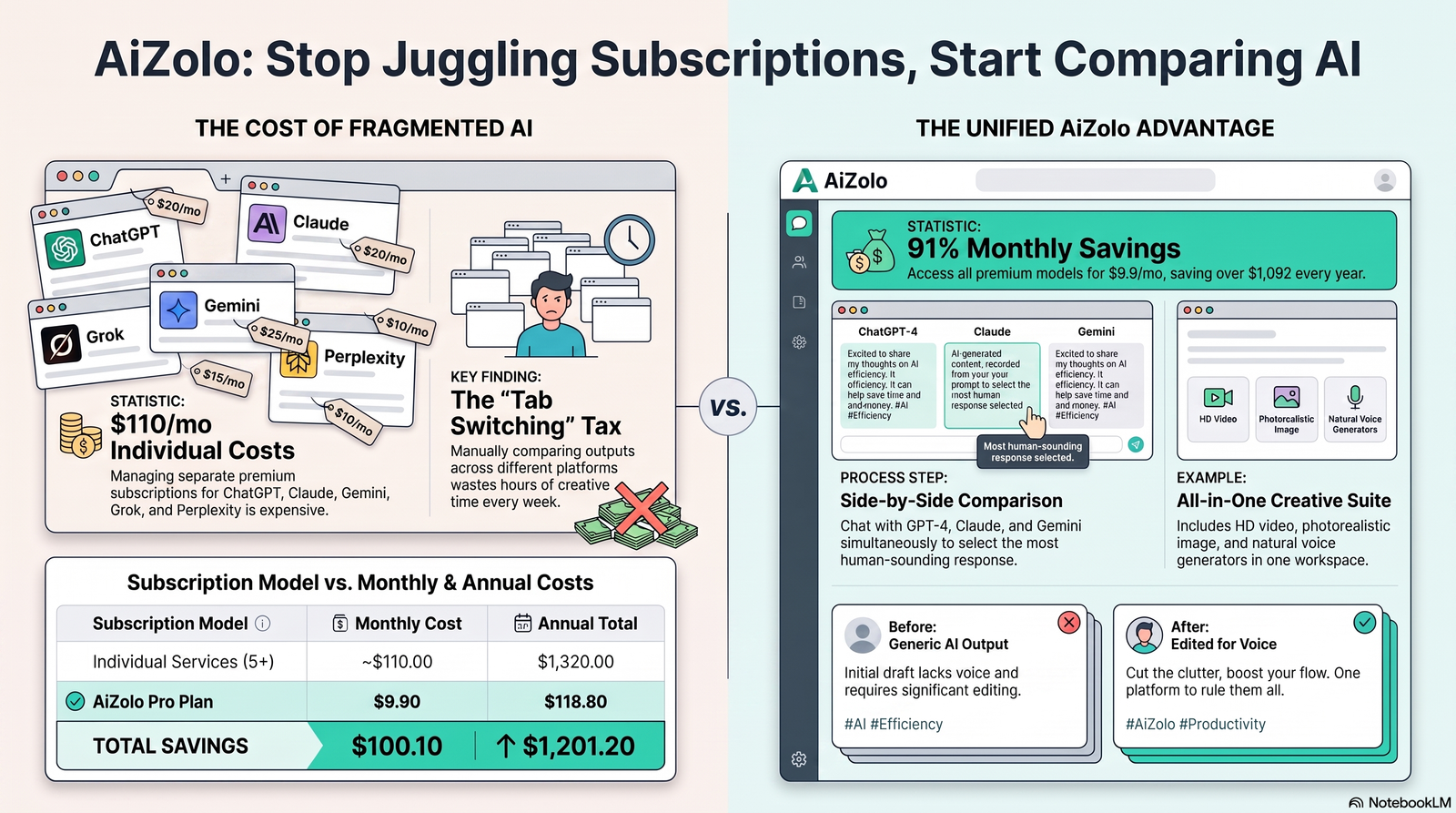
For teams managing this workflow at scale — batching prompts, storing frameworks, and testing hooks against real engagement data — platforms like Aizolo are built specifically to keep AI-assisted content creation organized without turning it into another disconnected tool in the stack.
Mistakes to Avoid
- Publishing unedited AI output. It’s detectable, and audiences increasingly recognize the rhythm of un-edited AI writing.
- Chasing “viral” as the goal. Optimizing for shock value over substance erodes trust and hurts long-term following quality.
- Ignoring platform truncation limits. A hook that gets cut off mid-sentence by the “Show more” fold can kill comprehension.
- Using the same framework every time. Repetition trains your audience to recognize (and skip) your pattern.
- Overpromising in the hook. If the body doesn’t deliver, engagement — and trust — drops fast.
- Skipping the audience-specificity step. A hook written for “everyone” resonates with no one in particular.
- Treating AI output as final instead of raw material. The workflow above exists because generation and editing are two separate skills.
Warning: Repeated use of manipulative engagement-bait phrasing (e.g., “Reply if you agree”) can trigger reduced algorithmic reach under current spam-adjacent content policies. Use sparingly, if at all.
Optimization Workflow
Once you’re publishing consistently, shift from generating hooks to optimizing them using real performance data.
- Tag your hooks by framework (curiosity, contrarian, list, etc.) in a simple spreadsheet or scheduling tool.
- Track early engagement — replies and “Show more” taps in the first hour are the strongest early signal.
- Review weekly — identify which 2–3 frameworks are consistently outperforming for your specific audience.
- Feed winners back into your prompts — ask your AI tool to generate more hooks modeled structurally (not verbatim) after your top performers.
- Retire underperforming formulas rather than clinging to a framework because it worked for someone else’s account.
Expert Tip: Your top-performing hook framework is audience-specific. What works for a SaaS founder’s audience often underperforms for a lifestyle creator’s audience, even on an identical topic.
Advanced Strategies
Build a Personal “Hook Voice” Prompt
Feed the AI 10–15 of your own best-performing past tweets and ask it to identify patterns in your phrasing, rhythm, and vocabulary. Use that analysis as a standing instruction in future prompts so generated hooks start closer to your actual voice.
Batch by Content Pillar, Not by Day
Instead of generating one hook at a time, generate 20–30 hooks across your 3–4 core content pillars in a single sitting. This produces more consistent thematic coverage and reduces topic fatigue.
Use AI for Hook Testing, Not Just Generation
Ask the model to critique a hook you’ve written: “What’s weak about this hook? What would make a reader scroll past it?” This reverses the workflow and often surfaces blind spots faster than generation alone.
Combine Frameworks Deliberately
Some of the strongest hooks combine two frameworks — for example, a Mistake Confession delivered as a Data Shock: “I ignored this metric for 6 months. It was costing us 22% of signups.”
Build a Swipe File From Your Own Wins
Most creators build swipe files from other people’s tweets. A more durable approach is building one from your own historical top performers, then feeding that file back into your AI prompts as reference material.
Why this works better than external swipe files:
- It reflects language your specific audience already responds to
- It avoids the “sounds like everyone else on the timeline” problem
- It compounds — every month of posting makes the file more accurate
To build one, export your top 20–30 tweets by engagement rate (not raw likes, which skew toward follower count), and group them by the framework they used. This becomes the reference set you paste into future prompts.
Separate Ideation Sessions From Editing Sessions
Generating and editing use different mental modes, and doing both at once tends to produce weaker output in both directions. Generation benefits from volume and speed; editing benefits from slowing down and reading each hook out loud.
A practical split:
- Monday: Generate 40–60 raw hook variations across your content pillars for the week
- Tuesday–Friday: Edit and schedule 1–2 hooks per day from that batch, reading each one aloud before publishing
This separation also reduces the temptation to publish a hook the moment it’s generated, before it’s had time to be evaluated with fresh eyes.
Future Trends
- Real-time context blending — AI tools are increasingly able to reference current trending conversations, letting hooks feel timely without manual research.
- Voice-matching becoming standard — expect more AI writing tools to build persistent “voice profiles” rather than requiring voice instructions in every prompt.
- Platform-level AI assistance — X and other platforms are experimenting with native AI drafting tools, which will shift some hook generation directly into the composer.
- Tighter spam-detection around AI patterns — as more accounts publish AI-drafted content, expect platforms to refine detection of low-effort, unedited output, making the editing step in this guide even more important, not less.
Based on current platform behavior, the accounts winning with AI-assisted content aren’t the ones generating the most tweets — they’re the ones editing the hardest.
Final Thoughts
AI won’t tell you what’s true, what’s funny, or what your specific audience actually cares about. What it will do is compress the ideation phase from twenty minutes down to two, so you can spend the time you save on the part machines still can’t do: judgment.
Use the frameworks. Use the prompts. But treat every AI-generated hook as a first draft, not a finished product — that single habit separates creators who build real audiences from accounts that plateau at generic engagement.
FAQ
1. Can AI actually write viral tweets on its own? No. AI can generate strong first-draft hooks quickly, but virality depends on timing, audience relationship, and editing that only a human can reliably provide.
2. What’s the best AI tool for generating Twitter hooks? General-purpose models like Claude or ChatGPT, used with a detailed, framework-based prompt, typically outperform narrow “hook generator” tools.
3. How many hook variations should I generate per tweet? Most experienced creators generate 15–25 variations, then narrow down to 1–2 strong finalists after editing.
4. Is it against Twitter’s rules to use AI for writing tweets? No. X does not prohibit AI-assisted drafting; issues only arise with spam behavior, engagement manipulation, or misleading automation, not AI use itself.
5. Why do my AI-generated hooks sound generic? Vague prompts produce generic output. Specify audience, tone, framework, and constraints to get usable variations.
6. Should I ever use AI hooks word-for-word? Rarely. Editing for voice and specificity is the step most responsible for actual performance gains.
7. What’s the ideal hook length for Twitter/X? Short enough to display fully before truncation — generally under 100 characters for the opening line, though this varies by device and settings.
8. How do I know which hook framework fits my niche? Test 3–4 frameworks over several weeks and track early engagement by category; your specific audience will show a clear pattern.
9. Can AI help me analyze which of my past tweets performed best? Yes — feeding your top tweets into an AI model and asking it to identify structural patterns is a highly effective advanced strategy.
10. Does using emojis in hooks help or hurt performance? It depends heavily on niche and audience; B2B and thought-leadership accounts often perform better without them, while lifestyle accounts may see the opposite.
11. How often should I refresh my hook frameworks? Rotate frameworks regularly — audiences that see identical structures repeatedly begin to recognize and skip the pattern.
12. Is a “viral” hook always the goal? Not necessarily. Consistent, trust-building engagement from a smaller relevant audience often outperforms one viral spike with low follow-through.
Conclusion
Learning how to use AI for generating viral hooks on Twitter comes down to one core shift: stop asking AI to write your tweet, and start asking it to expand your options. Give it a real framework, a specific audience, and a clear constraint — then do the human work of choosing, editing, and publishing only what actually sounds like you.
That combination — AI-speed ideation plus human-level editing — is what separates accounts that occasionally get lucky from accounts that build real, compounding reach.
Recommended External References
| Anchor Text | Official Website | Why Link Here | Suggested Placement |
|---|---|---|---|
| X Developer Documentation | https://developer.x.com | Authoritative source on platform behavior and API rules | “Why Hooks Determine Tweet Performance” section |
| Google Search Central | https://developers.google.com/search | Reference for Helpful Content and E-E-A-T guidance | Introduction or methodology note |
| OpenAI | https://openai.com | Reference for LLM capabilities discussed in “How AI Generates Hooks” | “How AI Generates Hooks” section |
| Anthropic | https://www.anthropic.com | Reference for Claude’s role in AI-assisted writing | “Best AI Tools Compared” section |
| Buffer | https://buffer.com | Reference for scheduling/testing workflow | “Optimization Workflow” section |
| Hootsuite | https://www.hootsuite.com | Reference for analytics and scheduling tools | “Best AI Tools Compared” section |
Author Bio
Jeevesh Tripathi Email: jeevesh@aizolo.com
Jeevesh Tripathi writes about AI, SEO, and automation, with a focus on turning AI tools into practical, repeatable content workflows. His work centers on helping marketers and founders move past generic AI output and build systems — like the one in this guide — that produce genuinely audience-specific results.