
If your team ships anything with an LLM in it, you’ve probably watched a bill triple in a single quarter without anyone changing the product. That’s not a billing mistake.
It’s what happens when every request — a one-line classification, a full customer support reply, or a 40-page document summary — gets routed to the same expensive model by default. Aizolo helps solve this by intelligently routing requests to the most cost-effective AI model.
This guide is a practical, engineering-first breakdown of how to reduce AI API costs using a multi-model AI platform: what actually drives token spend up, how model routing works under the hood, and the specific levers (caching, batching, prompt design, monitoring) that cut real production bills by 40–70% without touching output quality.
Savings vary by workload — a support bot behaves very differently from a coding agent — so every recommendation below comes with the conditions under which it actually pays off.
Table of Contents
What Makes AI API Costs So Expensive?
Three things compound quietly: token volume, model choice, and retry waste.
Most teams start with a single flagship model because it’s the safest default during prototyping. That’s reasonable for a demo.
It’s expensive in production, because flagship reasoning models often cost 10–25x more per token than a smaller model that would have handled 80% of the same requests just as well.
A classification call, an intent check, or a short FAQ answer doesn’t need frontier-level reasoning — but if every request hits the same endpoint, every request pays the frontier price.
Retries and errors add a second layer of waste. A malformed JSON response, a dropped connection, or a hallucinated tool call often triggers a full re-generation, doubling the token spend for that request without anyone noticing on the invoice line.
The third driver is architecture, not model choice: long system prompts sent on every call, no caching, no batching, and no visibility into which endpoint, customer, or feature is actually driving the spend. Teams that can’t answer “which product feature costs us the most in tokens” can’t optimize it either.
Understanding Tokens and Pricing
A token is roughly three-quarters of a word in English — shorter for common words, longer for rare ones, code, or non-Latin scripts.
Providers bill separately for input tokens (what you send) and output tokens (what the model generates), and output almost always costs more — often 4–6x the input rate, because generation is more compute-intensive than reading.
Context window size matters for a different reason: it’s not what you’re billed on per token, but it does determine how much history, retrieved context, or document text you can stuff into a single call before you start truncating — and every token of that context gets billed on every request, even if 90% of it is a static system prompt repeated verbatim.
Two features change the token math significantly. Prompt caching lets a provider store a frequently repeated prefix (system instructions, few-shot examples, a knowledge base chunk) and charge a fraction of the standard input rate on subsequent calls — commonly a 90% discount on cache hits.
Batch processing defers non-urgent requests to run asynchronously, typically at roughly half the standard per-token price, in exchange for slower turnaround.
Pricing changes often. Every major provider has revised its rate card multiple times in 2026 alone, and new model tiers launch every few months. Treat any specific number in this guide as illustrative, and always confirm current rates on the provider’s official pricing page before budgeting.
Single Model vs Multi-Model Platforms
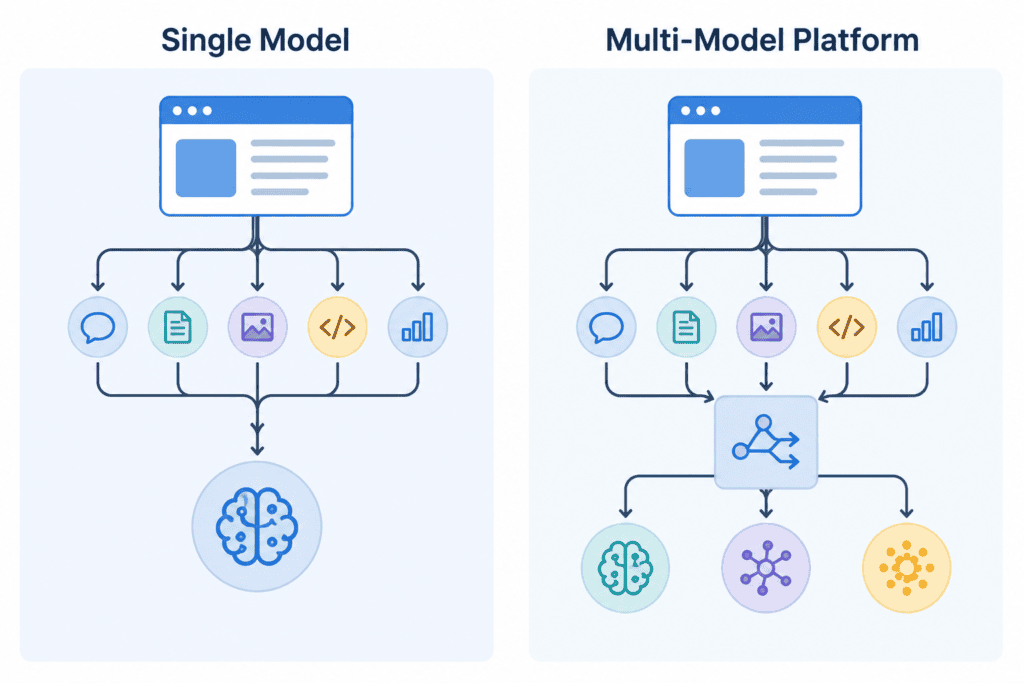
A single-model setup sends every request type — simple and complex — to one API. It’s the fastest way to ship, and it’s fine at low volume. The problem shows up at scale: you’re paying premium-tier rates for tasks a cheaper model handles just as accurately.
A multi-model platform sits between your application and multiple provider APIs (OpenAI, Anthropic, Google, DeepSeek, open-weight models via a host like OpenRouter or Together) and picks the right model per request based on task complexity, latency needs, and cost ceiling.
Think of it as a compiler for inference: your application describes what it needs, and the platform decides which model actually runs it.
| Approach | Cost Predictability | Engineering Effort | Best Fit |
|---|---|---|---|
| Single model, one provider | Low — bill scales linearly with all traffic at one rate | Minimal | Early prototypes, low volume, simple products |
| Manual multi-provider calls | Medium — you control routing but maintain it by hand | High — custom logic per endpoint | Teams with 2–3 well-understood task types |
| Multi-model AI platform | High — routing, fallback, and budgets are centrally managed | Low after setup | Products with mixed task complexity at real scale |
How Multi-Model Routing Works
At its core, model routing is a decision function: given a request, which model gives acceptable quality at the lowest cost and latency? Platforms implement this a few different ways, often combined.
Rule-based routing classifies requests by type — a support FAQ, a code generation task, a long-document summary — and maps each type to a pre-assigned model tier. It’s simple, predictable, and easy to audit, but it doesn’t adapt to requests that don’t fit a clean category.
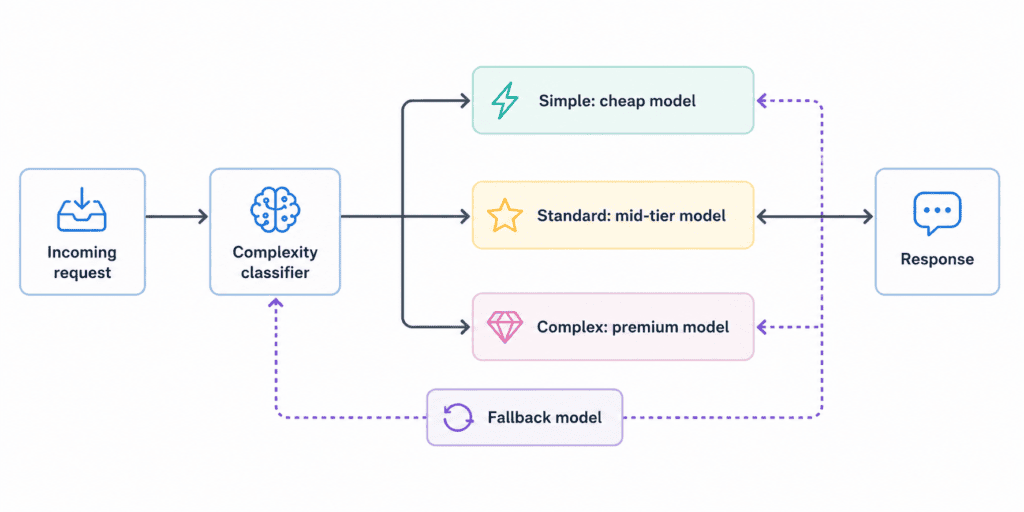
Complexity-scored routing runs a lightweight classifier (often a small, cheap model) against the incoming prompt to estimate difficulty, then routes accordingly. A one-line question gets the cheap model; a multi-step reasoning task escalates to a stronger one.
Fallback chains handle reliability as much as cost: if the primary model times out, returns malformed output, or hits a rate limit, the platform automatically retries on a secondary model rather than failing the request outright. This protects uptime without forcing you to over-provision your primary model’s capacity.
Embedding-based routing compares the incoming request against a bank of past requests with known outcomes, routing new requests toward whichever model historically performed best on similar inputs. This is more powerful but needs a feedback loop to stay accurate over time.
An API gateway sits in front of all of this, handling authentication, rate limiting, request logging, and — critically — normalizing the different request/response formats each provider uses so your application code doesn’t need a separate integration per vendor.
Ways to Reduce AI API Costs Using a Multi-Model AI Platform
This is the practical core of the guide. Each technique below can be adopted independently, but they compound — teams that combine four or five of these typically see the largest bill reductions.
Choosing the Right Model for Each Task
The single biggest lever is matching model tier to task difficulty. A rough framework that holds up across most products:
- Classification, routing, extraction, short FAQ answers: smallest/cheapest tier in a given provider’s lineup.
- General customer-facing generation, coding assistance, summarization: mid-tier “workhorse” model — usually the best cost-to-quality ratio available.
- Complex multi-step reasoning, high-stakes outputs, long-horizon agents: premium/flagship tier, used sparingly and only when the task justifies it.
A startup running a customer support bot is a good illustration. Early on, every ticket — from “what’s your refund policy” to a genuinely confusing billing dispute — got routed to a flagship model.
After introducing a router that sent simple, high-confidence intents to a smaller model and escalated only ambiguous or emotionally charged tickets to the flagship tier, the team cut its per-ticket cost sharply while keeping resolution quality flat, because the flagship model was still handling the tickets that actually needed it.
Prompt Optimization Strategies
Shorter, more structured prompts cost less and often perform better. Cutting boilerplate instructions, removing redundant examples, and using compact formats (like a short system prompt plus structured user input, rather than a long narrative prompt) reduces input tokens on every single call — which matters because input tokens are usually the majority of total volume in production traffic.
Few-shot examples are useful but expensive if repeated in full on every request; move stable examples into a cached prefix instead of inline text.
Reducing Token Usage
Beyond prompt trimming, three habits reduce output token waste specifically: capping max_tokens to a realistic ceiling for the task, asking for structured output (JSON, short-form) instead of open-ended prose when a rigid schema will do, and stopping generation early with stop sequences once the answer is complete rather than letting the model run past the useful content.
Caching AI Responses
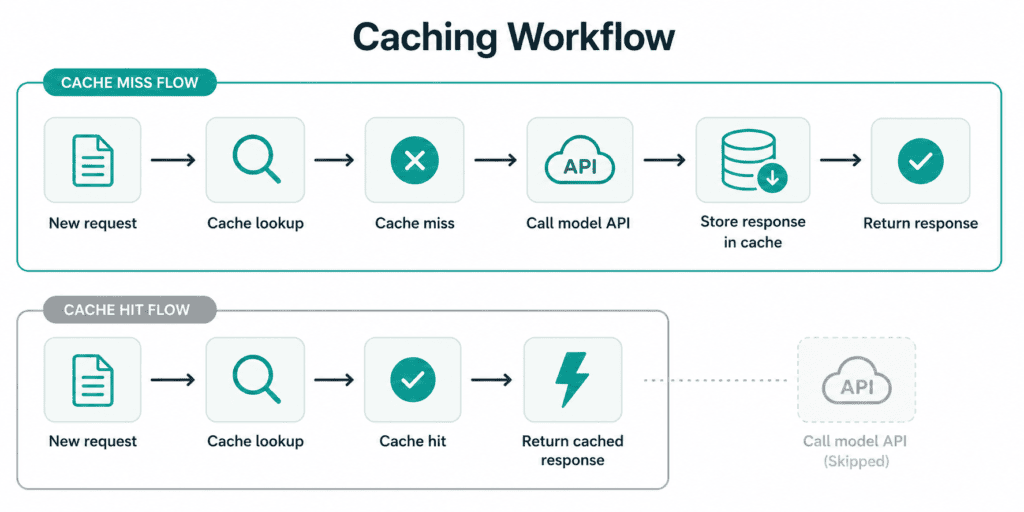
There are two distinct caching layers worth separating. Prompt caching (provider-side) discounts repeated input prefixes, as covered earlier.
Response caching (application-side) stores the full output for identical or near-identical requests — a genuinely repeated FAQ answer, for instance — so the request never reaches the model API at all.
For high-repetition workloads like documentation bots or common support questions, response caching alone can eliminate a meaningful share of total calls.
Batch Processing Requests
Not every request needs a sub-second response. Nightly report generation, bulk content tagging, dataset labeling, and other non-interactive workloads are strong candidates for batch APIs, which typically run at roughly half the real-time rate in exchange for completing within a longer window (often minutes to a few hours rather than instantly).
Sorting requests into “needs an immediate response” and “can wait” is a one-time engineering decision that pays off continuously.
Monitoring API Spending
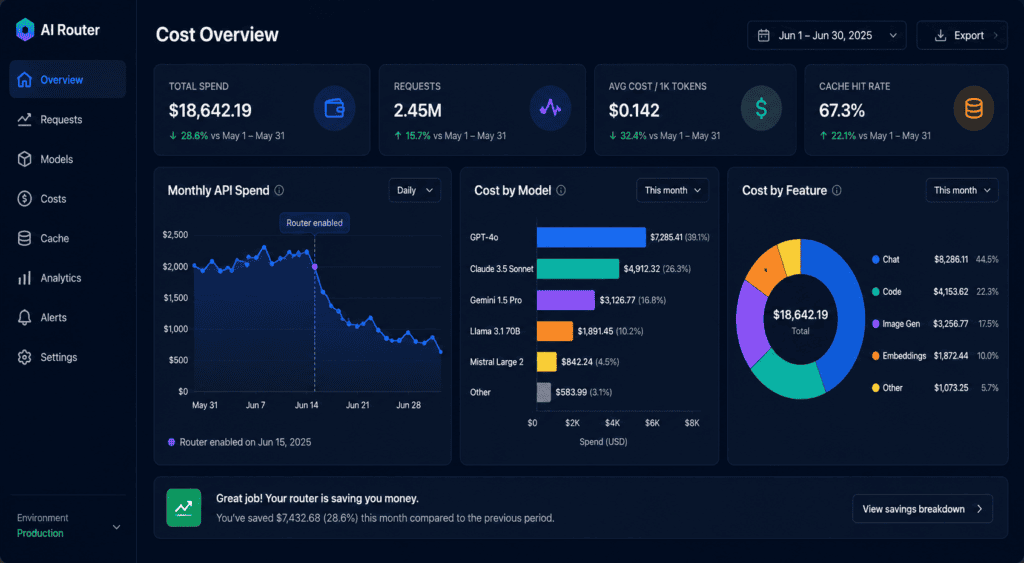
You can’t optimize what you can’t see. Effective monitoring means tracking cost per model, per feature, per customer, and per request type — not just a single monthly total.
This is where dashboards like the ones OpenRouter, Helicone, LangSmith, or TrueFoundry provide become genuinely useful: they let you spot, for example, that one specific feature is silently responsible for 40% of spend, or that a routing rule stopped firing correctly after a deploy.
Comparing OpenAI, Claude, Gemini, DeepSeek and Other Models
Every major provider now ships a tiered lineup — a cheap/fast tier, a balanced mid-tier, and a premium reasoning tier — which is exactly what makes multi-model routing effective: you can match tiers across vendors rather than being locked into one provider’s price ladder.
OpenAI’s lineup spans from sub-$1-per-million-token nano/mini models up to premium flagship pricing an order of magnitude higher, with batch and cached-input discounts available across most tiers. Anthropic’s Claude lineup follows a similar shape — a low-cost Haiku tier, a mid-tier Sonnet model most teams use as their production default, and a premium Opus tier for the hardest reasoning and agentic work, with cached input typically discounted around 90% off standard rates.
Google’s Gemini lineup adds a genuinely useful twist: even its cheapest Flash-Lite tier ships the same large context window as its premium Pro tier, which matters for long-document workloads on a budget. DeepSeek and other open-weight models, often accessed through aggregators, tend to sit meaningfully below the closed-model providers on price, at the cost of narrower tool-use and multimodal support in some cases.
None of this is static. Rate cards shift every few months, new model generations arrive, and older versions get discounted or deprecated. Multi-model platforms and pricing aggregators exist largely to absorb that churn so your application code doesn’t have to change every time a provider updates its pricing page.
Cost Comparison Table
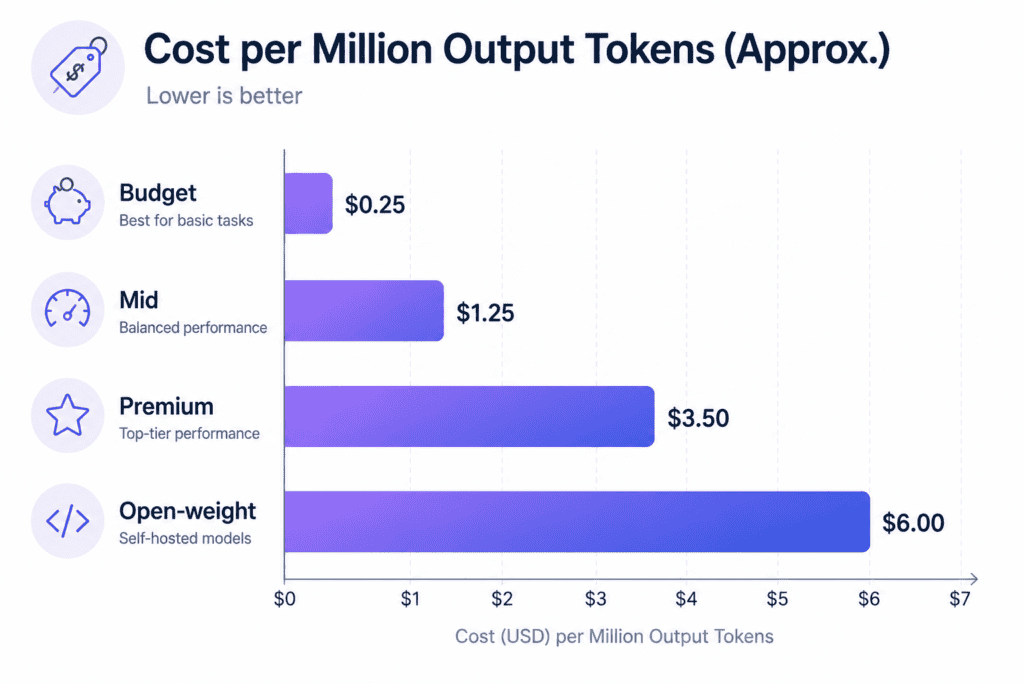
Figures below are illustrative, standard-tier, per-million-token rates as commonly published by third-party pricing trackers in mid-2026. Always verify current numbers on each provider’s official pricing page before budgeting — every row here is subject to change.
| Model Tier | Best For | Approx. Input / Output (per 1M tokens) | Speed | Quality |
|---|---|---|---|---|
| Budget tier (e.g., GPT nano/mini, Gemini Flash-Lite, Claude Haiku) | Classification, extraction, routing, short FAQs | ~$0.10–$1.00 / $0.40–$5.00 | Fastest | Good for narrow, well-defined tasks |
| Mid tier (e.g., GPT mid-tier, Gemini Flash, Claude Sonnet) | General generation, coding help, summarization | ~$1–$3 / $6–$15 | Fast | Strong price-to-quality balance |
| Premium tier (e.g., GPT flagship, Gemini Pro, Claude Opus) | Complex reasoning, agentic workflows, high-stakes output | ~$2–$5 / $10–$30 | Slower | Highest available quality |
| Open-weight (e.g., DeepSeek-class models via an aggregator) | High-volume, cost-sensitive workloads | Often below closed-model budget tiers | Varies by host | Competitive on many text tasks |
Real Business Examples
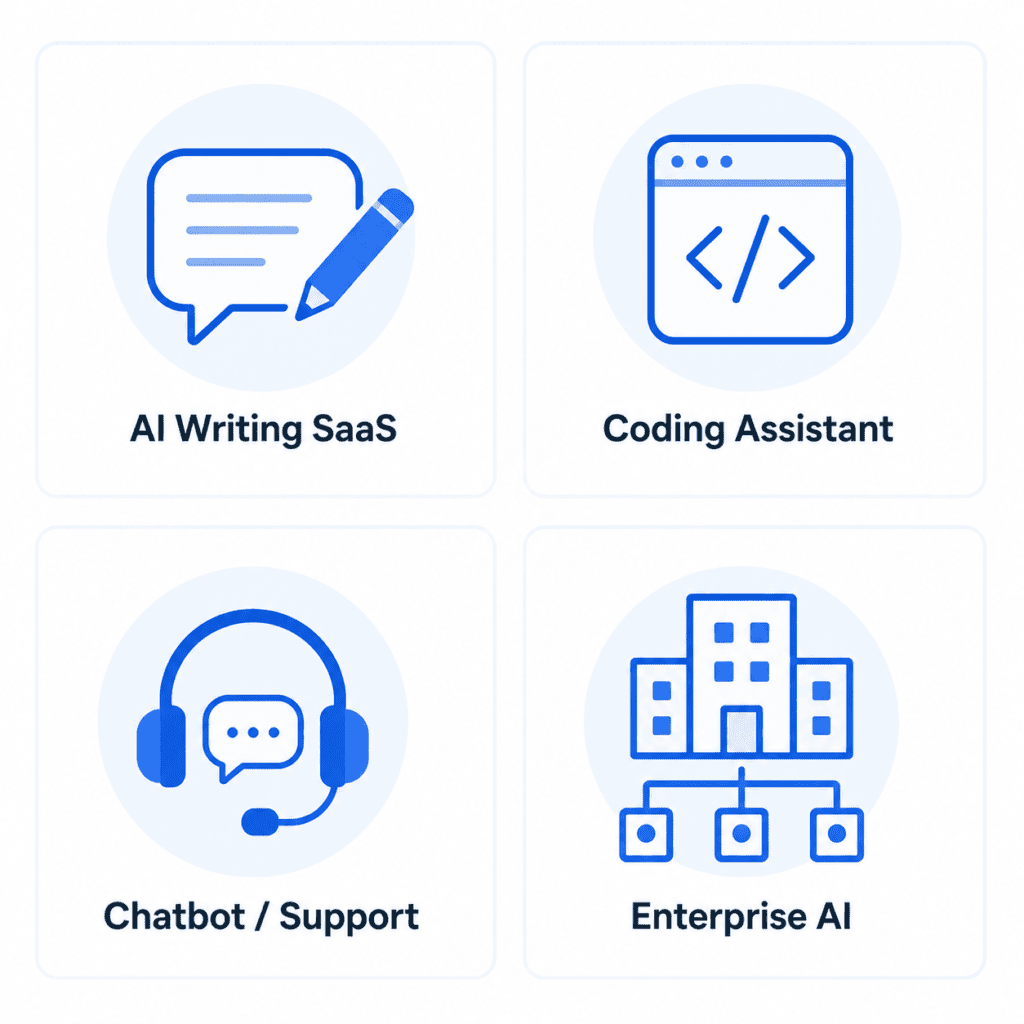
AI writing SaaS. A content-generation product routed every draft — from a one-paragraph product blurb to a 2,000-word article — through the same premium model.
After introducing length- and complexity-based routing, short-form requests moved to a mid-tier model with no measurable quality complaints, while long-form and brand-voice-sensitive drafts stayed on the premium tier. The team reported meaningfully lower per-generation cost within the first billing cycle.
Coding assistant. An engineering tools startup found that most inline code completions were short, low-risk suggestions, while a minority of requests were full function generation or multi-file refactors.
Splitting these into two tiers — fast/cheap for completions, premium for generation and refactors — cut the assistant’s inference bill while keeping the latency of everyday completions low, which mattered more to users than raw model quality for that specific interaction.
AI chatbot / workflow automation. A mid-size support operation combined three techniques at once: response caching for its top 200 recurring questions, batch processing for end-of-day ticket summarization, and a router that only escalated to a premium model when sentiment analysis flagged a frustrated customer.
Together, these compounded into a substantially lower blended cost per resolved ticket than any single technique alone would have achieved.
Enterprise AI deployment. A larger organization running AI across multiple internal tools centralized routing and monitoring through a single gateway rather than letting each team integrate providers independently.
The main win wasn’t a specific optimization technique — it was visibility: finance could finally see spend by team and feature, which made it possible to hold each team accountable for its own AI budget instead of treating the whole bill as one opaque line item.
Actual savings depend heavily on traffic mix, how aggressively you’re willing to route down in quality, and how much engineering time you invest in caching and monitoring — a team that only swaps its default model will see smaller gains than one that also implements caching, batching, and per-feature tracking.
Common Mistakes That Increase API Costs
- Defaulting every request to the flagship model “to be safe,” even for tasks a cheaper model handles identically.
- No
max_tokensceiling, letting the model run longer than the task requires. - Repeating a full system prompt and examples on every call instead of caching the stable portion.
- No retry limit, so a single failure mode can silently multiply cost across thousands of requests before anyone notices.
- Treating batch-eligible workloads as real-time, paying the real-time premium for reports or bulk jobs that could run overnight.
- Monitoring only the total monthly bill, with no breakdown by model, feature, or customer — which makes the actual source of cost growth invisible until it’s a crisis.
- Skipping fallback logic, so a rate limit or outage on the primary model causes failed requests instead of a graceful, if slightly more expensive, fallback.
Best Practices
- Start every new feature with the cheapest model that could plausibly work, and only escalate the tier if evaluation shows a real quality gap.
- Cache anything that repeats — prompts, retrieved context, and full responses where appropriate.
- Route by task type first, then refine with complexity scoring once you have real traffic data.
- Set hard per-feature and per-customer budget alerts, not just an account-level spend cap.
- Re-evaluate your model assignments quarterly — pricing and model quality both shift fast enough that a routing decision from six months ago may no longer be optimal.
- Keep a documented fallback chain for every production endpoint so a single provider’s outage doesn’t become your outage.
Future of AI API Cost Optimization
A few directions look durable rather than trendy. First, routing is getting more automated: instead of engineers hand-writing rules, more platforms are using learned routers that predict, per request, which model will produce an acceptable result at the lowest cost — closer to how a compiler picks optimization passes than to a static if/else chain.
Second, pricing itself is trending toward more granular, usage-shaped discounts — caching, batching, and volume tiers are becoming standard rather than premium features, which rewards teams that build for them early.
Third, open-weight models hosted through aggregators are narrowing the capability gap with closed frontier models on many everyday tasks, which gives cost-conscious teams a wider bench to route across. None of this removes the need for monitoring — if anything, more routing options make visibility into where money actually goes more important, not less.
Frequently Asked Questions
What is a multi-model AI platform? A multi-model AI platform is a layer between your application and multiple LLM providers that automatically selects which model handles each request based on task complexity, cost, and latency requirements, rather than sending every call to a single fixed model.
How much can multi-model routing actually save on AI API costs? Savings vary widely by workload, but teams combining routing with caching and batching commonly report cost reductions in the 40–70% range compared to sending all traffic to one flagship model. Results depend on your specific traffic mix and how aggressively you route down in quality.
Does switching to cheaper models hurt output quality? Not necessarily, if routing is done by task difficulty rather than blanket cost-cutting. Simple, well-defined tasks often show no measurable quality difference on a smaller model; the key is evaluating quality per task type before rolling routing out broadly.
What’s the difference between prompt caching and response caching? Prompt caching is a provider-side feature that discounts repeated input prefixes on the same model. Response caching is an application-side technique that stores entire outputs for identical or near-identical requests, avoiding a model call altogether on a cache hit.
Is batch processing worth it for a small startup? Yes, for any workload that doesn’t need an instant response — nightly reports, bulk tagging, offline summarization. Batch APIs commonly run at roughly half the real-time rate, and the setup effort is usually a single integration change.
Which provider is cheapest for AI APIs? There’s no single answer — every major provider (OpenAI, Anthropic, Google, DeepSeek and others) ships multiple tiers, and the cheapest option depends on the specific task, context length, and whether you’re using caching or batch pricing. Compare tiers, not just providers.
How do I know which tasks need a premium model? Run a small evaluation: send a sample of real requests to both a cheaper and a premium model, and score the outputs against your actual quality bar. Tasks with no meaningful quality gap are candidates for downgrading; tasks with a clear gap justify the premium tier.
Do I need an API gateway to do model routing? Not strictly, but it makes routing, fallback, and monitoring far easier to maintain than hand-written per-endpoint logic, especially once you’re calling more than two providers.
How often should I re-check my model routing setup? At least quarterly. Provider pricing and model quality both change frequently enough that a routing configuration can quietly become outdated well before anyone notices in the product.
Can multi-model routing introduce reliability risks? It can if fallback logic isn’t handled carefully — routing to an unfamiliar model without validating its output format can cause new failure modes. A well-built platform validates responses and has a defined fallback chain rather than routing blindly.
Final Thoughts
Reducing AI API costs isn’t a one-time model swap — it’s an ongoing discipline built on matching model tier to task difficulty, cutting wasted tokens through prompt design and caching, moving non-urgent work to batch processing, and keeping enough visibility into spend to catch problems before they become a surprise invoice.
A multi-model AI platform makes all of this practical to maintain at scale, but the underlying principles apply even with a lean, hand-rolled setup. Start with your highest-volume request type, measure what a cheaper model actually costs you in quality, and build outward from there.
Author Bio
Jeevesh Tripathi AI Researcher & SEO Content Strategist Email: jeevesh@aizolo.com
Jeevesh Tripathi researches AI infrastructure and API economics, with hands-on experience helping engineering teams cut LLM spend through model routing, caching, and monitoring strategy. His work sits at the intersection of applied AI systems and content strategy, focused on translating fast-moving provider pricing and platform changes into practical, implementable guidance for developers and technical decision-makers.