Introduction
Choosing between Claude Haiku 4.5 vs Gemini 3 Flash is one of the most common decisions facing developers building fast, high-volume AI products in 2026.
Both models sit at the “fast tier” of their respective families. Both were built for latency-sensitive, high-throughput workloads. And both claim near-frontier intelligence at a fraction of flagship pricing.
But they are not interchangeable. Aizolo makes it easier to compare Anthropic’s Claude Haiku 4.5 and Google’s Gemini 3 Flash, which make very different trade-offs in context window, pricing structure, multimodal input, and agentic tool use.
This guide compares them using officially published specifications from Anthropic and Google, independent benchmark data from Artificial Analysis and OpenRouter, and practical deployment notes for developers, startups, and enterprise teams. Every claim below is sourced — where data was unavailable or unverified, we say so rather than guessing.
Table of Contents
Quick Verdict
If you need the short answer before the deep dive:
- Choose Claude Haiku 4.5 if your workload is coding-heavy, agentic (sub-agents, computer use, tool orchestration), or you’re already inside the Anthropic/Claude Code ecosystem.
- Choose Gemini 3 Flash if you need a large context window (1M tokens), native multimodal input (video, audio, PDF), or the lowest possible input-token cost.
- Both are viable production defaults for chat, support, and summarization at scale — the deciding factor is usually context size and existing platform investment (Bedrock/Vertex/first-party API).
Note: This comparison covers the previous-generation Gemini 3 Flash (Dec 2025). For the current-generation comparison against Gemini 3.6 Flash, see our full 2026 Gemini 3.6 Flash vs Claude 4.5 Haiku guide.
TL;DR Comparison Table
| Attribute | Claude Haiku 4.5 | Gemini 3 Flash |
|---|---|---|
| Developer | Anthropic | Google DeepMind |
| Release date | October 15, 2025 | December 17, 2025 |
| Context window | 200,000 tokens | 1,048,576 tokens |
| Max output tokens | 64,000 | 65,535 |
| Input price (per 1M tokens) | $1.00 | $0.50 |
| Output price (per 1M tokens) | $5.00 | $3.00 |
| SWE-bench Verified | 73.3% | 78% |
| Modalities | Text, image | Text, image, audio, video, PDF |
| Extended/adjustable reasoning | Yes (extended thinking) | Yes (thinking levels: minimal/low/medium/high) |
| Availability | Claude API, Claude Code, Bedrock, Vertex AI, Microsoft Foundry | Google AI Studio, Vertex AI, Gemini CLI |
Claude Haiku 4.5 Overview
Claude Haiku 4.5 is Anthropic’s fastest and most cost-efficient current-generation model, released October 15, 2025. Anthropic positions it as a drop-in replacement for both the older Haiku 3.5 and the mid-tier Sonnet 4, at a much lower price point.
The headline claim from Anthropic is that Haiku 4.5 matches Claude Sonnet 4‘s performance on reasoning, coding, and computer-use tasks, while running with the latency and cost profile of a small model. It scores 73.3% on SWE-bench Verified, a widely used benchmark for real-world software engineering agent capability — a score competitive with several much larger models.
Haiku 4.5 also introduced extended thinking to the Haiku line for the first time, giving developers controllable reasoning depth, summarized or interleaved thought output, and tool-assisted workflows that support bash, coding, web search, and computer-use tools natively.
Key specs:
- 200,000-token context window
- Up to 64,000 output tokens
- $1.00 / $5.00 per million input/output tokens
- Model ID:
claude-haiku-4-5-20251001(aliasclaude-haiku-4-5) - Available via the Claude API, Claude Code, Amazon Bedrock, Google Cloud Vertex AI, and Microsoft Foundry
Gemini 3 Flash Overview
Gemini 3 Flash launched December 17, 2025 as Google’s high-speed, high-value “thinking” model, designed for agentic workflows, multi-turn chat, and coding assistance. Google’s stated goal was to deliver near-Pro-level reasoning and tool use with substantially lower latency than the larger Gemini 3 Pro model.
The most notable result from Google’s own announcement and independent write-ups: Gemini 3 Flash scored 78% on SWE-bench Verified, actually outperforming the larger Gemini 3 Pro (76.2%) on the same benchmark — an unusual case of a distilled “fast” model beating its own flagship on agentic coding.
Gemini 3 Flash also posted strong reasoning and knowledge scores, including 90.4% on GPQA Diamond and 81.2% on MMMU Pro, roughly matching Gemini 3 Pro’s multimodal performance while running considerably faster.
Key specs:
- 1,048,576-token context window (1M tokens)
- Up to 65,535 output tokens
- $0.50 / $3.00 per million input/output tokens
- Native multimodal input: text, images, audio, video, and PDFs
- Configurable “thinking levels”: minimal, low, medium, high
- Automatic context caching
- Available via Google AI Studio, Vertex AI, and Gemini CLI
Note on model freshness: Google shipped a successor, Gemini 3.6 Flash, on May 19, 2026, at $1.50/$9.00 per million tokens with a higher Artificial Analysis Intelligence Index score. If you’re evaluating models today, check out our full Gemini 3.6 Flash vs Claude 4.5 Haiku comparison for the current-generation breakdown, including updated pricing, benchmarks, and multimodal capabilities.
Feature Comparison Table
| Feature | Claude Haiku 4.5 | Gemini 3 Flash |
|---|---|---|
| Text generation | Yes | Yes |
| Image input | Yes | Yes |
| Video input | No | Yes |
| Audio input | No | Yes |
| PDF/document input | Yes (via document upload) | Yes (native) |
| Tool use / function calling | Yes | Yes |
| Computer use | Yes | Limited/agent-framework dependent |
| Adjustable reasoning depth | Yes (extended thinking) | Yes (thinking levels) |
| Prompt caching | Yes, up to 90% savings | Yes, automatic context caching |
| Batch API discount | Yes, 50% | Provider-dependent |
Pricing Comparison
| Model | Input (per 1M tokens) | Output (per 1M tokens) | Blended cost ratio |
|---|---|---|---|
| Claude Haiku 4.5 | $1.00 | $5.00 | 5:1 output-to-input |
| Gemini 3 Flash | $0.50 | $3.00 | 6:1 output-to-input |
On raw list price, Gemini 3 Flash is cheaper on both input and output tokens. For workloads dominated by short prompts and long generations — like content drafting or code generation — that gap compounds quickly.
Claude Haiku 4.5’s pricing is partly offset by Anthropic‘s prompt caching, which cuts repeated-context input costs by up to 90%, and batch processing, which adds a further 50% discount for non-real-time jobs. Gemini 3 Flash also supports automatic context caching, though savings vary by provider and region.
API Cost Analysis
For a rough monthly estimate, assume a customer support bot processing 50 million input tokens and 10 million output tokens per month:
| Model | Input cost | Output cost | Total monthly cost |
|---|---|---|---|
| Claude Haiku 4.5 | $50 | $50 | $100 |
| Gemini 3 Flash | $25 | $30 | $55 |
This is a list-price estimate before caching, batching, or regional pricing adjustments — actual costs will vary significantly based on your caching hit rate and whether you use batch processing. Always model your own token distribution before committing to a provider.
Performance Benchmarks
Independent benchmark aggregation (Artificial Analysis, BenchLM, OpenRouter) gives a mixed picture rather than a clean winner:
| Benchmark | Claude Haiku 4.5 | Gemini 3 Flash |
|---|---|---|
| SWE-bench Verified (agentic coding) | 73.3% | 78% |
| GPQA Diamond (graduate-level reasoning) | 64.6% | 90.4% |
| MMLU Pro | 80.0% | Not independently confirmed |
| MMMU Pro (multimodal) | Not disclosed | 81.2% |
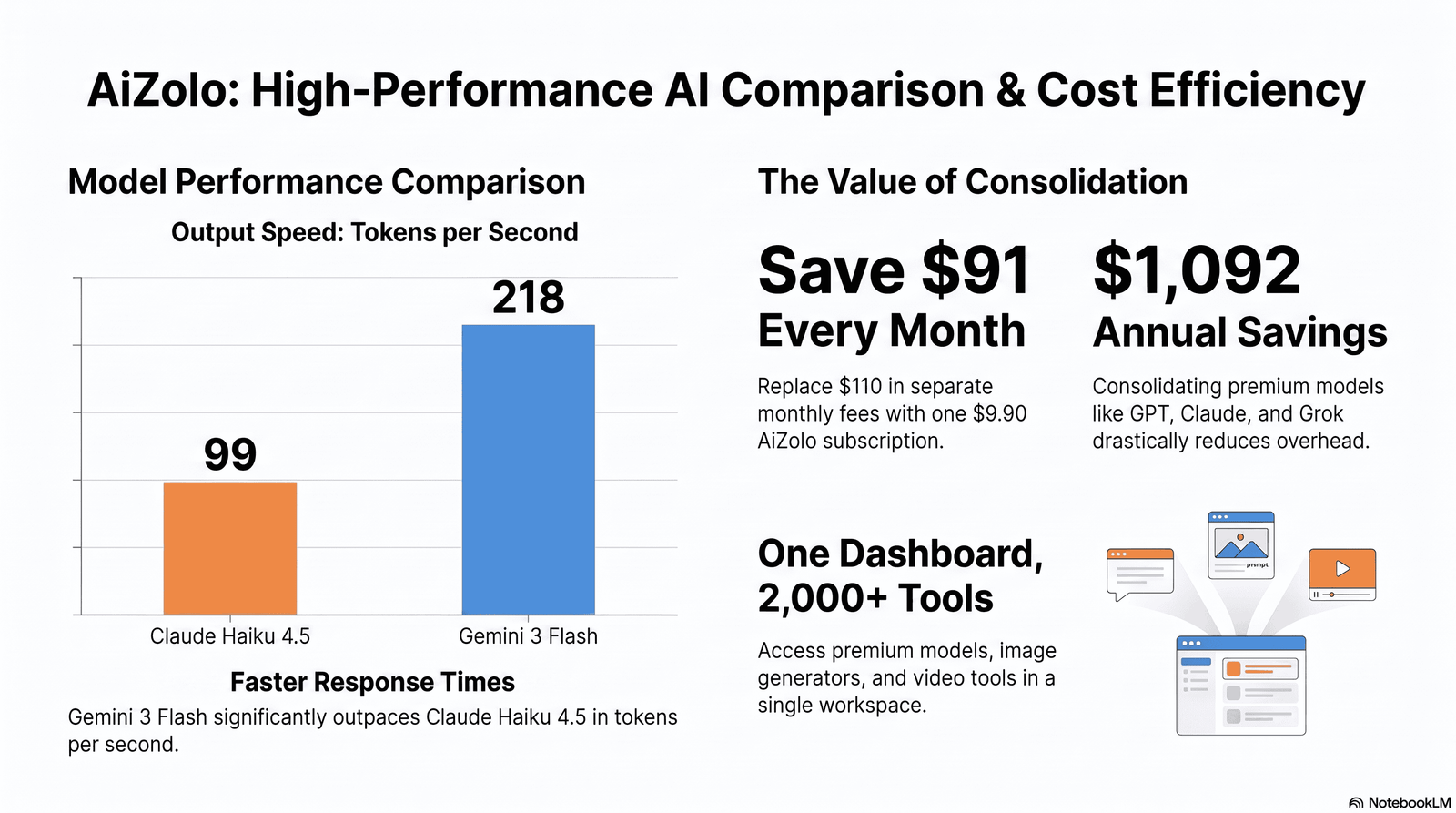
| Output speed | ~99 tokens/sec | ~218 tokens/sec (reported by third-party testers) |
| Time to first token | ~0.80s | Faster in most third-party latency tests |
Important caveat: benchmark numbers come from a mix of official vendor announcements and third-party aggregators, which don’t always use identical scaffolds, tool access, or sampling settings. Treat cross-vendor benchmark comparisons directionally, not as exact apples-to-apples science.
Coding Performance
Coding is where this comparison gets interesting. Anthropic has built its Haiku line specifically around coding and agentic workflows, and Haiku 4.5 scores 73.3% on SWE-bench Verified using a minimal bash-and-file-edit scaffold, with reports of it reaching roughly 90% of Sonnet 4.5’s performance on Augment’s agentic coding evaluation.
Gemini 3 Flash, however, posted a higher SWE-bench Verified score (78%), notably beating its own larger sibling, Gemini 3 Pro (76.2%). Third-party reviewers have called this “an inversion” — a distilled fast model outperforming the flagship it was distilled from — and attribute it to targeted optimization of coding-specific reasoning paths during training.
Practical takeaway: Gemini 3 Flash currently posts the higher published coding benchmark score, but Claude Haiku 4.5 has stronger native integration with agentic developer tools like Claude Code, sub-agent orchestration, and computer-use tooling — which matters as much as raw benchmark score for real engineering workflows.
Writing Quality
Neither Anthropic nor Google publishes a standardized “writing quality” benchmark, so this section relies on structural capability comparison rather than a numeric score — treat it as directional, not definitive.
Claude models, including the Haiku line, are generally regarded by developers as producing less repetitive, more naturally structured prose with fewer robotic transitions, which is why Claude is a common choice for long-form content generation and editing assistants.
Gemini 3 Flash’s writing quality benefits from its “thinking levels” setting — pushing reasoning effort to “high” tends to produce more coherent long-form output, at the cost of speed and token usage. Independent reviewers have also flagged that Gemini 3 Flash can run notably verbose relative to peers at similar price points, which affects output-token cost.
Reasoning
Gemini 3 Flash posts strong reasoning numbers for a “fast tier” model: 90.4% on GPQA Diamond and 33.7% on Humanity’s Last Exam without tools, both reported directly by Google. These scores are unusually high for a distilled, latency-optimized model and reportedly rival some larger frontier models.
Claude Haiku 4.5‘s GPQA score (64.6%, per third-party benchmark tracking) trails Gemini 3 Flash on this specific test, though Anthropic emphasizes that Haiku 4.5’s reasoning strength shows up most clearly in agentic and tool-augmented tasks rather than closed-book academic benchmarks.
Math
Neither vendor has published a dedicated, head-to-head math benchmark suitable for direct comparison at the time of writing. Third-party tracking places Claude Haiku 4.5’s math benchmark score around 39.0 (42nd percentile among tracked models), while comparable Gemini Flash-tier math scores were not consistently reported across sources during our research. Treat any math-specific comparison claims with caution until both vendors publish matched benchmark methodology.
Long Context
This is the single clearest differentiator between the two models.
- Claude Haiku 4.5: 200,000-token context window
- Gemini 3 Flash: 1,048,576-token context window (roughly 5x larger)
For workloads involving full codebase analysis, long legal or financial documents, or extended multi-turn agent memory, Gemini 3 Flash’s context ceiling is a meaningful structural advantage. Real-world deployments — including document-heavy finance and banking pilots reported for the successor Gemini 3.6 Flash — specifically leverage the million-token window for processing 100+ page documents in a single call.
If your application needs to exceed 200K tokens per request without chunking or retrieval workarounds, Gemini 3 Flash is the more natural fit.
Image Understanding
Both models accept image input. Gemini 3 Flash extends further into native video and audio understanding, plus PDF input, without requiring separate preprocessing pipelines — Google reports MMMU Pro (multimodal reasoning) scores of 81.2%, matching the larger Gemini 3 Pro.
Claude Haiku 4.5 supports image input for document and screenshot understanding, particularly well suited to computer-use and agentic UI-navigation tasks, but does not natively process video or audio.
Function Calling & Tool Use
Both models support structured function calling and tool use, which is standard for any 2026-era production model. The practical difference is ecosystem depth:
- Claude Haiku 4.5 has full support for coding, bash, web search, and computer-use tools, and is positioned by Anthropic specifically for sub-agent orchestration inside multi-agent systems (via Claude Code and the Claude API’s agent tooling).
- Gemini 3 Flash integrates tightly with Google’s own agentic surfaces — Gemini CLI, Antigravity, and Vertex AI — and is used in third-party coding agents such as Cursor, Cline, and JetBrains AI Assistant.
Neither is objectively “better” at tool use in isolation; the right choice depends on which agent framework and cloud ecosystem you’re already standardized on.
Agent Workflows
Both vendors explicitly market their fast-tier model for agentic workloads, but frame it differently:
- Anthropic frames Haiku 4.5 around sub-agent orchestration — running many fast, cheap agents underneath a more capable orchestrator model, useful for large refactors, migrations, and parallel task execution.
- Google frames Gemini 3 Flash around long-running agent loops — leveraging the 1M context window to maintain state across extended multi-turn agent sessions without aggressive summarization.
If your architecture is “one smart orchestrator, many fast workers,” Haiku 4.5’s design intent lines up well. If your architecture is “one long-lived agent with a huge working memory,” Gemini 3 Flash’s context window is the better structural fit.
Latency & Speed Tests
Third-party throughput testing (via OpenRouter and independent benchmark trackers) reports:
| Metric | Claude Haiku 4.5 | Gemini 3 Flash |
|---|---|---|
| Output tokens/second | ~99 | ~218 (per independent developer testing) |
| Time to first token | ~0.80s | Reported as faster in several third-party tests |
Gemini 3 Flash is consistently reported as the faster raw-throughput model in independent developer benchmarks, which — combined with its lower per-token price — is a major part of its appeal for high-frequency, latency-sensitive applications like terminal coding assistants and real-time chat.
For a deeper breakdown of time-to-first-token, output speed, and perceived responsiveness across six separate speed tests, see our full Claude Haiku 4.5 vs Gemini Flash 3.6 speed comparison.
Accuracy Tests & Hallucination Analysis
Accuracy and hallucination behavior are the hardest metrics to compare fairly, since methodologies differ across evaluators. A few sourced data points worth noting:
- Gemini 3 Flash scored 72.1% on SimpleQA Verified, a closed-book factual accuracy benchmark, according to independent review coverage — described as validating the model is reasonably grounded, though “slightly behind the absolute frontier of factual precision.”
- One independent developer write-up flagged a notably high hallucination rate for Gemini 3 Flash relative to Gemini 3 Pro, alongside a caveat that it uses roughly double the tokens of the older Gemini 2.5 Flash for equivalent tasks — worth validating against your own eval set before production deployment.
- Anthropic has not published a directly comparable SimpleQA-style hallucination score for Haiku 4.5 in its official materials; independent benchmark trackers show a lower overall “Intelligence Index” knowledge-percentile ranking for Haiku 4.5 relative to Gemini 3 Flash, but methodology and question sets differ between trackers.
Bottom line: run your own hallucination eval on your specific data before trusting either vendor’s aggregate score for a high-stakes use case — this is one of the areas where third-party claims varied most across our research.
Enterprise Readiness
Both models are available through major enterprise cloud channels:
- Claude Haiku 4.5: Claude API, Amazon Bedrock, Google Cloud Vertex AI, and Microsoft Foundry — giving enterprise buyers flexibility to deploy inside an existing AWS, GCP, or Azure security and billing boundary.
- Gemini 3 Flash: Google AI Studio and Vertex AI, with tiered enterprise SLAs reported for finance-sector pilots processing large document sets.
The fact that Claude Haiku 4.5 is available on Vertex AI (Google’s own cloud) as well as Bedrock and Azure-adjacent Foundry gives Anthropic unusually broad multi-cloud reach for an enterprise procurement team that wants vendor flexibility without re-architecting.
Security & Privacy
Both Anthropic and Google publish standard enterprise data-handling commitments (no training on API inputs by default, regional data residency options, SOC 2-type compliance documentation) through their respective platform documentation.
Because these terms are updated periodically and vary by deployment channel (first-party API vs. Bedrock vs. Vertex vs. Azure), always verify current terms directly on Anthropic’s and Google’s official trust and compliance pages before finalizing a procurement decision — do not rely on third-party summaries for legal or compliance sign-off.
Best Use Cases
| Use Case | Better Fit | Why |
|---|---|---|
| High-volume customer support chat | Either | Both are fast and inexpensive enough for free-tier deployment |
| Long-document analysis (100+ pages) | Gemini 3 Flash | 1M token context avoids chunking |
| Agentic coding / sub-agent orchestration | Claude Haiku 4.5 | Deeper Claude Code / computer-use integration |
| Video or audio understanding | Gemini 3 Flash | Native multimodal input |
| Cost-sensitive, token-heavy pipelines | Gemini 3 Flash | Lower list price on both input and output |
| Multi-cloud enterprise deployment | Claude Haiku 4.5 | Available on Bedrock, Vertex, and Foundry |
| Real-time coding assistants in terminals/IDEs | Gemini 3 Flash | Higher reported throughput |
Developer Experience
Claude Haiku 4.5 developers generally report a smoother experience for agent scaffolding since it shares tooling conventions with the larger Claude models and Claude Code — switching between Haiku and Sonnet tiers requires minimal prompt or scaffold changes.
Gemini 3 Flash developers benefit from the “thinking levels” parameter, which offers explicit, dial-able control over the cost/latency/quality trade-off per request — useful for applications that need to shift between “fast and cheap” and “slow and careful” dynamically within the same product.
Pros & Cons
Claude Haiku 4.5
Pros:
- Strong agentic coding and computer-use integration
- Broad multi-cloud availability (Bedrock, Vertex, Foundry)
- Predictable 5:1 output-to-input pricing ratio shared across the whole Claude lineup
- Extended thinking support for controllable reasoning depth
Cons:
- Smaller 200K context window vs. Gemini’s 1M
- No native video/audio input
- Higher per-token price than Gemini 3 Flash
Gemini 3 Flash
Pros:
- 1M token context window
- Lower input and output pricing
- Native video, audio, and PDF understanding
- Higher reported raw throughput
Cons:
- Reports of elevated hallucination rate relative to Gemini 3 Pro
- Already superseded by Gemini 3.6 Flash as of May 2026, which may affect long-term support and comparison relevance
- Narrower enterprise cloud availability than Claude Haiku 4.5
Which Model Should You Choose?
Work through these questions in order:
- Do you need more than 200K tokens of context in a single request? If yes, Gemini 3 Flash’s 1M window is the deciding factor — stop here.
- Is your workload primarily agentic coding with sub-agents, computer use, or terminal-based tooling? If yes, Claude Haiku 4.5’s tighter Claude Code integration is likely the stronger fit.
- Do you need native video or audio understanding without a separate preprocessing step? If yes, choose Gemini 3 Flash.
- Is raw per-token cost the primary constraint at your volume? If yes, Gemini 3 Flash’s list pricing is lower on both input and output.
- Are you already standardized on a specific cloud (Bedrock, Azure, or Vertex)? Claude Haiku 4.5 is available across all three; Gemini 3 Flash is Google-cloud-native.
For most greenfield teams building latency-sensitive, moderate-context applications, either model is a defensible default — the decision usually comes down to context window needs and existing cloud/tooling investment rather than a clear overall “winner.”
Frequently Asked Questions
Is Claude Haiku 4.5 cheaper than Gemini 3 Flash? No. Gemini 3 Flash is cheaper on both input ($0.50 vs $1.00 per million tokens) and output ($3.00 vs $5.00 per million tokens) at list price.
Which model has a bigger context window, Claude Haiku 4.5 or Gemini 3 Flash? Gemini 3 Flash, with a 1,048,576-token context window versus Claude Haiku 4.5’s 200,000 tokens.
Which model scores higher on SWE-bench Verified? Gemini 3 Flash scores 78% on SWE-bench Verified, compared to Claude Haiku 4.5’s 73.3%, based on official vendor-reported figures.
Does Claude Haiku 4.5 support video input? No. Claude Haiku 4.5 supports text and image input but not native video or audio understanding, unlike Gemini 3 Flash.
Is Gemini 3 Flash still the newest fast-tier Gemini model? No. Google released Gemini 3.6 Flash on May 19, 2026, as a successor, priced at $1.50/$9.00 per million tokens with improved benchmark scores.
Can I use Claude Haiku 4.5 on Google Cloud? Yes. Claude Haiku 4.5 is available on Google Cloud’s Vertex AI in addition to the Claude API, Amazon Bedrock, and Microsoft Foundry.
Which model is faster, Claude Haiku 4.5 or Gemini 3 Flash? Independent throughput testing reports Gemini 3 Flash generating output tokens roughly twice as fast as Claude Haiku 4.5, though exact figures vary by provider and load conditions.
Does Claude Haiku 4.5 support extended thinking? Yes. Haiku 4.5 introduced extended thinking to the Haiku line, offering controllable reasoning depth with summarized or interleaved thought output.
What is Gemini 3 Flash’s hallucination rate? Independent reviewers have reported an elevated hallucination rate for Gemini 3 Flash relative to Gemini 3 Pro; Google has not published a single official hallucination benchmark figure for direct comparison, so this should be validated on your own data.
Is Claude Haiku 4.5 good for coding? Yes. It scores 73.3% on SWE-bench Verified and is reported to reach around 90% of Claude Sonnet 4.5’s performance on agentic coding evaluations, according to Anthropic and third-party partners.
Which model is better for enterprise deployment? Claude Haiku 4.5 has broader multi-cloud availability (Bedrock, Vertex AI, Microsoft Foundry), which may matter more than raw benchmark scores for enterprise procurement flexibility.
Does Gemini 3 Flash support prompt caching? Yes, Gemini 3 Flash includes automatic context caching, though the exact discount structure varies by provider and region.
Can Gemini 3 Flash process PDF documents natively? Yes. Gemini 3 Flash accepts PDF input natively as part of its multimodal capabilities, alongside text, image, audio, and video.
Which model is better for real-time chat applications? Both are viable; Gemini 3 Flash’s lower list price and higher reported throughput make it attractive for high-frequency real-time chat, while Claude Haiku 4.5’s tool-use depth suits chat products that also need agentic actions.
Is there a newer version of Claude Haiku available? As of this writing, Claude Haiku 4.5 (released October 2025) is Anthropic’s current fast-tier model; check Anthropic’s official model page for the latest release before deploying, since model lineups update frequently.
Final Verdict
Claude Haiku 4.5 vs Gemini 3 Flash ultimately comes down to two questions: how much context do you need, and what ecosystem are you already building in.
Gemini 3 Flash wins on raw specs that are easy to point to — a 1M token context window, lower per-token pricing, native multimodal input, and a higher published SWE-bench score. For cost-sensitive, high-context, multimodal workloads, it’s a strong default.
Claude Haiku 4.5 wins on ecosystem depth — tighter agentic tooling, broader multi-cloud availability, and a design philosophy built specifically around sub-agent orchestration. For teams already invested in Claude Code or multi-cloud enterprise deployment, it remains the more natural choice.
Neither model is a universal winner. Test both against your own workload and your own accuracy benchmarks before committing — vendor-reported numbers are a starting point, not a guarantee.
Author Bio
Jeevesh Tripathi AI Researcher & Technical Content Specialist Email: jeevesh@aizolo.com
Jeevesh Tripathi is an AI researcher and technical content specialist focused on evaluating large language models for real-world developer and enterprise use. His work centers on model benchmarking, API pricing analysis, and practical deployment guidance across the Anthropic, Google, and OpenAI ecosystems.
He writes evidence-based comparisons grounded in official documentation and independent benchmark data, with an emphasis on transparency about what current evaluations can and cannot tell developers. Jeevesh regularly tracks model releases, pricing changes, and benchmark updates to keep technical buyers informed as the fast-moving AI landscape evolves. His analysis prioritizes practical decision-making over hype, helping teams choose the right model for their specific workload rather than the model with the loudest launch announcement.