Table of Contents
AI can create research that appears authoritative but contains fabricated facts, incorrect statistics, nonexistent articles, misleading citations, out-of-date information, or unsubstantiated assertions. Fluent writing can mask errors, especially when presented confidently by an AI.
The safest approach is not to ask one AI model for an answer and trust it. Instead, develop a verification workflow in which the AI creates a draft, multiple other models challenge the work, reliable sources are identified and verified, citations are confirmed, and significant assertions are evaluated by a human.
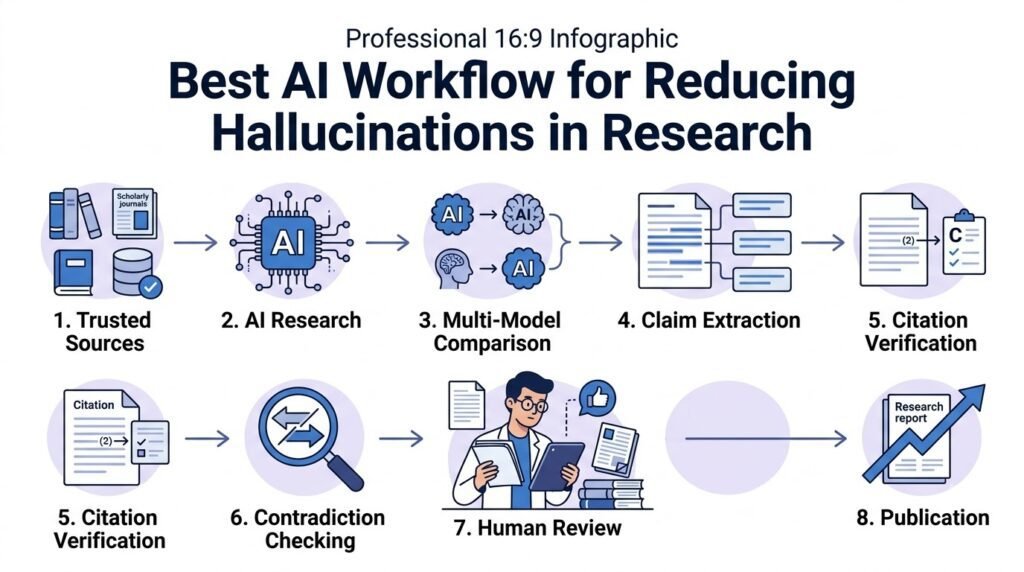
The best AI workflow for reducing hallucinations in research is a layered process that combines source-grounded research, multi-model comparison, citation verification, and human review. Each step is designed to target different types of misinformation.
Source-based research prevents unsubstantiated claims, cross-referencing diverse AI models can expose fabrication, citation verification ensures that there are actual sources for each statement made in a source material, and finally, human evaluation is what makes sure that context, quality, and high-impact statements are properly verified prior to publishing a research article.
This process does not prevent hallucination entirely, but it significantly reduces its impact on the research paper before it is published for the general audience.
Why AI Hallucinations Are a Problem in Research
What Is an AI Hallucination?
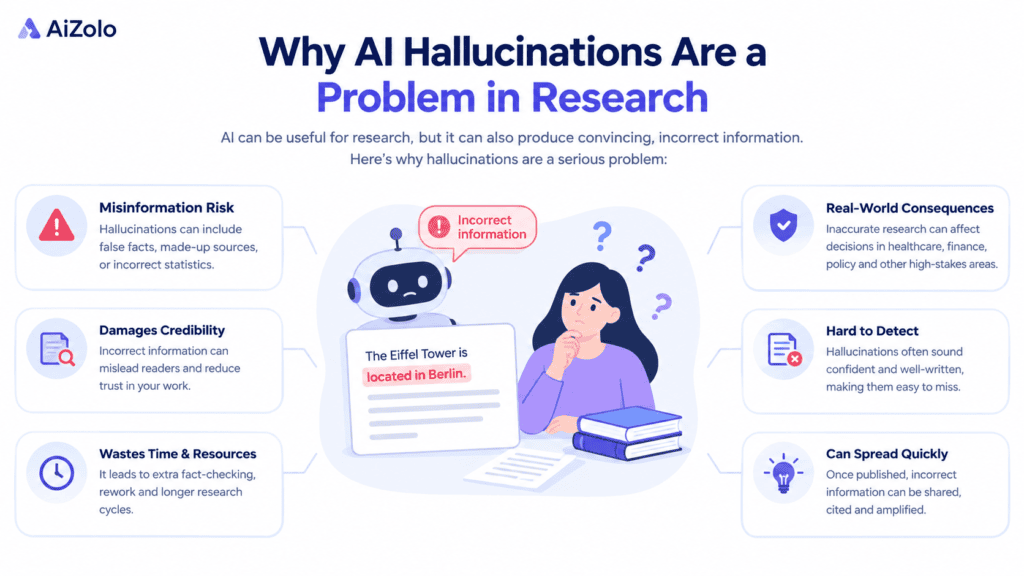
An AI hallucination is defined as information appearing to be true but, in reality, is false, unsubstantiated, misleading, or fabricated. The model isn’t malfunctioning in the usual sense. It is producing likely-sounding text, exactly as designed.
Evidently identifies several causes:
- Prediction, not knowledge: Predictions of words are not knowledge.
- Lack of grounding: the model has no source to check itself against.
- Problematic training data: outdated or flawed data carries into answers.
- Ambiguous prompts: vague questions encourage guesswork
- Pressure to answer: the model responds even though there is no information about it.
Common AI Hallucinations in Research
Research depends on precise, traceable claims, which makes it especially exposed. Typical failures include:
- Fabricated academic papers and non-existent authors
- Fake citations and fabricated URLs
- Incorrect publication dates
- Real citations assigned to claims that the source itself does not make
- Incorrect statistics and outdated discoveries
- Misquoted researchers and misinterpreted study results
These are real-world examples. Obviously documents with fabricated citations in a government report, fake legal cases, and books that do not exist. In all, polished output included false information, and nothing in its presentation suggested a problem.
Why Fluent AI Answers Are Difficult to Fact-Check
Fluency is not evidence.
A response may be grammatically correct, thorough, and confident but completely unsubstantiated. People automatically trust something that is properly written and well phrased without having to do any research, so a nicely written paragraph that is fabricated immediately puts us at ease. False citations can be created using correct grammar, real journal titles, and realistic author names, so unless we research them, they could appear legitimate at first.
Verification also takes effort that the answer itself discourages. Checking a single claim means looking for the source, verifying that it exists, and confirming that it says what the AI claims it does. You might be tempted to skim through dozens of claims like this.
That’s why the fix isn’t “read more carefully.” It’s a repetitive process, but it can be applied to every claim that an AI makes, and each is treated as unverified until it’s been confirmed against a real-world source.
What Makes the Best AI Workflow for Reducing Hallucinations in Research?
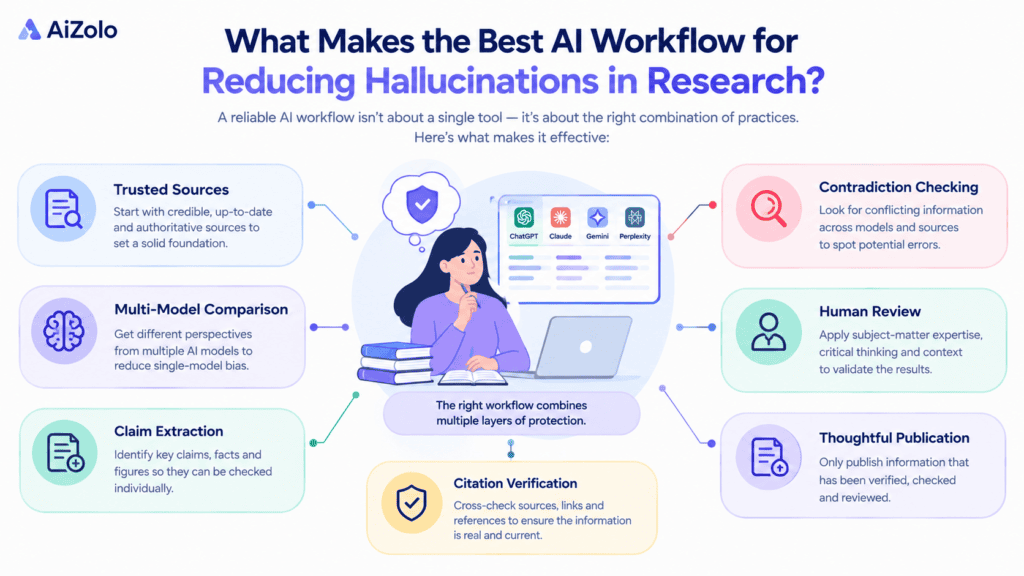
The best AI workflow to avoid hallucination does not involve a single hyper accurate model, but rather a system of checks and balances.
Forcing an AI model to gather sources, generate summaries, and then fact check itself can cause an information loop which is more prone to errors if the initial information was unreliable. An effective, high reliability workflow breaks this loop to avoid the issue.
Research question
↓
Collect trusted sources
↓
Generate answers with AI
↓
Compare multiple AI outputs
↓
Extract factual claims
↓
Verify claims against sources
↓
Check citations and statistics
↓
Resolve disagreements
↓
Human review
↓
Final publication
Why One AI Model Should Not Be Your Only Researcher
Having one single AI model perform both the tasks of generating research and checking for accuracy leaves room for conflicting incentives.
Models are optimized to generate plausible, fluid text; if a model introduces a subtle hallucination during generation, asking it “Is this accurate?” in the same thread often causes it to justify its initial error rather than catch it.
FutureAGI’s guidance highlights that overcoming this limitation requires a multi-layered framework rather than a single fix. Their recommended strategies for grounding AI models include:
- Retrieval-Augmented Generation (RAG Grounding): Anchoring outputs strictly to trusted, pre-retrieved source documentation.
- Uncertainty Handling & Refusal Scaffolds: Prompting and structuring models to explicitly state when confidence is low or to refuse answering when domain data is missing.
- Adversarial Testing & Ongoing Evaluation: Constantly stress-testing outputs with opposing prompts and benchmark suites to uncover hidden failure modes.
The Principle: Separation of Generation From Verification
In order to ensure research integrity your process must enforce a single fundamental principle:
AI Generation $\neq$ AI Verification
The model that creates a claim should never be treated as proof of that claim. Instead, best-in-class workflows assign generation to one LLM (or ensemble of LLMs) and hand off claim extraction, citation verification, and statistical checking to entirely separate verification agents or human editors. By separating drafting from auditing, hallucination rates drop exponentially.
Step 1: Start With Trusted Sources Before Asking AI
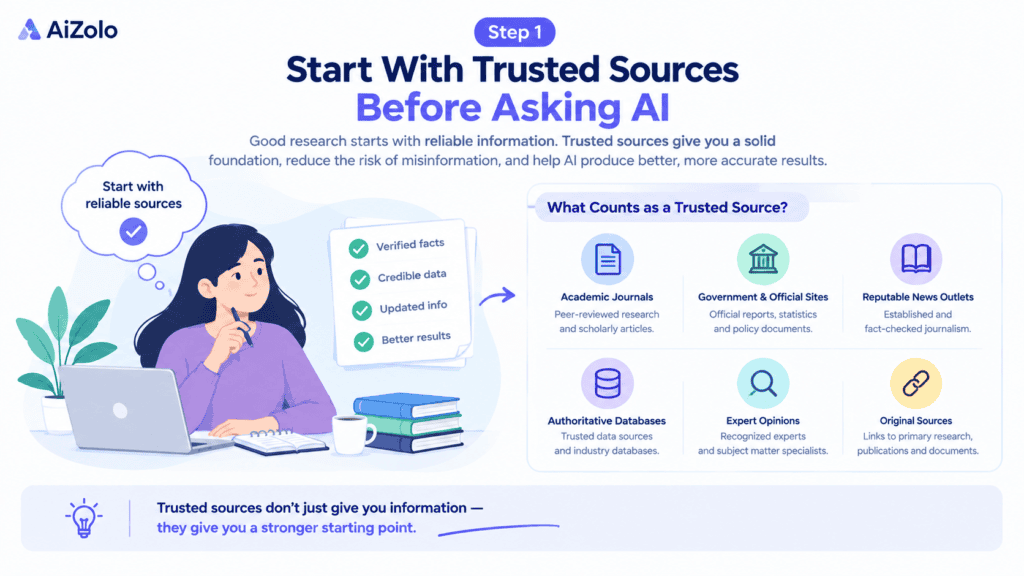
The first step in reducing hallucinations is to control the evidence that AI uses. Instead of beginning with an open-ended prompt such as “Research this topic,” start by collecting reliable sources and giving the model a defined evidence base. This shifts AI from acting as the source of information to acting as a tool for analyzing and synthesizing information.
Build a Source-First AI Research Workflow
Prioritize sources according to the type of research you are conducting:
- Primary research papers — useful for original findings, methods, and experimental results.
- Government publications — valuable for official statistics, regulations, and public data.
- Official documentation — essential for software, products, APIs, and technical specifications.
- University research — useful for academic findings and expert-led research.
- Reputable industry reports — helpful for market trends, benchmarks, and business data.
- Original datasets — provide underlying data rather than interpretations of it.
- Expert interviews — add firsthand perspectives and specialized knowledge.
- Established publications — useful for reporting, context, and independently investigated developments.
The principle is simple: AI tools should work with evidence, not be treated as the evidence. So that when the model has access to the relevant, authoritative sources, you can ask it to summarize, compare, extract claims, identify contradictions, or explain findings while the evidence is still available for verification.
Use RAG-Style Grounding to Reduce AI Hallucinations
Retrieval-augmented generation (RAG) provides a practical way to ground AI responses in external information. In contrast to using exclusively information encoded during training time, instead, the model retrieves relevant documents and uses these as context when constructing an answer.
This method allows reducing unsubstantiated claims since the system response is based on specific evidence.
Evidently encourages building AI outputs on reliable data, while FutureAGI emphasizes retrieval grounding combined with a requirement for citations as a promising approach to enhance the reliability of information.
Check Source Quality Before Giving It to AI
Source quality should be checked before the information enters your AI workflow. A weak, outdated, misleading, or incorrect source can contaminate everything that follows.
Think of the process as:
Bad source → bad context → potentially bad AI answer.
Assess the credibility of the source that provided the given information, the date of its publication or update, whether the source provides any supporting or refuting evidence, and whether the data or original research study can be retrieved.
For the most important claims, prioritize primary sources and original documents, if available, for all steps. Doing this adds reliability to each following stage, including the AI synthesis, cross-model comparisons, citation checks, and human review.
Step 2: Use Better Prompts to Reduce AI Hallucinations
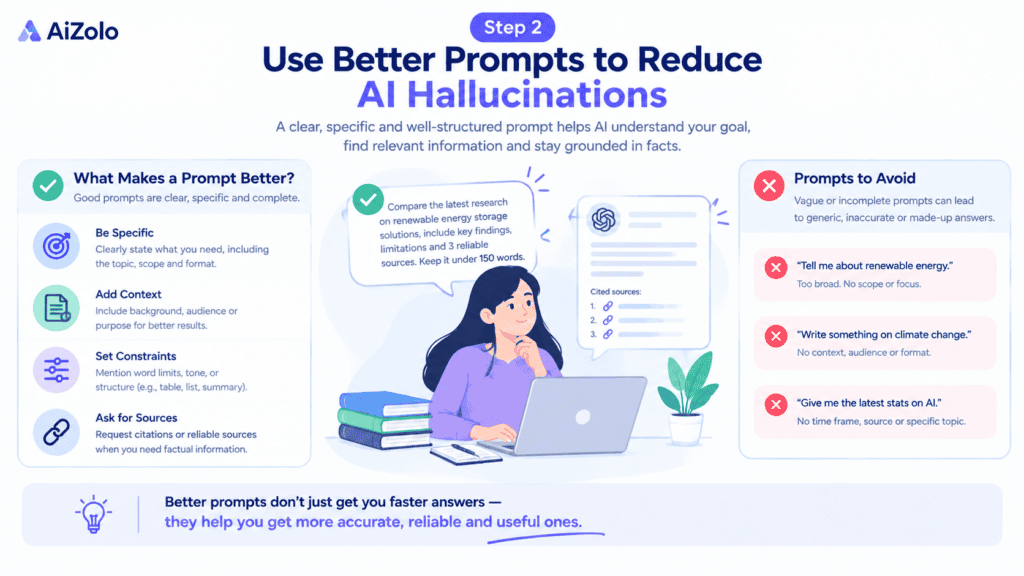
Better prompting can reduce hallucinations by clearly defining what evidence the model may use and what it should do when that evidence is incomplete. Instead of asking the AI to ‘give the most accurate answer,’ set limits to avoid unsupported assumptions in the final response.
Tell AI to Use Only the Provided Evidence
For research tasks, instruct the model to treat your sources as the evidence boundary:
“Answer using only the sources provided below. If the sources do not contain enough information to answer the question, say that the evidence is insufficient. Do not fill missing information with assumptions.”
This is what Evidently and CapeStart also advise, by telling the AI to restrict its responses to the context provided, and to identify when the documentation doesn’t contain an answer.
You can make the instruction even more specific for research:
“For every factual claim, identify the supporting source. Do not introduce facts from your general knowledge. If a claim is not supported by the provided sources, classify the claim as unverified.”
Ask AI to Separate Facts From Inference
A common hallucination problem occurs when an AI-generated interpretation is presented as though it were directly supported by a source. Prevent this by requiring a structured response:
- Verified fact: What the source explicitly states.
- Source: The document, paper, dataset, or webpage being used to justify the fact.
- Interpretation: What can reasonably be inferred from the evidence.
- Uncertainty: What is not supported, unclear, unsubstantiated, or needs additional verification.
For example, instead of asking AI to summarize a research paper, ask it to distinguish the authors’ findings from conclusions it generates itself. This would make it easier for someone to see where the evidence stops and the inference begins.
Give AI Permission to Say “I Don’t Know”
An AI model should not be forced to produce an answer when the evidence is insufficient. Add an explicit abstention instruction:
“If the provided sources do not support the answer, do not guess. State that the information could not be verified.”
This connects to the larger issue of uncertainty and abstention used to decrease the likelihood of the creation of unsupported AI outputs: when the evidence is not available, it is better to acknowledge uncertainty than to attempt to create a plausible-sounding answer.
The goal is not to make AI less useful. It is to make the model’s confidence match the available evidence.
Step 3: Compare Multiple AI Models Instead of Trusting One Answer
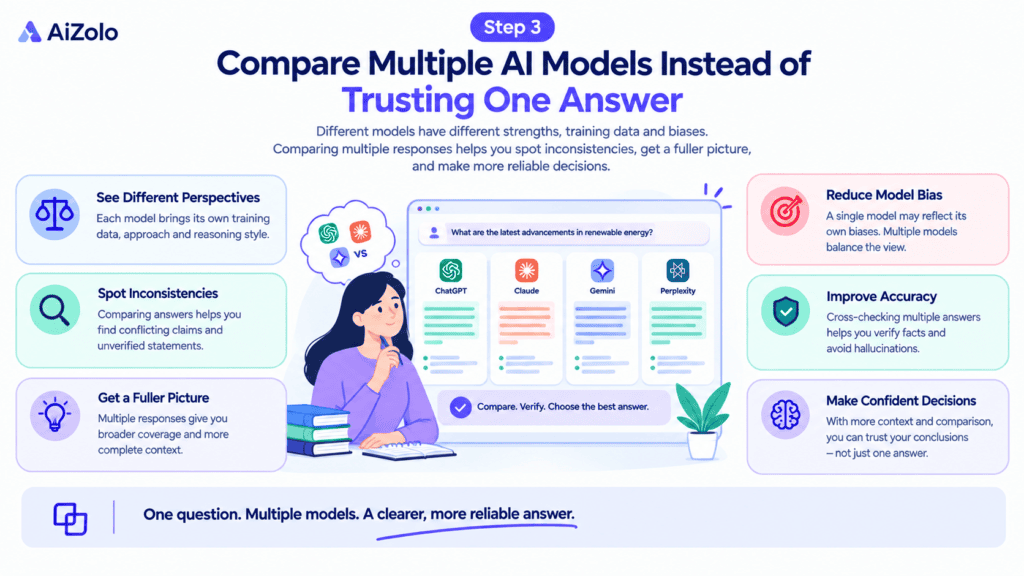
A single AI model can produce a convincing answer that contains a subtle factual error. A stronger research workflow is to ask the same question to multiple models and compare their responses before deciding what deserves verification.
Ask Multiple AI Models the Same Research Question
Instead of:
Question → Model A → Publish
use:
Question → Model A + Model B + Model C → Compare → Verify
The purpose is not to assume that the majority answer is correct. Different models could use the same training data, make the same unsupported claim, or make similar reasoning errors. Instead, use comparison to determine where further investigation is needed.
Look specifically for:
- Agreement points in the model
- Conflicting claims that require investigation
- Missing information or unanswered parts of the question
- Different interpretations of the same evidence
- Suspiciously specific claims without supporting sources
- Citations or references that need to be opened and checked
This allows the disagreement of models to be used as a research signal instead of presenting AI responses as separate votes.
Use AiZolo for Side-by-Side AI Research Comparison
When research requires checking the same question across several models, a multi-model workspace can simplify the comparison stage. AiZolo lets users send prompts to multiple AI models simultaneously and compare responses side by side in one workspace.
That can reduce the friction of copying the same research prompt between different AI tools and switching between multiple tabs. Its Smart Prompt Manager lets you save and reuse your research prompts.
In addition, the AI Memory function helps keep track of the conversation context. The platform also offers Projects, Dynamic Layout, and support for custom API keys, so you can organize your research or use your own API.
For example, you could send the same evidence-based research prompt to three models, place their answers side by side, mark conflicting claims, and then return to the original sources to verify those claims.
Don’t Treat Majority Agreement as Proof
Three AI models repeating the same incorrect claim does not make that claim true.
Multi-model agreement is a method of confidence scoring, but not a replacement for source verification.
Use model comparison to find what needs checking. Use trusted sources that verify information and conclusions. The difference is that the former presupposes a certain number of identical responses as a sign of accuracy, while the latter focuses on examining the basis of the response.
Step 4: Extract and Verify Every Important Research Claim
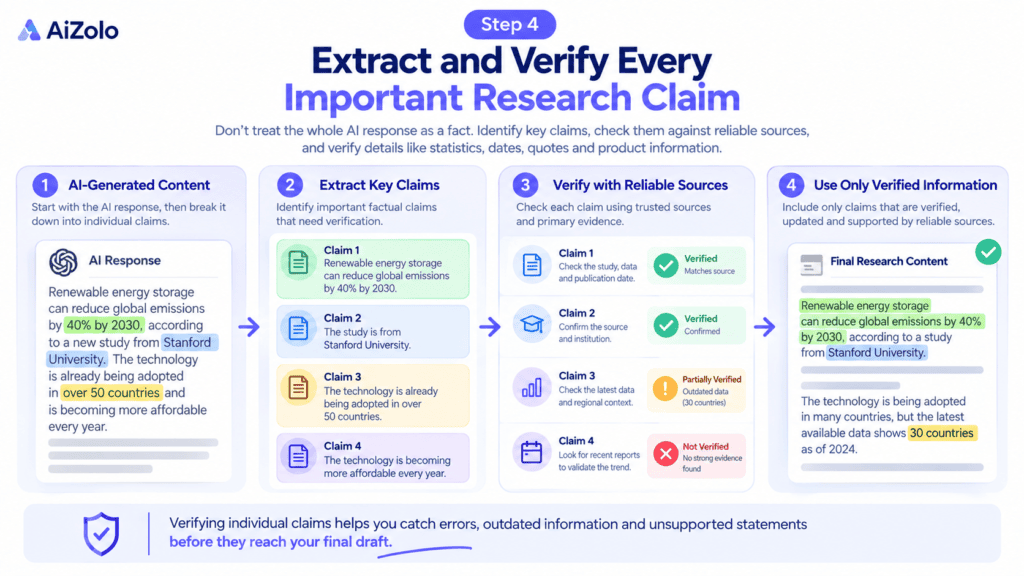
One of the most reliable ways to reduce AI hallucinations is to stop treating the generated response as a single block of information.
Breaking it down by claims and checking the significant ones against their sources can be a great way to ensure that no false information, skewed statistics, inaccurate conclusions, and incorrect citations find their way into the ultimate piece of written work.
Create a Research Claim Verification Table
After generating your research draft, extract each important factual claim into a simple verification table:
| AI-generated claim | Source | Verified? | Notes |
| Claim 1 | Source A | Yes | Directly supported |
| Claim 2 | Source B | No | Source says something different |
| Claim 3 | — | No | No reliable source found |
For each claim, instead of using the text provided with the citation, you should be opening the cited source. This way, you’ll have the possibility to access the original text and differentiate between what the model is claiming and what the source is saying.
Source-linked outputs and human reviews are valuable mechanisms to have in place because a lead or summary from AI should not be used as a replacement for the evidence itself.
Prioritize High-Risk Claims
Not every sentence needs the same level of scrutiny. Focus your strongest verification effort on claims where an error could materially change the meaning or credibility of your research.
Prioritize:
- Statistics and percentages
- Dates and timelines
- Names and identities
- Scientific findings
- Financial figures
- Medical claims
- Legal claims
- Product specifications
- Direct quotes
- Study conclusions
- Market-size and industry figures
Then you can label claims as Confirmed, Unverified, Contradicted, or Needs Review, rather than using an AI-generated confidence score. A model’s confidence does not establish that a claim is factually correct.
Check Whether the Source Actually Supports the Claim
This distinction is critical:
A real citation does not automatically make a claim true.
For example, AI might write:
“Study X found that AI improves research accuracy by 40%.”
You open Study X and discover that it actually says:
“AI improved task completion speed by 40%.”
The paper is real and the citation may be legitimate, but the AI has changed the meaning of the finding. This is a source mismatch: the cited material exists, but it does not support the specific claim generated by AI.
Therefore, citation verification should go beyond ensuring that the URL is valid.
Ask:
Does this source actually support this exact claim?
The last question can help avoid a particularly insidious type of hallucination: an accurate citation that appears to support a false or misleading statement.
Step 5: Verify AI Citations, Statistics, Dates, and Quotes
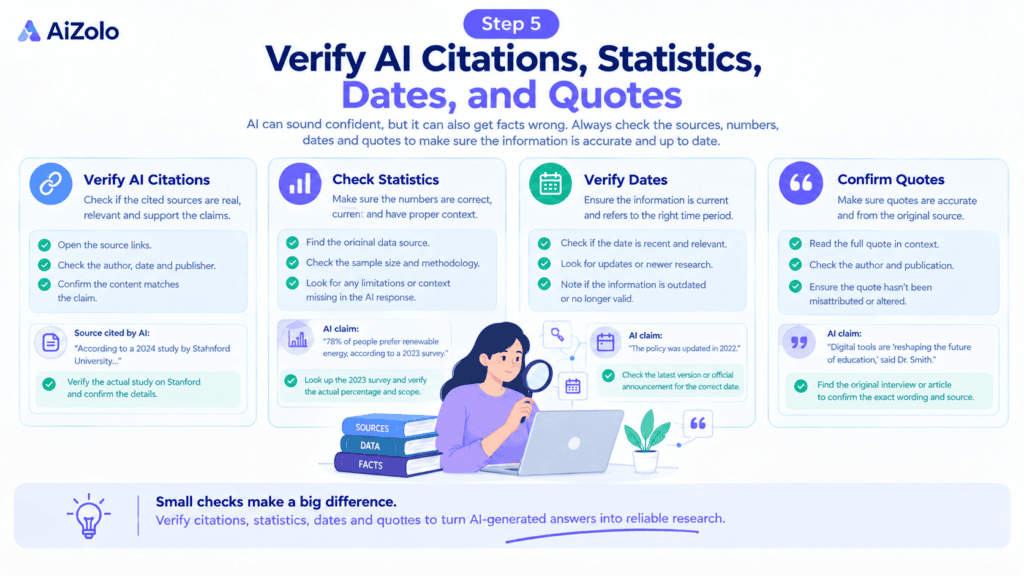
Even if an AI response has a citation, the cited material must still be checked. There is a possibility that the citation leads to an actual paper or webpage which doesn’t support the statement it was attached to.
The same goes for statistics, quotes, dates, and research findings.Verification should therefore examine both the source itself and the claim AI made from it.
How to Verify AI-Generated Citations
Use this checklist for every important citation:
- Open the citation.
- Confirm that the source actually exists.
- Check the title.
- Confirm the author or organization.
- Check the publication or update date.
- Locate the specific information referenced by AI.
- Confirm that the source actually supports the claim.
Do not stop after confirming that the link works. A functioning URL does not prove that the information attributed to it is accurate.
How to Fact-Check AI Statistics
Statistics require additional context because AI can misinterpret, combine, or change numerical information. When checking an AI-generated statistic, verify:
- Original source
- Publication date
- Sample size
- Geographic scope
- Research period
- Methodology
- Whether the number was directly reported or calculated
- Whether AI changed the wording or context
For example, a statistic that describes a set of respondents in a single country should not be reworded as if it describes the entire world. Likewise, a percentage taken from one set of data should not be automatically presented as a discovered fact from the study that contains it.
How to Verify AI-Generated Quotes
Quotes deserve especially careful verification because changing even a few words can alter someone’s meaning.
Use a simple search path:
Person → exact quote → original interview, paper, speech, transcript, or publication
Whenever possible, compare the wording of the quotation to the original source instead of a secondary article that repeats the quotation. Do not assume that quotation marks mean that the wording is authentic. The AI can generate plausible-sounding statements and attribute them incorrectly to real people.
How to Check Outdated Research
A source can be legitimate and still be unsuitable for a current claim. Research, product specifications, market figures, policies, and technical information can change over time.
For every time-sensitive claim, follow this sequence:
Publication date → latest authoritative source → current status
Compare older findings to newer research where appropriate and ensure that underlying information has been incorporated, superseded or withdrawn where appropriate. This is especially important in the case of rapidly evolving technologies, AI models, regulations, pricing and market statistics.
The goal is not simply to prove that an AI citation exists. It is to establish that the right source, right context, right date, and right wording support the claim you are publishing.
Step 6: Use a Second AI Verification Pass to Detect Hallucinations
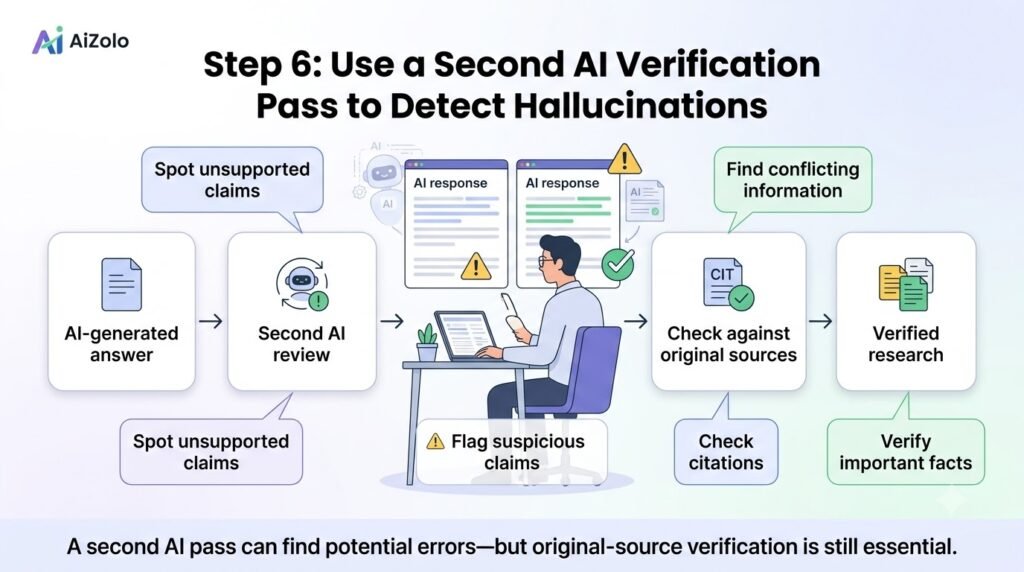
AI does not have to be used only as a content generator. A second pass of an AI can act as a reviewer looking for unsupported, incomplete, or contradictory claims before publication. The critical point is to ask the reviewer to look at the assertion and evidence together, not to ask a general question such as “Is this article accurate?”
Give the Reviewer the Claim and Source
Use a structured verification prompt:
“Verify each claim against the supplied source. Mark each claim as Supported, Partially Supported, Unsupported, or Contradicted. Do not use outside information.”
This will cause the model to consider the relationship between the claim and the evidence, rather than relying on general knowledge. In addition, it can help make the results of reviews more easily auditable, as each claim has an explicitly given status.
Ask AI to Find Conflicting Evidence
A stronger review does not simply ask whether something is correct. Ask the model to actively search the provided evidence for limitations or contradictions:
“Look specifically for evidence in the provided sources that contradicts or qualifies each claim.”
This is important because one source could support one claim while another source might contradict it. A study could provide evidence for a claim about one population and an AI generated sentence could take that evidence and wrongly apply it to the entire population.
Use Multiple Models for Difficult Claims
For especially important or unclear claims, test the same prompt across different AI models and review their responses.
A multi-model workspace such as AiZolo can make this easier by allowing responses to be compared side by side rather than manually moving between different AI tools.
If the models disagree, treat that disagreement as a reason to inspect the underlying source more closely—not as a reason to choose the majority response.
The final authority always comes back to the underlying source, not AI agreement, so the second AI pass actually serves to spot check claims that might need closer scrutiny, and the original evidence determines what can safely be published
Step 7: Add Human Review Before Publishing Research
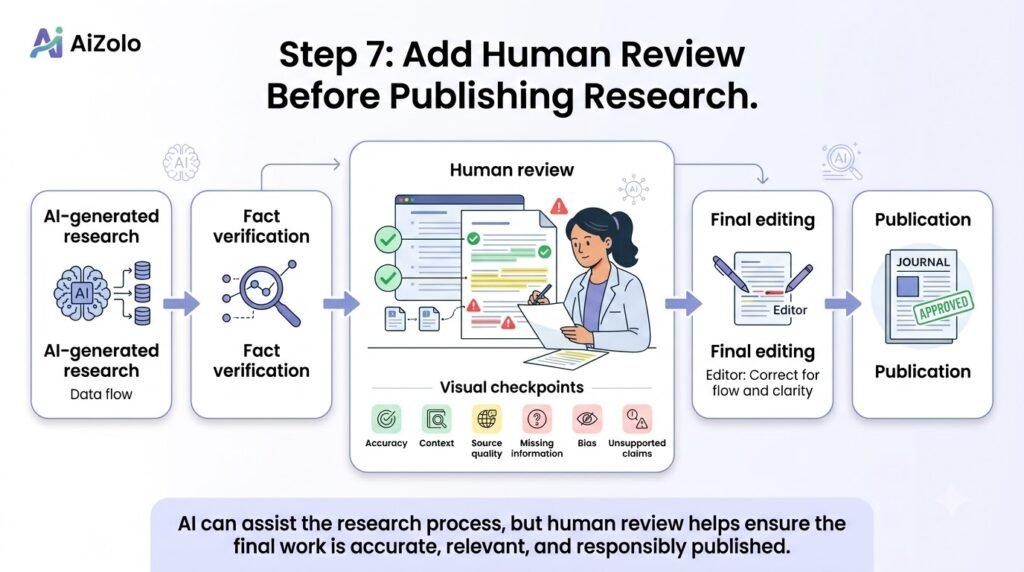
Even a carefully designed AI workflow should end with human review. AI can compare sources, point out inconsistencies, and highlight suspicious claims, but should not be the ultimate authority on a research topic that demands a large amount of accuracy.
Which Research Claims Need Human Verification?
Human review should be especially thorough for:
- Medical information
- Legal information
- Financial information
- Scientific claims
- Original research
- Sensitive statistics
- Expert quotations
- Claims that could materially affect readers
Evidently recommends human validation as an additional safeguard for regulated and high-stakes applications, rather than relying exclusively on automated validation.
What Humans Should Check
Before publishing, the final reviewer should ask:
- Is the claim actually supported by the evidence?
- Is the source credible and appropriate?
- Is the information current?
- Does the citation point to the correct source?
- Is the wording stronger than what the evidence supports?
- Has important context been removed?
- Did AI introduce anything that cannot be verified?
This final step is especially important when an AI has summarized a study or made a technical finding more approachable by changing it to a non-technical statement.
A source may support the general idea while not supporting the exact wording used in the article.
The goal is not to remove AI from the research process but rather to define its possible useful roles as research assistant, synthesizer, comparator, and reviewer while maintaining a central role for evidence and human judgment in the publishing process.
How AiZolo Fits Into an AI Research Verification Workflow
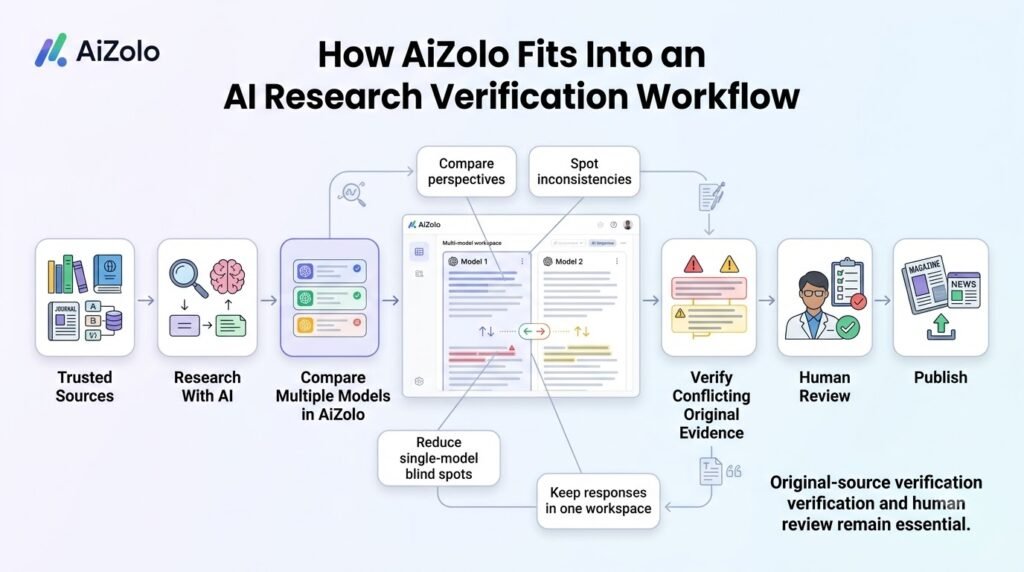
Compare Research Answers Side by Side
AiZolo lets you hold simultaneous conversations with multiple AI models and view their responses side by side. For verification, the workflow looks like this:
Same research question → multiple models → compare → identify conflicts → verify against sources
Send one identical question to several models. Where they agree, you have a lead worth checking. Where they disagree on a date, a statistic, or an author, you’ve found exactly the claims that need scrutiny first.
Agreement is not a guarantee, since models can make the same mistakes, therefore, in any case, it is necessary to verify information against their sources without leaving the chat.
Save Repeatable Research Prompts
Consistent checks produce consistent results. Using the Smart Prompt Manager in AiZolo, you can save prompts, organize them into groups, and reuse them in different chats to avoid re-writing verification steps each time. Here is an example of a convenient prompt set:
- Research extraction prompt: pull key claims, authors, and dates from a topic
- Citation verification prompt: ask the model to flag citations it cannot confirm exist
- Contradiction-check prompt: surface where sources or answers conflict
- Statistics verification prompt: list each figure with its claimed source and year
- Final fact-check prompt: review a draft and flag unsupported claims
Keep Research Context Organized
Longer research projects generate scattered threads. AiZolo offers several features that help with organization:
- Project Management to group related chats
- AI Memory to carry context between conversations
- Dynamic Layout to arrange model panels as needed
- Chat imports to bring existing conversations into one place
- Custom API keys to use your own model access
These are workflow tools. They make a verification process easier to run and repeat, but they don’t verify anything themselves. AiZolo does not prevent hallucinations, and no comparison view replaces checking claims against primary sources. Its value is in making that discipline faster and more consistent.
Common Mistakes That Increase AI Hallucinations in Research
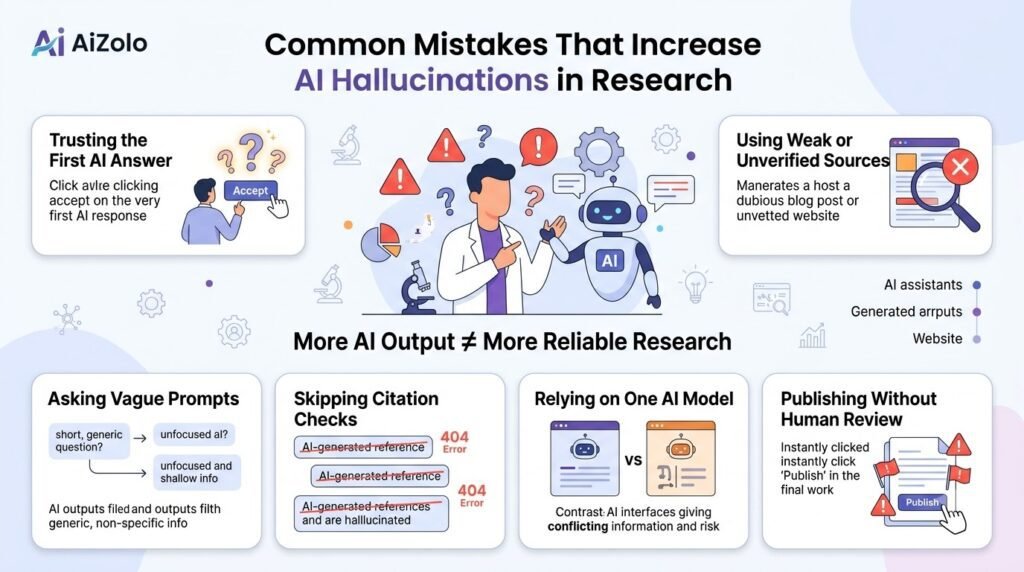
In fact, even well-intentioned research practices can contain loopholes that lead to increased occurrences of LLM inaccuracies, and their removal requires replacing these bad habits with appropriate validation strategies.
| Common Mistake | Better Approach |
| Trusting one AI model | Compare outputs and verify sources |
| Asking AI to “never hallucinate” | Give explicit evidence boundaries |
| Accepting citations automatically | Open and verify every important citation |
| Treating AI consensus as proof | Check the primary source |
| Using outdated sources | Check publication dates |
| Copying AI statistics | Verify the original dataset/report |
| Asking AI to fill missing information | Allow it to say “not found” |
| Skipping human review | Review high-impact claims |
| Checking only the final article | Verify claims during research |
| Using AI-generated sources without opening them | Confirm source existence and relevance |
Why Grounding Matters
The implementation of strict guardrails such as a retrieval-augmented generation (RAG), data quality requirements, and explicit prompting significantly reduces the possibility of generating fabrication content.
For instance, in CapeStart’s own reported experience, introducing RAG retrieval into their developer documentation workflow dropped hallucination rates from 31% down to 4%.
Moreover, with the help of RAG and data quality checks, they were able to reduce policy-related hallucinations by 89%. These results represent the performance of the model within one organization, CapeStart, and do not claim to be an industry benchmark.
However, the combination of dynamic retrieval and prompt engineering prevents the generation model from guessing the answer.
Final AI Research Hallucination Checklist
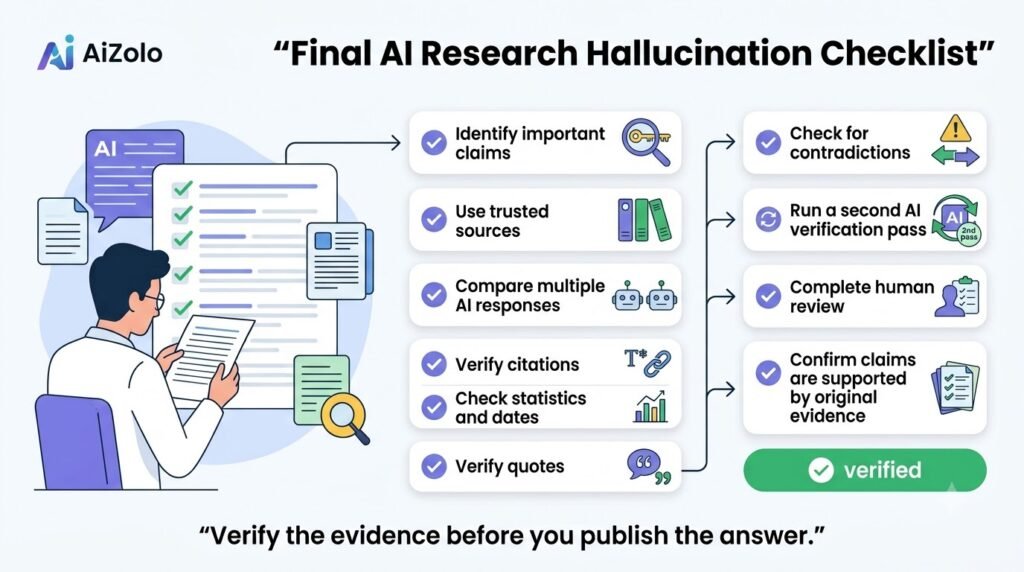
Before You Publish AI-Assisted Research
Run through this list before any AI-assisted research goes public. If you can’t check a box, that claim isn’t ready.
Claims and sources
- [ ] Every important factual claim has been identified.
- [ ] Primary sources were checked where available.
- [ ] AI-generated citations were opened, not just read.
- [ ] Sources actually support the claims attached to them.
Data and quotes
- [ ] Statistics were checked for date and context.
- [ ] Quotes were checked against the original text.
- [ ] Product, pricing, and time-sensitive information was checked for freshness.
Process and judgment
- [ ] Conflicting AI answers were investigated, not averaged out.
- [ ] Unsupported claims were removed.
- [ ] AI was allowed to abstain where evidence was missing.
- [ ] High-impact claims received human review.
- [ ] Final conclusions reflect the evidence rather than AI confidence.
If any item stays unchecked, revise the claim, find a better source, or cut it. A shorter piece with verified claims is worth more than a longer one you can’t defend.
Final Takeaway: Build a Verification Workflow, Not a Trust Workflow
The goal of reducing AI hallucinations in research isn’t to find a model that never makes mistakes. It is to build a workflow that makes unsupported information difficult to publish. AI can expedite research, but its outcomes need to be verified before they are put into a published form or an article.
A practical verification workflow looks like this:
Trusted sources → AI research → multi-model comparison → claim extraction → citation verification → contradiction checking → human review → publication
Therefore, the use of more than one AI-generated version of a paper is safer than relying on just one.
Evidently recommends techniques such as grounding, constrained prompting, validation, and evaluation to improve the reliability of LLM outputs. FutureAGI also makes a good point about utilizing multiple controls to reduce hallucinations rather than just one intervention.
For researchers that regularly have to compare answers generated by AI research assistants, a multi-model workspace like that of AiZolo would help to streamline the comparison stage as it could house the different answers generated by different models in one place rather than needing to have multiple browser tabs open at once.
The important caveat being to use the comparison as a verification supplement and not as a replacement for the original evidence.
FAQs
1. What is the best AI workflow for reducing hallucinations in research?
The most optimal AI workflow would leverage a combination of trusted sources, source-grounded prompts, comparisons across multiple models, claim-by-claim analysis, citation verification, and manual verification.
Researchers need to treat AI outputs with a healthy skepticism, double-checking important claims against the underlying evidence, and fact-checking any assertions that the model makes that aren’t explicitly grounded in the provided sources.
2. How can I reduce AI hallucinations in research?
One of the options to reduce AI hallucination is to provide the model with reliable source material, prompt it to use specific references, encourage it to base answers on available evidence, and ask it to admit uncertainty.
In addition, it may be helpful to review and compare multiple responses generated by AI and verify any potentially critical facts, statistics, citations, dates, and claims with external sources.
3. How do you fact-check AI-generated research?
Start by breaking the AI-generated research into individual factual claims. Find important claims, their sources, and verify if the sources actually back up the claims. Check statistics, citations, dates, quotes, interpretations separately.
Finally, skim through the article to make sure that there are no unsubstantiated or misleading claims.
4. How can I tell if an AI-generated citation is real?
Open the citation and verify that the referenced paper, article, report, or webpage actually exists. Check the title, author, publisher, publication date, and URL or DOI. Then read the relevant section to confirm that the source genuinely supports the AI-generated claim rather than merely appearing relevant.
5. Does asking multiple AI models reduce hallucinations?
Cross-verification of results between multiple AI models could highlight areas of agreement, information gaps, conflicting statements, and require additional research or investigation in specific areas.
Notably, however, cross-verification does not guarantee that information provided by AI models is accurate or correct.
The researcher should rely on cross-verification as an indicator to conduct additional research on the information provided by AI models. It is vital to double-check the critical facts and figures with original sources.
6. Can AI fact-check its own answers?
AI could examine its responses to ensure that there is nothing in them that it cannot support, is not self-contradictory, or does not need support.
However, its second response should not be considered as an independent verification. For critical research, it is better to consult primary or reliable sources instead of asking the same AI whether its response was correct.
7. What should you fact-check first in AI-generated research?
Prioritize claims that could affect the accuracy of the information provided, such as statistical data, citations, quotations, scientific findings, financial or mathematical calculations, medical and legal information, dates, and current product details.
Claims with specific details are much more likely to be incorrectly fabricated by an AI since it may lack reliable evidence to support a particular position and provide inaccurate information to the user.
8. Can AI completely eliminate hallucinations?
No single AI workflow can ensure that hallucinations will be eliminated from the research process. The best approach is to reduce the possibility of hallucinations and identify those that remain before publishing results.
Source ground, constrained prompts, multi-model comparisons, citations, automated checks, and manual reviews can increase the reliability of AI research with some risk of inaccuracy remaining.
Author Bio
Anshika Verma is a content researcher and AI content writer at AiZolo, specializing in AI tools, emerging technologies, and research-driven content. She focuses on simplifying complex AI topics into accurate, practical, and SEO-friendly insights.