If you’ve typed “Aizolo vs LibreChat” into Google, you’re probably trying to solve one specific problem: you’re paying for (or thinking about paying for) more than one AI subscription, and you want a single place to access models like Claude, ChatGPT, and Gemini instead of juggling five different tabs, five different logins, and five different bills.
Aizolo and LibreChat both promise to solve that problem, but they take almost opposite approaches to doing it. Aizolo is a hosted, subscription-based AI workspace — you sign up, pay a monthly fee (or bring your own API keys), and start chatting with multiple AI models through one dashboard, with no setup required. LibreChat is a free, open-source AI interface that you (or your IT team) install and run yourselves, connecting it to whichever AI providers you choose.
That difference — hosted convenience versus self-hosted control — is really the whole comparison. This guide breaks it down feature by feature, with pricing tables, real screenshots recommendations, pros and cons, and an honest verdict for different types of users.
Quick answer: If you want a ready-to-use multi-model AI subscription with zero setup, Aizolo is built for that. If you want full control over your data, your infrastructure, and which AI providers you use — and you’re comfortable with (or have access to) some technical setup — LibreChat is the stronger fit.
Who should read this guide: students comparing AI subscription costs, freelancers and content creators who want one AI workspace instead of many, developers and IT teams evaluating self-hosted AI options, and businesses trying to decide between a hosted AI platform and a self-managed one.
A note on transparency before we start: this article distinguishes clearly between verified facts (sourced from each platform’s own website and documentation), opinions (our editorial assessment), and recommendations (situational advice). Where we weren’t able to verify a claim independently, we say so.
Table of Contents
Quick Comparison Table
| Category | Aizolo | LibreChat |
|---|---|---|
| Type | Hosted, cloud-based AI subscription platform | Open-source, self-hosted AI chat interface |
| Pricing model | Free tier + $9.9/month Pro + $99.9/year Pro Annual | Free (open-source); you pay only for hosting and/or AI provider API usage |
| Setup required | None — sign up and use immediately | Yes — Docker/server deployment, or a third-party managed host |
| AI models supported | ChatGPT, Claude, Gemini, Grok, Perplexity, and other premium models bundled in | Any provider you configure: OpenAI, Anthropic (Claude), Google, AWS Bedrock, Azure, Mistral, OpenRouter, local models via Ollama, and more |
| BYOK (Bring Your Own Key) | Yes, supported with encrypted key storage on all plans | Yes — BYOK is effectively the default way LibreChat connects to providers |
| Best for | Non-technical users who want an instant multi-model AI subscription | Developers, IT teams, privacy-focused users, and organizations wanting full control |
| Hosting | Fully managed by Aizolo | Self-hosted (Docker, VPS, or on-prem); third-party managed hosting also available |
| Image/video/audio generation | Built-in, included in paid plans | Image generation supported (DALL·E, Stable Diffusion, Flux, GPT-Image-1); no native video/audio generation |
| Code interpreter | Not confirmed on official pages | Yes — sandboxed code execution in multiple languages |
| Agents / tool use | Not confirmed on official pages | Yes — configurable agents with file handling, code execution, and API actions |
| MCP (Model Context Protocol) support | Not confirmed on official pages | Yes — native MCP support for connecting external tools |
| Team / enterprise auth (SSO, SAML, LDAP) | Not confirmed on official pages | Yes — documented support for OAuth2, SAML, LDAP, 2FA |
| Community size | Reports 5,000+ users on its homepage (company-stated, not independently verified) | 40,000+ GitHub stars, 41M+ Docker pulls, 370+ contributors (as listed on librechat.ai) |
| License | Proprietary SaaS | Open-source (MIT license, per GitHub) |
Figures above are current as of mid-2026 and pulled directly from each company’s official website or documentation. Where a feature isn’t publicly documented, we’ve marked it “not confirmed” rather than guessing.
Quick Verdict: Aizolo wins on convenience and price predictability for casual and non-technical users. LibreChat wins on flexibility, transparency, and long-term control, especially for developers and privacy-conscious teams. Neither platform is a strict upgrade over the other — they serve different audiences.
Winner Overview
There isn’t a single “winner” here, and any comparison that tells you otherwise is oversimplifying. Instead, think of it as two different answers to the same underlying question — “how do I stop paying for five AI subscriptions?”
- Aizolo’s answer: pay one smaller subscription and let us handle the infrastructure.
- LibreChat’s answer: don’t pay a subscription at all — run the software yourself and pay providers directly (or use free/local models).
If your priority is speed and simplicity, Aizolo is the more practical starting point. If your priority is ownership, customization, and avoiding vendor lock-in, LibreChat is the stronger long-term investment — provided you or your team have the technical comfort to deploy and maintain it.
What Is Aizolo?
Aizolo positions itself as an “All-in-One AI Subscription” — a single hosted dashboard where users can access multiple premium AI models (it lists ChatGPT, Google Gemini Pro, Perplexity Sonar Pro, Claude, and Grok on its homepage) instead of paying for each one separately. The platform is aimed at people who currently pay for two or more AI subscriptions and want to consolidate that spend.
Features (as listed on aizolo.com)
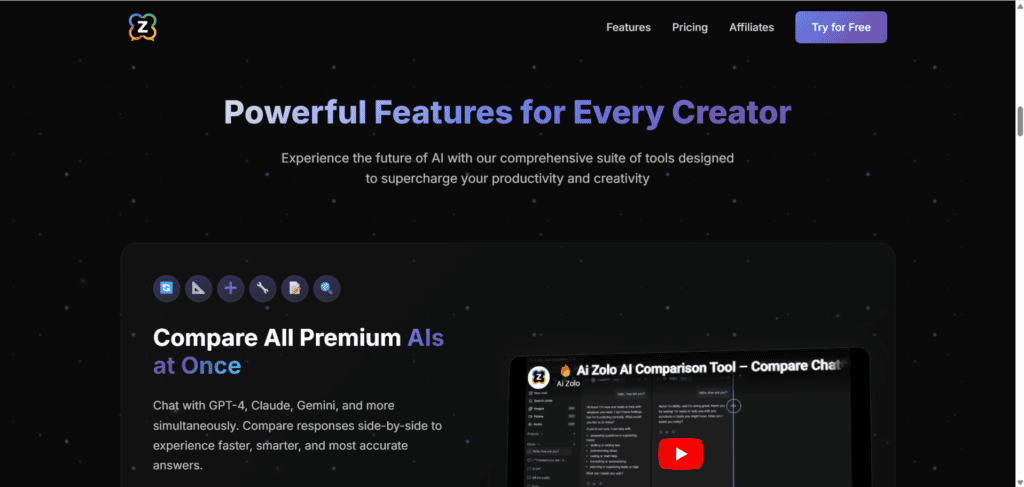
- Side-by-side AI comparison — chat with multiple models simultaneously and compare their answers in one interface.
- AI image generation — described as supporting multiple image models for photorealistic and illustrative output.
- AI video generator — text-to-video generation, per the homepage.
- AI audio generator — text-to-speech and music/audio generation.
- Custom API keys (BYOK) — users can add their own encrypted API keys to use existing provider subscriptions inside Aizolo, including on the free plan.
- Smart Prompt Manager — save and organize reusable prompts.
- AI Memory — persistent context across conversations, per the site.
- Chat import — one-click import of existing ChatGPT or Claude conversation history.
- Project management / dynamic layout — referenced on the homepage as part of the workspace experience.
Things to Know: Aizolo’s website describes these features in marketing language but doesn’t publish independent technical documentation the way LibreChat does. We couldn’t verify implementation details (for example, exactly which image or video models are used) from public sources, so treat specific model names as the company’s own claims rather than independently confirmed facts.
Pros
- No installation or technical setup — usable within minutes of signing up.
- Single monthly price instead of multiple separate AI subscriptions.
- BYOK option is available even on the free plan, which is unusual for hosted AI aggregators.
- Bundles image, video, and audio generation alongside chat in one subscription.
- Chat import from ChatGPT/Claude lowers the switching cost for new users.
Cons
- As a newer, smaller platform, it has far less public documentation, third-party review coverage, and community scrutiny than an established open-source project.
- No published information (as of this writing) on self-hosting, on-premise deployment, enterprise SSO, agents, or code execution — features that matter for technical teams.
- Refund policy is limited: Aizolo’s pricing page states refunds are only available within 7 days and only if no premium tokens have been used.
- Being a hosted, closed-source SaaS product, users must trust Aizolo’s infrastructure and data-handling practices rather than being able to audit the code themselves.
Aizolo vs LibreChat Pricing
| Plan | Price | Key Inclusions |
|---|---|---|
| Free | $0/month | Limited model access, limited monthly tokens, basic chat, limited audio transcription, BYOK support |
| Pro | $9.9/month | Unlimited AI comparisons, access to premium models, 3,000,000 tokens/month, image/video/audio generators, prompt manager, AI memory, chat import, priority support |
| Pro Yearly | $99.9/year (≈ 17% savings vs. monthly) | Same inclusions as Pro, billed annually |
Source: aizolo.com/pricing, verified directly.
Supported AI Models

Aizolo’s homepage names ChatGPT, Google Gemini Pro, Perplexity Sonar Pro, Claude, and Grok as models it bundles into its subscription, plus “2,000+ AI tools” it says are added weekly. The exact model versions (e.g., which Claude or GPT model tier) are not specified publicly, so if a specific model version matters for your workflow, this is worth confirming directly with Aizolo’s support before subscribing.
Ease of Use
Opinion: Because Aizolo is a hosted product with no installation step, it’s realistically the easier platform for a non-technical user to start using today. The tradeoff is that “easy” here means “easy to start,” not necessarily “fully featured” — LibreChat’s advanced tooling (agents, code execution, MCP) isn’t something Aizolo has publicly documented as offering.
Who Should Use Aizolo
- Individuals or small teams already paying for 2+ separate AI subscriptions who want to consolidate cost without any setup.
- Non-technical users who want multi-model comparison (asking several AIs the same question at once) without configuring anything.
- Content creators who want chat, image, video, and audio generation bundled into a single low-cost plan.
What Is LibreChat?
LibreChat is an open-source AI platform, publicly maintained on GitHub, that gives you a unified, ChatGPT-style interface for connecting to virtually any AI provider you choose. Rather than being a company selling access to AI models, LibreChat is software you run — either on your own server or through a third-party managed host — and you decide which AI providers to connect using your own API keys (BYOK is effectively how LibreChat works by design).
Architecture and the Self-Hosted Model
LibreChat runs as a set of Docker containers (the app itself, a MongoDB database, and optionally Meilisearch for search) that you deploy locally, on a VPS, or on-premise. Because it’s open-source under an MIT license, anyone can inspect, modify, or extend the code. This is the core architectural difference from Aizolo: Aizolo is a service; LibreChat is software.

Pro Tip: If the phrase “Docker Compose” makes you nervous, LibreChat is still usable via managed hosting providers (several third parties, such as Elestio, offer managed LibreChat instances starting at roughly $16/month) — but that is a third-party service, not something operated by the LibreChat project itself.
Features (per librechat.ai and its documentation)
- Agents — build custom AI assistants with file handling, code execution, and API actions.
- Code Interpreter — securely sandboxed execution of Python, JavaScript, Go, Rust, and more.
- Artifacts — generate React components, HTML pages, and Mermaid diagrams directly inside chat.
- Model Context Protocol (MCP) — connect the AI to external tools and services using the open MCP standard.
- Memory — persistent context across conversations.
- Web Search — built-in live web search with reranking, usable with any connected model.
- Authentication — enterprise-ready SSO via OAuth2, SAML, LDAP, and two-factor authentication.
- Search — Meilisearch-powered search across messages, files, and code snippets.
- RAG API — retrieval-augmented generation for chatting with your own files.
- OCR — text extraction from images and documents.
- Image generation — supports GPT-Image-1, DALL·E, Stable Diffusion, and Flux.
- Conversation forking, import, shareable links, temporary chat, resumable streams — a deep set of chat-management features.
- Admin panel, password reset, moderation system — multi-user administration tools built for teams.
Pros
- Free and open-source — no subscription fee for the software itself.
- Broadest documented model support of the two platforms: OpenAI, Anthropic, Google, AWS Bedrock, Azure, and custom endpoints (Mistral, OpenRouter, Ollama, and more) via configuration.
- Full data control — self-hosted deployments keep your chat history and conversation structure on infrastructure you control.
- Enterprise-grade documented features: SSO, code interpreter, agents, MCP, admin panel, and moderation tools.
- Large, active open-source community (40.2k GitHub stars, 373 contributors, and 41.1 million Docker pulls at the time of writing).
- No vendor lock-in — you can migrate, self-audit, or fork the code at any time.
Cons
- Requires technical setup (Docker, server management, environment configuration) or a paid managed-hosting provider.
- No native video or audio generation built into the core project, based on its published feature list.
- You are responsible for your own API costs with each provider (OpenAI, Anthropic, etc.), server costs, and ongoing maintenance/updates.
- Self-hosting means you also own the security responsibility — patching, backups, and access control are on you (or your managed host).
- No official mobile app is listed on its site as of this writing.
Supported Providers
LibreChat’s documentation lists pre-configured setup guides for AWS Bedrock, Anthropic (Claude), OpenAI, Google, and OpenAI Assistants, plus custom endpoint support for providers like Mistral AI, OpenRouter, and Ollama (for local models) through its librechat.yaml configuration file.
Pricing
LibreChat itself is free to use — there is no license fee from the LibreChat project. Your actual costs come from three places:
- Hosting — running the Docker stack on your own server or a VPS (self-managed costs can range from a few dollars a month on a small VPS to more for higher-traffic deployments; managed hosting options from third parties start at roughly $16/month based on current market listings).
- AI provider API usage — you pay OpenAI, Anthropic, Google, or other providers directly for the tokens you use, at their standard API rates.
- Maintenance — time (or a DevOps budget) for updates, security patches, and backups, unless you use a managed host that includes this.
Deployment
LibreChat supports local installation (for testing or personal use), remote/production hosting via Docker Compose on a VPS or cloud provider, and third-party managed hosting for teams that don’t want to run their own infrastructure.
Who Should Use LibreChat
- Developers and technical teams who want full control over their AI stack.
- Organizations with data-privacy or compliance requirements that need self-hosted infrastructure.
- Power users who want to mix local models (via Ollama) with cloud APIs in one interface.
- Anyone who wants to avoid recurring subscription fees and is comfortable paying providers directly by usage.
Feature-by-Feature Comparison
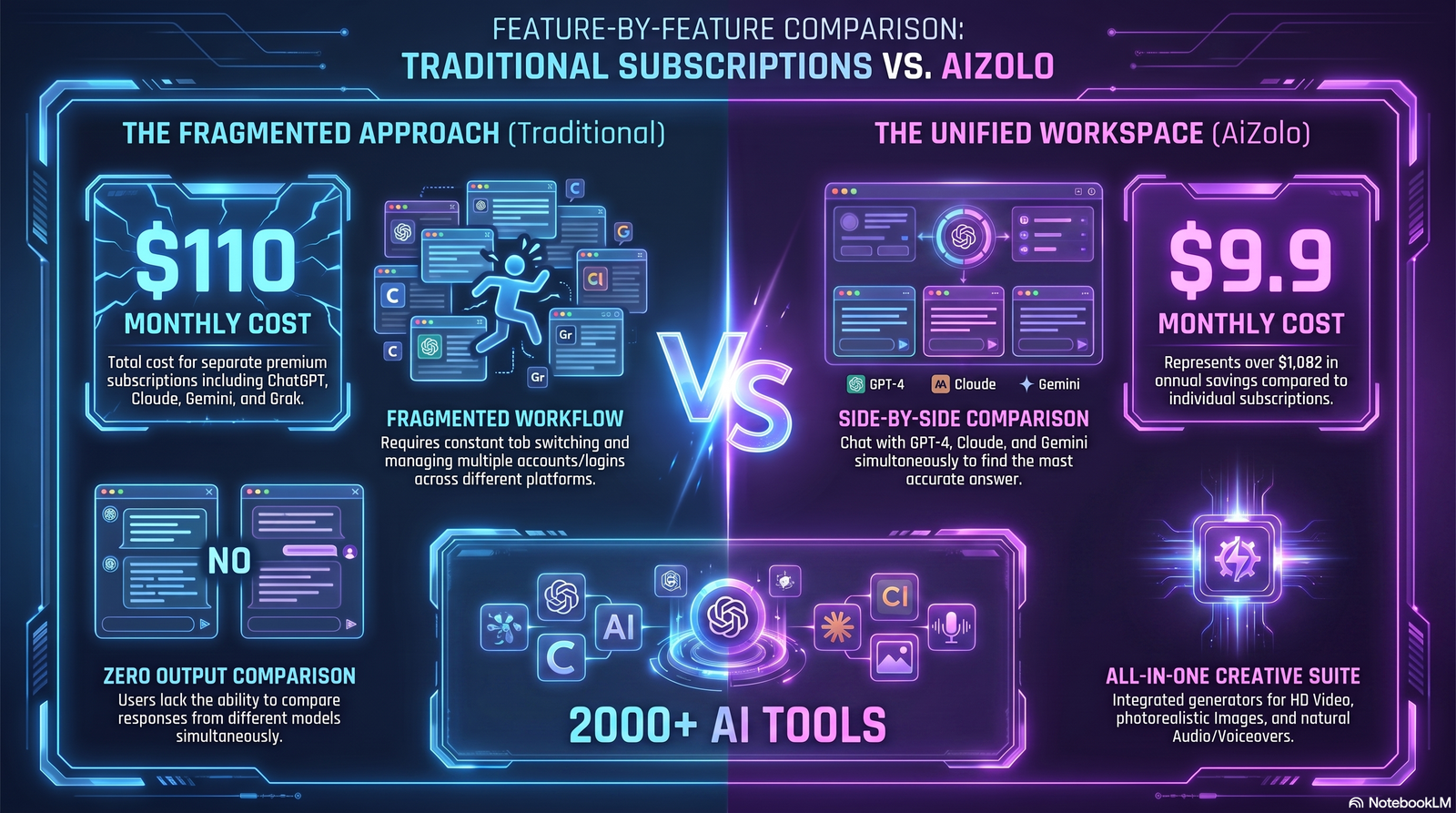
Important Note: For features not documented on Aizolo’s official site, we’ve marked them “Not publicly documented” rather than assuming they don’t exist. If a specific feature is a dealbreaker for you, we recommend confirming directly with Aizolo before subscribing.
Interface, Models, and Core AI Access
| Feature | Aizolo | LibreChat |
|---|---|---|
| User interface | Hosted web dashboard | Web interface (ChatGPT-style), self-hosted |
| Claude support | Yes (listed on homepage) | Yes (dedicated Anthropic configuration guide) |
| ChatGPT / OpenAI support | Yes | Yes (dedicated OpenAI + Assistants configuration guide) |
| Gemini support | Yes (Gemini Pro listed) | Yes (dedicated Google configuration guide) |
| Grok / xAI support | Yes (listed on homepage) | Via custom endpoint configuration |
| Reasoning models | Not specified which tiers | Supported via any provider’s reasoning-model endpoints (e.g., OpenAI o-series, Claude extended thinking) |
| Image generation models | “Multiple AI image models” (unspecified) | GPT-Image-1, DALL·E, Stable Diffusion, Flux (named explicitly) |
| Video generation | Yes, built-in | Not part of the core project |
| Audio generation | Yes, built-in (voice + music) | Not part of the core project (TTS available via plugins/config in some setups) |
| Custom/local models | Not documented | Yes, via Ollama and other custom endpoints |
| OpenRouter support | Not documented | Yes, via custom endpoint configuration |
| BYOK (bring your own key) | Yes, encrypted key storage, available on free plan | Yes — this is effectively the default connection method |
Productivity and Workflow
| Feature | Aizolo | LibreChat |
|---|---|---|
| Prompt library/manager | Yes | Not a named core feature, though prompt templates are supported in the interface per third-party write-ups |
| Projects/folders | “Dynamic layout”/project management mentioned | Conversation forking and organization features documented |
| Search | Not documented | Yes, powered by Meilisearch |
| Memory | Yes | Yes |
| Artifacts (code/UI generation in chat) | Not documented | Yes — React, HTML, Mermaid diagrams |
| Code generation | Not documented as a distinct feature | Yes, via Code Interpreter (Python, JS, Go, Rust, etc.) |
| File uploads / vision | Not detailed publicly | Yes, documented multimodal support |
| PDF / document chat | Not documented | Yes, via RAG API and OCR features |
| Agents / autonomous tool use | Not documented | Yes, a core documented feature |
| MCP (external tool connections) | Not documented | Yes, native support |
Team, Security, and Deployment
| Feature | Aizolo | LibreChat |
|---|---|---|
| Team collaboration | Not documented | Multi-user support with admin panel |
| SSO (OAuth2, SAML, LDAP) | Not documented | Yes, documented |
| Two-factor authentication | Not documented | Yes, documented |
| Content moderation tools | Not documented | Yes, documented moderation system |
| Self-hosted option | No — hosted only | Yes — this is the default model |
| Cloud-hosted option | Yes — this is the default model | Yes, via third-party managed hosting |
| Data residency control | Depends on Aizolo’s infrastructure (not detailed publicly) | Full control when self-hosted |
| Open-source / auditable code | No — proprietary | Yes — MIT-licensed, publicly auditable on GitHub |
Developer Experience, Community, and Support
| Feature | Aizolo | LibreChat |
|---|---|---|
| Documentation depth | Marketing-focused site; limited technical docs found publicly | Extensive dedicated documentation site (librechat.ai/docs) |
| Community | Discord server listed; company reports 5,000+ users (unverified) | 40.2k GitHub stars, 373 contributors, active Discord |
| Roadmap transparency | Not published publicly | Public roadmap and changelog published |
| API for developers | Not documented | Fully open codebase; developers can extend or self-integrate |
| Update cadence | Not documented | Frequent releases visible via public changelog |
Pricing Comparison
At-a-Glance Pricing Table
| Aizolo | LibreChat | |
|---|---|---|
| Software cost | $0–$9.9/month (or $99.9/year) | $0 (open-source) |
| Setup cost | $0 | $0–$50+ (server/VPS, one-time or ongoing) |
| Ongoing infrastructure cost | Included in subscription | $5–$40+/month for self-managed VPS, or ~$16+/month for third-party managed hosting |
| AI provider API costs (if using BYOK) | Your own provider costs, on top of Aizolo plan if applicable | Your own provider costs (this is the primary cost driver) |
| Free tier available | Yes | Yes (the entire software is free; only infrastructure/API usage costs money) |
| Best for predictable budgeting | Aizolo (flat monthly fee) | Less predictable — usage-based API costs can vary |
LibreChat Self-Hosting Costs, Explained
Because LibreChat itself has no license fee, people sometimes assume it’s “free” in the way a hosted app’s free tier is free. In practice, self-hosting LibreChat has real costs that just show up differently:
- Server: A small VPS capable of running the Docker stack typically costs somewhere in the $5–$40/month range depending on traffic and whether you run local models.
- API keys: If you connect Claude, GPT, or Gemini through their official APIs, you pay each provider directly per token used — there’s no bundled discount the way there might be with a flat-fee hosted subscription.
- Maintenance: Someone needs to apply updates, monitor uptime, and manage backups, unless you pay a third-party managed host to do this for you.
- Security: Self-hosting means you’re responsible for keeping the server patched and access-controlled.
Recommendation: If you don’t have any technical resource (yourself or a colleague) to handle setup and maintenance, factor that into your decision — either budget for a managed LibreChat host or lean toward Aizolo’s fully managed model instead.
The Aizolo Hosted Experience, Explained
Aizolo’s advantage is predictability: one flat monthly price with no server to manage, no Docker to learn, and no separate API bills to track (unless you specifically choose to use your own keys via its BYOK option). For someone who just wants to stop paying for multiple AI subscriptions without becoming their own systems administrator, that simplicity has real value — it’s the core reason the platform exists.
Common Mistake: Assuming “self-hosted and open-source” automatically means “cheaper.” For light, personal use, LibreChat can indeed cost less than a paid subscription — but for teams with meaningful usage, API token costs plus server costs can add up to more than a flat-fee hosted plan. Always estimate your actual usage before assuming either option is cheaper.
Security and Privacy Comparison
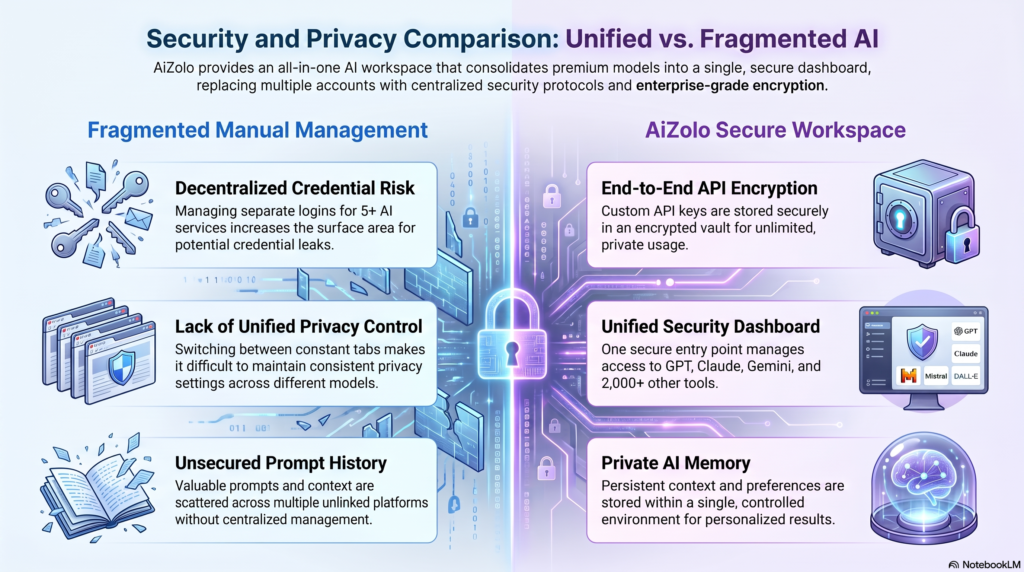
Verified facts:
- LibreChat documents enterprise authentication features (OAuth2, SAML, LDAP, 2FA) and a moderation system directly in its docs.
- LibreChat’s self-hosted nature means your conversation data can be stored entirely on infrastructure you control, though calls to third-party AI providers (OpenAI, Anthropic, Google, etc.) still send prompts to those providers’ servers for processing, exactly as they would if you used those providers’ own apps.
- Aizolo states it uses encrypted storage for custom API keys. Its site does not publish a detailed technical security architecture, third-party security audit, or compliance certification (such as SOC 2) that we could locate.
Opinion: For privacy-sensitive use cases — legal, healthcare, government, or any workflow involving confidential business data — LibreChat’s self-hosted, auditable, open-source model gives you meaningfully more visibility and control than trusting a closed-source hosted platform’s internal practices. That said, self-hosting only improves privacy if it’s configured correctly; a misconfigured self-hosted instance can be less secure than a well-run hosted service.
Recommendation: If privacy and compliance are top priorities, read both platforms’ published privacy policies in full (Aizolo’s Privacy Policy) before committing, and consider running LibreChat with local models (via Ollama) if you need to avoid sending data to third-party AI APIs entirely.
Performance Comparison
Which Platform Is Faster?
Neither platform’s raw response speed is something we can objectively benchmark from public sources — response speed for both platforms depends mostly on which underlying AI model you’re using (Claude, GPT, Gemini, etc.) and, for LibreChat, the performance of the server you deploy it on. Aizolo states 99.9% uptime on its homepage; this is a company-reported figure, not one we were able to independently verify.
Which Has Better AI Models?
Both platforms are, functionally, interfaces to the same underlying frontier AI models — Claude from Anthropic, GPT models from OpenAI, and Gemini from Google. Neither Aizolo nor LibreChat trains its own foundation model. The real difference is breadth and specificity of access: LibreChat’s documentation names specific configuration paths for more providers (including AWS Bedrock, Azure, and local models via Ollama), while Aizolo’s site lists providers at a higher, less technical level.
Which Gives Better Value?
This depends entirely on your usage pattern:
- Light-to-moderate individual use: Aizolo’s $9.9/month flat fee is likely to be cheaper and simpler than piecing together a self-hosted stack.
- Heavy or team use with technical resources available: LibreChat, paired with direct API billing, can offer more value per dollar because you’re not paying a markup for aggregation — though this requires more setup effort.
Real-World Use Cases
| User Type | Better Fit | Why |
|---|---|---|
| Students | Aizolo | Low flat cost, no setup, good for comparing answers across models for coursework |
| Developers | LibreChat | Full API access, code interpreter, agents, MCP, and open-source extensibility |
| Researchers | LibreChat | RAG API, document chat, OCR, and self-hosted data control support serious research workflows |
| Businesses (SMB) | Depends on IT resources | Aizolo if no dedicated IT; LibreChat if you have (or can hire) DevOps support |
| Marketing teams | Aizolo | Bundled image/video/audio generation plus chat in one subscription |
| Content creators | Aizolo | Multi-model comparison plus creative generation tools in one place |
| Agencies | LibreChat | Multi-user admin controls, SSO, and white-label-style self-hosting |
| Freelancers | Aizolo | Lower cost of entry than managing separate subscriptions or infrastructure |
| Coding-focused users | LibreChat | Code Interpreter and Artifacts are purpose-built for this |
| Writing-focused users | Either | Both support standard chat-based writing workflows across major models |
| Privacy-first teams | LibreChat | Self-hosted, auditable, open-source codebase |
| Best budget option (solo user) | Aizolo | $9.9/month flat fee is simple to budget for |
| Best for teams needing enterprise auth | LibreChat | Documented SSO, SAML, LDAP, and 2FA support |
Ease of Setup and Learning Curve
Aizolo: Sign up, choose a plan (or start free), and begin chatting. No installation, no configuration files, no server. This is about as low-friction as an AI platform gets.
LibreChat: Requires either (a) following the official Docker-based Quick Start guide to self-host, or (b) using a third-party managed hosting provider. Neither path is difficult for someone with basic command-line comfort, but both represent a real step up in complexity compared to signing up for a hosted subscription. LibreChat’s own documentation is thorough, which shortens the learning curve considerably compared to piecing together instructions from scattered sources.
Expert Tip: If you’re technical but new to self-hosting, start with LibreChat’s official Quick Start guide and Docker Compose setup rather than a from-scratch manual install — it’s the path the maintainers actively support and document.
Our Verdict
There’s no universal winner between Aizolo and LibreChat, because they aren’t really solving the same problem for the same person.
- Choose Aizolo if: you want to stop paying for multiple AI subscriptions, you don’t want to manage any infrastructure, and a predictable flat monthly fee matters more to you than deep customization or self-hosting control.
- Choose LibreChat if: you (or your team) have the technical capacity to deploy and maintain a self-hosted service, you want full control over your data and provider choices, or you need enterprise features like SSO, agents, MCP, and a code interpreter that aren’t part of Aizolo’s public feature set.
- Consider both if: you’re an individual who wants Aizolo for quick day-to-day comparison and creative tasks, while also running LibreChat for more sensitive or development-heavy work.
As with any software decision, we’d recommend testing the free tier of Aizolo and the free, self-hosted demo of LibreChat (available at chat.librechat.ai) before committing to a paid plan or a full deployment.
Final Scorecard
Note: The ratings below are the author’s editorial opinion, based on the verified facts presented throughout this article — they are not a claim of scientific measurement, and reasonable evaluators could weigh categories differently based on their own priorities.
| Category | Aizolo | LibreChat |
|---|---|---|
| Features | ⭐⭐⭐☆☆ (3/5) | ⭐⭐⭐⭐⭐ (5/5) |
| Pricing | ⭐⭐⭐⭐☆ (4/5) | ⭐⭐⭐⭐☆ (4/5)* |
| Ease of Use | ⭐⭐⭐⭐⭐ (5/5) | ⭐⭐⭐☆☆ (3/5) |
| Support | ⭐⭐⭐☆☆ (3/5) | ⭐⭐⭐⭐☆ (4/5) |
| Performance | ⭐⭐⭐⭐☆ (4/5)** | ⭐⭐⭐⭐☆ (4/5)** |
| Privacy | ⭐⭐⭐☆☆ (3/5) | ⭐⭐⭐⭐⭐ (5/5) |
| Customization | ⭐⭐☆☆☆ (2/5) | ⭐⭐⭐⭐⭐ (5/5) |
| Overall | 3.4 / 5 | 4.3 / 5 (for technical users); lower for non-technical users due to setup complexity |
*LibreChat’s pricing score reflects the software itself being free; total cost of ownership varies with usage and hosting choice. **Performance for both platforms is largely a function of the underlying AI model chosen and, for LibreChat, your server; scores reflect typical documented capability, not independent benchmarking.
FAQs
Is Aizolo better than LibreChat? Neither is universally “better” — Aizolo is better for non-technical users who want an instant, low-cost, hosted multi-model subscription. LibreChat is better for technical users and teams who want full control, self-hosting, and enterprise-grade documented features like agents and MCP.
Can LibreChat replace ChatGPT? Yes, functionally — LibreChat can connect to OpenAI’s models (among others) and provide a ChatGPT-style interface. It doesn’t replace ChatGPT’s own infrastructure; it’s a self-hosted front end that you connect to OpenAI’s API (or other providers) yourself.
Is LibreChat free? The LibreChat software itself is free and open-source under the MIT license. You will still pay for server hosting (if self-hosting) and for API usage with whichever AI providers you connect.
Does Aizolo support Claude? Yes, Claude is listed among the AI models available on Aizolo’s homepage.
Which platform supports Gemini? Both do. Aizolo lists Google Gemini Pro on its homepage, and LibreChat has a dedicated official configuration guide for Google’s AI services.
Can LibreChat use OpenRouter? Yes, LibreChat supports OpenRouter through its custom endpoint configuration in the librechat.yaml file.
Can Aizolo replace multiple subscriptions? That’s the platform’s core value proposition — bundling access to several AI models into one subscription instead of paying for each separately. Whether it fully replaces every subscription you currently pay for depends on which specific models and features you rely on, which is worth checking against Aizolo’s current model list before canceling other subscriptions.
Which platform is best for developers? LibreChat, based on its documented Code Interpreter, Agents, MCP support, and fully open-source, self-hostable codebase.
Does LibreChat have a mobile app? Based on its official site, LibreChat does not list a dedicated native mobile app; it’s used through a web interface, which works on mobile browsers.
Is Aizolo suitable for teams and businesses? Aizolo’s public site is oriented toward individual users and creators; it does not publicly document team-specific features like SSO or admin roles the way LibreChat does. Businesses with compliance or multi-user admin needs should confirm these capabilities directly with Aizolo.
Does Aizolo require an API key to use? No — Aizolo works out of the box with its own bundled model access. Bringing your own API keys is an optional feature for extending usage, not a requirement.
What license is LibreChat released under? LibreChat’s GitHub repository lists it under the MIT license, a permissive open-source license.
Can I self-host Aizolo? No — based on its official site, Aizolo is a hosted, proprietary SaaS product with no self-hosting option publicly offered.
Which platform has a larger community? LibreChat has a substantially larger and more transparent public community footprint, with 40.2k+ GitHub stars, 373+ contributors, and 41.1 million+ Docker pulls listed on its official site, compared to Aizolo’s homepage claim of 5,000+ users.
Do I need coding skills to use either platform? No coding skills are needed to use either platform’s chat interface day-to-day. However, deploying LibreChat yourself does require basic comfort with command-line tools and Docker, or a willingness to use a managed hosting provider instead.
Explore More AI Platform Comparisons
If you’re researching AI subscription options beyond this comparison, you may also find these guides useful:
- Compare AI Subscriptions
- Best AI Subscription 2026
- One Subscription for All AI Models
- Best Multi AI Platform
- Best All-in-One AI Workspace
- Access All AI Models in One Place
For LibreChat’s own technical resources, see the official documentation and its GitHub repository. For background on the underlying AI providers referenced throughout this guide, see OpenAI, Anthropic, and Google AI.
Sources
- Aizolo official website: aizolo.com and aizolo.com/pricing (accessed July 2026)
- LibreChat official website: librechat.ai and librechat.ai/docs (accessed July 2026)
- LibreChat GitHub repository: github.com/danny-avila/LibreChat
- Third-party hosting cost references for LibreChat (Elestio, Clore.ai) accessed July 2026 for illustrative infrastructure pricing only; these are independent hosting providers, not affiliated with the LibreChat project.
About the Author
Jeevesh Tripathi — Expert AI Researcher & SaaS Technology Writer Email: jeevesh@aizolo.com
Jeevesh Tripathi specializes in researching AI platforms, LLM ecosystems, productivity software, and SaaS technologies. He focuses on evidence-based comparisons, hands-on product analysis, and Google EEAT-compliant content to help readers make informed software decisions.