
Introduction
A comedian walks into a bar. He orders a drink and asks the bartender, “Can ChatGPT write my set for me?”
The bartender says, “It can write a set. Whether it’s yours is the question.”
That joke — clunky as it is — captures everything this article is about.
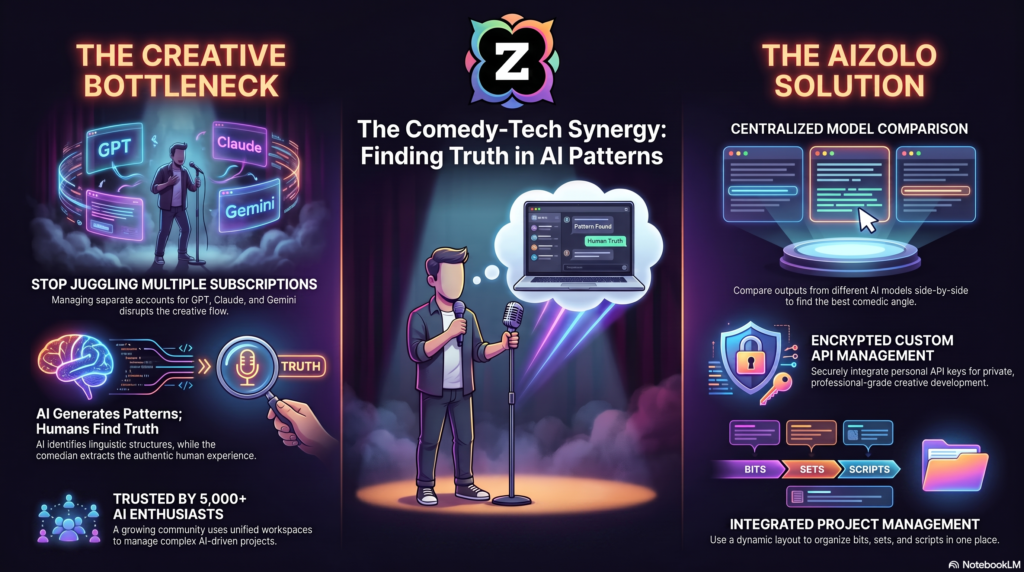
AI for generating stand-up comedy and dark humor has exploded over the past two years. Aizolo has become one of the platforms comedians with a laptop try—some swear by it, while others swear at it.
Most end up somewhere in the middle: impressed by the speed, frustrated by the blandness, and genuinely unsure how to fit these tools into a creative workflow built on instinct, timing, and lived experience.
This guide is for them. And for the curious. And for the working writer who needs 40 jokes by Friday.
We’ll cover what AI comedy tools can actually do, which ones are worth your time, how to prompt them properly, where dark humor gets complicated, and what the best comedians do that no language model has figured out yet.
No hype. No fluff. Just what you need to know.
Table of Contents
Can AI Actually Understand Humor?
Short answer: No. Longer answer: Not in any way that resembles how a human does.
Humor is fundamentally about violated expectations. A good joke sets up a mental model and then collapses it in a specific, satisfying way. That collapse needs to feel both surprising and inevitable.
The best comedians — your Mulaneys, your Notaros, your Glover-era stand-up specials — make you feel like you couldn’t have seen it coming but also couldn’t imagine it going any other way.
AI language models work by predicting likely next tokens based on patterns learned from billions of words of text. They have seen a staggering number of jokes. They know what jokes look like.
They can reproduce the grammatical shape of a setup and punchline. But they do not experience surprise. They don’t know what it’s like to be a human in a specific moment, in a specific room, with a specific cultural chip on your shoulder.
What they do instead is pattern-match against a vast internal library of joke structures, comedic setups, and punchline templates. This is not nothing.
It’s actually quite useful for brainstorming, for generating volume, for breaking writer’s block. But it’s a fundamentally different process from what happens when a comedian finds a joke in their own life.
The key insight: AI generates jokes. Comedians find jokes. The difference matters.
That said, when AI is used as a brainstorming tool rather than a replacement writer, it can dramatically speed up the creative process. It’s at its best when a human is steering.
Why Timing Matters More Than Punchlines
Ask any working comedian what separates a good joke from a great one and they’ll probably say one word: timing.
A punchline lands differently depending on when it arrives. The pause before it. The rhythm of the sentence leading in. Whether the audience is slightly tense or fully relaxed.
Whether the comedian looks left or right when they say it. These micro-variables compound in ways that no text-based AI can account for.
This is one of comedy’s fundamental challenges for any AI comedy writer assistant: the joke on the page is not the joke in the room.
Here’s a practical example. Consider these two versions of the same punchline:
Version A: “And then she said she loved me. Which was weird. Because we’d only met at my funeral.”
Version B: “She said she loved me. We’d only met at my funeral.”
Version B is funnier on paper because it’s tighter. But a skilled performer might deliver Version A because the extra words give the audience time to lean in. The “which was weird” is a permission slip. It tells the audience: yes, what’s coming is strange, you’re allowed to laugh.
AI can generate both versions. It cannot tell you which one works for you, in your voice, in your room.
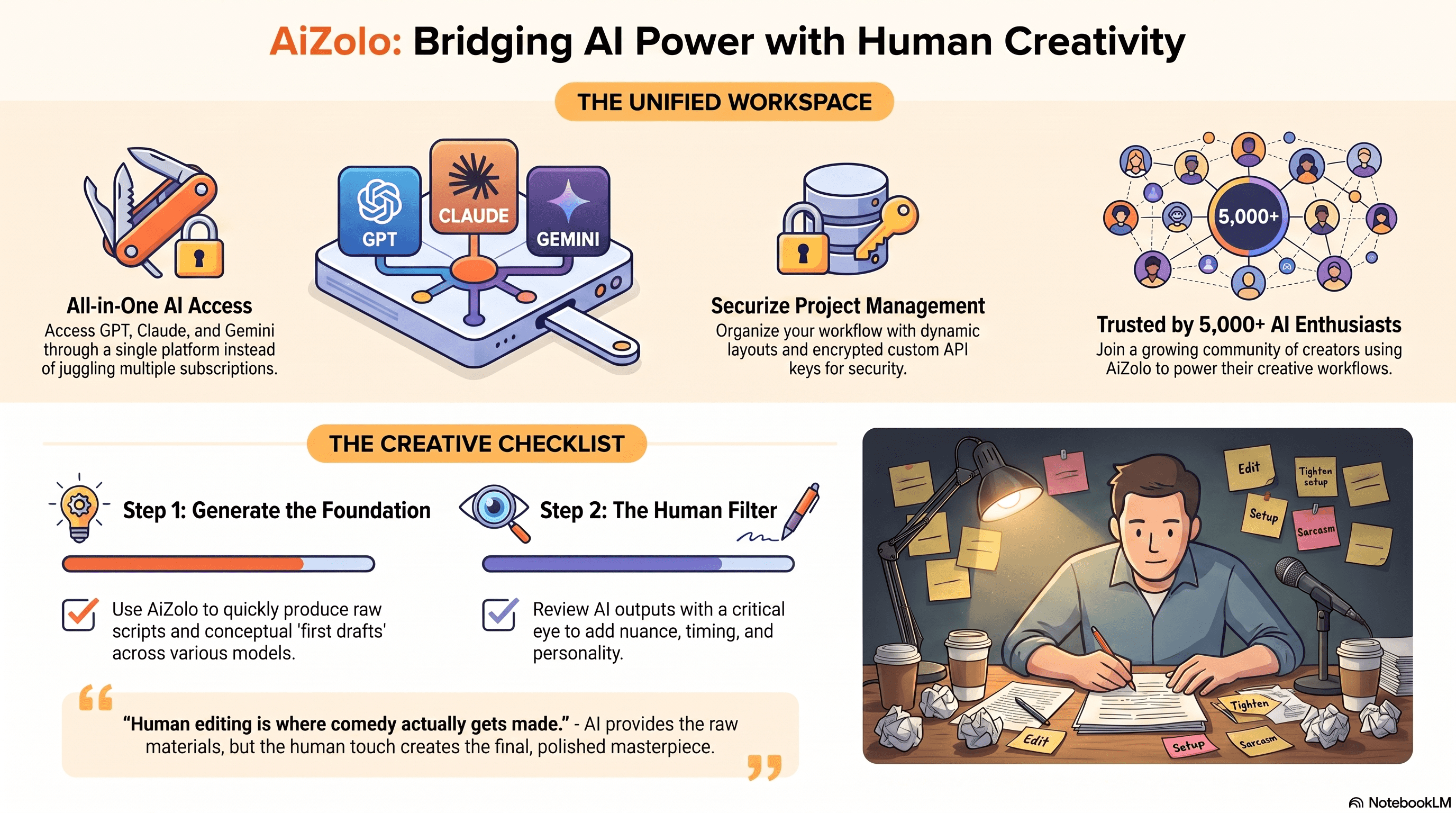
This is why AI-generated comedy always needs a human performance layer on top of it. The script is just the skeleton.
Workflow implication: When reviewing AI-generated jokes, read them out loud. The ones that feel natural in your mouth are the ones worth keeping.
What AI Comedy Tools Are Actually Good At
Despite the limitations, AI tools have real strengths when used correctly. Here’s where they genuinely deliver:
Volume generation. Writer’s block is the enemy of stand-up preparation. AI can generate 50 joke premises in minutes. Most will be garbage. But if five of them spark something real, that’s five more than you had before.
Structural variations. Give an AI a joke you’ve written and ask it to rewrite it ten different ways. You’ll often find a version with a better word order, a tighter punchline, or a callback you hadn’t considered.
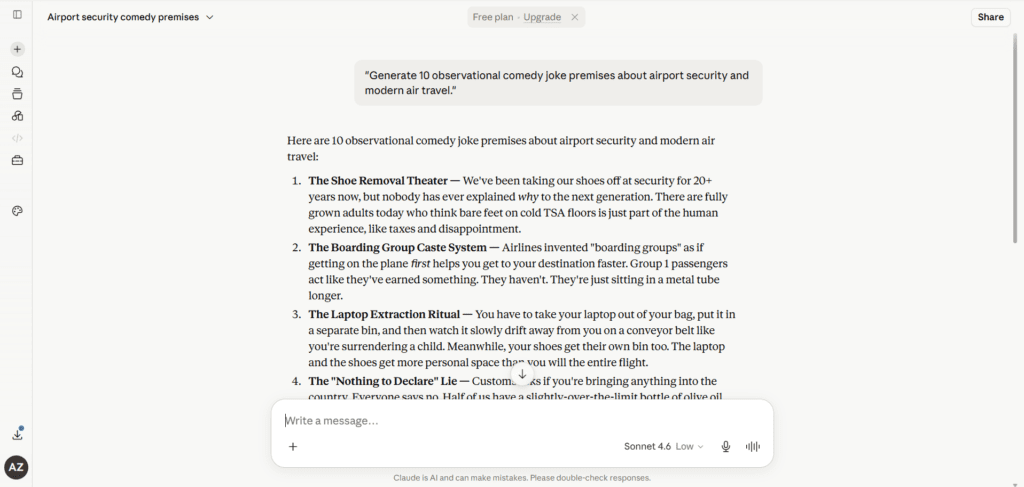
Premise exploration. AI is good at identifying angles on a topic. If you’re writing about airport security, it can quickly surface “taking off shoes,” “TSA’s attitude,” “the liquid rule,” “the guy who forgets his belt” — all the standard entry points. That gives you a map of the territory.
Callback generation. Ask an AI to read your entire set and identify callback opportunities. It can spot recurring themes and suggest places where a reference to an earlier bit would land well.
Wordplay and puns. AI models are genuinely strong at linguistic pattern-matching. If you need puns, homophones, or unexpected word substitutions, they can crank these out reliably.
Topic brainstorming for specific audiences. “Generate 20 comedy topics that would resonate with nurses who’ve worked overnight shifts” is a genuinely useful prompt. AI can think across demographics quickly.
Best AI Tools for Comedy Writing
After testing each of these tools across multiple comedy styles and prompt types, here’s the honest comparison:
| Tool | Best For | Dark Humor Support | Custom Persona | Price (2025) | Verdict |
|---|---|---|---|---|---|
| ChatGPT (GPT-4o) | Volume generation, brainstorming | Moderate (with prompting) | Strong via system prompts | Free / $20/mo Plus | Best all-around |
| Claude (Anthropic) | Nuance, character voice, longer sets | Careful but capable | Excellent | Free / $20/mo Pro | Best for voice matching |
| Gemini Advanced | Research-backed comedy, topical humor | Limited | Moderate | $20/mo (Google One AI) | Good for topical sets |
| Perplexity AI | Current events comedy | Limited | Weak | Free / $20/mo Pro | Best for news-based humor |
| Mistral (Le Chat) | Experimental, less filtered | More permissive | Moderate | Free / €15/mo | Worth testing |
| Jasper AI | Marketing-friendly humor, brand voice | Very limited | Good | $49/mo | Overkill for most comedians |
| Copy.ai | Short-form jokes, social captions | Limited | Moderate | Free / $49/mo | Decent for social content |
Notes on the comparison:
Claude tends to produce more contextually aware jokes — it’s better at understanding what isn’t funny and steering away from it, which paradoxically makes it more useful for dark comedy work because it forces you to be intentional with your framing.
ChatGPT is the most comfortable to iterate with quickly. The conversation format suits comedy brainstorming naturally.
Gemini struggles with consistent comedic voice but is genuinely useful when you need topical material grounded in recent news.
Why AI Struggles with Live Audience Context
This deserves its own section because it’s the most important limitation — and the one most beginners misunderstand.
Stand-up comedy is not literature. It’s a live performance art form. The audience brings everything with them: their mood, their demographics, the news cycle of that week, the vibe of the venue, the energy of the opening act. A joke that killed on Thursday can die on Friday because the room changed.
AI has no access to any of this. It generates comedy for an imaginary, averaged audience. That averaged audience tends to be… polite. Suburban. Easily satisfied by well-structured premises with obvious but inoffensive punchlines.
Real audiences are not averaged. They’re specific. And specificity is where comedy lives.
The crowd work problem. Crowd work — where a comedian improvises with specific audience members — is one of the most beloved parts of live stand-up. It’s also completely inaccessible to AI. The best AI can do is help you prepare response templates for common audience scenarios (“what do you do for a living?” responses, heckler comebacks, responses to unusual names). This is actually useful preparation, but it’s not real crowd work.
The reference gap. A topical joke about something that happened yesterday may not be in an AI’s training data. You can work around this with web-enabled tools like Perplexity or Gemini, but the quality of topical humor from AI is generally lower than what a well-read comedian writes themselves.
The filter gap. AI tools apply safety filters that are calibrated for a general internet audience, not a comedy club audience that signed up specifically to hear uncomfortable things said out loud. This creates a constant tension that dark humor writers especially will feel.
Different Humor Styles AI Can Emulate
AI handles different comedic styles with varying degrees of success. Here’s the honest breakdown:
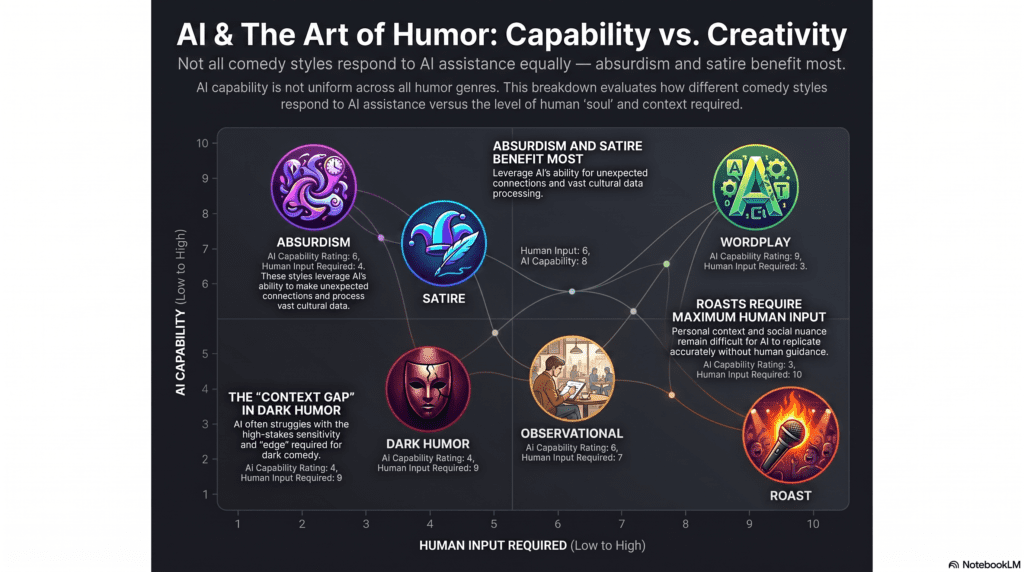
Observational comedy — AI handles this reasonably well. It can identify universal human experiences and frame them comedically. The material tends toward safe, relatable premises (airports, grocery stores, social media). Strong starting point, requires human specificity added.
Self-deprecating humor — AI can write general self-deprecating jokes but lacks the personal detail that makes this style land. You need to feed it real information about yourself to get anything useful.
Satire — This is where AI actually shines. Give it a clear target (a political position, a corporate trend, a cultural absurdity) and frame your intent clearly. The structural logic of satire — exaggerate the internal logic of something until it collapses — suits how language models reason.
Absurdist comedy — AI is surprisingly good here. Absurdism requires departing from logic in a consistent internal way, and AI models can generate strange but internally coherent scenarios without difficulty.
Dark comedy — This requires the most careful prompting and human oversight. More on this below.
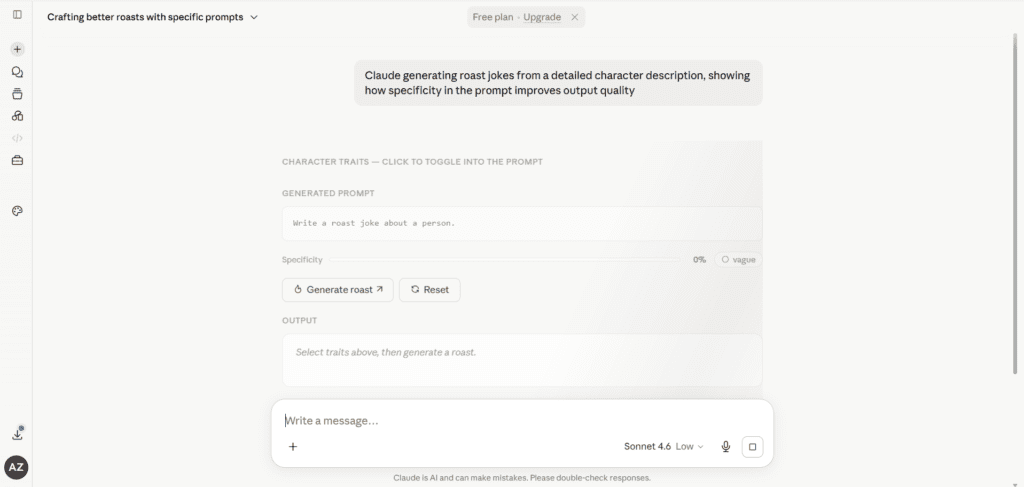
Roast comedy — AI can generate roast-style jokes but tends to flatten them. Real roast jokes require knowing the specific person deeply. With sufficient character detail, AI output improves dramatically.
Wordplay and puns — Strong AI territory. It can generate dozens of pun variations quickly.
Sketch comedy — AI can draft basic sketch structures but struggles with the comedic rhythm of back-and-forth dialogue and escalating absurdity without human intervention.
How to Write a Stand-Up Routine with AI: Step-by-Step Workflow
This is the practical workflow used by comedians who’ve integrated AI tools effectively.
Step 1: Define your topic and voice before opening any AI tool
Write down: What is this set about? What’s your point of view on it? What do you genuinely feel about this topic? This prevents you from just accepting the AI’s angle on the subject, which will almost always be generic.
Step 2: Generate premises, not jokes
Your prompt: “Give me 30 comedy premises about [topic] from the perspective of someone who [your specific angle]. Just premises — one sentence each, no punchlines yet.”
This gives you raw material to react to. Reject what doesn’t feel like you. Circle what sparks something. Add your own premises to the list.
Step 3: Develop the premises you like
For each premise you circled: “Take this premise: [X]. Give me 5 different punchline directions — some obvious, some unexpected, one absurd, one dark.”
Review each direction. The AI is showing you the shape of the joke space. Your job is to find where your instinct wants to go.
Step 4: Tighten the language
Once you have raw jokes you like: “Rewrite this joke to be 30% shorter without losing the punchline. Keep the voice casual and direct.”
Then read it out loud. If it sounds like you, keep it. If it sounds like a language model, rewrite it yourself.
Step 5: Build callbacks
“Here are five jokes from my set: [paste jokes]. Identify any themes, words, or images that could serve as callback material later in the set.”
Then: “Write three callback lines that reference [specific element from earlier joke] and could land at the end of the set.”
Step 6: Build the structure
“Here are 12 jokes: [paste jokes]. Arrange them into a 5-minute set structure. Put the strongest joke in the second position, build energy through the middle, and end on my biggest closer.”
AI is actually decent at set structure because it can see the whole thing at once and suggest logical progressions. Use this output as a starting point, not a final decision.
Step 7: Final human pass
Print it out. Perform it in front of a mirror or camera. Cross out everything that doesn’t feel like you. Rewrite those sections by hand. The AI set is now your first draft.
Prompt Library: 25+ Ready-to-Copy Comedy Prompts
Stand-Up Premises
Generate 20 observational comedy premises about working from home. Focus on the psychological weirdness, not just the convenience clichés.Write 15 stand-up premises about getting older that avoid the obvious topics (knees, early bedtimes). Find the angles nobody's done.Give me 10 comedy premises about technology from the perspective of someone who is simultaneously dependent on it and suspicious of it.
Punchline Development
Here's my setup: "[YOUR SETUP]". Give me 8 different punchline options — vary the length, the word order, and the emotional register. Include one that goes darker than expected.Rewrite this joke three ways: once as self-deprecation, once as absurdism, once as pure wordplay. Original joke: "[YOUR JOKE]"This punchline lands flat: "[YOUR WEAK PUNCHLINE]". What's the core comedic logic? Give me 5 punchlines that land on the same truth more sharply.
Roast Writing
Write a roast joke for someone who [brief character description: job, hobby, personality quirk]. The joke should punch up, not down. Avoid anything about appearance.I'm roasting my friend who [describe specific trait or habit]. Give me 6 roast jokes that are mean but clearly affectionate. Think bachelor party speech energy.
Observational Comedy
Write observational comedy about airport security that goes beyond the obvious (shoes, liquids). Find the existential or psychological layer.What's funny about grocery store self-checkout? Give me 10 angles and develop the three most original ones into full jokes.Write observational material about the specific social awkwardness of being the first person to arrive at a party.
Satire
Write a satirical stand-up bit about corporate wellness programs. The tone should be absurdist — take the internal logic of corporate wellness to its illogical extreme.Write satire about social media culture that doesn't rely on "phones at dinner" clichés. Find the deeper absurdity.Satirize the "hustle culture" mindset as if it were a religion. Use the specific language and logic of religious devotion applied to productivity.
Dark Humor
Write dark comedy about [topic: death, illness, failure] that finds genuine human truth rather than shock value. The darkness should make the joke more honest, not just more extreme. Avoid targeting any protected group — the target should be the situation or system, not people.Write a dark humor joke about [universal human fear] from a perspective of acceptance rather than cruelty. Think Carlin-era philosophy, not trolling.
Callbacks
Here are five jokes from my set: [PASTE JOKES]. Find three callback opportunities and write the callback lines.I opened my set with this joke: [PASTE JOKE]. I want to close the set by returning to this image in an unexpected way. Give me 5 options for the callback closer.
Crowd Work Preparation
I'm performing at a company holiday party for [describe company type]. Give me 10 crowd work questions I could ask to get audience members talking, plus a follow-up comedy response for each most likely answer.Give me 8 responses to "What do you do for a living?" for these common answers: teacher, accountant, nurse, software engineer, "I'm between jobs," and "I'd rather not say."
Open Mic Preparation
I have 5 minutes at an open mic. Here are my 8 jokes: [PASTE]. Arrange them in the best order for a first-time audience. Explain why you made each structural choice.I'm nervous about [specific scenario: no laughs, heckler, forgetting material]. Give me mental frameworks and specific lines for handling each situation.
Podcast Humor
I host a comedy podcast about [topic]. Give me 15 episode-opening jokes that connect to the theme without being too inside-baseball for new listeners.
Social Media Content
Write 10 Twitter/X-length jokes (under 280 characters) about [topic]. Each should have a clear setup and punchline structure. No threads.Give me 5 Instagram caption options for [describe situation/photo] that are funny without trying too hard.
Real Prompt Examples with Outputs and Analysis
Let’s look at how specific prompts perform in practice.
Example 1: Observational Comedy About Airport Security
Prompt: “Write observational comedy about airport security that goes beyond the obvious (shoes, liquids). Find the existential layer.”
AI Output (condensed):
“There’s a moment in airport security that nobody talks about. You’ve put your laptop in a separate bin. Your shoes in another bin. Your belt, your watch, your dignity — all in separate bins.
And you’re standing there in your socks, arms out, waiting for a machine to decide if you’re a threat to society.
And you think: this is the most honest I’ve ever been in public. I have no armor. I have no persona. I am just a person in socks, hoping I didn’t accidentally pack my travel-sized confidence.”
Why this works: The AI found a genuinely interesting angle — the vulnerability of the security checkpoint as an existential strip-down. The “travel-sized confidence” line is solid wordplay.
The rhythm is slightly long for a punchline but could be tightened. A human comedian would add specific detail from their own experience (“I was wearing the socks with the dogs on them”).
What needs human editing: The transition from the sequence of bins to the “most honest” line needs a beat — a pause in delivery. The final image needs one more specific, personal detail to land.
Example 2: Dark Humor with Guardrails
Prompt: “Write a dark humor joke about medical diagnosis that finds the absurdity in the situation rather than targeting sick people. Punch up — at the system or the euphemisms.”
AI Output:
“My doctor called to say the test results were ‘concerning.’ Concerning. That’s the medical word for ‘I’ve seen this before but I need you to calm down before I explain the rest.’ They have a whole vocabulary for this. ‘Atypical’ means ‘wrong.’ ‘Unremarkable’ means ‘fine.’ ‘Remarkable’ means ‘you’ve made my day terrible.'”
Why this works: The target is the medical euphemism system, not people who are sick. The escalating definition structure is clean. “You’ve made my day terrible” is a good inversion — the patient’s terror framed through the doctor’s inconvenience. This is dark humor that punches at power (institutional language that dehumanizes) rather than at vulnerability.
What needs human editing: The opening line is generic. A comedian would start with their specific doctor, their specific voice.
Dark Humor and AI: Where Things Get Complicated
Dark humor is the most interesting frontier for AI comedy tools — and the most fraught.
The best dark comedy has always served a purpose: it processes what’s too painful to discuss directly. Richard Pryor talking about his drug addiction. Joan Rivers on aging and death. Anthony Jeselnik on taboo subjects with a persona so clearly performative that audiences understand the contract.
The problem with AI-generated dark humor is that AI has no stake in the material. It doesn’t know what it’s like to be ill, grieving, marginalized, or angry about something real. So when it writes dark jokes, it tends to go one of two directions:
Too safe: Dark comedy that isn’t actually dark. Jokes with dark setups that pivot to harmless punchlines. “Edgy” in shape but not in substance.
Too crude: When prompted to push limits, some AI tools produce material that is simply mean rather than truthful. Cruelty without insight. This is the worst outcome — it’s not dark humor, it’s just dark.
How to prompt for genuine dark comedy:
The framing matters enormously. Compare:
- “Write a dark joke about cancer.” → Usually produces either an inappropriate cancer punchline or a sanitized deflection.
- “Write dark humor about the waiting — the period between a diagnosis and knowing what happens next. The target is the uncertainty itself, not the illness. Find the absurdity in how we’re supposed to behave normally during that time.” → Produces something with genuine emotional truth.
The second prompt gives the AI a point of view. It specifies the target (uncertainty, not illness), the angle (behavioral absurdity), and the emotional register (absurdist rather than cruel). This level of directorial clarity gets dramatically better results.
Ethical lines that remain firm regardless of framing:
Punch direction matters. AI-generated dark humor works best when it targets:
- Systems (medical, legal, bureaucratic)
- Situations (death, failure, awkward circumstances)
- Universal human experiences (fear, embarrassment, self-deception)
It becomes genuinely problematic when AI generates material that targets:
- Protected characteristics (race, religion, disability, sexual orientation, gender)
- Specific individuals for harassment
- Victims of trauma or tragedy without redemptive purpose
These lines aren’t just about safety filters — they’re about craft. The best dark comedy punches through darkness toward something true. Punching down is almost always lazy writing.
Common Mistakes Beginners Make
Mistake 1: Accepting the first output. The first response is almost never the best one. Always iterate. Ask for variations, alternatives, and different approaches.
Mistake 2: Prompting for jokes instead of premises. “Write me 10 jokes about dating” produces weaker material than “Give me 10 premises about the specific weirdness of dating in your 30s.” Work in stages.
Mistake 3: Not specifying voice. Generic prompts produce generic comedy. Tell the AI whose voice you’re going for, or describe your own. “Write in a dry, deadpan style, short sentences, no exclamation points” produces noticeably different output.
Mistake 4: Using AI-generated jokes verbatim on stage. The phrasing AI uses is subtly wrong for performance. Words chosen for reading don’t always suit speaking. Rewrite every AI-generated joke in your own words before performing it.
Mistake 5: Ignoring the bad output. The jokes you reject are often more useful than the ones you keep. A bad AI joke in the right neighborhood shows you where you don’t want to go — which can clarify where you do.
Mistake 6: Expecting AI to know your life. The most powerful stand-up comes from specific personal experience. AI can help you find the shape of a joke; only you have the content.
Mistake 7: Skipping the read-aloud step. This cannot be overstated. Read every AI-generated joke out loud before deciding if it works. The mouth knows things the eye misses.
Ethical Concerns Around Offensive Jokes
The ethics of AI comedy writing deserve honest treatment.
There is a legitimate concern that AI systems can be prompted — with enough patience — to generate material that is racist, sexist, ableist, or otherwise harmful. The guardrails on major AI platforms exist precisely because of this.
When people circumvent those guardrails (jailbreaks, persona prompts that “roleplay” different values), they may generate material that is not only offensive but genuinely harmful when spread.
Comedy has always pushed against social norms. That’s part of its value. But there’s a meaningful difference between a comedian from a marginalized group reclaiming a narrative about their experience, and an anonymous AI-generated post “joking” about that same group’s experience without accountability or context.
Accountability matters. A stand-up comedian stands on a stage with their name attached. They live with the consequences of what they say. An AI has no consequences. This asymmetry is ethically significant.
AI-generated offensive material spreads without context. A live audience understands that they’re in a comedy club with a specific performer. Text shared online strips all of that context away. Jokes that work in one context become something entirely different when screenshot and redistributed.
For working comedians: The ethical principle is the same as it’s always been — you are responsible for what you say. AI is a tool. If you use AI to generate something harmful and perform it, the responsibility doesn’t transfer to the AI. It stays with you.
AI Hallucinations in Comedy
Here’s an unexpected problem that comedy writers run into with AI: the confident wrong punchline.
Language models are optimized for fluency and coherence. They generate text that sounds correct and complete. In factual writing, this manifests as AI confidently stating wrong facts (hallucinations). In comedy writing, it manifests as jokes that have the form of a funny joke without actually being funny.
The setup scans. The punchline arrives at the expected moment. The rhythm is correct. And yet — it doesn’t land. There’s something structurally present and comedically absent.
This is, in a strange way, the comedy equivalent of an AI hallucination: a joke-shaped object that isn’t a joke.
Experienced comedy writers can spot these immediately. The tell is usually one of three things:
- The punchline is predictable. You saw it coming from the setup. No subverted expectation.
- The punchline is random. It’s unexpected but not in a satisfying way — there’s no logic connecting it to the setup.
- The joke is technically accurate. It makes a factually correct observation that just isn’t funny. Comedy and correctness are not the same thing.
How to filter for these: After getting AI output, ask yourself: “Would I be surprised if someone said this to me?” If the answer is no — if you can predict exactly where the sentence is going — cut it.
Human Editing Checklist for AI-Generated Jokes
Before any AI-generated material goes into your set, run it through this checklist:
Voice check
- [ ] Does this sound like something I would actually say?
- [ ] Is the vocabulary mine, or is it the AI’s “slightly formal default”?
- [ ] Have I replaced any words that feel artificial with my natural equivalents?
Comedy mechanics check
- [ ] Is the punchline genuinely surprising in hindsight?
- [ ] Is the setup as tight as it can be — no unnecessary words before the pivot?
- [ ] Have I read this out loud at least twice?
- [ ] Does the rhythm work when spoken, not just when read?
Specificity check
- [ ] Can I add a personal detail that makes this feel lived-in rather than generic?
- [ ] Have I replaced any vague references with specific ones?
Originality check
- [ ] Could this joke have been written by any comedian, or does it feel like mine?
- [ ] Is there a version of this joke that’s already well-known that this too closely resembles?
Ethics check
- [ ] Who is the target of this joke?
- [ ] Does the joke punch up, at systems, or at universal experience?
- [ ] Would I be comfortable saying this under my own name in any context?
Structural check
- [ ] Does this joke fit where I’ve placed it in the set?
- [ ] Does it set up any callbacks I can use later?
- [ ] Is the closer of the joke strong enough, or does it trail off?
The Future of AI-Assisted Comedy Writing
Where is this going? Honestly, faster than most people in comedy are comfortable with.
Multimodal AI and performance feedback. Models that can watch a performance and provide timing feedback are already in development. Imagine uploading a video of your set and getting analysis: “Pause 0.3 seconds longer after ‘airport’; your current delivery rushes the punchline.”
Voice-matched joke generation. As AI context windows expand, you’ll be able to feed entire transcripts of your previous sets and get generation that’s genuinely tuned to your style. Early versions of this exist now; they’ll improve significantly.
Real-time crowd analysis. AI tools that analyze audience response in real-time (through video or audio) could, theoretically, flag when a bit isn’t landing and suggest pivots. This is further out — and raises interesting questions about authenticity.
AI comedy writers in professional rooms. This is already happening quietly. Writers’ rooms use AI for brainstorming. Late-night shows use it for volume generation. This isn’t replacing comedy writers — it’s changing what the job looks like. The judgment and the voice still need to be human.
The copyright question. AI-generated comedy exists in legally murky territory. If you use an AI output verbatim in a published special, who owns it? Current U.S. copyright guidance suggests AI-generated content without sufficient human authorship may not be copyrightable. This matters enormously for comedians building a body of work. The practical advice: always substantially edit AI output. Make it yours, demonstrably.
Conclusion
AI for generating stand up comedy and dark humor is a genuine tool with genuine limitations. It won’t replace comedians. It won’t understand timing, live audiences, or the specific weight of personal experience. But it will help you brainstorm faster, generate more material, find angles you’d have missed, and break through the blank-page paralysis that kills creative momentum.
The comedians who will get the most from these tools are the ones who treat AI as a first-draft machine — something that gives you raw material to react to, not finished product to perform. The judgment, the voice, the truth in the joke: that’s still yours.
Dark humor specifically requires the most care. The best dark comedy punches through pain toward something true. AI can sketch the shape of that; only a human with real stakes can fill it in.
Use the prompt library. Use the workflow. Edit everything. Read it out loud. Put your specific life into it.
The funniest version of any AI-generated joke is the version you write after the AI shows you what it can’t do.
FAQs
1. Can AI write stand-up comedy jokes?
Yes, AI can generate stand-up comedy jokes, but with important caveats. AI tools like ChatGPT and Claude can produce large volumes of joke premises, punchline variations, and structural suggestions quickly. The quality varies significantly — the best outputs require careful prompting, iteration, and human editing. AI-generated jokes tend to be structurally correct but generically phrased; the comedian’s job is to add voice, specificity, and personal truth.
2. What is the best AI tool for comedy writing?
For most comedians, ChatGPT (GPT-4o) offers the best balance of volume, flexibility, and iteration speed. Claude tends to produce more nuanced output for character voice and longer-form sets. Gemini is useful for topical, research-backed humor. The best approach is testing at least two tools for your specific style — different AI models produce noticeably different comedic defaults.
3. Can AI generate dark humor?
AI can generate dark humor, but it requires careful prompting. Most platforms apply safety filters that default toward avoiding dark or controversial content. The key is framing: specify the target of the humor (systems, situations, universal experiences rather than protected groups), the angle (absurdist, satirical, philosophical), and the purpose (processing truth, not causing harm). Vague “dark joke” prompts typically produce either sanitized material or crude shock content.
4. Is it ethical to use AI-generated jokes in stand-up?
Using AI as a brainstorming and drafting tool is generally considered acceptable in the comedy community, similar to how writers have always used research, collaboration, and feedback. The ethical line is around disclosure and editing: claiming an entirely AI-generated set as original work is deceptive; substantially editing and personalizing AI output into your own material is standard creative process. Be transparent with fellow comedians. Perform material you can stand behind.
5. Will AI replace stand-up comedians?
Not in any meaningful near-term sense. Stand-up comedy is a live performance art built on specific human experience, timing, audience connection, and vulnerability. AI can assist with the writing component of comedy creation but has no access to the performance layer where comedy actually lives. It’s more accurate to say AI changes what comedy writing looks like as a workflow — not that it replaces the comedian.
6. What comedy styles work best with AI?
Satire, absurdist comedy, observational premises, wordplay, and puns are where AI performs most reliably. Self-deprecating humor, personal anecdote comedy, and crowd work are least suited to AI (they require specific personal information). Dark comedy can work well with precise prompting.
7. How do I prompt AI for funnier jokes?
Work in stages rather than asking for finished jokes. Prompt for premises first, then punchline options for each premise, then refinement. Be specific about tone, target, and voice. Give the AI constraints: “shorter,” “more specific,” “less predictable,” “darker,” “absurdist.” The more directorial your prompt, the better the output.
8. Can AI help with crowd work?
Not in real-time — AI cannot react to a live audience. But AI is useful for preparing crowd work: generating response templates for common audience scenarios, practicing comebacks for likely heckler lines, and brainstorming opening questions for different venue types. Think of it as rehearsal preparation, not live performance support.
9. Are AI-generated jokes copyrightable?
Under current U.S. Copyright Office guidance, AI-generated content without sufficient human authorship may not qualify for copyright protection. If you substantially edit and personalize AI-generated jokes — changing the language, adding original content, restructuring the material — the resulting work may be protected as your own. Verbatim AI output is legally uncertain. Always substantially edit any AI material you intend to publish or perform professionally.
10. What mistakes do comedians make when using AI for jokes?
The most common mistakes are: accepting the first output without iteration, using AI-generated text verbatim without editing for voice, prompting for finished jokes instead of working in stages, ignoring the read-aloud test, and not adding personal specificity to generic AI premises.
11. Can AI write roast jokes?
Yes, and this is one of the stronger use cases. Roast jokes follow a clear structure that AI handles well. The quality improves dramatically when you provide detailed information about the person being roasted — their job, habits, quirks, specific incidents. Generic “roast someone who is lazy” prompts produce generic results; specific character details produce sharper material.
12. How does AI handle timing in comedy?
AI cannot manage timing in the performance sense — it has no access to pauses, delivery speed, or audience response. But it can help with written timing: varying sentence length for rhythm, placing punchlines at the end of clauses, tightening setups. The performance timing layer always requires the comedian.
13. What are the limits of AI comedy generation?
The core limits: AI has no lived experience to draw from; it generates jokes about what jokes look like, not from genuine feeling. It cannot access live audience context or adjust in real-time. Its safety filters restrict the darkest and most challenging material. It tends toward generic phrasing that requires human rewriting. And it has no understanding of comedic timing in performance.
14. Should I tell audiences when jokes are AI-assisted?
This is an evolving community norm rather than a legal requirement. Many working writers and comedians use AI tools without disclosure, similar to how comedy writers have always used ghost writers, collaborators, and punch-up writers without stage disclosure. If you substantially edit and personalize AI material, disclosure is a personal choice. If you perform AI output with minimal editing and present it as entirely original, that starts to feel dishonest.
15. Can AI help with open mic preparation?
Yes — this is one of the most practical applications. AI can help structure a 5-minute set, suggest joke ordering based on energy progression, generate backup jokes if your first choices don’t land, prepare responses for common scenarios, and brainstorm material for specific venue types.
Key Takeaways
- AI for generating stand up comedy and dark humor works best as a brainstorming and drafting tool, not a replacement for human comedic judgment.
- The most effective workflow: generate premises first, develop punchlines second, refine language third, add personal specificity last.
- ChatGPT and Claude are the strongest general-purpose AI comedy tools; the best choice depends on whether you prioritize volume or voice.
- Dark humor requires directorial prompting — specify target, angle, and purpose explicitly to avoid sanitized or cruel outputs.
- AI cannot replicate comedic timing, live audience context, or the personal experience that makes stand-up feel true.
- Every AI-generated joke should pass a read-aloud test and a voice check before going into a set.
- The comedian remains legally and ethically responsible for all material they perform, regardless of its source.
- AI-generated content without substantial human editing may not qualify for copyright protection under current guidance.
- The future of comedy writing likely involves AI as a standard collaborator — like a writers’ room tool, not a replacement for the comedian.
- The funniest version of any AI output is the one you write after seeing what the AI got wrong.
About the Author
Jeevesh Tripathi is an Expert AI Researcher and Technical Content Specialist at Aizolo, focused on AI productivity, generative AI platforms, prompt engineering, and emerging AI technologies. Jeevesh researches AI tools extensively, evaluates real-world workflows, and creates evidence-based guides that help professionals choose the right AI solutions.
suggestion for site design: I thought i was never going to stop scrolling down. Your site is too “wordy.” I’m just looking for a way to register because i need an AI to help me re-write a 19 question questionnaire, and google sent me here. I still don’t even know if there’s a place to create an account here. I dont see menu’s or anything that’s intuitive
you can login here https://chat.aizolo.com/