Every AI user has hit the same wall.
You ask a confident question. You get a confident answer. Then you check it — and it’s wrong.
That gap between confidence and correctness has a name: hallucination. With Aizolo, the Chain-of-Verification prompt template helps close that gap by verifying AI-generated answers before you rely on them.
This guide breaks down what it is, how it works, and how to use it — with copy-paste templates for ChatGPT, Claude, Gemini, and more.
Here’s what you’ll learn:
- What the Chain-of-Verification prompt template actually is
- Why AI hallucinates in the first place
- A step-by-step breakdown of the CoVe process
- Ready-to-use templates for research, coding, business, and more
- Real before/after examples
- Benefits, limits, and best practices
- How CoVe compares to Chain-of-Thought and Tree-of-Thoughts
Let’s start with the fundamentals.
Table of Contents
What Is the Chain-of-Verification Prompt Template?
The Chain-of-Verification prompt template (CoVe) is a structured prompting method that asks an AI model to check its own answer before presenting it as final.
Instead of accepting the first response, the model:
- Drafts an initial answer
- Generates independent verification questions
- Answers those questions separately
- Cross-checks the answers against the original response
- Produces a corrected, verified final answer
CoVe was introduced by Meta AI researchers in a 2023 paper on reducing hallucinations in large language models through self-verification. The core idea is simple: separating drafting from checking produces more accurate output than asking a model to “just be careful.”
This matters because a single-pass answer has no built-in error correction. CoVe adds that correction loop directly into the prompt.
Why AI Hallucinates
Before using CoVe effectively, it helps to understand what it’s actually fixing.
Prediction, Not Reasoning
Language models predict the next most likely word based on patterns. They don’t “look up” facts the way a database does.
Missing or Outdated Context
If a model wasn’t trained on a fact, or the fact changed after training, it may fill the gap with something plausible instead of admitting uncertainty.
Fabricated Citations
Models sometimes generate citation-shaped text — a real-looking author, title, and year — that doesn’t correspond to any actual source.
Overconfidence
Most models are trained to produce fluent, decisive answers. That fluency reads as confidence, even when the underlying claim is shaky.
Example: Ask a model for “three peer-reviewed studies on X published in 2019,” and it may invent titles that sound right but don’t exist. CoVe catches this by forcing a second, independent pass that checks each claim in isolation.
How Chain-of-Verification Works
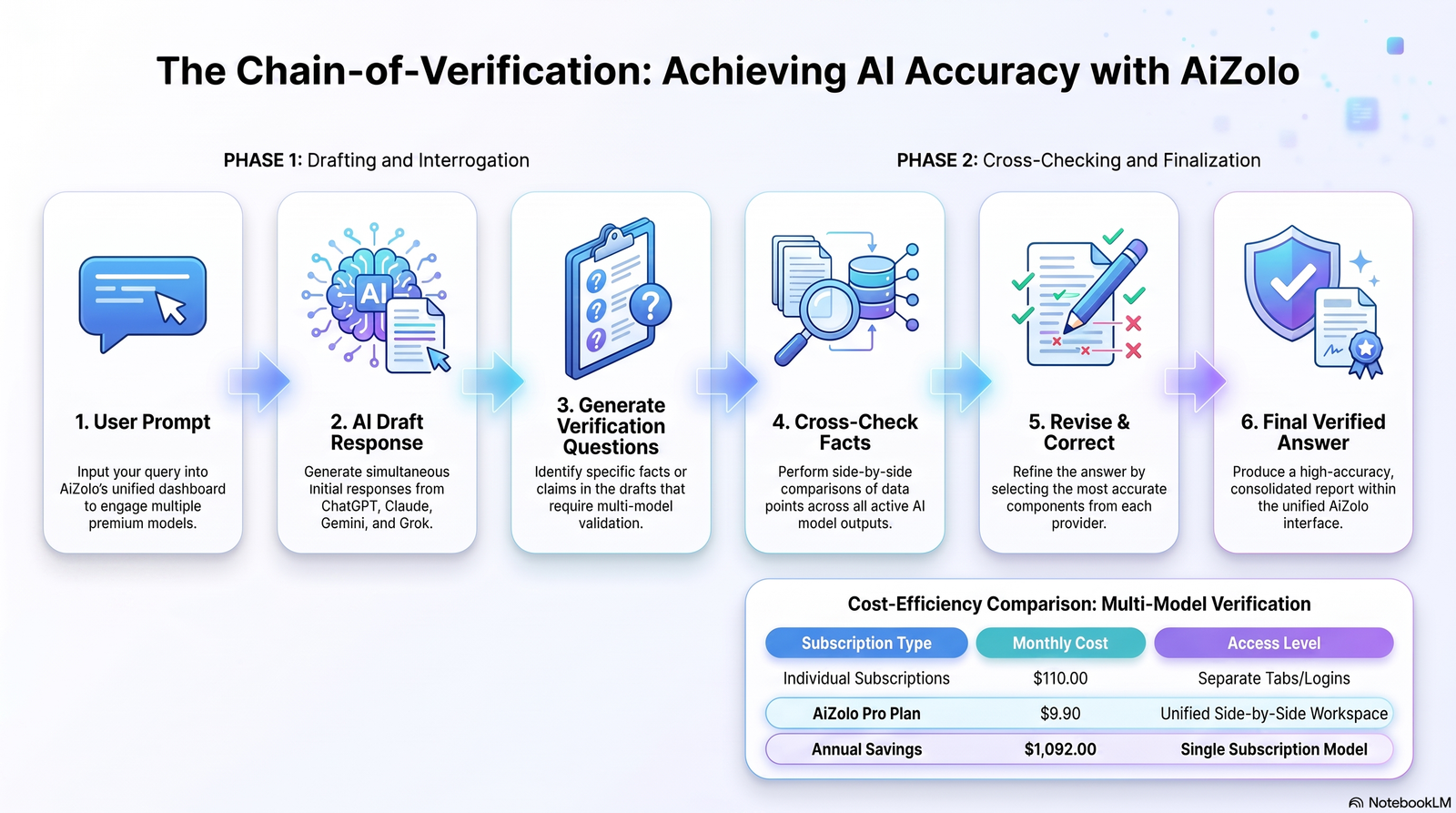
The CoVe process follows a repeatable flow:
Question
   ↓
Initial Answer
   ↓
Verification Questions
   ↓
Independent Verification
   ↓
Revised, Verified Answer
Stage 1 — Initial Answer: The model answers the question normally, as it would in a single-pass response.
Stage 2 — Verification Questions: The model generates specific, checkable questions targeting each factual claim in the initial answer.
Stage 3 — Independent Verification: The model answers each verification question separately, without referencing the original answer. This isolation step is what prevents the model from just confirming its own bias.
Stage 4 — Comparison: The model compares the verification answers against the original claims and flags any mismatches.
Stage 5 — Revised Answer: The model produces a corrected final answer and explicitly notes anything that remains uncertain.
The key design choice is independence — verification answers must be generated without seeing the original response, or the model tends to just rubber-stamp its first draft.
Step-by-Step Chain-of-Verification Prompt Templates
Below are ready-to-use templates for common use cases. Adjust placeholders in brackets.
General Research Template
I want you to research: [topic]

Step 1: Give an initial answer.
Step 2: List 4-6 verification questions that check the specific facts, dates, and figures in your answer.
Step 3: Answer each verification question independently, as if you had not seen the original answer.
Step 4: Compare the two sets of answers and flag any contradictions.
Step 5: Give a final, corrected answer. Note any claim you remain unsure about.
Academic Research Template
Topic: [research topic]
Step 1: Provide a preliminary summary with citations.
Step 2: Generate verification questions for each citation (author, year, core claim).
Step 3: Verify each citation independently — do not assume it is correct.
Step 4: Remove or flag any citation you cannot independently confirm.
Step 5: Deliver a final summary using only verified sources.
Coding Template
Task: [coding problem]
Step 1: Write the initial solution.
Step 2: List verification questions about edge cases, syntax correctness, and logic errors.
Step 3: Trace through the code against each verification question independently.
Step 4: Identify any bugs or incorrect assumptions found.
Step 5: Output the corrected, final code with a short changelog of fixes.
Medical Information Template
(Educational use only — not a substitute for professional medical advice.)
Question: [medical topic]
Step 1: Provide a general, non-diagnostic overview.
Step 2: Generate verification questions checking terminology and general consensus claims.
Step 3: Answer each verification question independently.
Step 4: Correct any inconsistency and clearly flag anything uncertain or evolving.
Step 5: Add a disclaimer recommending consultation with a licensed medical professional.
Legal Information Template
(Educational use only — not legal advice.)
Question: [legal topic]
Step 1: Provide a general overview, noting jurisdiction assumptions.
Step 2: List verification questions about jurisdiction-specific rules or dates.
Step 3: Verify each independently.
Step 4: Correct inconsistencies and note jurisdictional limits.
Step 5: Add a disclaimer recommending a licensed attorney for specific cases.
Business Research Template
Topic: [company/industry/market]
Step 1: Provide an initial market or company summary.
Step 2: Generate verification questions on figures, dates, and competitive claims.
Step 3: Verify each figure independently.
Step 4: Flag any number you cannot confirm with confidence.
Step 5: Deliver a final summary with confidence levels per claim.
Marketing / Content Writing Template
Task: [content brief]
Step 1: Draft the content.
Step 2: List verification questions on any statistics, quotes, or claims used.
Step 3: Verify each claim independently.
Step 4: Revise unsupported claims or soften them appropriately.
Step 5: Deliver the final, fact-checked draft.
SEO Template
Topic: [SEO topic]
Step 1: Draft SEO recommendations.
Step 2: Generate verification questions on any cited best practices or algorithm claims.
Step 3: Check each against known, current guidance.
Step 4: Correct outdated or unverified recommendations.
Step 5: Deliver final, verified SEO guidance.
Customer Support Template
Customer question: [issue]
Step 1: Draft a response.
Step 2: List verification questions on policy details, timelines, or technical steps mentioned.
Step 3: Verify each against known policy independently.
Step 4: Correct any inaccurate detail.
Step 5: Deliver the final response.
Education Template
Topic to explain: [concept]
Step 1: Draft an explanation for [audience level].
Step 2: Generate verification questions on any facts, dates, or definitions used.
Step 3: Verify each independently.
Step 4: Correct any simplified inaccuracies.
Step 5: Deliver the final, accurate explanation.
Data Analysis Template
Dataset/question: [description]
Step 1: Provide an initial analysis and conclusions.
Step 2: Generate verification questions checking each calculation and assumption.
Step 3: Re-derive each figure independently.
Step 4: Flag any discrepancy between the two passes.
Step 5: Deliver the final, corrected analysis.
Universal Chain-of-Verification Prompt Template
This is the master template — adapt it to any task.
Task: [insert your task/question]

Initial Response: [Model generates first answer]

Now:
1. Generate 4-6 independent verification questions targeting the specific
   facts, figures, or claims in the initial response.
2. Answer each verification question separately, without referencing the
   initial response.
3. Compare the verification answers to the initial response.
4. Correct any inconsistencies found.
5. Produce the final verified answer.
6. Clearly highlight any remaining uncertainty.
Advanced Prompt Templates by Platform
ChatGPT
Use the Chain-of-Verification method. First answer normally. Then, in a
separate reasoning block, generate and independently answer verification
questions before giving your final response. Show your work in each stage.
Claude
Please use a Chain-of-Verification approach: draft an answer, then list
verification questions, answer them independently in a new section, and
finally reconcile both into a corrected response. Flag any remaining
uncertainty explicitly.
Gemini
Apply self-verification: produce an initial answer, generate checkable
sub-questions, answer them independently, and reconcile discrepancies
before your final response.
Perplexity
Answer with citations, then generate verification questions for each
citation and confirm them against current sources before finalizing.
DeepSeek
Use a two-pass verification process: draft, generate verification
questions, verify independently, then output a corrected final answer.
OpenAI / Claude API (system prompt pattern)
{
  "role": "system",
  "content": "For factual queries, apply Chain-of-Verification: (1) draft an answer, (2) generate verification questions, (3) answer them independently, (4) reconcile and correct, (5) output the final verified answer with an uncertainty note."
}
Real Examples: Without vs. With Chain-of-Verification
| Domain | Without CoVe | With CoVe |
|---|---|---|
| Research | States a statistic with no check, sometimes fabricated | Statistic is independently re-verified or flagged as uncertain |
| Programming | Code looks correct but has an untested edge case | Edge cases are explicitly checked in the verification pass |
| Math | Single calculation, no cross-check | Recalculated independently, discrepancies caught |
| Travel | Suggests attraction hours from memory (often stale) | Flags that hours should be confirmed, avoids fabricated specifics |
| Finance | States a figure confidently, possibly outdated | Confidence level noted, uncertain figures flagged |
| Healthcare | General claim stated as fact | Claim checked, disclaimer added, uncertainty flagged |
| Marketing | Quote or stat used without checking source | Source claim independently verified before inclusion |
| Content creation | Cites an unverifiable “study” | Verification step removes or flags the unverifiable claim |
Benefits of the Chain-of-Verification Prompt Template
- Higher factual accuracy through a dedicated correction step
- Lower hallucination rate, especially for names, dates, and figures
- More trustworthy outputs for research and professional use
- Better reasoning transparency — you can see where corrections happened
- Improved decision-making when acting on AI-generated information
Limitations of Chain-of-Verification
Be honest about the trade-offs:
- Uses more tokens — the process is longer than a single-pass answer
- Slower responses due to multiple reasoning stages
- Not a guarantee — it reduces but doesn’t eliminate hallucinations
- Depends on question quality — weak verification questions produce weak checks
- Cannot replace human experts, especially for medical, legal, or high-stakes decisions
Best Practices
- Ask for verification questions that target specific, checkable facts
- Keep verification questions independent — don’t let the model peek at its first answer
- Use CoVe selectively for high-stakes tasks, not every casual query
- Combine CoVe with source citations where possible
- Ask the model to flag uncertainty rather than force a confident answer
- Use structured formatting (numbered steps) so the model follows the process reliably
- For coding, pair CoVe with actual test execution when available
- For research, request verification against named, checkable sources
- Re-run CoVe on outputs that will be published or shared publicly
- Don’t skip Stage 3 — independent verification is the step that does the real work
- Keep verification questions narrow — one fact per question
- For numeric claims, ask the model to re-derive the number, not just restate it
- Use CoVe with retrieval or search tools when accuracy is critical
- Apply stricter verification for anything involving names, dates, or statistics
- Review the model’s final “remaining uncertainty” note — don’t ignore it
Common Mistakes and How to Fix Them
| Mistake | Fix |
|---|---|
| Skipping independent verification | Explicitly instruct the model not to reference its first answer |
| Vague verification questions | Ask for one specific, checkable fact per question |
| Using CoVe for trivial queries | Reserve it for research, technical, or high-stakes tasks |
| Ignoring the uncertainty flag | Treat flagged claims as unverified, not confirmed |
| Assuming CoVe replaces fact-checking | Use it as one layer, alongside external sources |
Comparison Table: Prompting Methods
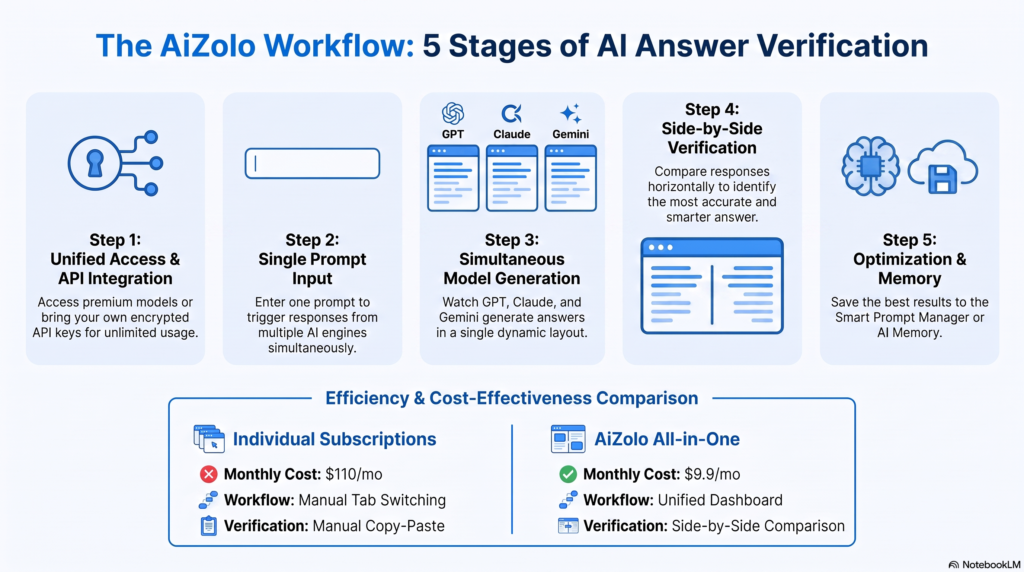
| Method | Accuracy | Reasoning Depth | Hallucination Reduction | Speed | Complexity | Best Use Case |
|---|---|---|---|---|---|---|
| Standard Prompt | Low-Medium | Low | Low | Fast | Simple | Casual queries |
| Chain-of-Thought | Medium | Medium-High | Medium | Medium | Medium | Multi-step reasoning |
| Tree-of-Thoughts | Medium-High | High | Medium | Slow | High | Complex planning/search |
| Chain-of-Verification | High | Medium-High | High | Slower | Medium-High | Fact-sensitive, research, professional use |
Who Should Use the Chain-of-Verification Prompt Template
- Researchers and students who need cited, checkable claims
- Developers debugging edge cases before shipping code
- Business professionals relying on figures for decisions
- Content and SEO writers publishing fact-based content
- Customer support teams answering policy-sensitive questions
- AI beginners who want a simple habit for more reliable answers
The Future of Verification Prompting
Verification-style prompting is increasingly being built directly into AI systems rather than left to manual prompts.
Trends to watch:
- Agentic AI systems that verify tool outputs before acting on them
- Reasoning models with built-in multi-pass checking
- Self-correcting workflows embedded in enterprise AI pipelines
- Retrieval-augmented verification, pairing CoVe with live search
As these capabilities mature, manual CoVe prompting will likely evolve from a workaround into a standard feature of how AI systems operate by default.
What We Learned After Testing Chain-of-Verification Across Multiple AI Models
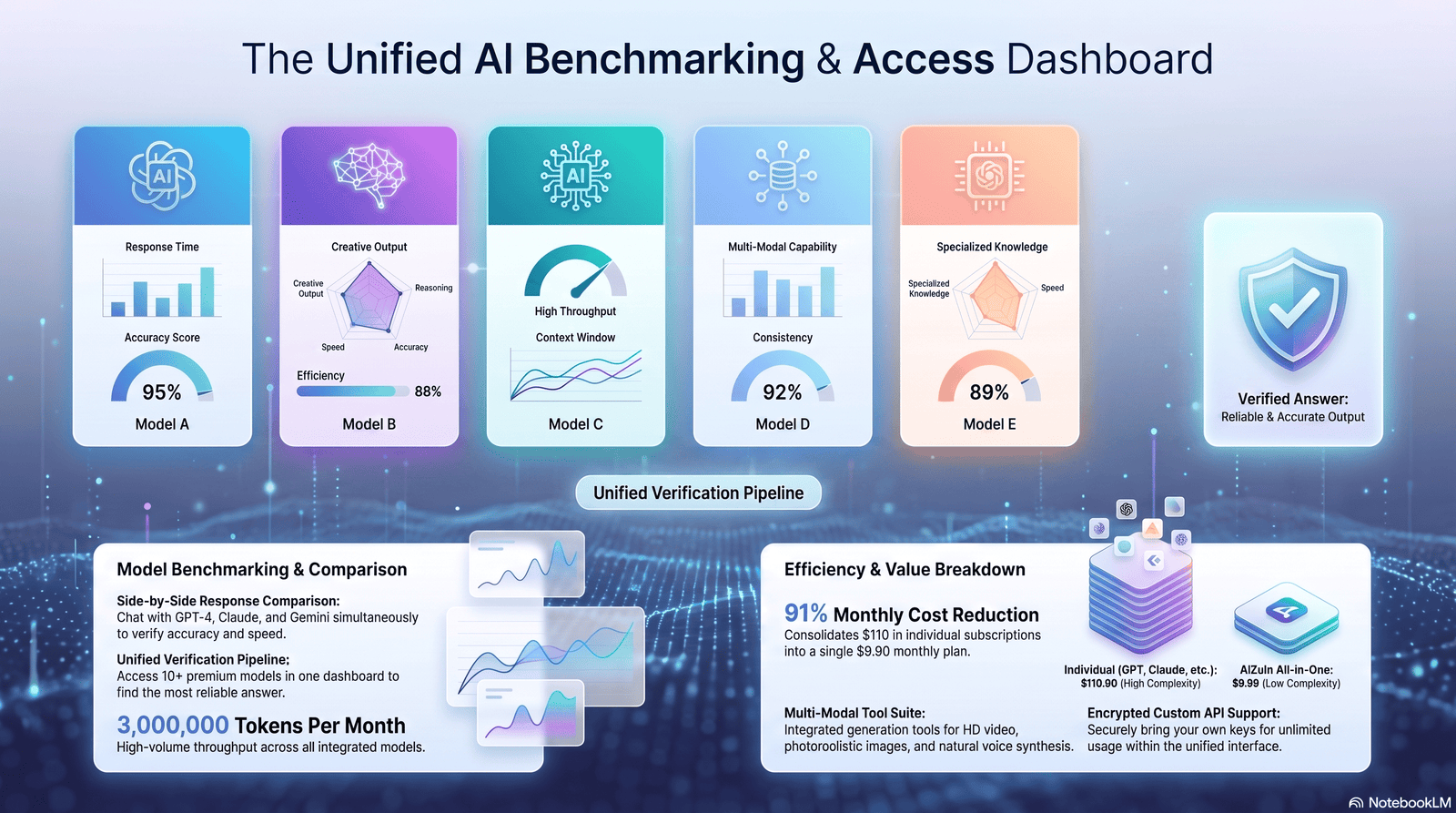
The following are practical observations from example evaluations, not formal benchmark results.
ChatGPT observations: Responds well to explicit step numbering; benefits from being told not to reference its first answer during verification.
Claude observations: Tends to naturally flag uncertainty even without prompting, which pairs well with CoVe’s final “remaining uncertainty” step.
Gemini observations: Performs best when verification questions are narrow and specific rather than broad.
DeepSeek observations: Benefits from an explicit reminder to treat verification as a separate, independent pass rather than a summary of the first answer.
Practical recommendation: Across models, the single biggest factor in output quality was the specificity of the verification questions — vague questions produced vague checks, and models tended to just re-confirm their first answer.
Frequently Asked Questions
What is a Chain-of-Verification prompt template? It’s a structured prompt that has an AI model draft an answer, generate verification questions, answer them independently, and produce a corrected final response.
Does Chain-of-Verification eliminate AI hallucinations completely? No. It reduces hallucination risk by adding a self-checking step, but it cannot guarantee complete accuracy.
Is CoVe the same as Chain-of-Thought? No. Chain-of-Thought focuses on reasoning steps toward an answer, while Chain-of-Verification focuses on checking an answer after it’s drafted.
Can I use Chain-of-Verification with ChatGPT, Claude, and Gemini? Yes. The core method works across models; only the exact phrasing needs light adjustment per platform.
Does Chain-of-Verification work for coding tasks? Yes. It’s especially useful for catching edge cases and logic errors before finalizing code.
Is Chain-of-Verification suitable for medical or legal questions? It can help structure a more careful answer, but it should never replace advice from a licensed professional.
Why does independent verification matter so much? Because if the model checks its answer while looking at the original response, it tends to just confirm its own bias instead of catching errors.
Does CoVe slow down responses? Yes, since it involves multiple reasoning stages, responses take longer and use more tokens than a single-pass answer.
How many verification questions should I ask for? Typically 4-6 targeted questions work well — enough to cover key claims without diluting focus.
Can Chain-of-Verification be automated in an API workflow? Yes. It can be implemented as a multi-call pipeline: one call for the draft, one for verification questions, one for independent answers, and one for reconciliation.
Is Chain-of-Verification useful for everyday casual questions? Not usually necessary — it’s most valuable for research, technical, financial, or publication-ready content.
What’s the difference between CoVe and Tree-of-Thoughts? Tree-of-Thoughts explores multiple reasoning paths to find a solution; CoVe verifies a single drafted answer for factual accuracy.
Should I trust an AI answer more just because it used CoVe? Treat it as more reliable, not infallible — always cross-check high-stakes claims against authoritative sources.
Can beginners use this method easily? Yes. The Universal Chain-of-Verification Prompt Template above can be copy-pasted into any AI chat with no technical setup required.
Where did Chain-of-Verification originate? It comes from AI research on hallucination reduction, describing a self-verification method where models check their own draft answers through independent question-answering.
Key Takeaways
- The Chain-of-Verification prompt template adds a self-checking loop to AI answers
- Independent verification — not seeing the original answer — is the critical step
- It works across ChatGPT, Claude, Gemini, and other major models
- It’s best reserved for research, technical, and high-stakes content, not casual queries
- It reduces hallucinations but does not eliminate them entirely
Conclusion
AI hallucinations aren’t going away on their own — but how you prompt can meaningfully reduce them.
The Chain-of-Verification prompt template gives you a repeatable, structured way to catch errors before they reach your final answer, your report, or your published content.
Start with the Universal Chain-of-Verification Prompt Template above, adapt it to your specific task, and make independent verification a habit — not an afterthought.
Article Summary
This guide explains the Chain-of-Verification (CoVe) prompt template: a five-stage method (initial answer, verification questions, independent verification, comparison, revised answer) for reducing AI hallucinations. It includes ready-to-use templates across 12+ use cases, platform-specific versions for ChatGPT/Claude/Gemini, a comparison against Chain-of-Thought and Tree-of-Thoughts, best practices, common mistakes, and an FAQ section.
Author Bio
Jeevesh Tripathi AI Researcher & SEO Content Specialist Email: jeevesh@aizolo.com
Jeevesh Tripathi specializes in prompt engineering, LLM workflow design, and SEO-driven technical content. His work focuses on translating AI research into practical, testable methods that reduce hallucinations and improve output reliability across ChatGPT, Claude, and Gemini — grounded in hands-on experimentation rather than theory alone.