Ask five AI models the same question and you rarely get five identical answers.
GPT-6.1 Sol could potentially refute the premises upon which it is based. Claude Sonnet 5.5 would restructure the issue, whereas Claude Opus 5.5 or Grok 4.7 would recognize a lurking danger that the others have overlooked.
That difference is useful, but simply collecting five answers is not enough.
A more effective approach would be to enable them to critique, contest, defend, and evaluate each other’s arguments, leading up to a final synthesis
That is the basic idea behind an AI debate workflow:
Independent analysis → Comparison → Cross-critique → Rebuttal → Judge → Synthesis → Human verification
The goal is not to find the model that always wins. It is to create a method in which different responses of AI reveal assumptions, expose weaknesses, and offer useful alternatives
This approach is also different from simply asking several models the same question and choosing the majority answer. Multiple models can have the same error, so agreement should be seen as a favorable sign, not an indicator of correctness.
If you want to compare the same prompt across multiple models without constantly switching between AI services, AiZolo provides a workspace for comparing multiple AI models side by side.
Its current product page also lists features such as Dynamic Layout, Project Management, Prompt Manager, AI Memory, and custom API key support.
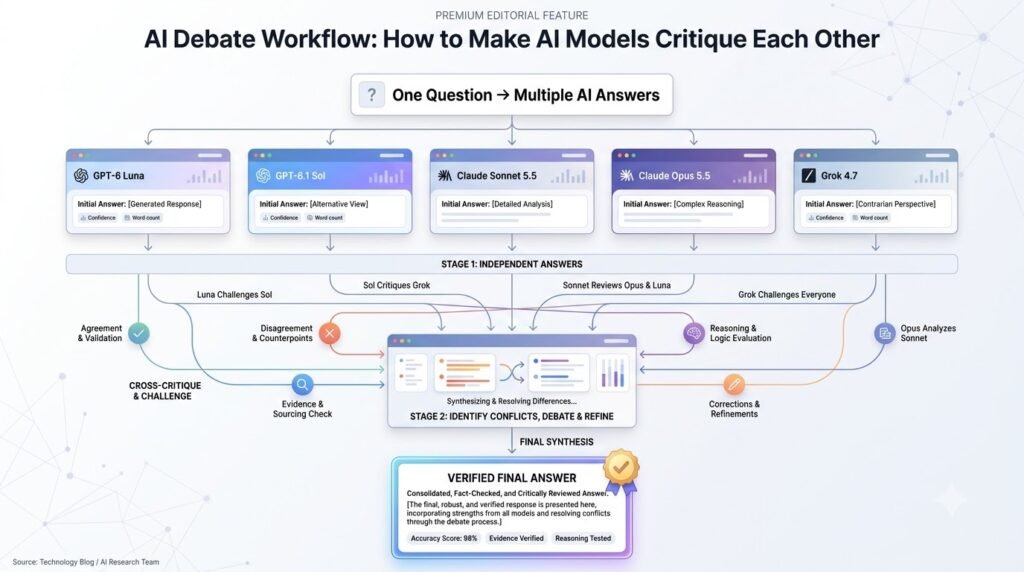
Table of Contents
What Is an AI Debate Workflow?
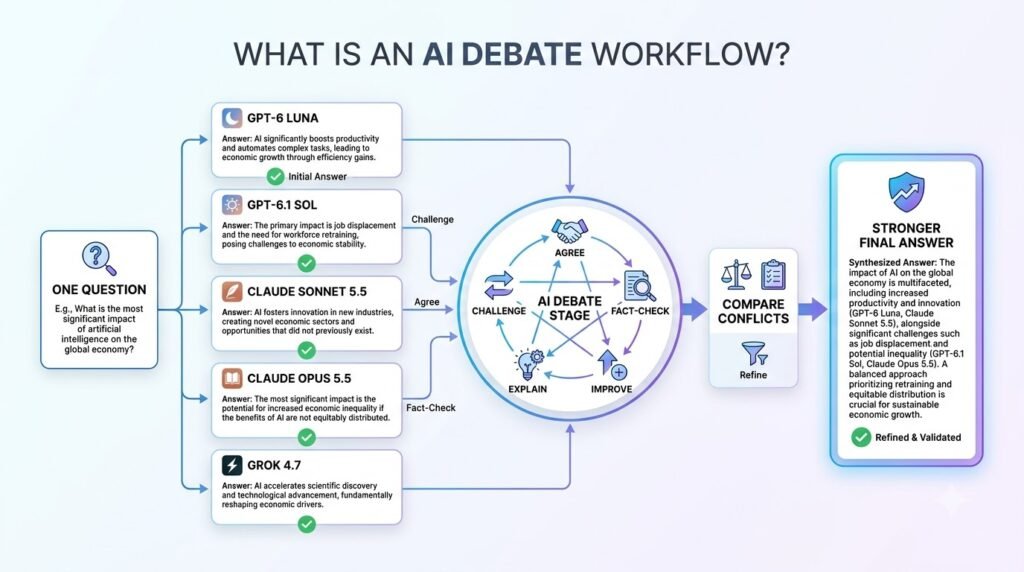
An AI debate workflow is a structured process in which multiple AI models independently analyze a question and then challenge, critique, defend, and evaluate competing answers.
The important word is structured.
A basic multi-model comparison looks like this:
Question → Model A + Model B + Model C + Model D + Model E → Compare answers
An AI debate goes further:
Question → Independent answers → Cross-critique → Rebuttal → Judge → Final synthesis
The difference is that the models interact with the reasoning produced by other models.
This is closely related to multi-agent debate research, where multiple language-model agents engage in a debate, trading arguments and counterarguments over several rounds.
A 2026 survey of 141 multi-agent debate studies identified substantial variation in how systems select participants, organize the debate, and resolve conflicts.
A practical workflow does not require you to build a complicated autonomous agent system, however. The same effect can be achieved manually by using different models for different tasks.
For example:
| Model | Example workflow role |
| GPT-6 Luna | Fast independent analysis |
| GPT-6.1 Sol | Deep challenger |
| Claude Sonnet 5.5 | Structured critic |
| Claude Opus 5.5 | Deep reviewer or judge |
| Grok 4.7 | Alternative or contrarian perspective |
These are workflow roles, not claims that one model is permanently better at a particular task.
The same model can perform different roles depending on the problem.
If you want a closer look at how these two models differ in reasoning, coding, speed, and workload fit, see our detailed Claude 5.5 Sonnet vs Claude 5.5 Opus comparison.
The real objective is to create a panel of independent perspectives rather than treating five models as five isolated chatbots.
Why Do AI Models Give Different Answers?
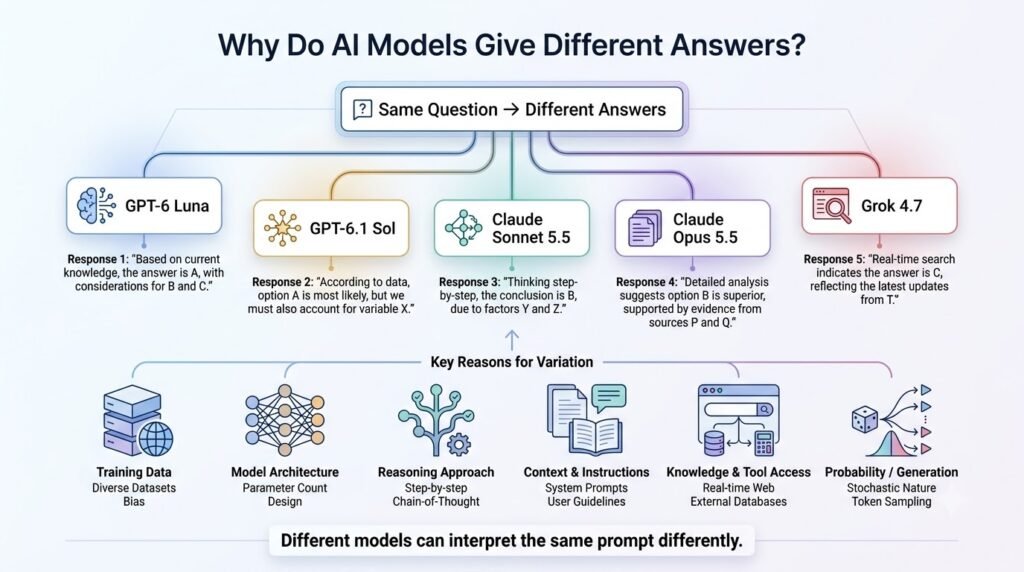
If you ask several models the same question, disagreement is normal.
AI models can give different or conflicting answers even when none of them is intentionally giving false information.
Different reasoning approaches
Two models can start with the same information but use different reasoning paths.
One may break a problem into explicit steps. Another way is to think of most probable interpretation and go for it right away. Neither of these approaches is failing.
Different assumptions
Models may silently assume different things.
For example, suppose you ask:
Should a startup build its own AI customer-support system?
One model might assume the startup has a large engineering team.
Another might assume the startup has only two developers.
A third approach might be to assume that customer data should not leave a company’s infrastructure.
Their recommendations can therefore differ because they are solving slightly different versions of the problem.
Different interpretations of the prompt
Ambiguous prompts create even more disagreement.
If the question did not specify the criteria for ‘best’, one model may have been optimized for cost and another for performance.
This is why an AI debate should begin with a clearly defined question and evaluation criteria.
Different strengths and blind spots
A model may notice a security issue that another ignores. Another may identify a business constraint that the first model missed. A third may produce a more practical implementation plan.
That variation is one of the reasons to use multiple models in the first place.
Confidence does not equal correctness
One of the biggest mistakes is assuming that the most confident answer is the strongest one.
The same applies to consensus.
If Luna and Sonnet recommend option A while Sol, Opus, and Grok recommend option B, the majority does not automatically make B correct.
AI systems may share patterns of training, assumptions, and failure modes. In particular, multi-agent research topics have investigated scenarios in which agents reached seeming consensus in spite of differing internal decision making models.
So disagreement should not be eliminated immediately.
It should be investigated.
AI Debate vs. AI Comparison vs. AI Brainstorming
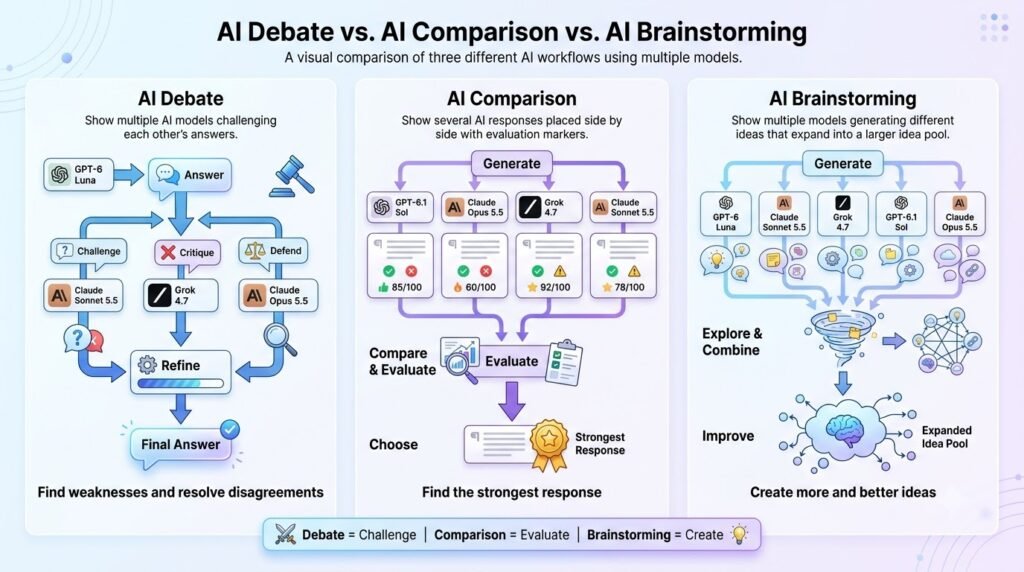
These workflows overlap, but they solve different problems.
| Workflow | Main purpose |
| Multi-model comparison | See how models answer differently |
| AI brainstorming | Generate more possibilities |
| AI fact-checking | Verify claims |
| AI synthesis | Combine useful information |
| AI debate | Challenge competing reasoning |
AiZolo already has content around using multiple models for brainstorming. That workflow emphasizes independent idea generation, comparison, challenge, and choice.
The AI debate workflow should therefore focus on something different:
argument → criticism → defense → evaluation
When should you use an AI debate?
An AI debate is most useful when there is something meaningful to disagree about.
Good examples include:
- Complex research questions
- Strategic decisions
- Technical architecture
- Product decisions
- Business strategy
- Competing recommendations
- Ambiguous problems
- High-value content research
- Risk analysis
- Complex coding decisions
You probably do not need five models debating:
“What is the capital of France?”
or:
“Rewrite this sentence professionally.”
For simple tasks, the additional model calls add complexity without much benefit.
The value of debate increases when different reasonable answers are possible and the consequences of choosing poorly matter.
The 6-Step AI Debate Workflow
The practical workflow can be reduced to six major stages:
Ask → Map → Critique → Rebut → Judge → Synthesize
Let’s walk through each stage.
Step 1 — Ask All Five Models Independently
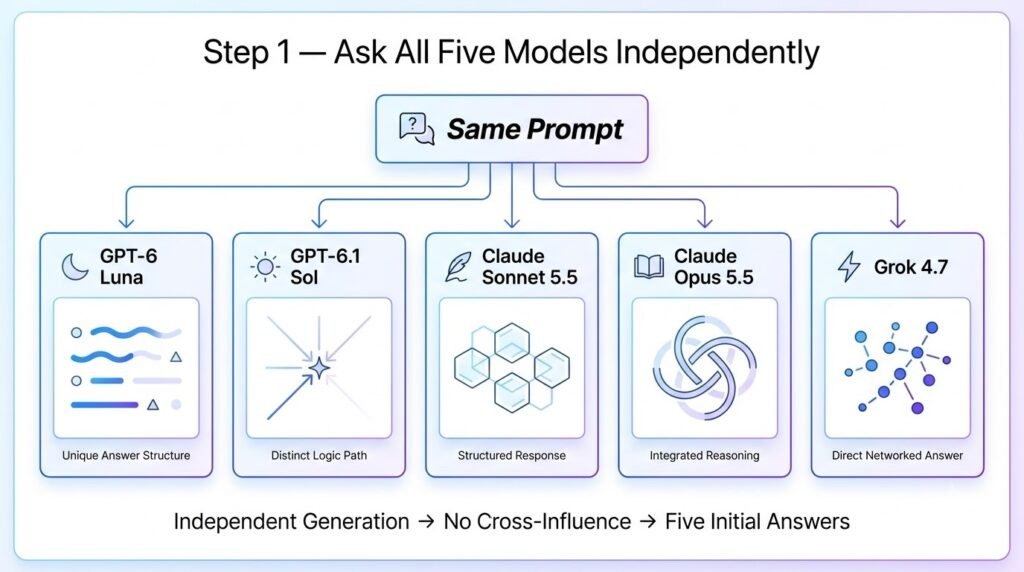
Start with exactly the same core question.
For example:
Should a startup build its own AI customer-support system or use an existing AI platform?
Send the question independently to:
- GPT-6 Luna
- GPT-6.1 Sol
- Claude Sonnet 5.5
- Claude Opus 5.5
- Grok 4.7
If you’re deciding how to use the two GPT models in this workflow, our GPT 6 Luna vs GPT 6.1 Sol comparison covers their differences in performance, efficiency, pricing, and workload fit.
Do not show one model another model’s answer yet.
This first stage is important because it preserves independent reasoning.
If Luna sees Sonnet’s answer before producing its own, Luna is no longer giving you an independent position. It is reacting to Sonnet.
That can be useful later, but you want the first round to capture the models’ original interpretations.
Ask every model to provide:
- Its recommendation
- Main reasoning
- Key assumptions
- Evidence or facts supporting the conclusion
- Risks
- Conditions that could change the recommendation
This gives you much more useful material than simply asking each model for a one-line answer.
Step 2 — Map Agreement and Disagreement
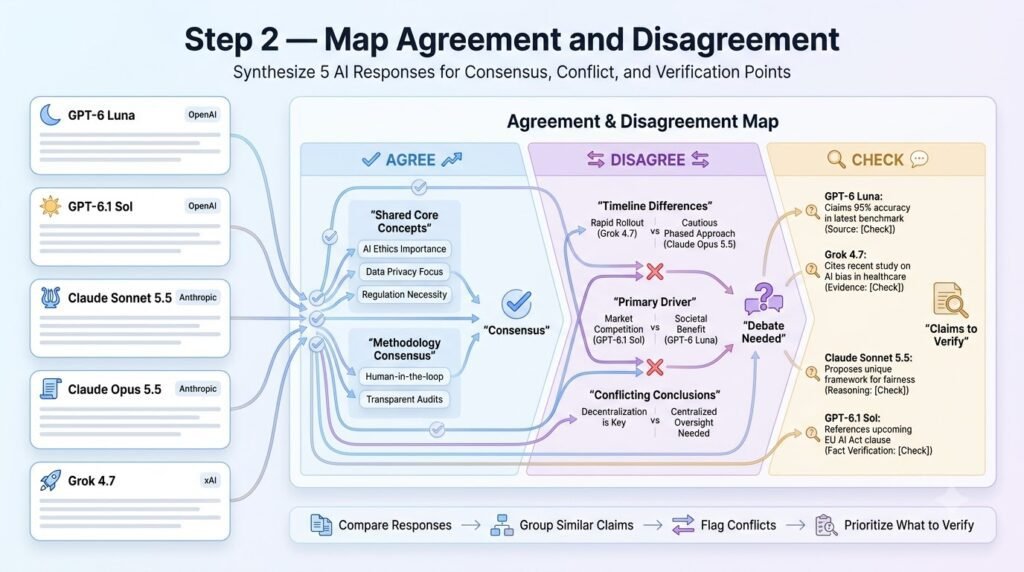
Once you have the five independent answers, don’t immediately ask a model to combine them.
First map where they agree and disagree.
Create three categories.
Agreement
What do most models independently identify?
For example:
- Existing platforms reduce development time.
- Building internally provides greater customization.
- Security requirements affect the decision.
Disagreement
Where do their conclusions differ?
Perhaps:
- Luna recommends an existing platform.
- Sol recommends building internally.
- Sonnet gives a conditional recommendation.
- Opus identifies security as the deciding factor.
- Grok argues that long-term operating costs matter more than initial development costs.
Missing information
This category is easy to overlook.
Ask:
What important issue did only one model mention?
A minority position can be valuable precisely because it introduces something the others missed.
A simple comparison table can make this visible:
| Issue | Luna | Sol | Sonnet | Opus | Grok |
| Lower initial cost | ✓ | ✗ | ✓ | ✓ | ✓ |
| Maximum customization | ✗ | ✓ | ✓ | ✓ | ✗ |
| Security concern | ✓ | ✓ | ✓ | ✓ | ✓ |
| Vendor lock-in | ✗ | ✓ | ✓ | ✓ | ✓ |
| Faster deployment | ✓ | ✗ | ✓ | ✓ | ✓ |
The table isn’t a voting system.
Its purpose is to identify where the debate needs to happen.
Step 3 — Make AI Models Critique Each Other
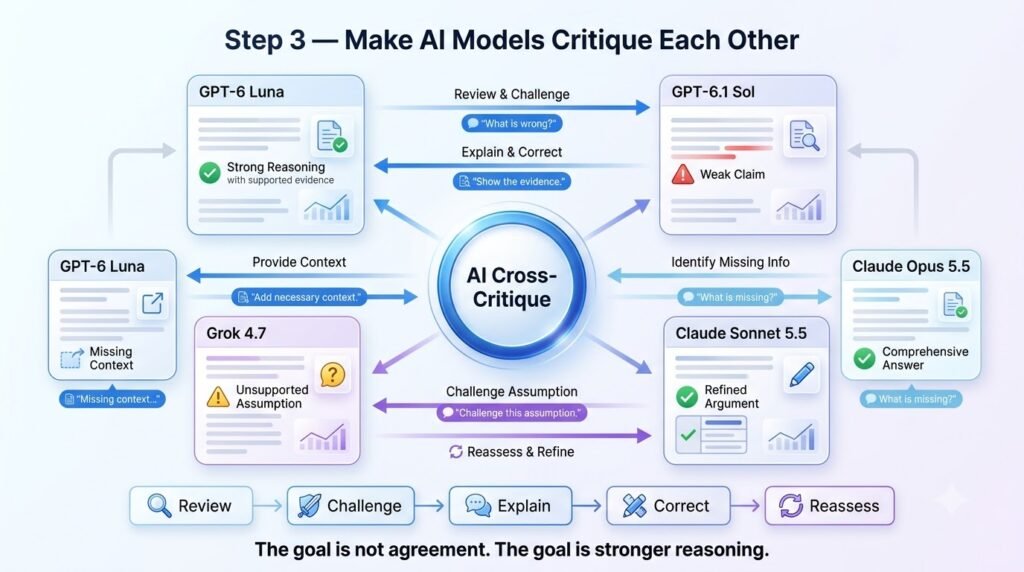
This is the heart of the workflow and the most important stage for anyone asking how to make AI models critique each other.
Do not simply ask:
“Which answer is correct?”
Instead, give one model another model’s answer and ask it to attack the reasoning.
For example:
Claude Sonnet 5.5 critiques GPT-6 Luna
Then:
GPT-6 Luna critiques Claude Sonnet 5.5
You could also create other pairings:
GPT-6.1 Sol critiques Grok 4.7
Grok 4.7 critiques GPT-6.1 Sol
Then use Claude Opus 5.5 to review the major disagreements.
The critic should be given specific instructions.
Ask it to identify:
- Factual weaknesses
- Unsupported assumptions
- Logical gaps
- Missing evidence
- Contradictions
- Edge cases
- Alternative interpretations
- Claims that require external verification
A weak critique sounds like:
“This answer could be improved by considering more factors.”
A useful critique sounds like:
“The recommendation assumes that the startup has sufficient engineering capacity to maintain an internal system. If the team has fewer than three engineers, that assumption materially changes the cost and deployment analysis.”
Specific criticism creates something the next round can actually respond to.
Step 4 — Run a Rebuttal Round
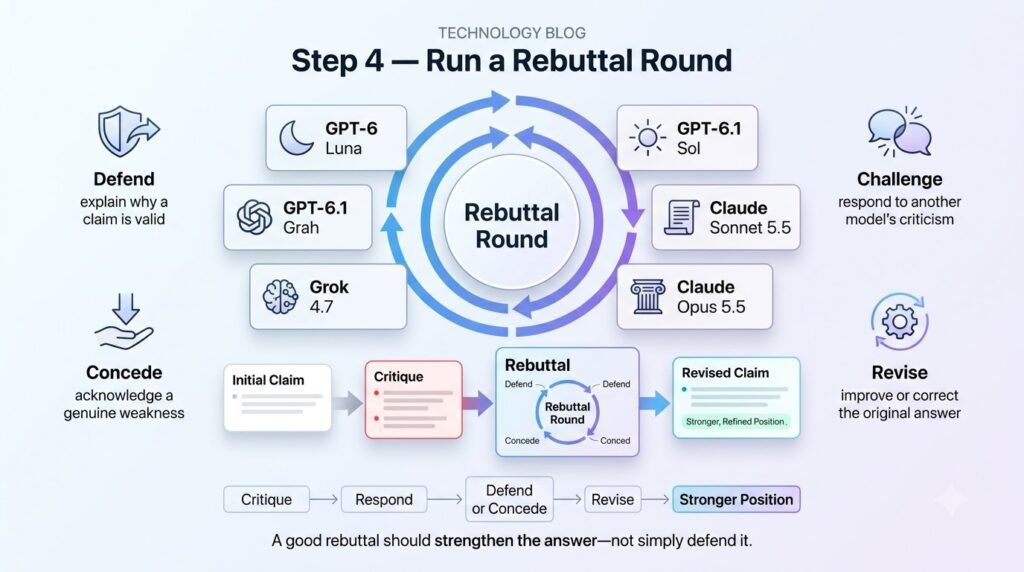
Criticism alone is not enough.
The original model should get an opportunity to respond.
For example:
Luna → receives Sonnet’s critique → Luna responds
Then:
Sonnet → receives Luna’s critique → Sonnet responds
The rebuttal serves several purposes.
The original model can:
- Defend a valid argument
- Acknowledge an error
- Clarify an assumption
- Add missing evidence
- Revise its conclusion
- Explain why the criticism does not apply
This matters because a critic can misunderstand an argument.
Suppose Sol says:
“Luna ignores security.”
Luna may respond:
“Security was included in the original analysis, but I weighted it below regulatory requirements because the scenario assumes customer data is already processed through a compliant third-party provider.”
Now you have a more useful exchange.
The disagreement has become explicit.
Instead of:
Luna says A. Sol says B.
you now have:
Luna says A because X. Sol challenges assumption X. Luna explains why X does or does not apply.
That is much closer to genuine structured debate.
Step 5 — Use a Judge Model to Evaluate the Debate
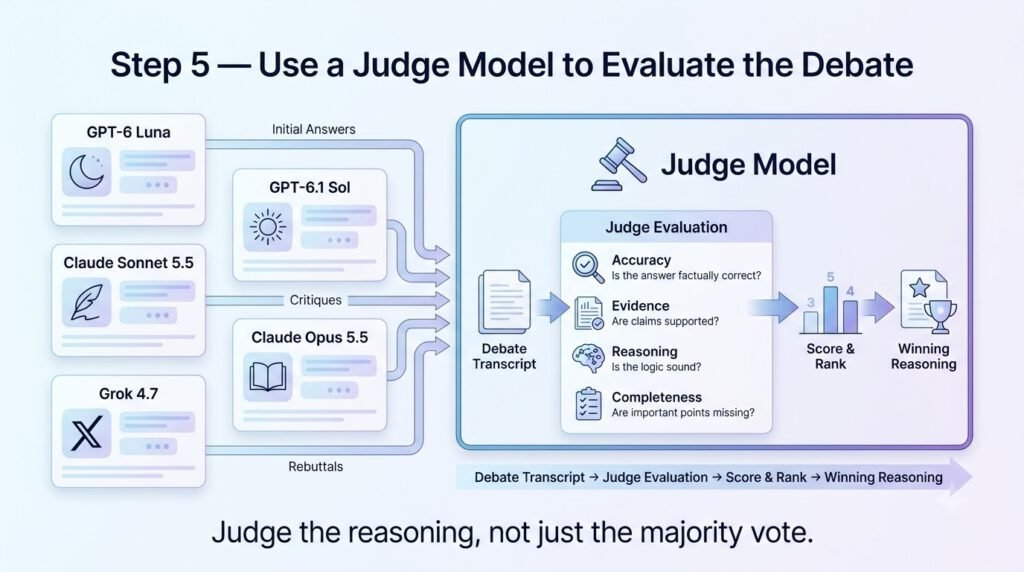
After the critique and rebuttal rounds, bring in a judge.
The judge should receive:
- Original question
- Five initial answers
- Agreement map
- Major disagreements
- Critiques
- Rebuttals
For this example workflow, you could use Claude Opus 5.5 or GPT-6.1 Sol as the judge.
Ask the judge to score each position using a consistent rubric.
| Criterion | Score |
| Accuracy | /10 |
| Reasoning | /10 |
| Evidence | /10 |
| Completeness | /10 |
| Assumptions | /10 |
| Practical usefulness | /10 |
But don’t ask:
“Which model won?”
Ask:
“Which arguments are best supported, which weaknesses remain unresolved, and what evidence would be required to make the final recommendation stronger?”
That produces a much more useful evaluation.
Don’t use majority vote as the judge
A majority vote is tempting:
3 models said A, 2 said B, therefore A wins.
But that’s not a reliable reasoning process.
Models can independently repeat the same assumption or factual error.
Recent research on multi-agent debate also highlights that the way agents interact and how agreement is resolved can materially affect outcomes. The 2026 survey of MAD research notes that many systems rely on conventional voting structures even though alternative interaction and agreement mechanisms remain underexplored.
The judge should therefore evaluate arguments and evidence, not simply count votes.
Step 6 — Combine AI Responses Into One Answer
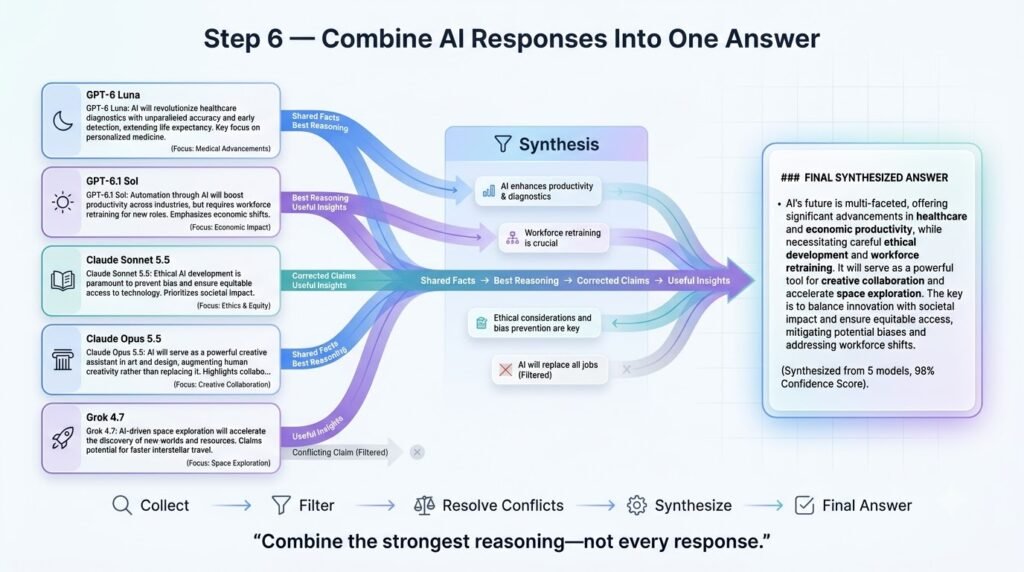
Now you can finally synthesize the responses.
This is where the keyword how to combine AI responses into one answer fits naturally into the workflow.
The process becomes:
Five answers → Agreements → Conflicts → Critiques → Rebuttals → Strongest arguments → Final synthesis
The final answer should not simply paste the five responses together.
It should remove duplication, preserve important differences, and explain unresolved uncertainty.
Don’t average conflicting answers
Suppose:
Model A: Build internally.
Model B: Use an existing platform.
Do not automatically write:
“The best approach is somewhere between building and buying.”
That doesn’t resolve anything.
Instead ask:
Why do the models disagree?
Perhaps Model A assumes the company expects 10 million support requests per month.
Model B assumes 50,000 requests per month.
Once that assumption is exposed, the disagreement becomes conditional.
The final answer can then say:
Use an existing platform if speed, lower initial engineering cost, and moderate customization are the priorities. Consider building internally when the company requires deep customization, has sufficient engineering capacity, and expects the long-term economics to justify the investment.
That is more useful than artificial consensus.
Preserve unresolved uncertainty
Sometimes the debate won’t establish a clear winner.
That’s okay.
If two positions remain plausible because the available evidence is insufficient, the final answer should say so.
A good synthesis might conclude:
“The available information does not establish that either option is universally better. The decision depends primarily on data-security requirements, engineering capacity, expected volume, and the level of customization required.”
That is a better result than forcing the models to agree.
How to Handle Conflicting AI Responses
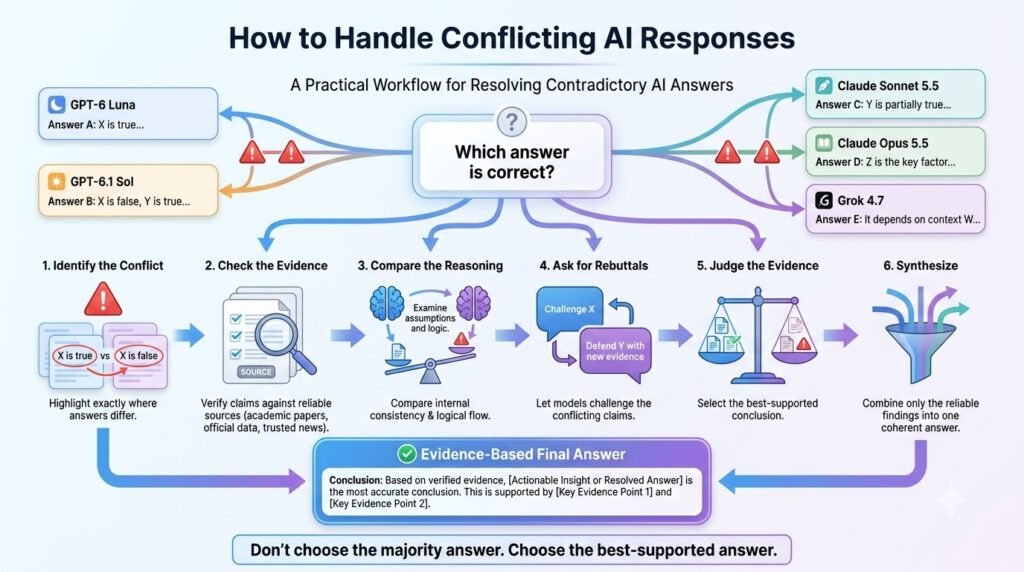
Conflicting AI responses are not necessarily a problem.
They can tell you exactly where the question needs more investigation.
Use this framework when models disagree.
1. Identify the exact conflict
Don’t say:
“The models disagree.”
Write down exactly what they disagree about.
Is it a factual claim?
An interpretation?
A recommendation?
A prediction?
2. Ask each model what assumption it made
This is often where the real disagreement appears.
Ask:
“What assumption in your reasoning most strongly affects your conclusion?”
Do the same for the opposing model.
3. Ask for evidence
Separate:
What the model knows
from:
What the model is assuming
Ask each side to identify which claims can be independently verified.
4. Challenge the evidence
Give the opposing model the evidence and ask:
“Does this evidence actually support the conclusion? Identify any weaknesses in how it is being interpreted.”
This prevents the debate from becoming a contest over which model sounds more convincing.
5. Run a rebuttal
Let each model respond to the strongest criticism.
Don’t allow it to simply repeat the original answer.
Require it to either defend, revise, or withdraw the relevant claim.
6. Verify unresolved claims externally
If the disagreement concerns a current price, law, benchmark, product feature, medical fact, financial statistic, or other changing factual claim, check a reliable external source.
AI debate is not a substitute for evidence verification.
7. Use human judgment for high-stakes decisions
For decisions involving significant financial, legal, medical, security, or safety consequences, AI debate should support human judgment rather than replace it.
AI-generated arguments can be persuasive without being correct.
Research into multi-agent fact-checking has revealed that structure-based multi-agent refinement can enhance the faithfulness of generated explanations, but it cannot eliminate the need to verify the underlying evidence.
How to Make AI Models Critique Each Other Effectively
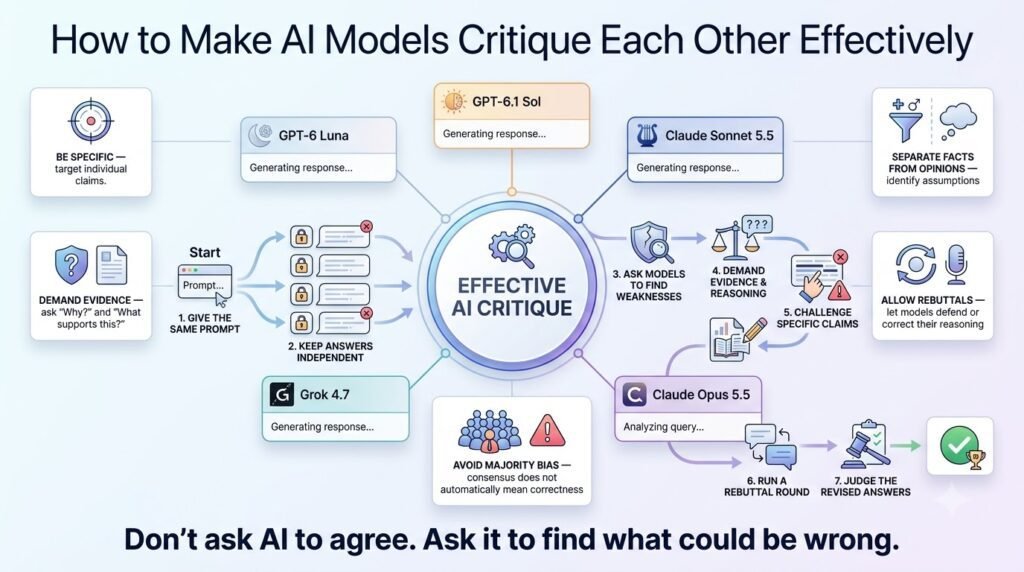
The quality of the debate depends heavily on how you structure the prompts.
Give every model the same original question
Changing the prompt between models makes the comparison less meaningful.
Make sure to keep the main question the same.
You may add instructions specific to the roles but do not change the facts, implicitly or explicitly.
Don’t reveal other answers too early
First-round independence matters.
If every model sees the first model’s answer, later responses may become variations of the first response rather than genuinely independent analyses.
Give the critic an evaluation framework
Don’t ask:
“Critique this.”
Instead specify:
“Identify factual errors, unsupported assumptions, logical weaknesses, missing considerations, contradictions, and claims requiring external verification.”
The more specifically the instructions are given, the easier it will be to critique the paper.
Ask for evidence, not confidence
A model saying:
“I am highly confident”
doesn’t make the claim stronger.
Ask:
“What evidence supports this claim?”
Then ask:
“What evidence would prove this claim wrong?”
That creates a more useful adversarial test.
Separate critique from rebuttal
Don’t ask one model to criticize and defend itself in the same instruction.
First produce the critique.
Then let the original model respond.
This makes the roles clearer.
Use a separate judge
If possible, separate:
Debater → Critic → Judge
rather than asking one model to generate the argument, critique itself, and declare itself correct.
A separate evaluator creates at least some role separation.
Stop when the debate stops producing new information
More debate isn’t always better.
If Round 3 simply repeats Round 2, another round may add cost without improving the conclusion.
A useful stopping rule is:
Stop when the latest round introduces no new evidence, assumption, counterargument, or correction.
This makes the workflow more efficient.
Example: Five AI Models Debate a Real Business Decision
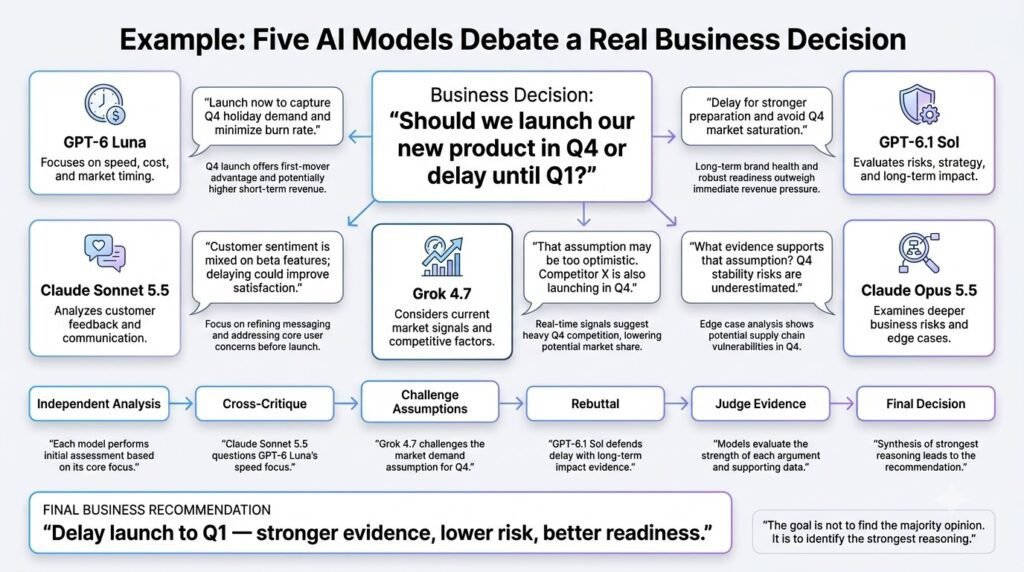
Consider this question:
Should a startup build its own AI customer-support system or use an existing AI platform?
The five models independently analyze the problem.
Round 1: Independent answers
GPT-6 Luna focuses on speed, implementation effort, and operational simplicity.
GPT-6.1 Sol focuses on long-term control, architecture, and scalability.
Claude Sonnet 5.5 weighs customization against engineering resources.
Claude Opus 5.5 identifies security, maintenance, and long-term operational risks.
Grok 4.7 introduces an alternative perspective around cost efficiency and vendor dependency.
These aren’t “winner” labels.
They are different lenses through which to examine the same decision.
Round 2: Identify disagreements
The biggest disagreements might be:
- Initial cost
- Long-term cost
- Security
- Customization
- Scalability
- Maintenance
- Vendor lock-in
- Time to market
Now you know what the debate needs to investigate.
Round 3: Cross-critique
Give Sol’s argument to Luna.
Ask:
“Identify the strongest unsupported assumption in this recommendation.”
Give Luna’s argument to Sol.
Ask the same question.
Repeat the process with the other models.
Now the models are no longer just producing independent answers.
They are testing one another’s reasoning.
Round 4: Rebuttal
Suppose Sol argues that internal development provides greater long-term control.
Luna might challenge the engineering and maintenance burden.
Sol can then respond:
“The recommendation assumes the startup expects enough transaction volume and customization requirements to justify the internal infrastructure.”
That assumption can now be tested.
Round 5: Judge
Opus evaluates:
- Which claims have evidence?
- Which arguments depend on unsupported assumptions?
- Which risks were overlooked?
- Which recommendation changes under different conditions?
Round 6: Final synthesis
The final answer might not say:
“Build internally.”
or:
“Buy an existing platform.”
Instead:
Use an existing platform when the priority is faster deployment, lower initial engineering investment, and standard customer-support requirements.
Consider building internally when security, customization, control, or long-term scale are factors. Build externally when lower cost, faster time to market, or access to specialized expertise are priorities.
That is what a useful AI debate should produce: a conditional decision framework, not a forced winner.
Reusable Prompts for an AI Debate Workflow
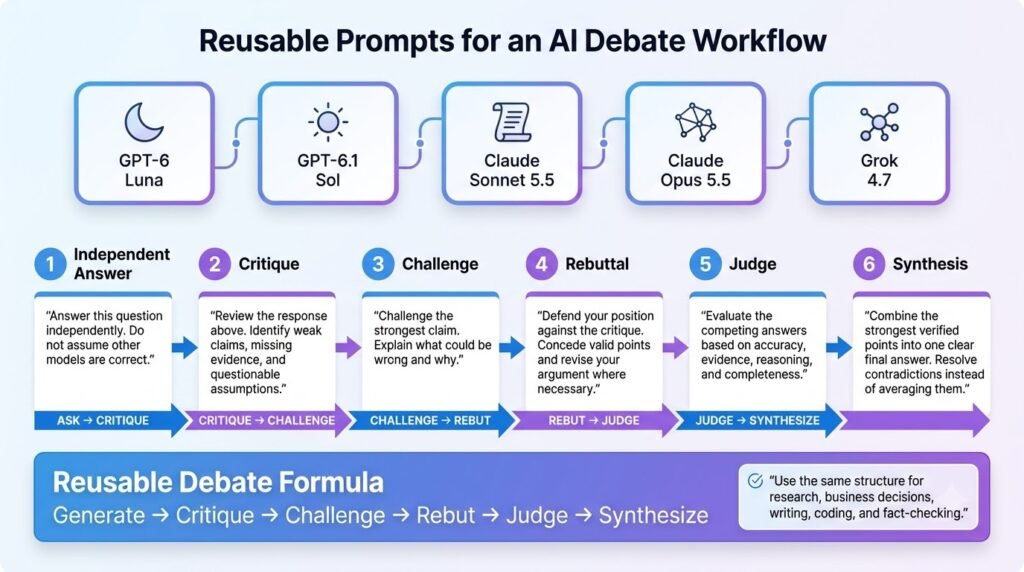
You can adapt the following prompts to research, strategy, coding, product decisions, or content evaluation.
Prompt 1 — Independent Analysis
Analyze the following question independently. Do not assume that another AI model has already answered it. Give your conclusion, reasoning, key assumptions, supporting evidence, major risks, and the conditions that could change your conclusion. Clearly distinguish facts from assumptions.
Prompt 2 — Critic
Review the following AI response as a critical analyst. Identify factual errors, unsupported assumptions, logical weaknesses, missing considerations, contradictions, edge cases, and claims that require independent verification. Do not rewrite the answer. Focus specifically on weaknesses that could change the conclusion.
Prompt 3 — Rebuttal
Review the criticism of your previous answer. Defend claims which are still valid, acknowledge weaknesses in other claims, clarify any assumptions on which you have based a claim, and revise your conclusion if the criticism is valid and supports that revision. Do not defend a claim simply because you made it.
Prompt 4 — Judge
Evaluate the competing AI positions according to the original question, initial answers, critiques, and rebuttals. Score their accuracy, reasoning, evidence, completeness, assumptions, and practical usefulness.Do not choose a winner based on majority vote. Explain which arguments are best supported and which disagreements remain unresolved.
Prompt 5 — Synthesizer
Create one final answer using the strongest supported conclusions from the debate. Remove duplicated reasoning, resolve conflicts where the evidence allows, preserve useful minority insights, and explicitly identify unresolved uncertainty. Do not manufacture consensus.
Prompt 6 — Adversarial Fact Check
Review the proposed final answer as a skeptical fact-checker. Identify every factual claim that should be independently verified before the answer is relied upon. Separate verifiable facts, assumptions, predictions, and opinions. Do not rewrite the answer.
The sixth prompt is particularly useful when the debate is being used for research or published content.
Common Mistakes When Making AI Models Debate
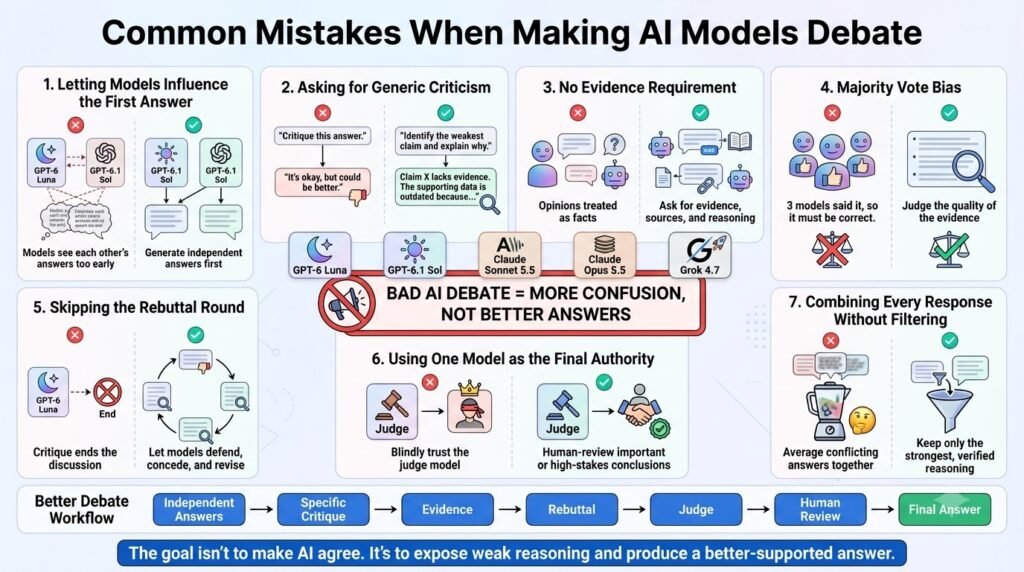
Mistake 1: Treating majority vote as truth
Five models agreeing does not prove a claim is correct.
Consensus is a signal worth examining, not a replacement for evidence.
Mistake 2: Letting models see the first answer too early
This can create anchoring.
Preserve independent analysis before starting the debate.
Mistake 3: Asking vague critique questions
“Critique this answer” is less useful than specifying what the critic should examine.
Mistake 4: Skipping the rebuttal
A critique can be incomplete or based on a misunderstanding.
Give the original model an opportunity to respond.
Mistake 5: Using one model as both debater and judge
Role separation makes the process easier to audit.
Mistake 6: Forcing consensus
The final answer doesn’t always need to make every model agree.
Sometimes the most accurate conclusion is:
“The evidence is insufficient to choose between these positions.”
Mistake 7: Running too many debate rounds
More tokens and more responses do not automatically mean better reasoning.
Stop when additional rounds stop producing meaningful new information.
Mistake 8: Treating AI debate as a replacement for evidence
A model can generate a convincing rebuttal to a claim that is actually true.
The final answer still needs verification when factual accuracy matters.
How to Run This AI Debate Workflow in AiZolo

The easiest part of an AI debate workflow is generating the first round. The tedious part is often moving the same prompt between different AI services and keeping their responses organized.
AiZolo is designed around multi-model comparison, allowing users to work with multiple AI models in one workspace and compare responses side by side. Its current feature set also includes Dynamic Layout, Project Management, Smart Prompt Manager, AI Memory, and custom API key support.
For this workflow, you can use the five-model setup:
GPT-6 Luna + GPT-6.1 Sol + Claude Sonnet 5.5 + Claude Opus 5.5 + Grok 4.7
The important point is that AiZolo can simplify the comparison and organization stages. The actual debate logic still depends on how you structure your prompts and evaluation process.
A practical sequence is:
One prompt → Five responses → Compare → Cross-critique → Rebuttal → Judge → Final synthesis
That makes the process easier to repeat without turning every research question into a maze of browser tabs.
When Should You Use an AI Debate Workflow?
Not every AI task needs a debate.
| Task | Use AI Debate? |
| Simple definition | ❌ |
| Basic calculation | ❌ |
| Routine rewriting | ❌ |
| Simple summary | ❌ |
| Brainstorming | 🟡 |
| Research | ✅ |
| Conflicting answers | ✅ |
| Business strategy | ✅ |
| Technical architecture | ✅ |
| Complex coding decisions | ✅ |
| Risk analysis | ✅ |
| High-stakes decisions | ✅ + human verification |
A useful rule is:
Use an AI debate when the cost of choosing the wrong answer is greater than the cost of evaluating multiple perspectives.
For a simple question, one good response may be enough.
For a complex decision with competing trade-offs, structured disagreement can be much more valuable.
The Bottom Line: AI Debate Is About Better Evaluation, Not More Answers
The value of using multiple AI models isn’t simply getting five answers.
The real advantage comes from making those answers challenge each other.
GPT-6 Luna, GPT-6.1 Sol, Claude Sonnet 5.5, Claude Opus 5.5, and Grok 4.7 can be treated as a panel of AI analysts rather than five isolated chatbots.
The basic workflow is:
Independent analysis
↓
Compare
↓
Identify disagreement
↓
Cross-critique
↓
Rebuttal
↓
Judge
↓
Synthesize
↓
Human verification
The important part is what happens between the first answer and the final answer.
Don’t automatically trust the majority.
Don’t force the models to agree.
Don’t confuse confidence with evidence.
Instead, use disagreement to find assumptions, test arguments, expose missing information, and determine what still needs verification.
That is what makes an AI debate workflow useful: not simply producing more AI output, but creating a structured process for deciding which parts of that output deserve to be trusted.
FAQs
What is an AI debate workflow?
An AI debate workflow is a structured process where multiple AI models independently analyze a question and then critique, challenge, defend, and evaluate each other’s reasoning. A final judge or synthesizer reviews the exchange before producing a conclusion. Human verification remains important when the decision depends on factual or high-stakes information.
How do I make AI models critique each other?
First ask each model to answer the same question independently. Then provide one model’s response to another and give the critic specific criteria, such as factual accuracy, assumptions, logical gaps, missing evidence, and edge cases. After criticism, let the original model respond before moving to judging and synthesis.
How do you handle conflicting AI responses?
Identify the exact disagreement first. Then ask each model to state its assumptions and supporting evidence. Have the models challenge those assumptions, run a rebuttal round, and verify unresolved factual claims externally. Do not automatically choose the answer supported by the largest number of models.
Can AI models debate each other?
Yes. AI models can participate in structured debate workflows by producing independent arguments, reviewing competing responses, generating rebuttals, and evaluating alternatives. Multi-agent debate is an active research area, although the quality of the outcome depends heavily on the debate structure, evaluation criteria, and evidence used.
How do I combine AI responses into one answer?
Don’t simply merge or average the responses. First identify agreements, disagreements, assumptions, and unique insights. Then evaluate the strongest arguments and evidence. The final synthesis should remove duplication, preserve useful minority perspectives, resolve conflicts where possible, and clearly state any uncertainty that remains.
Should I use multiple AI models for research?
Multiple models can be useful when research involves complex reasoning, competing interpretations, or important claims that need cross-checking. However, model agreement should not be treated as proof. Use independent sources to verify important facts, especially when the information is current, technical, legal, financial, medical, or otherwise high stakes.
Can AI models agree on the wrong answer?
Yes. Multiple models can share similar training patterns, assumptions, or failure modes and therefore produce the same incorrect conclusion. This is why an AI debate should examine the reasoning and evidence behind an answer rather than relying on the number of models that support it.
Author
Anshika Verma is a content researcher and writer at AiZolo, focused on researching AI tools, models, and creator technologies. Her work emphasizes clear explanations, source verification, and practical AI workflows.