AI-generated content can sound convincing while containing outdated or inaccurate information, so important claims should always be verified against reliable sources.
Comparing responses from multiple AI models can help identify discrepancies. For a faster comparison workflow, AiZolo lets you run the same prompt across multiple AI models side by side.
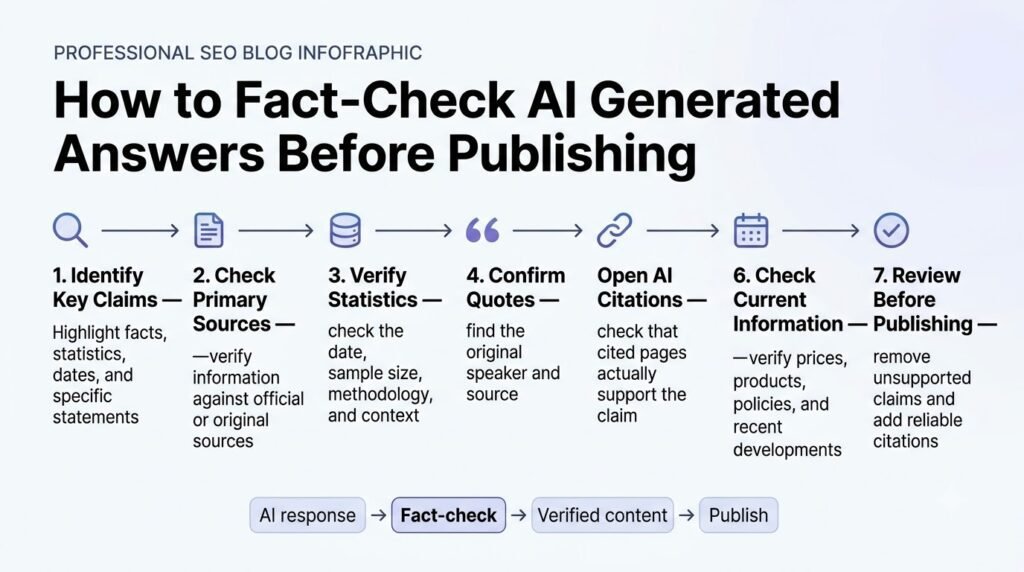
Table of Contents
AI can produce text that contains confident language, elegant diction, and impressive style, even when it is including some false information. It can generate plausible-sounding but incorrect dates, statistics, citations, material, quotes, products, and other information.
That makes knowing how to fact-check AI generated answers before publishing essential for anyone using AI to create articles, reports, research, or other public-facing content.
The idea is not to distrust all answers generated by artificial intelligence. Instead, it is necessary to determine which of them require verification and fact-checking before publishing.
A simple and non-critical question requires a more superficial check, while a research or medical, financial, or any other essential topic requires a more in-depth examination.
This article will present a step-by-step guide on fact-checking AI to verify claims, citations, statistics, quotes, and time-sensitive information before posting.
Why You Should Fact-Check AI-Generated Answers Before Publishing
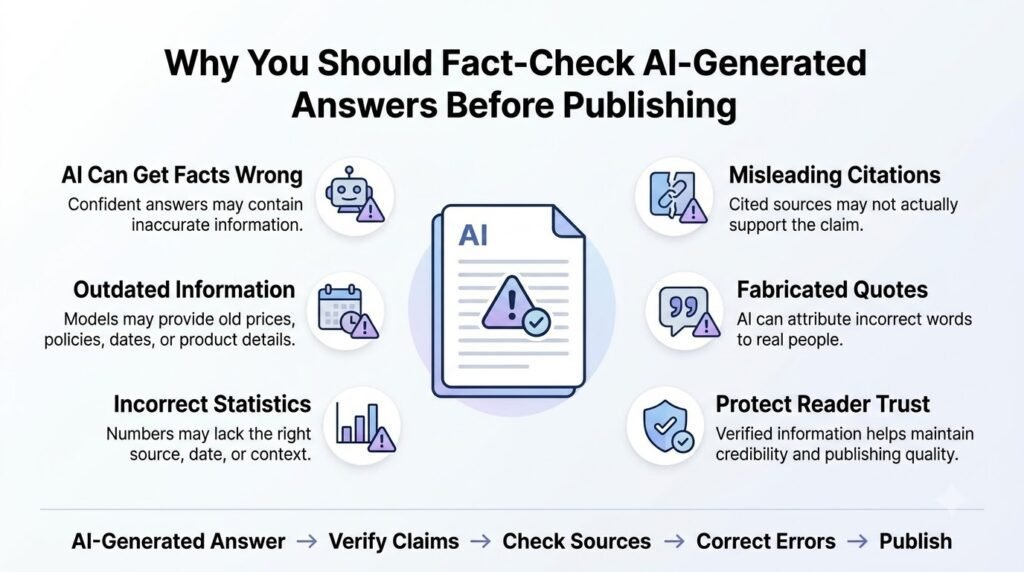
AI Can Sound Confident and Still Be Wrong
Fluency and factual accuracy are different things. AI models are built to produce text that reads well, not to confirm that every claim is true. A polished, authoritative paragraph can still be wrong.
Common failures include:
- Fabricated citations that look real but don’t exist
- Outdated statistics presented as current
- Incorrect dates
- Invented quotes attributed to real people
- Wrong product specifications
- Real sources attached to claims they don’t actually support
TheTechHacker states the problem correctly because errors could be hidden in a correctly written paragraph. A proofread and editing stage is only concerned with ensuring proper flow and grammar and will not be able to spot errors in facts. Checking facts is a different process altogether.
AI Hallucinations Are Not Always Obvious
A hallucination is when an AI generates information that sounds plausible but is false or unsupported. The model isn’t lying. It predicts likely-sounding words, and sometimes the most plausible-sounding answer isn’t the true one.
The tricky part is that hallucinations rarely look strange. They tend to appear as a believable statistic, a reasonable-sounding study name, or a date that’s off by a year, which is why they slip past readers.
Not Every AI Claim Needs the Same Level of Verification
You don’t need to spend equal effort on every sentence. A risk-based approach, similar to the one Forbes and TheTechHacker describe, matches scrutiny to the potential for harm.
| Claim type | Verification level |
| General explanation | Basic |
| Date, name, or specification | Moderate |
| Statistics or research | High |
| Medical, legal, or financial claims | Very high |
| Quotes or citations | Verify directly at the source |
The higher the stakes, the closer you should get to the primary source. For quotes and citations, don’t rely on the AI’s version at all. Open the original and confirm it says what the AI claims.
How to Fact-Check AI-Generated Content Before Publishing
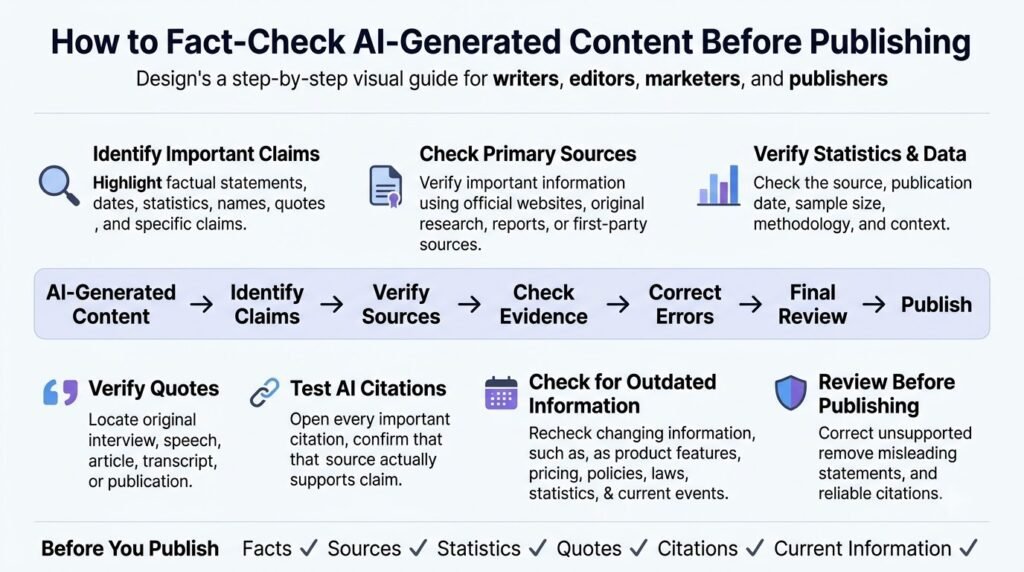
AI-generated text can sometimes appear authoritative, even if they include a few inaccurate, out-dated, inflated, or unsubstantiated claims. Fact-checking these statements that could sway the reader’s decision or perception rather than just checking the overall writing fluency and grammar is essential before publication.
A practical workflow is:
Extract claims → trace them to original sources → verify citations → cross-check important facts → check freshness → verify high-risk details separately.
1. Extract Every Factual Claim From the AI Answer
Before editing an AI-generated article, identify the statements that can actually be verified.
Look for:
- Statistics and percentages
- Dates and timelines
- Names and titles
- Prices and costs
- Product specifications
- Research findings
- Direct quotes
- Company claims
- Legal or regulatory statements
- Superlatives such as “best,” “largest,” “fastest” or “most popular”
The idea is to build up a checking list as a tool, rather than an all-in-one article. TheTechHacker suggests looking for statements that need an external source to back up instead of just asking an AI system to test on itself.
For example, suppose an AI-generated article says:
“Company X became the fastest-growing AI company in 2026.”
Do not verify the sentence as a whole. Break it into separate questions:
- Did Company X actually experience significant growth?
- What metric is being used to define “growth”?
- What period is being measured?
- Which companies are being compared?
- What original source supports the claim?
Breaking complex statements into smaller claims makes unsupported assumptions much easier to detect.
2. Go Back to the Original Source
Once you identify a claim, trace it back to where the information originally came from.
A good primary-source-first workflow would be:
AI answer → cited source → original document → verify the claim
It is best to go to the source whenever possible, not to another article that may have repeated the information.
For example:
| Claim type | Preferred source |
| Company information | Official website or newsroom |
| Product features | Official documentation |
| Pricing | Official pricing page |
| Research findings | Original research paper |
| Government information | Government website |
| Laws and regulations | Official legislation or regulator |
| Statistics | Original report or dataset |
| News | Reputable original reporting |
The fact why this is important is that secondary sources can contain errors on their own when summarizing another source. TheTechHacker similarly emphasizes tracing claims to their origin, rather than trying to compare one secondary source to another.
3. Open and Check Every AI-Generated Citation
A citation is not automatically evidence.
AI systems can sometimes provide citations that are incomplete, incorrect, outdated, or only loosely related to the claim. Open each important citation and check:
- Does the source actually exist?
- Is the author or organization correct?
- Is the publication date accurate?
- Does the URL lead to the claimed source?
- Does the source actually support the statement?
- Has the AI changed, exaggerated, or oversimplified the source’s conclusion?
For research-heavy content, go further. Check the study’s sample size, methodology, limitations, and conclusions. A source may be legitimate while the AI’s interpretation of it is still inaccurate.
For example, a study showing an association between two variables does not necessarily prove that one caused the other. Always compare what the original source actually concludes with what the AI-generated article claims.
4. Cross-Check Important Claims With Multiple Sources
Don’t rely on one source for claims that are important. Instead of asking another AI whether the first one was right,
Instead, use lateral reading to go to a new site and find the information yourself.
For an important claim, you might compare:
- The primary source
- An independent reputable source
- A specialist publication, database, or research source where appropriate
If several websites repeat exactly the same statement, that does not necessarily mean you have several independent confirmations. They may all be copying the same original source.
The stronger question is:
Are these sources independently reporting the same fact, or are they all repeating the same information?
This distinction is particularly important when fact-checking statistics, company claims, breaking news, and research findings.
5. Check Whether the Information Is Still Current
An AI-generated statement can be factually correct and still be unsuitable for publication because it is outdated.
This is especially important for content covering:
- AI models
- Software and product features
- Pricing
- APIs and usage limits
- Regulations
- Product specifications
- Statistics
- Current events
For example, an AI article might correctly state a software product’s price based on information from several months ago. If the company has updated its pricing page since then, the statement is no longer true for an up-to-date article.
Before publishing time-sensitive information, make sure the statement reflects the latest information on an official source and write down the relevant date if applicable.
TheTechHacker lists pricing, features, API limits, supported platforms, and similar information as categories that can change rapidly.
6. Verify Statistics, Dates, Quotes, and Superlatives Separately
Some types of claims deserve their own verification process because AI can easily misinterpret or exaggerate them.
Statistics
Check:
- Who conducted the study or collected the data?
- When was it conducted?
- What was the sample size?
- Who or what was included in the population?
- What geography was covered?
- What exactly was measured?
A statistic without its method and population can give the appearance of falsehood even if it is genuine.
Dates
Check the exact nature of the event. For products and companies, make sure you differentiate between:
- Announcement
- Launch
- Release
- General availability
These dates could be different, causing a factual error.
Quotes
Find the original interview, speech, article, transcript, post, or other first-hand source. Look at the wording, and context, instead of using an AI generated quotation.
Superlatives
Treat words such as “best,” “fastest,” “largest,” “most popular,” and “leading” as claims that require evidence.
Ask:
- According to which measurement?
- During which period?
- Among which competitors?
- Based on which dataset or source?
A fact checking process should test whether not only if it sounds good, but also the evidence to prove it.
How to Verify AI-Generated Content With AI Fact-Checking Tools
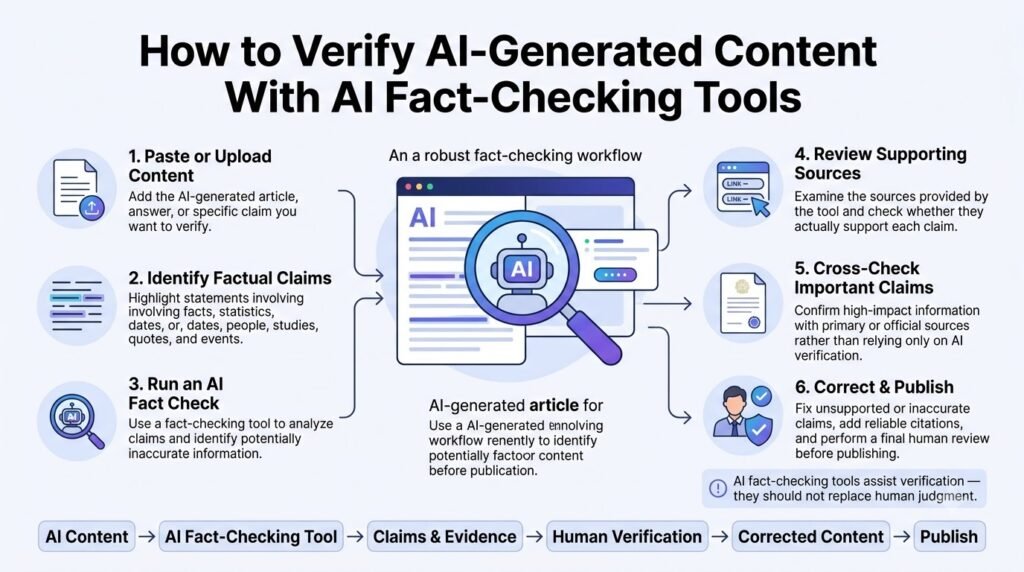
While AI can accurately generate facts, it is also prone to hallucination, out-of-date information, and logical fallacies. The reader cannot always trust the information published by generative AI.
New AI-fact checking systems offer multiple tools that help fact-checkers confirm each claim, supporting research, and the sources that support them.
Google Fact Check Explorer for Existing Fact Checks
The fastest way to evaluate a questionable statement is to check whether reputable journalists or organizations have already verified it.
Google Fact Check Explorer lets you search through a large database of published fact checks. These are claims that have been debunked by trusted publishers using ClaimReview structured data.
This search tool is perfect for fact-checkers who need to quickly verify a claim. Especially if it’s a breaking news item, a political figure’s statement, or any other time-sensitive or popular claim.
Instead of doing hours of research on a rumor that has already been debunked, content creators can use Google Fact Check Explorer to find out if any fact-checking organizations such as PolitiFact, Snopes, or Reuters have already taken on the claim.
Elicit and Consensus for Research Claims
When checking research-heavy articles, medical claims, or scientific assertions, summary-based AI models may twist the findings of research or even cite papers that do not exist. To verify academic claims, a person needs to be able to access the paper directly:
- Elicit: This tool is designed explicitly for academic-paper research, allowing one to analyze the original literature and find out the key points, sample sizes, and conclusions of the research paper.
- Consensus: This tool is meant to search through peer-reviewed journals, posing a question and receiving a percentage of agreement from researchers in the field, along with a list of articles that mention the searched subject.
Both tools can help one find research articles quickly, but unless one reads the papers one needs to fact-check, one cannot be certain of the validity of the information provided by an AI.
Reverse Image Tools for AI-Generated Visuals
If your article is based on visual information, text verification will not be enough. Images created with AI generators may include fake pictures, modified screenshots, and deepfakes.
Specialized reverse search and forensic tools help verify visual media:
- TinEye: A reverse image search engine that tracks where an image originated, how it has been modified over time, and where else it appears online.
- FotoForensics: Uses Error Level Analysis (ELA) to highlight areas of an image that have undergone digital editing or manipulation.
- AI or Not: Uses algorithms that can recognize if the image, video, or graphic was created with Midjourney, DALL-E, Stable Diffusion, or any other AI graphic tool.
AI Detectors Are Not Fact Checkers
A common misconception in content auditing is equating AI text detection with factual verification. It is crucial to distinguish between the two:
- AI Detectors analyze stylistic features, word predictability (perplexity), and structural patterns (burstiness) to answer one specific question: “Was this text probably generated by an AI model?”
- Fact Checkers analyze external evidence, primary sources, and real-world data to answer a fundamentally different question- “Is this claim actually true?”
An article written entirely by a human can be completely inaccurate, while a 100% AI-generated paragraph might be entirely factual.
An AI detector is not going to protect a publisher against inserting false information, factual accuracy requires dedicated claim verification regardless of the entity responsible for the prose.
How to Fact-Check AI Answers Using Multiple AI Models
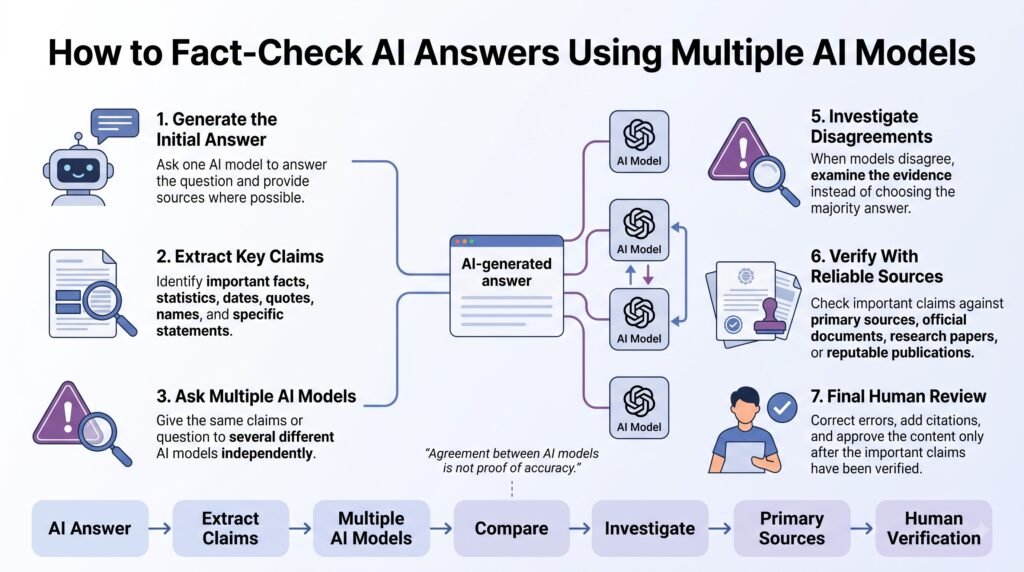
Ask the Same Question to Multiple AI Models
One of the simplest ways to catch AI errors is to stop relying on a single model. The method is simple: ask the same question to several models, compare the answers, and investigate if they differ.
For example, you might ask each model: “What was the original publication date of [X]?” If three models give the same date and one gives a different one, that discrepancy tells you exactly where to look first.
A good approach suggested by Forbes is using the same query for different models and looking at the places where they started to differ. One should investigate differences but use agreement as confirmation of what one already knows.
One caution matters here. Multiple models agreeing does not prove a fact is true. Models can share the same training data, the same blind spots, and even the same mistakes.
One should not confuse agreement on an answer with sufficient research. If there is a need for more evidence, it should be looked for in the primary sources.
Use AiZolo to Compare AI Answers Side by Side
If you regularly fact-check AI-generated content, comparing the same question across multiple models can be much easier than opening several browser tabs and pasting the same prompt into each one.
AiZolo brings multiple AI models into one workspace, so you can send the same prompt to several models at once and compare their responses side by side. Makes it a good tool for identifying discrepancies or issues that need to be addressed.
It is important to note that AiZolo does not replace the need for verification via primary sources.
Its value here is making the comparison stage faster. The final fact check should always go back to the source, whether that be the original research, documentation, or publication.
Build a Reusable Fact-Checking Prompt
A good fact-checking workflow starts with a consistent prompt. Instead of rewriting instructions each time, save one you can reuse on every draft. For example:
Extract every factual claim from the following content. Classify each claim as either a date, statistic, quote, product fact, research claim, or opinion. Determine which claims need to be verified. Avoid assuming that a claim is true merely because it appears in the draft.
This prompt transforms a vague instruction to check for errors into a specific list of claims to be checked, which can then be sorted according to the verification levels described in the preceding chapter.
AiZolo’s Prompt Manager lets you save prompts like this and reuse them across different AI models, so you can run the same claim-extraction step everywhere without retyping it. Running it through more than one model can also surface claims that one model overlooked.
A 5-Step AI Fact-Checking Workflow Before You Publish
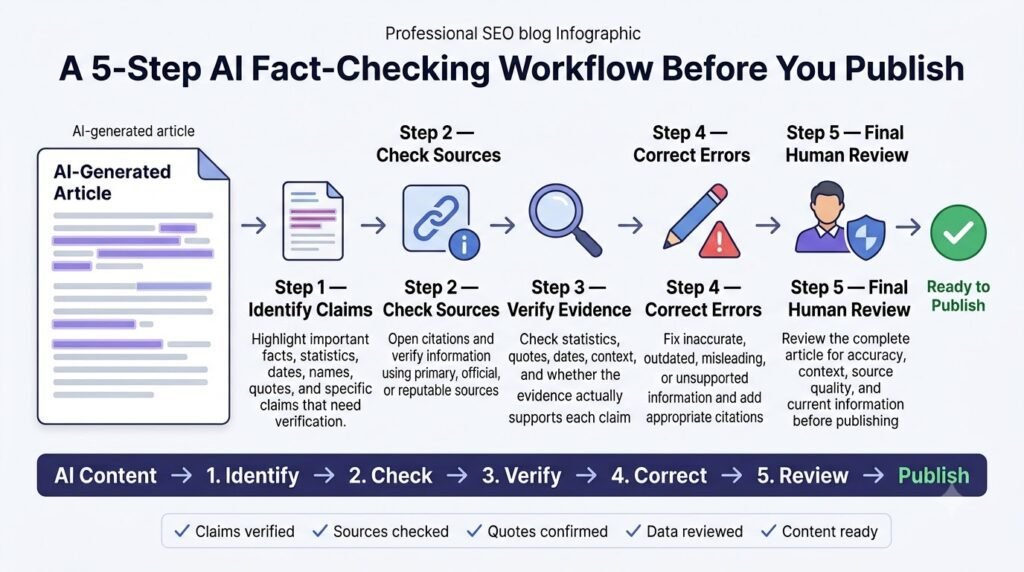
Run your AI generated drafts through this high speed verification checklist to eliminate hallucinations, out of date information, and incorrect facts prior to publishing.
Verification Pipeline: AI Draft → Extract Claims → Find Sources → Verify → Update → Human Review → Publish
Step 1: Highlight
Scan your draft and mark every high-risk claim that requires independent verification:
- Statistics & numbers: Data points, percentages, market figures
- Dates & timelines: Event years, release dates, historical milestones
- Direct Quotes: Statements given by a person or organization
- Proper nouns: Names of people, companies, software, and locations
- Citations & Links: References to external studies or publications
- Product Details: Pricing, technical specifications, feature lists
- Research Claims: Medical, scientific, or industry findings
Step 2: Source
Find the source of all the claims you highlighted in the previous step
- Make sure to use official documents, research studies, interviews, or press releases as your sources
- Avoid using blogs, articles, and any other non-official resources.
Step 3: Compare
Cross-examine your AI draft against the original reference.
- Compare the exact wording, context, and numbers.
- Ensure the draft accurately reflects the source material without stripping critical context.
Step 4: Correct
Edit your text to resolve discrepancies identified during comparison:
- Outdated information: Updating out of date dates, prices or statistics.
- Unsupported statements: Delete any statements not supported by concrete data.
- Exaggerated wording: Tone down hyperbole or unverified superlatives.
- Incorrect cited: Correct incorrectly cited, misattributed or otherwise faulty documentation.
- Misleading: Elaborate on statements that may give an inappropriate or unjustified impression on the reader
Step 5: Publish
Perform a final human review. Send the content live only after every highlighted factual claim has passed verification. This five-step workflow is directly aligned with TheTechHacker’s concise publishing method.
Common AI Fact-Checking Mistakes to Avoid
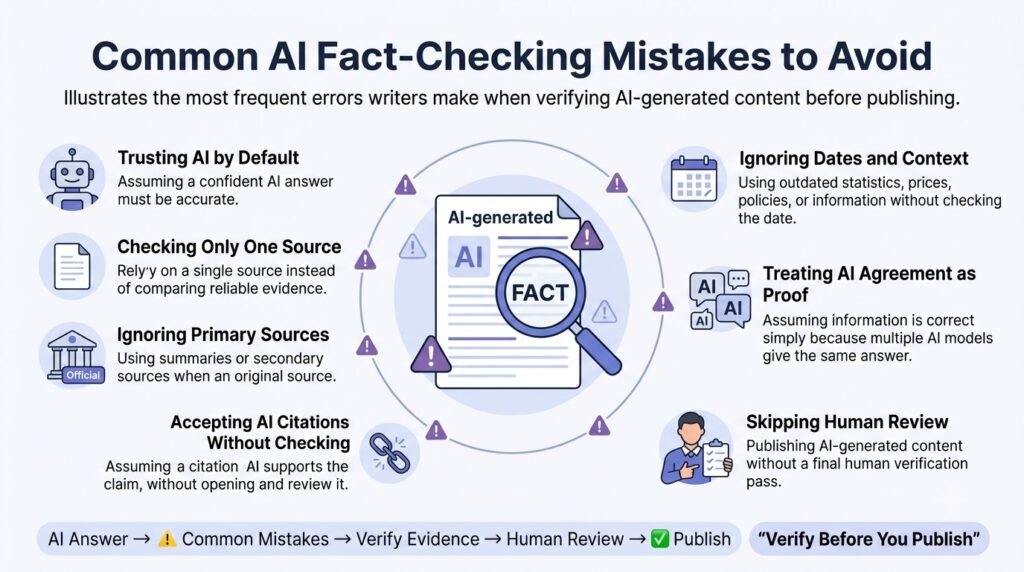
Fact-checking AI-generated content is not only about finding obvious errors. The verification process is prone to errors in and of itself, which can occur if one goes only by weak evidence, or stops checking prematurely. Avoid these common problems before publishing.
Trusting AI Because It Sounds Confident
AI can produce fluent, specific, and authoritative-sounding statements even when the underlying information is wrong. Confidence is not evidence.
Do not treat facts as established until you can back them up with credible sources, especially if their veracity may change what a reader decides to do.
Checking AI With Another AI and Stopping There
Using multiple AI models can be useful for identifying disagreements or highlighting claims that deserve closer examination. However, agreement between two or more AI systems is not independent proof.
AI models sometimes repeat the same wrong information due to the same root causes. Use their responses as leads for further research, and double-check any critical assertions in their responses against other reliable sources
Verifying Only the Main Claim
A major statement can be accurate while the supporting details are wrong.
Dates, percentages, names, product specs, quotes, and other minor claims, also pose a threat to the article’s credibility. Check the supporting facts, not only the concluding point.
Using Secondary Sources Instead of Original Sources
A secondary article may accurately summarize a source—or introduce an error while doing so.
Whenever possible, go back to the original research paper, dataset, government documents, company files, pricing page, or another primary source. It is especially important for research, stats, pricing, regulations, and product specs.
Confusing AI Detection With Fact-Checking
AI detection and fact-checking answer different questions.
An AI detector attempts to assess whether text may have been generated or assisted by AI. It does not establish whether the claims in that text are true.
Human-written content can include factual inaccuracies, while AI-generated content can contain true information. The claims themselves must be verified.
Forgetting That Facts Can Become Outdated
Some information changes quickly. A statement that was accurate at the time of publication can turn out to be incorrect.
Pay special attention to software features, pricing, API limits, company policies, regulations, product specifications, and statistics.
For these topics, check the latest authoritative source before publishing and update the article when the underlying information changes.
The given text is organized into sections and bullet points, providing headings and subheadings that highlight the critical areas that require additional fact-checking for AI:
- Medical and Health Content: Checking against medical and healthcare sites and expert bodies
- Financial Content: Comparing the given information with current rates, rules, and main financial documents.
- Legal Content: Referring to the relevant statutes, legal resources, and legislative research.
- Research and Academic Content: Going through the main papers on the topic rather than paraphrasing.
- Product, Pricing, and Tech Content: Consulting the most up-to-date formal product documentation and specifications.
The core take-away is that high-impact topics demand rigorous, primary-source verification over casual inquiries.
FAQs: How to Fact-Check AI Generated Answers Before Publishing
How do you fact check AI generated answers?
Extract all the claims with specific dates, names, statistics, quotation, and product from the provided text and verify each of them by looking for the source of the information, an article, or an official website of the company or organization mentioned in the claim.
Give the most scrutiny to numbers, research findings, and anything that could affect someone’s health, money, or legal standing.
What is the best way to verify AI-generated information?
Match your effort to the risk. General answers require simple sanity checks whereas statistics and research require visiting the source of information. Comparing several model answers can point you in the right direction, but make sure to double-check with an external reliable source.
Can AI fact-check itself?
Partly. Asking a model to review its own answer, or asking a second model to review the first, can surface inconsistencies, unsupported claims, and details worth double-checking.
But a model can repeat the same error, or confidently defend a wrong one, so this cannot be considered an independent verification of the result. It should instead be seen as an indication of suspicious evidence. To actually prove something, you’ll need another source of information besides the ai.
How can I check if an AI citation is real?
Search for the exact title, author, and publication. Then open the source itself and check three things: that it exists, that the details (authors, year, journal) match, and that it actually supports the claim it’s attached to. That last check matters because AI sometimes pairs a real source with a claim it never makes.
How do you verify AI-generated content before publishing?
Run a separate pass through your facts after editing your facts, since proofreading will miss a lot. Extract all the factual claims, sort them by how risky they are, make sure all of them are checked off against main sources, and verify every quote and source. Replace anything you can’t verify or remove it.
What are the best AI fact-checking tools?
No tool can fully replace source checking. Useful options may be grouped into a few categories, such as multi-model comparison workspaces (e.g., AiZolo) to identify contradictions, search engines and academic databases to verify the source of information, and specialized fact-checking websites that address the most widespread rumors.
Choose based on what you’re verifying, and treat any tool’s output as a lead to follow up.
Can you trust AI-generated answers for research?
Use them as a starting point, not as a source. AI is good for ideation, summarizing of concepts, and suggestion of directions, but it can generate fake citations, incorrect results, and outdated information with ease. Anything you rely on for research should be traced to the original material.
Is an AI detector the same as a fact-checking tool?
No. An AI detector estimates whether text was written by a machine. A fact-checking process would be determining the truth of the claims made within the text.
Human-written content can be wrong, and AI-written content can be accurate, so detection tells you nothing about factual reliability.
Should you use multiple AI models to verify an answer?
It can help. If the models are contradicting each other, then you’ve found a claim that is worth investigating.
Otherwise, you might want to take it as a confirmation of your own analysis, since different models can make the same mistakes. You’ll want to use a variety of models to check your claims, and then check against original sources.
Final Checklist: Is Your AI-Generated Article Ready to Publish?
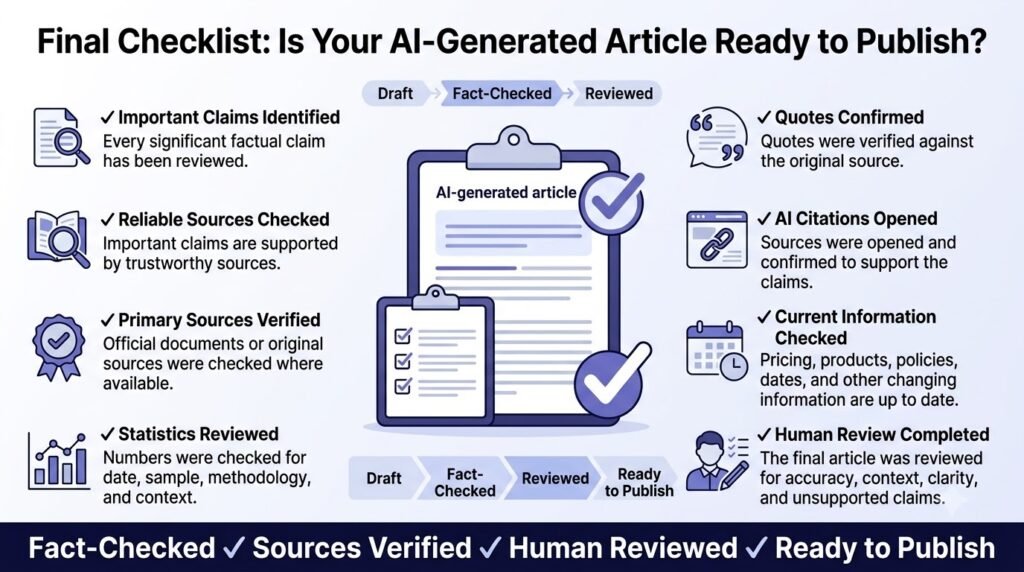
Before publishing an AI-assisted article, run through this final checklist:
- ☐ Every important factual claim has been identified.
- ☐ Important claims have reliable supporting sources.
- ☐ Primary sources were checked wherever available.
- ☐ Statistics were verified for date, sample size, population, and context.
- ☐ Quotes were checked against the original source.
- ☐ AI-generated citations were opened and verified.
- ☐ Product features, pricing, and specifications are current.
- ☐ Images, charts, and screenshots accurately represent the information shown.
- ☐ Multiple independent sources were compared for high-impact claims.
- ☐ A human reviewed the final article for accuracy, context, and clarity.
If any important claim cannot be backed up by a reliable source, then it should be further researched, qualified, or removed. It doesn’t mean that AI will not be used in the publishing process, but rather that all significant claims should have a reliable basis before being delivered to the reader.
Author Bio
Anshika Verma is a Content Researcher and AI Content Writer at AiZolo, specializing in AI tools, AI models, AI comparisons, and emerging AI technologies. She researches the latest developments in artificial intelligence and creates accurate, SEO-focused content that helps readers understand and choose the right AI tools for their needs.