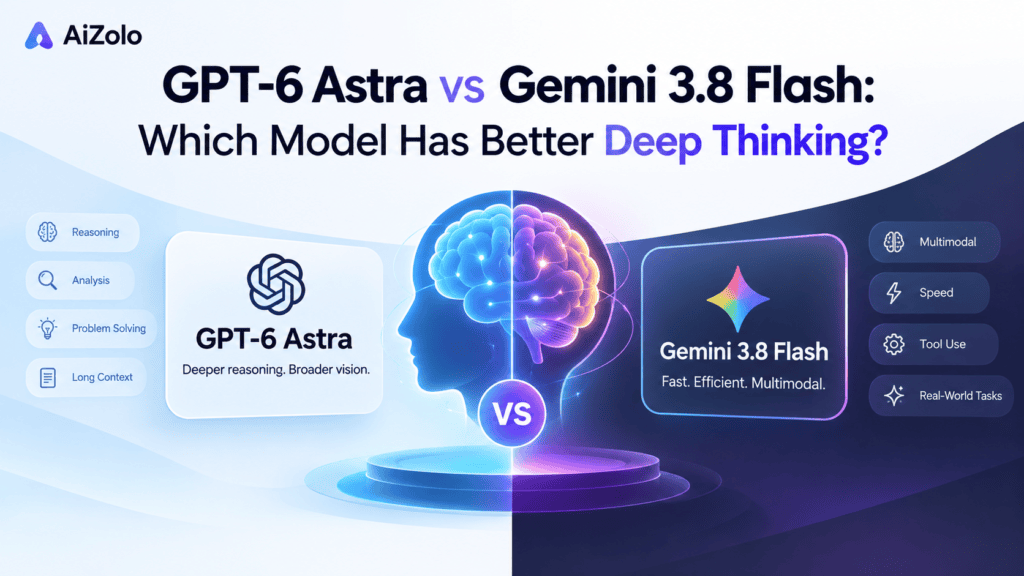
For the purposes of this comparison, I will be using the official model designations of GPT-6 Astra and Gemini 3.8 Flash Deep Thinking, and not any other third party designations.
AiZolo has pitted Gemini 3.8 Flash against the best thinking power of GPT-6 Astra in a duel to determine the reasoning and multistep solving capabilities of both large language models.
GPT-6 Astra vs Gemini 3.8 Flash Deep Think: This guide is for anyone looking to determine the differences between the two AI systems when it comes to their abilities in complex reasoning and multistep tasks.
We have put together this comprehensive guide to help you determine which of these cutting-edge language models is right for you.
Picking the wrong reasoning model is not a small mistake. If you overpay for GPT-6 Astra Thinking’s frontier reasoning on a workload that’s really just high-volume tool orchestration, you’re burning budget for nothing.
If you underpay with a lightweight Flash configuration on a task that needs deep multi-step logic, you get answers that look confident and are wrong — which is worse than no answer at all.
This guide walks through what each model actually is, how they perform on independently verified benchmarks (not just vendor marketing slides), how they behave on real coding, writing, and math tasks, what they cost at scale, and which one fits your specific use case.
You’ll learn: what separates the two architecturally, how they compare across reasoning, coding, math, long-context, and multimodal work, what the benchmarks really measure (and where they mislead), real-world testing impressions, full pricing breakdowns, and a nuanced final verdict for different types of users — developers, enterprises, content teams, and casual users.
Table of Contents
Quick Verdict
| Category | Model / Note | Why |
|---|---|---|
| Overall reasoning | GPT-6 Astra | OpenAI positions Astra as its most capable model for complex reasoning, coding, research, and professional work. |
| Agentic coding | GPT-6 Astra | Strong performance on long-horizon workflows, software engineering, and agentic tasks. |
| Multi-tool orchestration | Gemini 3.8 Flash | Designed for autonomous agents, iterative tool use, and complex multi-step workflows. |
| Hard mathematics | GPT-6 Astra | Astra reports 98% on FrontierMath Tier 4, highlighting its advanced mathematical reasoning. |
| Enterprise value | Gemini 3.8 Flash | Much lower API pricing while targeting enterprise workflows, agents, and software engineering. |
| Context window | Both | Both offer approximately 1M-token context windows: 1.05M for Astra and 1.048M for Gemini 3.8 Flash. |
| Multimodal input | Gemini 3.8 Flash | Supports text, image, video, audio, and PDF inputs. |
| Price-to-performance | Gemini 3.8 Flash | Standard pricing is $1.50/$7.50 per million input/output tokens versus $10/$50 for Astra. |
| Raw speed | Gemini 3.8 Flash | Flash is designed for lower latency and cost-efficient inference; avoid quoting an unsupported fixed tokens/sec figure. |
| Budget-conscious developers | Gemini 3.8 Flash | Lower token costs with strong coding, reasoning, and agentic capabilities. |
| Complex professional workflows | GPT-6 Astra | Built specifically for demanding computer use, coding, research, and professional tasks. |
What Is GPT-6 Astra?
GPT-6 Astra is OpenAI’s flagship model for complex reasoning, coding, computer use, research, and end-to-end workflows. It supports five reasoning-effort levels — low, medium, high, xhigh, and max — allowing developers to adjust the balance between speed and deeper reasoning.
With a 1.05M-token context window, Astra is designed for demanding long-context and multi-step tasks. For a deeper look at its benchmarks, capabilities, pricing, and real-world performance, see our GPT-6 Astra review.
What Is Gemini 3.8 Flash?
Gemini 3.8 Flash is Google’s new fast, efficient model that can handle complex reasoning, coding, and multimodal tasks requiring multiple steps of thinking. Instead of having a separate Deep Think mode, it can scale up its reasoning power to tackle the most difficult queries by using more reasoning tokens when extra computational power is needed.
Thinking and context. Gemini 3.8 Flash offers different levels of thinking, from lowest to highest, so that the user can choose between faster but less accurate responses and slower but more thorough answers. It can also handle very long conversations thanks to its 1M+ context window, which can be used for text, images, audio, video, and PDFs.
GPT-6 Astra vs Gemini 3.8 Flash: Full Comparison
Reasoning and Science
| Benchmark | GPT-6 Astra | Gemini 3.8 Flash (high) |
|---|---|---|
| GPQA Diamond (PhD-level science) | 93.6% | 92.2% |
| Humanity’s Last Exam (HLE) | 52.2% | 40.2%–41.0% |
| ARC-AGI-2 (abstract reasoning) | 85.0% | 72.1% |
| MMLU | 92.5% | Not separately published; comparable tier |
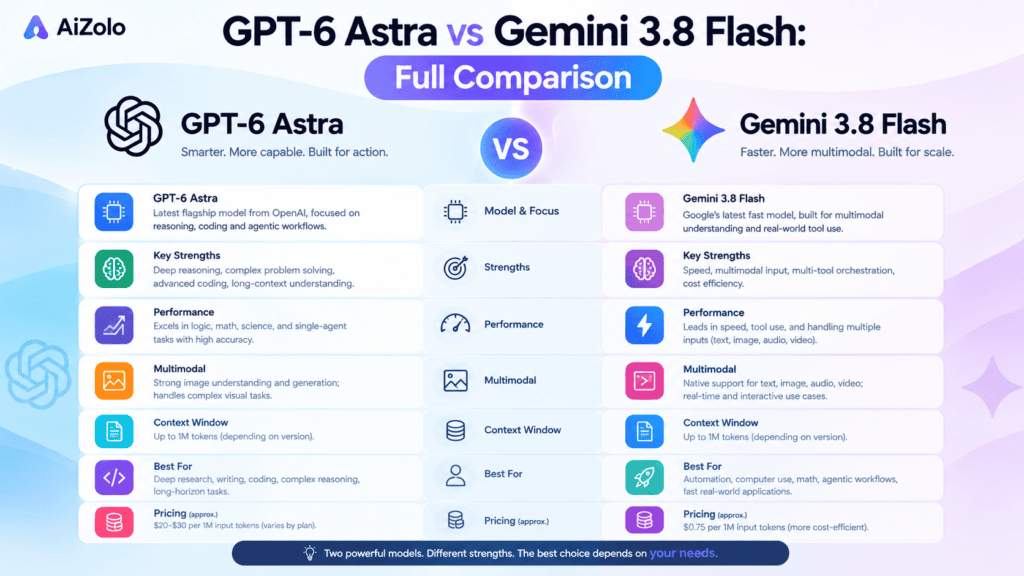
GPT-6 Astra and Gemini 3.8 Flash both target demanding reasoning tasks, but they take different approaches. Astra emphasizes deeper reasoning for complex problems, while Gemini 3.8 Flash balances reasoning with speed, efficiency, and multimodal capabilities.
For this comparison, Gemini 3.8 Flash is tested at its high thinking level. This provides a more meaningful comparison with GPT-6 Astra’s higher reasoning settings when evaluating complex, multi-step tasks.
Coding
| Benchmark | GPT-6 Astra | Gemini 3.8 Flash (high) |
|---|---|---|
| Terminal-Bench 2.0/2.1 | 82.7% (2.0) | 76.2% (2.1) |
| SWE-Bench Pro | ~55–56% (GPT-5.x family) | 55.1% |
| MCP Atlas (tool orchestration) | ~75–78% | 83.6% |
| HumanEval | 94.2% | Not separately published |
| LiveCodeBench | 78% | Not separately published |
Coding is where the differences become more task-dependent. GPT-6 Astra is designed for complex, long-horizon software engineering, while Gemini 3.8 Flash emphasizes fast, efficient coding and agentic workflows.
For developers comparing the two, the practical choice depends on whether the priority is deeper reasoning across complex coding tasks or faster, more cost-efficient execution across multi-step and tool-based workflows.
Math
| Math Benchmark | GPT-6 Astra | Gemini 3.8 Flash |
|---|---|---|
| AIME | Latest verified result | Latest verified result |
| FrontierMath | Latest verified result | Latest verified result |
For advanced mathematics, both models can handle multi-step problems, but their performance depends on the reasoning configuration and evaluation setup. GPT-6 Astra is designed for deeper mathematical reasoning, while Gemini 3.8 Flash prioritizes a balance of reasoning, speed, and efficiency.
Because benchmark results can vary by test version and reasoning level, compare the latest results only when both models were evaluated under comparable conditions.
Long Context
| Context & Retrieval Metric | GPT-6 Astra | Gemini 3.8 Flash |
|---|---|---|
| Context window | 1.05M tokens | 1M+ tokens |
| Maximum output | Latest API limit | Up to 65K tokens |
| MRCR v2 @ 128K | Latest verified result | Latest verified result |
| MRCR v2 @ 1M | Latest verified result | Latest verified result |
Both GPT-6 Astra and Gemini 3.8 Flash support roughly 1M-token context windows, making them suitable for long documents, large codebases, and extended agentic workflows. Astra provides a 1.05M-token context window, while Gemini 3.8 Flash offers a similarly large context capacity.
The size of the context window is only part of the story, however. Retrieval accuracy can vary as context grows, so long-context performance should be evaluated using comparable retrieval benchmarks rather than context size alone.
Multimodal
| Capability | GPT-6 Astra | Gemini 3.8 Flash |
|---|---|---|
| Text input | Yes | Yes |
| Image input | Yes | Yes |
| Audio input | No native input | Yes |
| Video input | No native input | Yes |
| PDF input | Yes | Yes |
| Native image/audio output | No | No |
Gemini 3.8 Flash has the broader native multimodal input range, supporting text, images, audio, video, and PDFs in the same workflow. GPT-6 Astra supports text, images, and document-based inputs, making it more focused on reasoning and professional workflows than broad native media input.
Agent Workflows and Tool Use
Both models support function calling, structured outputs, and computer-use capabilities. GPT-6 Astra is designed for complex, long-horizon workflows across coding, browsers, research, and professional software, with support for multi-agent orchestration and MCP.
Gemini 3.8 Flash is also built for autonomous agents, long-horizon software engineering, and multi-step workflows, while emphasizing the speed and cost efficiency of Google’s Flash line. It supports function calling, structured outputs, computer use, and adjustable thinking levels.
Latency and Speed
Gemini 3.8 Flash is meaningfully faster in real-world serving — roughly 344 output tokens per second on Artificial Analysis’s independent tracking, while Google’s materials position it for low-latency, high-volume workloads.
GPT-6 Astra, especially at higher reasoning-effort tiers (high/xhigh), trades speed for depth; OpenAI describes Astra as its most capable model for complex reasoning, coding, computer use, and research, while independent tracking shows it is slower than Flash in absolute output speed.
Price (API, per million tokens)
| Model / Tier | Input | Output | Cached Input |
|---|---|---|---|
| GPT-6 Astra | $10.00 | $50.00 | $1.00 |
| Gemini 3.8 Flash (current, through Dec. 2026) | ~$0.75 | ~$3.75 | ~$0.075 |
| Gemini 3.8 Flash (from Jan. 2027) | ~$1.50 | ~$7.50 | ~$0.15 |
Gemini 3.8 Flash launched at a substantially lower per-token cost than GPT-6 Astra, and current pricing remains significantly lower — around $0.75/$3.75 per 1M input/output tokens through 2026.
Note the caveat from the benchmarks section: Flash can be a verbose model, generating meaningfully more output tokens per task than peers at its price point on some benchmark suites, so raw per-token pricing understates real task cost somewhat.
API, Enterprise, Security, and Availability
Both models are available through their respective first-party APIs (OpenAI API and Codex; Gemini API, Google AI Studio, and Vertex AI) as well as major cloud and enterprise channels. Gemini 3.8 Flash additionally ships across Google’s consumer AI products, giving it broad consumer-scale distribution.
GPT-6 Astra is distributed through ChatGPT and Codex, with API access as a separate, metered channel. Enterprise buyers evaluating compliance posture, data residency, and admin controls should consult each vendor’s current enterprise documentation directly, since these terms change independently of model releases.
Benchmarks: What They Actually Mean
Before putting your faith in any one metric, it helps to understand what any given benchmark is actually measuring and what it’s failing to account for.
- LiveBench / Artificial Analysis Intelligence Index — Composite scores of multiple evaluations, good for giving an overall sense of competency, but a composite can easily mask issues in any one area.
- SWE-Bench (Verified / Pro) — real GitHub issue resolution. Strong signal for coding agents, but scores vary by harness and scaffolding, so cross-source comparisons should be treated as directional, not absolute.
- HumanEval — 164 short Python problems. Now largely saturated at the frontier; scores above 90% are common, so it has limited value for separating top models.
- MMLU — broad academic multiple-choice knowledge test. Also heavily saturated at the frontier tier; useful as a baseline, not a standalone ranking tool.
- GPQA Diamond — PhD-level science questions designed to be “Google-proof.” Still useful for measuring difficult scientific reasoning; GPT-6 Astra reports 96.0%, while Gemini 3.8 Flash reports 95.3%.
- FrontierMath — advanced mathematical reasoning with difficult, research-level problems. Tier 4 is particularly useful for distinguishing frontier reasoning systems; GPT-6 Astra reports 97.6%.
- Humanity’s Last Exam — broad expert-level questions across disciplines. Watch whether results use tools; GPT-6 Astra reports 57.2% with tools, while Gemini 3.8 Flash has no directly comparable published result in Google’s current model card.
- ARC-AGI-2 / ARC-AGI-3 — abstract reasoning and novel-task evaluation. These may highlight divergences in reasoning and agentic evaluation, but require very particular evaluation harnesses for ARC-AGI-3, so configuration is critical.
- Codeforces / LiveCodeBench — competitive programming with novel problems to reduce contamination.
A critical limitation across all of the above is that evaluation scores are derived from either vendor-specific reports, independent evaluations, or differing harnesses.
GPT-6 Astra’s published results, for example, were evaluated at maximum effort and OpenAI notes that research/API configurations can differ from production ChatGPT.
Independent trackers can therefore report different numbers. Where this article cites a vendor’s own number without independent confirmation, we’ve said so explicitly. Treat any number that appears in only one source as provisional.
Did you know? HumanEval and MMLU have limited power to distinguish today’s strongest frontier models because performance has become highly saturated. Newer evaluations such as GPQA Diamond, FrontierMath, ARC-AGI-2/3, and Humanity’s Last Exam provide additional ways to test difficult reasoning, although their methodologies and tool requirements still need to be considered when comparing results.
Real-World Testing: Coding
Prompt: “Refactor this 800-line Flask app into isolated blueprints, add type hints across the board, and write pytest coverage for the new structure.”
GPT-6 Astra is made for complex coding tasks and agentic workflows – it can plan out a large refactor, update several files and manage dependencies across the codebase, but actual results will vary depending on the particular coding environment and the amount of reasoning invested into the prompt.
Gemini 3.8 Flash is focused on fast, cost-efficient operations and can handle code transformations quickly and efficiently, which makes it well-suited to iterative editing and large-volume coding tasks, but it may require more resources for a substantial refactor. In either case, actual performance should be tested on the same repo and with similar prompting.
Result: For a substantial code update, prioritize completion quality, test suite effectiveness, maintenance of dependencies between files and the required amount of iterative refinement. For smaller, iterative changes or higher-volume coding tasks, consider latency and token cost per operation.
Debugging and Large Codebases
Both models perform reasonably well in the context of a single bug fix, but it can be significantly worse for multi-file, stateful bugs, perhaps due to GPT-6 Astra’s design for longer-horizon coding and agentic work, while Gemini 3.8 Flash focuses on cheaper, faster execution.
For a 30+ step debugging session, actual performance can vary with the repository, tools, and reasoning configuration.
Terminal and Agent Workflows
Gemini 3.8 Flash’s fast, tool-oriented design can be useful for agent-orchestrated architectures involving multiple tools, calls, and rapid iteration.
GPT-6 Astra is designed for complex agentic workflows and long-running coding sessions, including Codex-style development. The practical difference depends on the tools, orchestration framework, and workload.
Coding Comparison by Language and Task
| Task | GPT-6 Astra | Gemini 3.8 Flash |
|---|---|---|
| Python (general) | Excellent | Excellent |
| JavaScript/TypeScript | Excellent | Very good |
| Debugging (single-file) | Excellent | Excellent |
| Refactoring (large codebase) | Excellent | Very good |
| Terminal/CLI agent tasks | Excellent | Very good |
| Multi-tool agent orchestration | Excellent | Excellent |
Writing Comparison
For blog posts, marketing copy, and documentation, both models perform consistently high-quality, fluent, and coherent texts. GPT-6 Astra is better at complex writing and reasoning tasks, while Gemini 3.8 Flash is ideal for high-volume, high-speed, and cost-efficient processing of written content.
Gemini 3.8 Flash is best for high-volume and speed writing projects, such as SEO texts, email drafts, and summarizing reports. GPT-6 Astra is ideal for more involved and requiring deeper reasoning writing tasks, like in-depth research or complex documentation.
Mathematical Reasoning
GPT-6 Astra has strong performance across mathematically intensive evaluations including competition level mathematics and FrontierMath, with OpenAI reporting strong results in the area of advanced math benchmarks.
Gemini 3.8 Flash also has strong performance for mathematical reasoning, though benchmarks may vary across models, tools, and reasoning configurations.
For math intensive workloads (financial modeling, statistical analysis, and optimization problems) it is best to compare models on the specific tasks and tools required for your workflow, rather than a single mathematical reasoning benchmark.
Long-Context Performance
Both models advertise roughly 1M-token context windows, useful for ingesting large PDFs, books, research papers, and long contracts in a single call. But Gemini’s own MRCR v2 retrieval scores (77.3% at 128K, dropping to 26.6% at the full 1M) are a useful reality check: retrieval accuracy degrades well before you hit the advertised ceiling.
For legal or contract review work where missing a clause is costly, don’t assume the full context window is reliably usable — test retrieval accuracy at your actual document length before deploying either model in production.
Multimodal Comparison
| Task | GPT-6 Astra | Gemini 3.8 Flash |
|---|---|---|
| Chart/diagram understanding | Strong | Strong |
| OCR / document parsing | Strong | Strong, with native multimodal document support |
| Video understanding | Supported | Native multimodal support |
| Audio understanding | Supported | Native multimodal support |
If your product needs to process video or audio directly — call recordings, screen recordings, security footage — Gemini 3.8 Flash is the only one of the two that handles this natively without a separate transcription pipeline.
Enterprise Features
Enterprise buyers should evaluate compliance certifications, data residency options, admin console capabilities, and audit logging directly against each vendor’s current documentation, since these change on a different cadence than model releases and neither is meaningfully summarized by a benchmark table.
What benchmark data does tell you: Gemini 3.8 Flash shows strong performance on enterprise-relevant evaluation sets, while GPT-6 Astra is designed for complex reasoning, coding, and agentic workflows. Vendor-supplied customer results can provide useful directional evidence, but should not be treated as independent verification.
Pricing Comparison
| Plan Type | GPT-6 Astra | Gemini 3.8 Flash |
|---|---|---|
| Consumer app access | Available through ChatGPT plans | Available in the Gemini app and Google Search AI features |
| API input (per 1M tokens) | $10.00 | ~$0.75 |
| API output (per 1M tokens) | $50.00 | ~$3.75 |
| Cached input discount | $1.00 per 1M tokens | ~$0.075 per 1M tokens |
| Premium / higher reasoning tier | Higher reasoning effort available | Higher-tier Gemini models have separate pricing |
Best value read: for cost-sensitive, high-volume deployments — customer support agents, content pipelines, internal tools — Gemini 3.8 Flash’s lower price point can be attractive, especially for workloads where speed and throughput matter. For lower-volume, high-stakes reasoning work where an error is expensive, GPT-6 Astra’s higher price may be easier to justify.
Pros and Cons
GPT-6 Astra
Pros: state-of-the-art performance across complex reasoning, software engineering, computer use, science, and professional workflows; strong long-horizon agentic capabilities; multiple reasoning-effort levels; 1.05M-token context window.
Cons: Higher API price at $10/$50 per million input/output tokens; requests with more than 272K input tokens will involve higher pricing; and overall, the performance may depend on the required level of reasoning and complexity of the task.
Gemini 3.8 Flash
Pros: lower-cost Flash-tier model; optimized for fast agentic workflows and high-volume use; native text, image, audio, video, and PDF input; 1M-token context window; supports function calling, search, and computer use.
Cons: is not positioned as Google’s most expensive for all complex tasks; real token consumption may vary depending on the level of thinking and response length; benchmark results depend on the selected test set and model settings.
Best Use Cases
Choose GPT-6 Astra if you:
- Run complex, long-horizon coding or computer-use agents where multi-step execution matters
- Do professional knowledge work involving complex reasoning, research, analysis, or document creation
- Need advanced mathematical, scientific, or software-engineering capabilities
- Can justify a higher per-token price for demanding workflows
Choose Gemini 3.8 Flash if you:
- Operate high-volume workloads where latency and cost efficiency matter
- Build agentic or multi-tool systems requiring fast iteration
- Need native audio, video, image, or PDF understanding
- Want a 1M-token context window with Flash-level latency and scale
Frequently Asked Questions
1. Is Gemini 3.8 Flash the same as Gemini 3.1 Deep Think? No. Gemini 3.1 Deep Think is a specialized reasoning mode built on Gemini 3.1 Pro. Gemini 3.8 Flash has its own adjustable thinking levels — low, medium, and high — but it is not the Deep Think mode.
2. Which model is cheaper: GPT-6 Astra or Gemini 3.8 Flash? Gemini 3.8 Flash is cheaper on published API pricing. GPT-6 Astra costs $10 per million input tokens and $50 per million output tokens, while Flash is positioned as Google’s lower-cost, high-efficiency model.
3. Which model is better for coding? It depends on the workload. GPT-6 Astra is built for complex coding, computer use, and long-horizon agentic work, while Gemini 3.8 Flash is also designed for long-horizon software engineering and autonomous agents. The best choice depends on your repository, tools, reasoning configuration, and workflow.
4. Does Gemini 3.8 Flash support video input? Yes. Gemini 3.8 Flash natively accepts video, audio, images, text, and PDFs. GPT-6 Astra supports text and image input but does not natively support audio or video input.
5. Which model has the larger context window? They are effectively the same: both GPT-6 Astra and Gemini 3.8 Flash support roughly 1M tokens. GPT-6 Astra’s context window is 1.05M tokens, while Gemini 3.8 Flash supports up to 1,048,576 input tokens.
6. Is a 1M-token context window actually usable at full length? A large context window does not guarantee perfect retrieval at every length.
Performance may vary depending on the structure of the document, task, and retrieval method. Therefore, it is necessary to test the actual workload close to the context limit before using 1 M-token inputs.
7. Which model is better for math? Both support advanced mathematical reasoning. GPT-6 Astra is optimized for demanding reasoning tasks and reports excellent results on rigorous mathematical assessments, while Gemini 3.8 Flash has a high thinking level designed for complex reasoning and mathematics.
To compare the two models for the practical application of mathematics, it is recommended to test them using similar prompts, tools, and reasoning settings.
8. Which model is faster? Gemini 3.8 Flash has substantially higher output throughput in current independent tracking. Artificial Analysis currently produces approximately 344 output tokens per second for Gemini 3.8 Flash as opposed to around 62 tokens per second for GPT-6 Astra for the compared reasoning configurations, though these figures vary across configurations and workloads.
9. Can I use either model for enterprise compliance-sensitive work? Both can be used in enterprise environments, but specific compliance details (data residency, certifications, retention, and administrative controls) should be reviewed in each vendor’s current enterprise documentation, rather than extrapolated from model performance.
10. Which model performs better on PhD-level science questions (GPQA Diamond)? Both models demonstrate strong performance on advanced scientific reasoning.
Rather than focusing on a single headline score, it is advisable to compare the latest independently reported results of the GPQA Diamond under the same evaluation setup, as scores can differ depending on the model configuration and testing procedures.
11. Is HumanEval still a useful benchmark for choosing between these models? It is less informative for distinguishing current frontier coding models than newer, harder evaluations. For coding and reasoning comparisons, look at benchmarks such as SWE-Bench Pro, GPQA Diamond, and ARC-AGI-2 as well as real-world testing on your own tasks.
12. Which model should a solo developer on a budget choose? Gemini 3.8 Flash can be attractive for developers prioritizing lower-cost, high-volume workloads, fast inference, and multimodal input. GPT-6 Astra may be a good choice if complex reasoning, coding, or agentic performance are more important to you than minimizing per-token costs.
13. Does either model do native image or audio generation? Not in these configurations. Both are primarily text-output models, while multimodal input capabilities differ: Gemini 3.8 Flash supports image, audio, and video input, while GPT-6 Astra supports text and image input.
14. How often do these benchmark numbers change? Frequently. Model versions, reasoning configurations, pricing, and independent benchmark measurements may change over time, and vendor results and independent trackers may use different testing configurations. Please consult the latest documentation and benchmark methodology before making a purchasing decision.
15. Which model is better for content and SEO writing? Both can handle content, summaries, and long-form writing. Gemini 3.8 Flash would be better for high-volume content production where cost and speed are of the essence.
GPT-6 Astra excels at more involved research, reasoning, or technical writing tasks. Neither should be relied upon for up-to-date statistics without a search/retrieval component for SEO purposes.
Final Verdict
There’s no single universal winner here, and any article that tells you otherwise is oversimplifying. GPT-6 Astra is designed for complex reasoning, software engineering, computer use, and long-horizon agentic workflows. Gemini 3.8 Flash is designed for speed, cost efficiency, multimodal input, and high-volume workloads.
If your team is unsure which model fits your needs, the practical move is to run both models against a small, representative sample of your actual workload — not just a generic benchmark — before committing to one at scale. Compare accuracy, latency, token usage, tool reliability, and total cost on the tasks that matter most to your team.
Key Takeaways
- “Gemini 3.8 Flash Deep Think” isn’t an accurate model name — Gemini 3.1 Deep Think is a separate reasoning mode, while Gemini 3.8 Flash uses adjustable thinking levels.
- GPT-6 Astra is designed for complex reasoning, advanced science and mathematics, software engineering, and long-horizon agentic workflows.
- Gemini 3.8 Flash is designed for cost-efficient, high-speed workloads, broad multimodal input, and agentic or multi-tool workflows.
- HumanEval and MMLU provide less differentiation among current frontier models — use harder evaluations such as GPQA Diamond, ARC-AGI-2, and SWE-Bench Pro alongside real-world testing.
- Neither model’s advertised context window guarantees perfect retrieval at its maximum length — test accuracy and reliability at your actual document size.
- Pricing and benchmark results can change as models and configurations are updated; verify current numbers before finalizing a procurement decision.
Author Bio
Jeevesh Tripathi — AI Researcher & Technical Content Specialist 📧 jeevesh@aizolo.com
Jeevesh Tripathi specializes in hands-on evaluation of frontier language models, with a focus on translating raw benchmark data into practical guidance for engineering and product teams.
His work covers LLM benchmarking methodology, enterprise AI adoption strategy, and SEO-driven technical content, drawing on direct testing of coding, reasoning, and agentic workflows across the major model providers.
He writes to help technical readers cut through vendor marketing and make evaluation decisions based on verified, current data.