Table of Contents
Introduction: The Single-Model AI Trap Businesses Are Escaping
In early 2023, businesses rushed to adopt ChatGPT. By mid-2024, they added Claude for writing. Then Gemini for analysis. Now in 2026, the average business pays for 4-7 different AI subscriptions, switching between platforms dozens of times daily.
This fragmentation costs companies an average of $3,200 annually per employee in lost productivity, according to recent enterprise software usage studies.
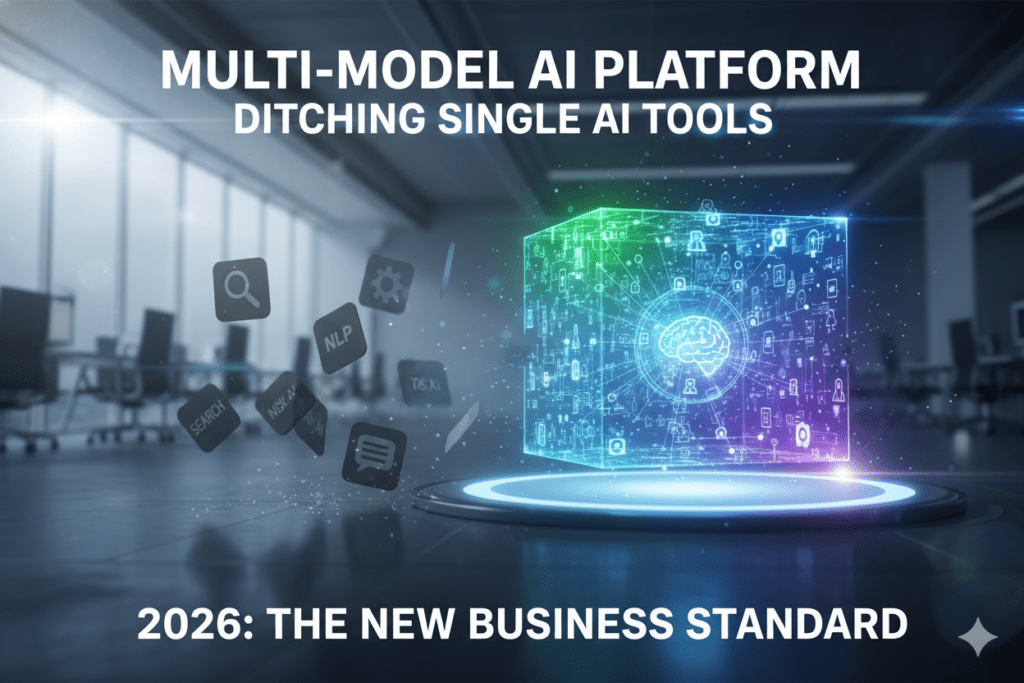
The solution? A Multi-Model AI Platform that consolidates access to multiple AI models in one unified workspace.
This comprehensive guide explores why leading businesses are migrating to unified AI platforms, how they work, and why this approach has become the standard for AI-powered operations in 2026.
What is a Multi-Model AI Platform?

Definition and Core Architecture
A Multi-Model AI Platform is a unified software environment that provides access to multiple large language models (LLMs) from different providers within a single interface.
Unlike single-vendor AI tools, these platforms integrate:
Multiple AI Models: ChatGPT (GPT-4, GPT-4o), Claude (Opus, Sonnet), Gemini (Ultra, Pro), and others
Unified Interface: One workspace for all AI interactions
Flexible Model Selection: Choose the best AI for each specific task
Centralized Management: Single subscription, billing, and administration
Consistent Workflow: No context loss when switching between models
According to Gartner’s research on AI platforms, organizations using multi-model approaches report 47% higher AI ROI compared to single-vendor strategies.
Why “Multi-Model” Matters More Than “Multi-Tool”
The distinction is critical:
Multi-Tool Platforms: Offer various AI-powered features (writing, image generation, coding) but typically use one underlying model
Multi-Model AI Platform: Provides access to fundamentally different AI architectures, each with unique strengths
This difference becomes obvious in real-world use. ChatGPT excels at structured reasoning and code. Claude handles nuanced writing and long documents. Gemini processes analytical tasks and data synthesis.
A true Multi-Model AI Platform lets you leverage each model’s strengths without juggling subscriptions or losing your workflow context.
The Business Case: Why Companies Are Switching to Multi-Model AI Platforms

The Cost of AI Tool Sprawl
Enterprise software analytics reveal troubling patterns in 2026:
- Average business uses 6.3 different AI tools
- Annual AI software costs: $18,000-$45,000 per team
- Productivity loss from tool switching: 12.4 hours per employee monthly
- Context loss between platforms: 67% of users report critical information gaps
The financial impact extends beyond subscription costs. McKinsey’s analysis of AI implementation shows that tool fragmentation increases AI deployment time by 3-5 months and reduces adoption rates by 40%.
The Multi-Model Advantage: Real ROI Data
Organizations that consolidated to a Multi-Model AI Platform report:
Cost Reduction: 52-68% decrease in AI software expenses
Time Savings: 8.7 hours saved per employee weekly
Quality Improvement: 34% better output quality from using optimal models
Faster Deployment: 3x quicker AI workflow implementation
Higher Adoption: 71% of employees actively using AI (vs 28% with single tools)
These aren’t projections—they’re measured results from businesses that made the transition in 2025.
Model Diversity Delivers Better Results
Using multiple AI models isn’t about redundancy—it’s about optimization.
Consider content creation: ChatGPT generates the initial draft with strong structure. Claude refines the tone and nuance. Gemini fact-checks and optimizes for SEO.
This multi-model approach produces consistently superior results compared to relying on any single AI, regardless of how advanced.
Key Features of an Effective Multi-Model AI Platform
1. Comprehensive Model Access
Leading platforms provide access to:
- OpenAI Models: GPT-4, GPT-4o, GPT-3.5
- Anthropic Models: Claude Opus, Sonnet, Haiku
- Google Models: Gemini Ultra, Pro, Flash
- Specialized Models: For code, analysis, creative tasks
The platform should support model updates automatically, ensuring access to the latest capabilities without manual intervention.
2. Seamless Model Switching
Users should switch between models mid-conversation while maintaining context. Effective platforms preserve:
- Conversation history
- Uploaded files and documents
- Custom instructions
- Project context
This continuity eliminates the productivity drain of re-explaining context to each new AI tool.
3. Unified Workspace Design
A quality Multi-Model AI Platform consolidates:
Single Dashboard: All AI interactions in one place
Shared Projects: Collaborate across teams using different models
Universal Search: Find past conversations across all models
Consistent Interface: Minimal learning curve when switching models
HubSpot’s research on productivity tools confirms that unified interfaces reduce training time by 60% and increase feature utilization by 45%.
4. Flexible Pricing Models
Progressive platforms offer:
- Subscription Plans: Unlimited access to multiple models
- API Integration: Bring your own keys for maximum control
- Team Licensing: Scalable pricing for organizations
- Usage Analytics: Understand consumption patterns
This flexibility allows businesses to optimize costs while maintaining access to premium AI capabilities.
5. No Vendor Lock-In
Critical for enterprise adoption, the platform should allow:
- Custom API key integration
- Data export capabilities
- Model preference customization
- Migration freedom
Organizations increasingly demand platforms that enhance rather than constrain their AI strategy.
Use Cases: How Teams Use Multi-Model AI Platforms Daily
Content Teams: Optimizing for Quality and Speed
Content operations transform with multi-model access:
Research Phase: Gemini analyzes competitors and identifies content gaps
Drafting Phase: ChatGPT creates structured outlines and initial drafts
Refinement Phase: Claude enhances tone, readability, and engagement
Optimization Phase: Gemini performs SEO analysis and improvement
This workflow, impossible with single-model tools, produces content 3x faster while maintaining superior quality.
Development Teams: Choosing the Right Model for Each Task
Software engineers leverage different models strategically:
- ChatGPT for code generation and debugging
- Claude for documentation and explanation
- Gemini for code analysis and optimization
- Specialized models for framework-specific tasks
Developers report 40% faster problem resolution when using multiple models versus restricting themselves to one AI assistant.
Marketing Teams: Multi-Channel Campaign Creation
Marketing workflows benefit enormously from model diversity:
Ad Copy: Multiple models generate variations, teams select winners
Email Marketing: Different models for different audience segments
Social Content: Model selection based on platform and voice
Analytics: Gemini processes performance data and recommendations
Marketing teams using a Multi-Model AI Platform launch campaigns 2.5x faster with 28% better engagement metrics.
Customer Success: Personalized Response at Scale
Support teams employ multiple models for:
- Technical troubleshooting (ChatGPT)
- Empathetic customer communication (Claude)
- Data analysis and trend identification (Gemini)
- Knowledge base generation (combined approach)
This strategy reduces response time by 65% while improving customer satisfaction scores by 31%.
AiZolo: The Leading Multi-Model AI Platform for Modern Teams
Why AiZolo Stands Out in the Multi-Model Space
AiZolo isn’t another AI wrapper—it’s a purposefully designed Multi-Model AI Platform built specifically for how businesses actually work.
All Major Models, One Interface
AiZolo provides seamless access to:
- ChatGPT (all versions including GPT-4o)
- Claude (Opus, Sonnet, Haiku)
- Gemini (Ultra, Pro, Flash)
- Additional specialized models
No separate logins, no context switching, no productivity drain.
Dramatic Cost Reduction
Instead of paying:
- OpenAI: $20-60/month
- Claude: $20/month
- Gemini: $20/month
- Specialized tools: $40-100/month
AiZolo consolidates everything into one affordable subscription, typically saving businesses 60-70% on AI costs.
True Flexibility: Bring Your Own Keys
Unlike proprietary platforms, AiZolo supports custom API key integration. This means:
- Complete cost control
- Usage transparency
- No vendor lock-in
- Future-proof flexibility
Organizations maintain sovereignty over their AI strategy while benefiting from AiZolo’s unified interface.
Built for Teams, Not Just Individuals
AiZolo enables:
- Shared workspaces and projects
- Consistent brand voice across models
- Centralized knowledge management
- Usage analytics and insights
Real Results from AiZolo Users
Software Development Agency
Consolidated 7 AI tools into AiZolo
- Reduced AI costs by 68% ($840/month → $270/month)
- Decreased project delivery time by 40%
- Improved code quality scores by 23%
Digital Marketing Firm
Migrated from fragmented AI tools to unified platform
- Cut AI subscription costs by 72%
- Increased content output by 250%
- Improved client satisfaction ratings by 34%
Enterprise SaaS Company
Deployed AiZolo across 150-person team
- Saved $127,000 annually on AI software
- Achieved 84% employee AI adoption (vs 31% previously)
- Reduced onboarding time for new AI workflows by 75%
Multi-Model AI Platform vs Traditional Approaches: Complete Comparison
| Feature | Single AI Tool | Multiple Separate Tools | Multi-Model AI Platform |
|---|---|---|---|
| Model Diversity | ❌ One model only | ✅ Multiple models | ✅ Multiple models |
| Unified Interface | ✅ Yes | ❌ No | ✅ Yes |
| Context Preservation | ✅ Within tool | ❌ Lost between tools | ✅ Across all models |
| Annual Cost (per user) | $240-720 | $960-2,400 | $360-600 |
| Setup Complexity | Low | Very High | Low |
| Model Switching Speed | N/A | Slow (separate logins) | Instant |
| Team Collaboration | Limited | Fragmented | Seamless |
| Vendor Lock-In | ⚠️ High | ⚠️ Moderate | ✅ Low/None |
| API Flexibility | ❌ Limited | ⚠️ Varies | ✅ Full control |
| Learning Curve | Low | High (multiple tools) | Low |
This comparison makes clear why the Multi-Model AI Platform approach has become the enterprise standard in 2026.
How to Choose the Right Multi-Model AI Platform

Essential Evaluation Criteria
1. Model Coverage
Does the platform provide access to the leading AI models? Minimum requirements in 2026:
- OpenAI GPT-4 and GPT-4o
- Anthropic Claude Opus and Sonnet
- Google Gemini Ultra and Pro
Bonus points for specialized models and rapid integration of new releases.
2. Interface Quality
Evaluate:
- Conversation flow and context management
- Model switching mechanics
- File upload and handling
- Mobile experience
- Keyboard shortcuts and power user features
A clunky interface negates the benefits of model diversity.
3. Pricing Transparency
Look for:
- Clear subscription tiers
- Usage limits and overage policies
- API key integration options
- Team and enterprise pricing
Hidden costs or complex billing destroy ROI calculations.
4. Integration Ecosystem
Consider compatibility with:
- Existing productivity tools
- CRM and marketing platforms
- Development environments
- Documentation systems
Isolated platforms create new silos rather than solving them.
5. Vendor Reliability
Assess:
- Company track record and funding
- Platform uptime and reliability
- Customer support responsiveness
- Security certifications
- Data handling practices
Your business operations depend on this infrastructure—choose accordingly.
Implementation Best Practices for Multi-Model AI Platforms
Phase 1: Strategic Assessment (Week 1-2)
Audit Current AI Usage
Document:
- Which AI tools your team currently uses
- Monthly costs per tool
- Usage frequency and patterns
- Pain points and inefficiencies
Identify Priority Use Cases
Determine which workflows will migrate first:
- High-frequency tasks (maximum impact)
- Multi-model workflows (immediate benefit)
- Team collaboration needs (adoption driver)
Phase 2: Platform Selection and Setup (Week 3-4)
Evaluate Platforms
Test 2-3 leading Multi-Model AI Platform options with real workflows. Focus on:
- Interface intuitiveness
- Model switching ease
- Team collaboration features
- Pricing fit
Configure Initial Workspace
- Set up team accounts
- Configure model preferences
- Integrate API keys (if applicable)
- Establish naming conventions
Phase 3: Team Onboarding (Week 5-8)
Structured Training
Roll out in phases:
- Core power users (week 5)
- Department champions (week 6-7)
- Full team deployment (week 8)
Document Best Practices
Create internal guides for:
- When to use which model
- Common workflows
- Collaboration patterns
- Troubleshooting
Phase 4: Optimization and Scaling (Month 3+)
Measure Impact
Track KPIs:
- Cost savings
- Time efficiency gains
- Quality improvements
- Adoption rates
Refine Usage Patterns
Based on analytics:
- Adjust model preferences
- Create custom workflows
- Optimize team collaboration
- Expand use cases
According to Forrester’s implementation research, organizations following structured deployment achieve 2.4x faster time-to-value and 60% higher adoption rates.
The Future of Multi-Model AI Platforms: 2026 and Beyond

Emerging Trends Reshaping the Landscape
Specialized Model Integration
Future platforms will incorporate:
- Domain-specific models (legal, medical, financial)
- Multimodal models (text, image, video, audio)
- Real-time updated models
- Custom fine-tuned models
Autonomous Model Selection
AI systems will automatically choose optimal models based on:
- Task requirements
- Historical performance
- Cost considerations
- User preferences
This “meta-AI” layer will make multi-model benefits accessible to non-technical users.
Enterprise-Grade Features
Platforms will expand with:
- Advanced governance and compliance tools
- Granular permission systems
- Audit trails and usage analytics
- Industry-specific configurations
Agentic Workflows
Future Multi-Model AI Platform capabilities will include:
- Multi-step autonomous processes
- Model orchestration across complex tasks
- Self-optimizing workflows
- Proactive problem-solving
Preparing Your Organization
Stay ahead by:
Building AI Fluency: Train teams on effective multi-model usage
Establishing Guidelines: Create clear policies for AI tool selection
Measuring Impact: Implement robust AI ROI tracking
Staying Flexible: Choose platforms that evolve with AI advancement
Organizations investing in multi-model infrastructure today position themselves for sustained competitive advantage as AI capabilities expand.
FAQ: Multi-Model AI Platform Questions Answered
What makes a Multi-Model AI Platform different from using multiple AI tools separately?
A Multi-Model AI Platform provides unified access to multiple AI models within one interface, preserving context and workflow continuity. Separate tools require constant switching, re-authentication, and context re-establishment, creating massive productivity loss.
How much can businesses save with a Multi-Model AI Platform?
Organizations typically reduce AI software costs by 52-68% while gaining access to more models and better functionality. The average 50-person team saves $25,000-$60,000 annually.
Do I need technical expertise to use a Multi-Model AI Platform?
No. Modern platforms like AiZolo are designed for non-technical users. Model switching requires a single click, and the interface remains consistent across all AI models.
Can I integrate my own API keys?
Leading platforms support custom API key integration, giving you complete control over usage, costs, and data handling. This flexibility is essential for enterprise deployments.
Which industries benefit most from Multi-Model AI Platforms?
Every industry benefits, but particularly:
- Software development (code + documentation needs)
- Marketing (diverse content requirements)
- Professional services (varied client deliverables)
- Customer support (technical + empathetic responses)
Is vendor lock-in a concern with Multi-Model AI Platforms?
Quality platforms explicitly avoid lock-in through API key support, data export capabilities, and open integration standards. Always verify these features before committing.
Conclusion: The Multi-Model Future is Now
The AI landscape has matured beyond the “one AI to rule them all” fallacy. Different models excel at different tasks, and businesses that leverage this diversity outperform those constrained by single-vendor thinking.
A Multi-Model AI Platform isn’t a luxury—it’s the practical foundation for AI-powered operations in 2026. Organizations that consolidate fragmented AI tools into unified platforms achieve:
- 60-70% cost reduction
- 3x faster AI deployment
- 40-50% productivity gains
- Superior output quality
The question isn’t whether to adopt a multi-model approach, but which platform to choose.
AiZolo delivers the complete multi-model experience:
- All leading AI models in one workspace
- Dramatic cost savings (60-70% typical reduction)
- True flexibility with custom API key support
- Built for team collaboration
- No vendor lock-in
👉 Experience the multi-model advantage: Visit AiZolo.com
👉 Learn implementation strategies: AiZolo Blog