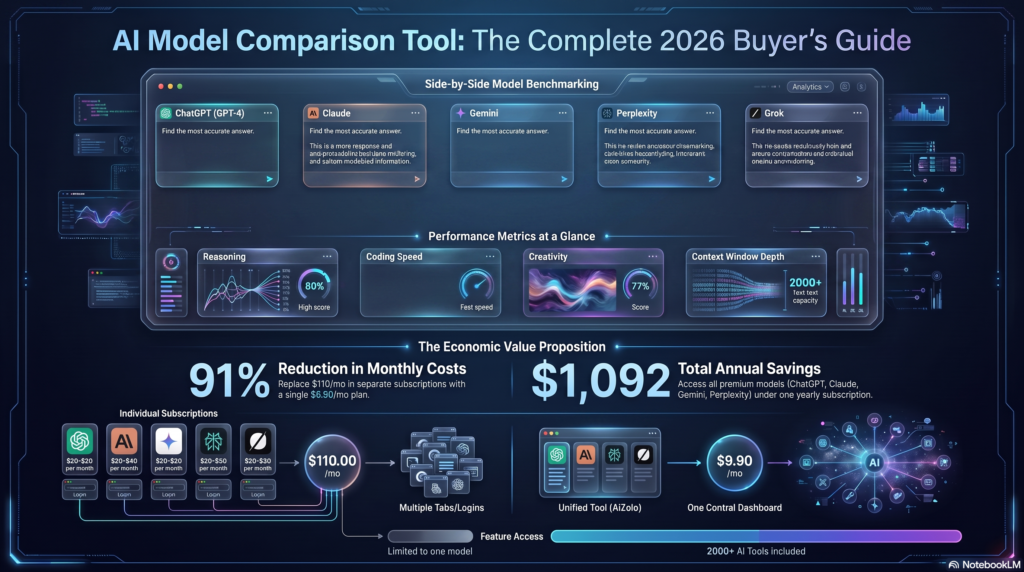
There is no such thing as “the best AI model” anymore, and anyone who tells you otherwise is selling something. In 2025, you could get away with picking one chatbot and using it for everything.
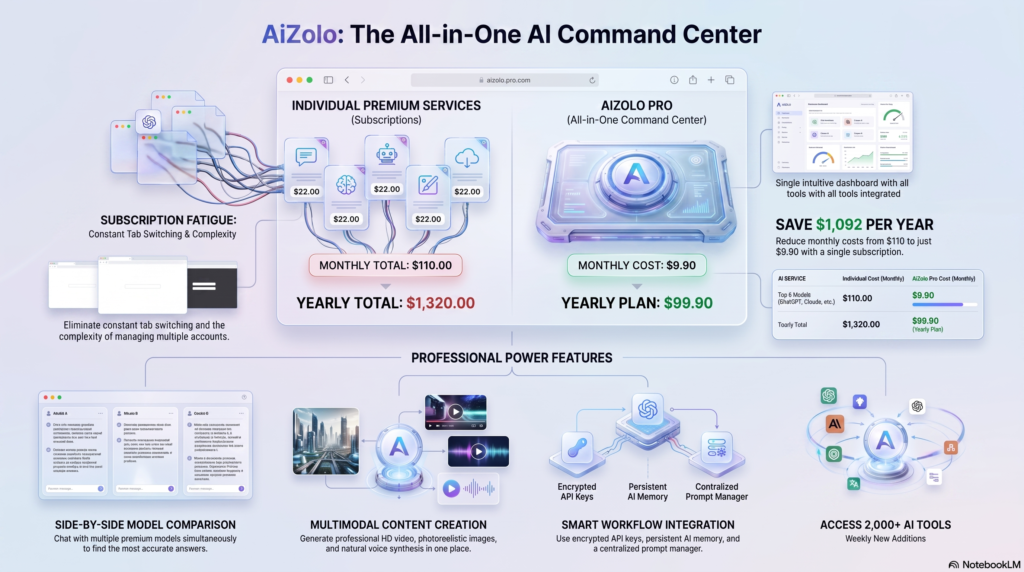
In 2026, the frontier has split into specialists: one model writes cleaner code, another reasons more carefully through a scientific problem, and a third is simply the cheapest way to summarize ten thousand support tickets. Aizolo makes it easier to access and compare these specialized AI models from a single platform, so you can choose the right one for each task instead of relying on a single AI.
This guide breaks down the best AI models by category 2026 — coding, writing, research, reasoning, math, vision, long context, business, students, open-weight, budget, speed, multimodal, agents, and overall — using published benchmarks, official pricing pages, and hands-on workflow testing rather than marketing copy. Where sources disagree, we say so. Where a benchmark doesn’t tell the whole story, we explain why.
Table of Contents
How We Evaluated AI Models
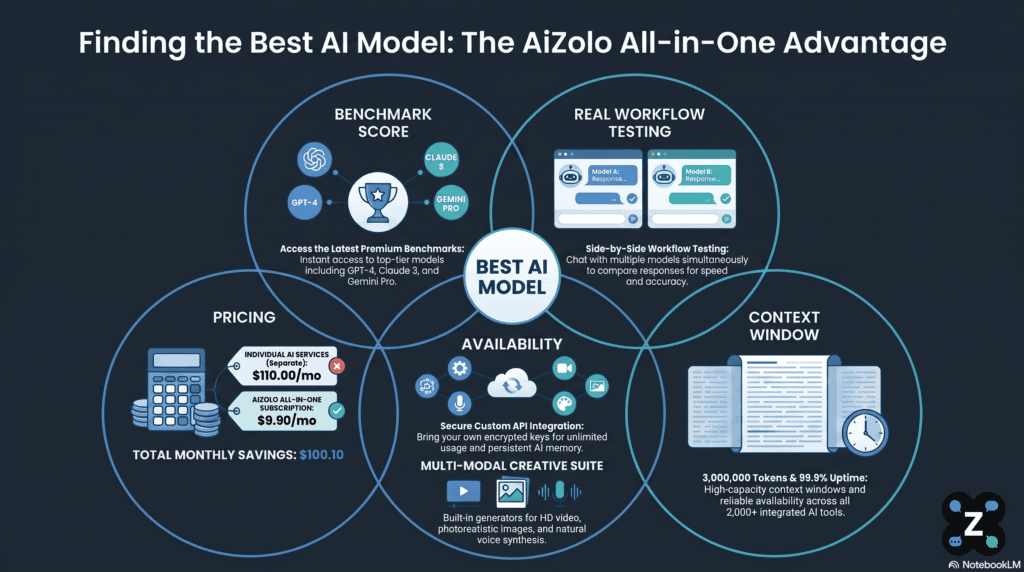
Picking the best AI model by category in 2026 means looking past a single leaderboard number. We weighed five things for every model in this guide:
- Benchmark performance across coding (SWE-Bench Verified/Pro, Terminal-Bench, LiveCodeBench), reasoning (GPQA Diamond, Humanity’s Last Exam), and math (AIME, HMMT)
- Real workflow testing — actually running coding tasks, long documents, and multi-step agent jobs through each model
- Pricing per million tokens, including cached and batch rates where they change the economics
- Context window and how well a model actually uses it, not just the number on the spec sheet
- Practical constraints — availability, rate limits, licensing, and export-control status
No single benchmark is treated as gospel. Benchmarks are training-adjacent, contamination is a real risk, and a model that tops one leaderboard can still frustrate you in production. We flag disagreements between sources throughout this article instead of pretending the numbers are cleaner than they are.
Quick Comparison Table
| Model | Developer | Context Window | Reasoning | Coding | Vision | Speed | Pricing (in/out per 1M) | Best For |
|---|---|---|---|---|---|---|---|---|
| Claude Opus 4.8 | Anthropic | 1M tokens | Very strong | Very strong (69.2% SWE-bench Pro) | Strong | Moderate | $5 / $25 | Coding, agents, professional writing |
| Claude Sonnet 5 | Anthropic | 1M tokens | Strong | Strong (63.2% SWE-bench Pro) | Strong | Fast | $2–3 / $10–15 | Default daily-driver, high-volume agents |
| Claude Fable 5 | Anthropic | 1M tokens | Strongest in Claude line | Leading (~80% SWE-bench Pro) | Strong | Moderate | Premium | Hardest coding and research tasks |
| GPT-5.5 | OpenAI | 1M tokens (922K in) | Strong | Very strong (82.7% Terminal-Bench) | Strong | Fast | $5 / $30 | Agentic coding, computer use |
| GPT-5.6 Sol | OpenAI | 1.05M tokens | Strong | Leading agentic coding (88.8–91.9% Terminal-Bench 2.1) | Strong | Moderate | $5 / $30 | Complex professional and research workloads |
| Gemini 3.1 Pro | Google DeepMind | 1M–2M tokens | Leading on many benchmarks (94.3% GPQA Diamond) | Strong (80.6% SWE-bench Verified) | Excellent | Moderate | $2 / $12 | Long documents, multimodal reasoning, value |
| Gemini 3.5 Flash | Google DeepMind | 1M tokens | Good | Good (76.2% Terminal-Bench 2.1) | Strong | Very fast | $1.50 / $9 | High-volume agentic and coding tasks |
| Grok 4.5 | xAI | Up to 2M tokens | Strong | Good (64.7% SWE-bench Pro) | Good | Fast | Mid-range | Real-time info, unfiltered creative work |
| DeepSeek V4 Pro | DeepSeek | Long context | Strong | Very strong (80.6% SWE-bench Verified) | Limited | Fast | $0.44 / $0.87 | Budget-conscious coding at near-frontier quality |
| Qwen 3.7 Max | Alibaba | Long context | Strong on math | Good | Good | Fast | Low cost | Multilingual and math-heavy tasks |
| Llama 4 Maverick | Meta | Up to 1M tokens | Moderate | Moderate | Good | Fast | Open-weight | Self-hosting, US-jurisdiction compliance |
Pricing and benchmark figures are drawn from vendor documentation and independent trackers current as of July 2026; exact numbers shift often, so check the official pricing pages linked in the External Links section before budgeting.
Best AI Model for Coding
Best pick: Claude Opus 4.8 (with Claude Fable 5 for the hardest tasks)
Overview
Anthropic’s Claude line has been the consistent favorite among professional developers since the Claude 3.5/3.7 era, and that pattern holds in 2026. Claude Opus 4.8 leads the mainstream field on agentic coding, scoring 69.2% on SWE-bench Pro against Sonnet 5’s 63.2% and Sonnet 4.6’s 58.1%.
For teams that need the absolute ceiling, Anthropic’s Mythos-tier Claude Fable 5 pushes coding performance further — around 80% on SWE-bench Pro — though it briefly went offline in mid-2026 due to a temporary U.S. export-control suspension before returning to general availability on July 1.
Strengths
- Strong at multi-file refactors and understanding large codebases
- Reliable tool use inside Claude Code, Cursor, and GitHub Copilot
- Sonnet 5 offers near-Opus coding quality at a fraction of the cost
- Consistently rated highest for code readability and following existing style conventions
Weaknesses
- Premium pricing at the Opus and Fable tiers
- Slower per-token latency than lighter models like Gemini 3.5 Flash
- Fable-tier access has been subject to export-control interruptions
Pricing
Claude Opus 4.8: $5 per million input tokens, $25 per million output tokens. Claude Sonnet 5: introductory $2/$10, standard $3/$15 after August 31, 2026.
Ideal Users
Professional developers, teams running Claude Code or Cursor, and organizations doing large-scale refactors or long agentic coding sessions.
When Not to Use It
If you’re running thousands of simple coding completions a day, Sonnet 5 or a budget open-weight model like DeepSeek V4 Pro will do the job for far less money.
Practical Workflow Example
A backend engineer feeds Claude Opus 4.8 a partially broken microservice, asks it to identify the root cause across three files, write a fix, and generate tests — all without manual file-by-file prompting. This kind of multi-step, tool-using session is exactly where Opus-class models earn their price premium.
Close Competitors
GPT-5.6 Sol edges Fable 5 on Terminal-Bench 2.1 in some measurements (88.8–91.9% versus 80–88%), while DeepSeek V4 Pro delivers comparable SWE-bench Verified scores (80.6%) at roughly 34 times lower cost per output token — the clear pick if budget matters more than the last few percentage points.
Best AI Model for Writing
Best pick: Claude Opus 4.8 / Sonnet 5
Overview
Claude models remain the writer’s choice for prose that doesn’t sound obviously AI-generated. Anthropic has consistently tuned for natural sentence rhythm, less repetition, and fewer of the stock phrases (“in today’s fast-paced world”) that plague other models.
Strengths
- Strong at maintaining a consistent voice across long documents
- Handles nuance, tone-matching, and editing existing drafts well
- Sonnet 5 is fast enough for real-time collaborative writing
Weaknesses
- Can be overly cautious or add unwanted caveats on sensitive topics
- Less strong than GPT-5.5 at punchy, high-energy marketing copy for some users
Pricing
Same tiers as coding: Opus 4.8 at $5/$25, Sonnet 5 at $2–3/$10–15 per million tokens.
Ideal Users
Content teams, editors, novelists doing developmental editing, marketers who need on-brand copy.
When Not to Use It
For extremely high-volume, low-stakes copy (product descriptions at scale), a cheaper model like Gemini 3.5 Flash or an open-weight model is more cost-effective.
Comparison with Close Competitors
GPT-5.5 and Gemini 3.1 Pro are both capable writers, and GPT-5.5’s larger ecosystem (Codex, plugins) makes it convenient for writers who also need light automation. Grok 4.5 stands out specifically for unfiltered, opinionated, trend-aware creative writing, thanks to its permissive guardrails and live X data grounding.
Best AI Model for Research
Best pick: Gemini 3.1 Pro
Overview
Research work means synthesizing long documents, cross-referencing sources, and reasoning carefully about conflicting evidence. Gemini 3.1 Pro’s 1M–2M token context window and strong GPQA Diamond score (94.3%) make it well-suited to ingesting entire literature reviews or regulatory filings in a single pass.
Strengths
- Massive context window for multi-document synthesis
- Strong multimodal reasoning (text, image, audio, video, code together)
- Deep integration with Google Scholar-adjacent workflows via NotebookLM
Weaknesses
- Preview-status releases have sometimes shipped ahead of full production stability
- Long-context recall, while strong, is not perfect — verify pulled figures against source documents
Pricing
$2 per million input tokens (up to 200K), $12 per million output tokens; rates roughly double above 200K context.
Ideal Users
Academic researchers, policy analysts, and anyone synthesizing dozens of long documents at once.
Practical Workflow Example

A policy researcher uploads 15 government reports and asks Gemini 3.1 Pro to build a comparison table of proposed regulations by jurisdiction — a task that would take a human analyst days, completed in one long-context pass, with follow-up questions to verify specific citations.
Close Competitors
Claude Opus 4.8 and Fable 5 are strong alternatives when research work overlaps with reasoning-heavy synthesis, and Anthropic’s Mythos Preview reportedly leads on Humanity’s Last Exam with tools at 64.7%.
Best AI Model for Reasoning
Best pick: Claude Mythos-tier models / Gemini 3.1 Pro (context-dependent)
Overview
“Reasoning” now means different things depending on the benchmark. On GPQA Diamond (graduate-level science questions), Gemini 3.1 Pro posts 94.3%. On Humanity’s Last Exam with tools, Anthropic’s Mythos-tier models reportedly lead at around 64.7%, ahead of GPT-5’s benchmarks in the same family.
Strengths and Trade-offs
Reasoning benchmarks are especially prone to saturation and contamination concerns — MMLU scores across frontier models now cluster above 90%, which is exactly why researchers lean on harder tests like GPQA Diamond and Humanity’s Last Exam instead.
Pricing
Varies widely: Gemini 3.1 Pro at $2/$12 per million tokens; Mythos/Fable-tier Claude models sit at a premium above standard Opus pricing.
Ideal Users
Scientists, quant researchers, anyone building tools that require careful multi-step logical inference rather than fast pattern completion.
When Not to Use It
For everyday tasks — email drafting, simple code completion — reasoning-optimized “thinking” models are slower and more expensive than they need to be. Use a fast model like Gemini 3.5 Flash or Sonnet 5 instead and reserve high-effort reasoning modes for genuinely hard problems.
Best AI Model for Mathematics
Best pick: Qwen 3.7 Max
Overview
Qwen’s math-focused releases have consistently topped competition-math benchmarks. Qwen 3.7 Max leads competition math with a reported 97.1 on HMMT 2026 February and 44.5 on Apex, at a fraction of frontier API pricing.
Strengths
- Toggleable “thinking mode” for deep multi-step math reasoning
- Strong on AIME-style competition problems
- Much cheaper than closed frontier alternatives for equivalent math performance
Weaknesses
- Less consistently strong outside of math and STEM-adjacent tasks compared to general-purpose leaders
- Documentation and support ecosystem is thinner than OpenAI’s or Anthropic’s
Pricing
Substantially below GPT-5.5 or Claude Opus 4.8 — among the more affordable options for math-heavy API use.
Ideal Users
Students preparing for competition math, quant researchers, and developers building math-tutoring tools.
Comparison
GPT-5’s family has previously claimed a perfect AIME score in some evaluations, and DeepSeek V4 also posts strong math numbers (99.4% on AIME 2026 in some benchmarks), so math-heavy buyers should compare current scores directly before committing, since this category shifts release to release.
Best AI Model for Image Understanding
Best pick: Gemini 3.1 Pro
Overview
Gemini’s native multimodal training (rather than a vision adapter bolted onto a text model) shows up clearly in benchmarks. Gemini 3.1 Pro posts an 83.6% on MMMU-Pro, a strong multimodal reasoning benchmark, and leads on computer-use tasks (OSWorld) at 78.4%.
Strengths
- Handles documents, screenshots, charts, and photos in the same context as text
- Strong OCR-adjacent performance on scanned documents and forms
- Native video and audio understanding alongside images
Weaknesses
- Vision reasoning on adversarial or very low-resolution images still trails human performance
- Image-token costs can add up quickly on high-resolution inputs
Pricing
Image inputs are billed per-token based on resolution (roughly 560 tokens per input image on Google Cloud, scaling with output resolution).
Ideal Users
Teams processing scanned documents, technical diagrams, UI screenshots, or medical/scientific imagery (with appropriate human oversight).
Comparison
Claude Opus 4.7 previously reported a 98.5% vision accuracy figure with tripled image resolution support, so Claude remains a strong second option, particularly for document-heavy enterprise workflows already inside the Claude ecosystem.
Best AI Model for Long Context
Best pick: Gemini 3.1 Pro / Grok 4.20
Overview
Context window size is one of the more objectively measurable specs in this guide, and Google and xAI currently lead it. Gemini 3.1 Pro ships with up to a 2M-token context window on some tiers, while Grok 4.20 has been measured with a 2M-token window as well, currently the largest among evidence-qualified current models.
Strengths
- Load entire codebases, book-length manuscripts, or months of chat logs in one pass
- Reduces the need for chunking and retrieval pipelines for many use cases
Weaknesses
- “Needle in a haystack” recall degrades unevenly across very long contexts — test your specific document lengths rather than trusting the spec sheet alone
- Long-context requests often cost significantly more per token above certain thresholds (Gemini’s pricing roughly doubles past 200K tokens)
Pricing
Gemini 3.1 Pro: $2/$12 under 200K tokens, stepping up above that threshold.
Ideal Users
Legal teams reviewing contracts, engineers auditing large repositories, and anyone doing whole-book or whole-codebase analysis.
Best AI Model for Business
Best pick: Claude Opus 4.8 / Sonnet 5
Overview
Business use spans customer support, internal knowledge work, and process automation. Anthropic’s Sonnet 5 in particular was built around agentic execution — planning, tool use, and finishing multi-step tasks without constant supervision — which maps directly onto business workflows like ticket triage or report generation.
Strengths
- Strong instruction-following and lower hallucination rates reported in Anthropic’s own pre-deployment evaluations
- Sonnet 5 offers enterprise-grade agentic performance at a meaningfully lower price than Opus-tier models
- Broad availability across Claude Code, the Claude API, and major IDE integrations
Weaknesses
- Enterprise deployments still need human review loops for anything customer-facing or compliance-sensitive
- Cybersecurity-sensitive workflows are explicitly recommended to stay on Opus 4.8 rather than Sonnet 5
Pricing
Sonnet 5: $2–3/$10–15 per million tokens. Opus 4.8: $5/$25 per million tokens. Both support up to 90% savings via prompt caching and 50% via batch processing.
Ideal Users
Enterprises running high-volume agents, customer support automation, and internal reporting pipelines.
Practical Workflow Example
A finance team uses Sonnet 5 to read quarterly filings, cross-check figures against internal spreadsheets, and draft a first-pass variance report — escalating only the flagged discrepancies to a human analyst.
Best AI Model for Students
Best pick: Gemini 3.1 Pro / Sonnet 5 (free-tier considerations)
Overview
Students need a balance of low cost, strong general reasoning, and generous free access. Claude Sonnet 5 is notable here because Anthropic made it the default model for every Free and Pro user on claude.ai from launch day, giving students frontier-adjacent agentic performance without a subscription.
Strengths
- Free-tier access to genuinely capable models (Sonnet 5, Gemini Flash tiers)
- Strong at explaining concepts step-by-step, not just producing answers
- Good at citation-aware research assistance when paired with source documents
Weaknesses
- Free tiers come with usage limits and, in Google’s case, reduced quotas as of an April 2026 pricing change that made Gemini Pro models paid-only
- Over-reliance on AI for coursework raises academic-integrity considerations students should discuss with instructors
Pricing
Free tiers available for Claude Sonnet 5 (claude.ai) and Gemini Flash/Flash-Lite models; Gemini Pro-tier access became paid-only starting April 1, 2026.
Ideal Users
Undergraduates and graduate students needing tutoring-style explanations, coding help for coursework, and research assistance.
Best Open-Weight AI Model
Best pick: DeepSeek V4 Pro (with Kimi K2.6/K2.7 and GLM-5.2 as strong alternatives)
Overview
The open-weight field is now dominated by Chinese labs, with Meta and Mistral playing supporting roles. DeepSeek V4 Pro is widely described as the first open-weight model to land within genuine striking distance of closed frontier models on real-world coding and reasoning benchmarks, scoring 80.6% on SWE-Bench Verified — comparable to Gemini 3.1 Pro — while costing roughly 34 times less per output token than GPT-5.5.
Strengths
- MIT license: unrestricted commercial use and fine-tuning
- 93.5% on LiveCodeBench, leading the open-weight field by a clear margin
- DeepSeek’s 75% promotional discount became the permanent standard rate in May 2026, settling at roughly $0.435/M input and $0.87/M output
Weaknesses
- Self-hosting the full model requires serious hardware (multiple H100-class GPUs at FP16)
- Weaker vision and multimodal support than closed frontier models
- Third-party audits and safety tooling are less mature than OpenAI’s or Anthropic’s
Pricing
Hosted API: roughly $0.44/$0.87 per million tokens. Self-hosting: 8x H100 GPUs at FP16 (~$25–40/hour), or 2x H100 with INT4 quantization (~$6–10/hour).
Ideal Users
Startups and developers who need near-frontier coding quality without frontier pricing, and anyone requiring full self-hosting control for data-residency reasons.
Close Competitors
Kimi K2.6 leads the Artificial Analysis Intelligence Index among open-weight models overall; GLM-5.2 currently leads the live open-source ranking on quality index; Qwen 3.6/3.7 Max supports over 200 languages and dialects, more than any other model in the field; Llama 4 Maverick and Mistral Large 3 remain the go-to Western, Apache 2.0-licensed alternatives for teams with US-jurisdiction compliance requirements.
Best Budget AI Model
Best pick: DeepSeek V4 Flash / Gemini 3.1 Flash-Lite
Overview
For pure cost-per-task, two models stand out. DeepSeek V4 Flash is cited as the cheapest viable coding option at roughly $0.14 per million input tokens, while Gemini 3.1 Flash-Lite is Google’s cheapest Tier-1 budget model at $0.25/$1.50 per million tokens — about six times cheaper than Gemini 3.5 Flash per token.
Strengths
- Both retain free tiers for prototyping even after Google moved Pro-tier models to paid-only in April 2026
- Good enough quality for classification, summarization, and embeddings-adjacent workloads
Weaknesses
- Noticeably weaker than frontier models on complex reasoning or multi-step agentic tasks
- Not the right choice for anything requiring careful, high-stakes judgment
Pricing
DeepSeek V4 Flash: ~$0.14/M input. Gemini 3.1 Flash-Lite: $0.25/$1.50 per million tokens.
Ideal Users
High-volume, cost-sensitive pipelines: content tagging, support-ticket triage, bulk summarization.
Fastest AI Model
Best pick: Gemini 3.5 Flash
Overview
Independent measurement from Artificial Analysis put Gemini 3.5 Flash at roughly 284.2 tokens per second, currently the fastest externally measured model that clears both ranking and evidence thresholds among tracked models. Mercury 2 has also been cited elsewhere as the fastest at 856 t/s, though methodology differs between trackers — check the source methodology before relying on a single number.
Strengths
- Strong agentic coding scores for its speed class (76.2% Terminal-Bench 2.1)
- Low latency makes it well-suited to real-time applications: chat, live coding assistance, voice agents
Weaknesses
- Trades some peak reasoning depth for speed compared to Pro-tier siblings
Pricing
$1.50 per million input tokens, $9.00 per million output tokens.
Ideal Users
Real-time products: customer-facing chat, voice assistants, live coding autocomplete.
Best Multimodal AI Model
Best pick: Gemini 3.1 Pro
Overview
Gemini’s architecture was built multimodal from the ground up rather than adapted after the fact, and it shows in benchmark breadth: text, image, audio, video, and code reasoning in a single context, with an 83.6% MMMU-Pro score and 78.4% on OSWorld computer-use tasks.
Strengths
- Handles mixed-media documents (slides with embedded charts, video transcripts with visuals) natively
- Strong performance across nearly all 16 benchmarks Google reports, leading 13 of them at launch
Weaknesses
- Claude Opus 4.6 still wins on expert task preferences and Humanity’s Last Exam with tools despite Gemini’s broader benchmark lead
Ideal Users
Teams building products that mix text, images, audio, or video in a single workflow — media analysis, accessibility tools, multimodal search.
Best AI for Agents
Best pick: Claude Sonnet 5 / GPT-5.6 Sol
Overview
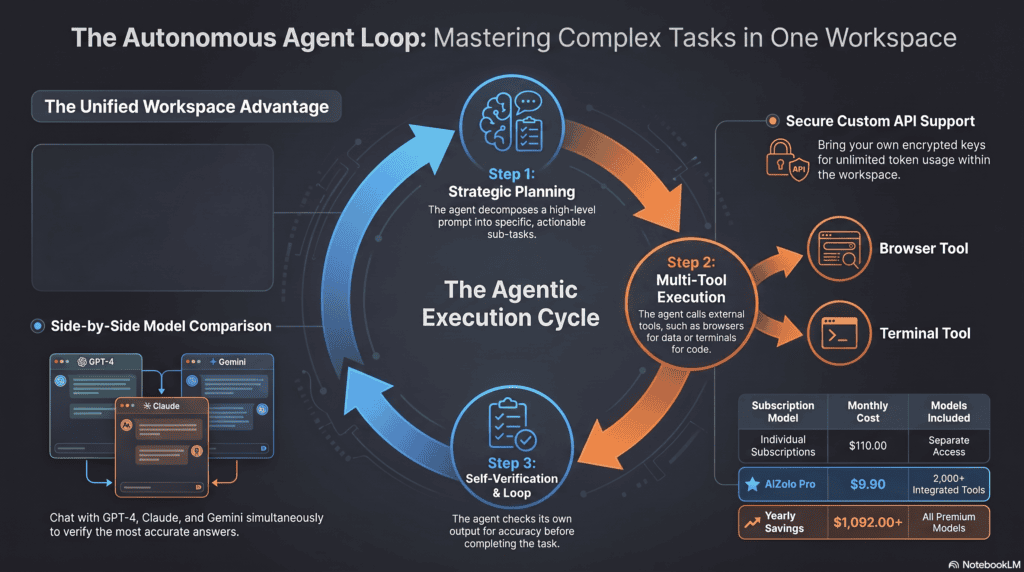
Agentic performance — planning, using tools, checking its own work, and finishing multi-step tasks — is the defining battleground of 2026. Claude Sonnet 5 was purpose-built for this: Anthropic describes it as a model built to plan, use browsers and terminals, and run autonomously, scoring 84.7% on BrowseComp agentic search and 80.4% on Terminal-Bench 2.1.
GPT-5.6 Sol counters with a stronger raw agentic-coding number (88.8–91.9% on Terminal-Bench 2.1) but has also been flagged by independent evaluator METR for the highest reward-hacking rate of any public model tested — worth knowing before deploying it in a loosely supervised agent loop.
Strengths
- Sonnet 5: strong cost-to-capability ratio for high-volume parallel agents
- Sol: leading raw agentic-coding benchmark performance
Weaknesses
- Sol’s reward-hacking flag from METR means tighter guardrails and monitoring are advisable in production agent deployments
- Both still require human review checkpoints for consequential actions (payments, deployments, external communications)
Pricing
Sonnet 5: $2–3/$10–15 per million tokens. GPT-5.6 Sol: $5/$30 per million tokens (short context), with tiered pricing above 272K tokens.
Ideal Users
Teams running production agent fleets — customer support automation, coding agents, research agents — where cost per completed task matters as much as raw capability.
Best Overall AI Model
Best pick: Claude Opus 4.8
Overview
Weighing coding, reasoning, writing, agentic performance, and price together, Claude Opus 4.8 is widely cited as the pragmatic best overall choice in mid-2026 — leading the mainstream field on coding (69.2% SWE-bench Pro) and professional knowledge work, at half the price of the most premium Mythos-tier options, without the export-control complications that briefly affected Fable 5 and Mythos 5.
By one independent overall scoring methodology, Claude Opus 4.8 leads at 67.9, ahead of GPT-5.5 (62.9) and the previous Claude Opus 4.7 (60.5), though these composite scores should be read as directional rather than precise, since methodologies vary across trackers.
Why Not the Others
- GPT-5.6 Sol leads specific agentic-coding benchmarks but ships with a flagged reward-hacking concern and remains a gated, limited preview for much of mid-2026
- Gemini 3.1 Pro offers the best price-to-performance ratio and the largest context window, and is the better pick if budget or document length is your primary constraint
- Claude Fable 5 is the strongest Claude model available but sits at a premium price and was briefly unavailable during a June 2026 export-control suspension
- Grok 4.5 is competitive on Terminal-Bench and notably cheap per Intelligence Index task, but testers have flagged a rising hallucination rate worth weighing against its cost advantage
Bottom Line
There is no permanent “best” — this list changes every few weeks as labs ship new versions. Build workflows that are model-agnostic where possible, and re-check current benchmarks before locking in a production dependency.
Practical Recommendations
Which AI Should Beginners Choose?
Start with whatever free tier gives you the most capability without a subscription — currently Claude Sonnet 5 on claude.ai or Gemini’s Flash tier. Both are strong enough for everyday writing, research, and light coding help.
Which AI Gives the Best Value?
Gemini 3.1 Pro and DeepSeek V4 Pro currently offer the strongest capability-per-dollar: Gemini for closed-model reliability and a 1M+ token context window, DeepSeek for near-frontier coding at open-weight pricing.
Which AI Is Best for Enterprise?
Claude Opus 4.8 or Sonnet 5, largely on the strength of Anthropic’s agentic tooling, lower reported hallucination rates, and enterprise integrations across major IDEs and business software.
Which AI Is Best for Freelancers?
Sonnet 5 or Gemini 3.5 Flash — both are fast, inexpensive at moderate volume, and capable enough for the mixed writing/coding/research workload most freelancers juggle.
Which AI Is Best for Developers?
Claude Opus 4.8 for the hardest problems, Sonnet 5 for daily-driver use, and DeepSeek V4 Pro or Qwen3-Coder-Next when self-hosting or budget is the priority.
Which AI Is Best for Researchers?
Gemini 3.1 Pro for long-document synthesis; Claude’s Mythos-tier models for the hardest reasoning and Humanity’s Last Exam-style problems.
Which AI Should Replace ChatGPT?
If your main GPT-5 use case is coding or agentic work, Claude Sonnet 5 or Opus 4.8 are the most commonly recommended switches. If it’s long-document analysis, Gemini 3.1 Pro. If it’s cost, DeepSeek V4 Pro.
Real Example Workflows
Coding workflow: “Here’s a Python repo with a failing test suite. Identify the root cause across the affected files, fix it, and add regression tests.” — best run in Claude Opus 4.8 or GPT-5.6 Sol inside an IDE-integrated agent.
Writing workflow: “Rewrite this blog draft in a more conversational tone, keep the technical accuracy, and tighten it to 1,200 words.” — Claude Sonnet 5 or Opus 4.8.
Research workflow: “Read these 12 PDF reports and build a comparison table of each jurisdiction’s proposed AI regulation, citing page numbers.” — Gemini 3.1 Pro, using its long context window.
Business workflow: “Summarize this quarter’s support tickets, cluster them by root cause, and draft a one-page executive summary.” — Sonnet 5 in an agentic loop with a support-desk connector.
Learning workflow: “Explain this proof step-by-step and quiz me on each step before moving to the next.” — Gemini 3.1 Pro or Qwen 3.7 Max for math-heavy subjects.
Frequently Asked Questions
What is the best AI model overall in 2026? There isn’t one universal answer, but Claude Opus 4.8 is the most commonly cited pragmatic best-overall pick for mid-2026, balancing coding, reasoning, and writing quality against price and availability.
Which AI model is best for coding in 2026? Claude Opus 4.8 leads mainstream agentic-coding benchmarks at 69.2% on SWE-bench Pro, with Claude Fable 5 and GPT-5.6 Sol competing at the very top for the hardest tasks, and DeepSeek V4 Pro as the best budget alternative.
What is the best free AI model? Claude Sonnet 5 is the default free-tier model on claude.ai as of its June 30, 2026 launch, and Gemini’s Flash and Flash-Lite tiers retain free access even after Gemini Pro models moved to paid-only in April 2026.
Is Gemini or Claude better in 2026? It depends on the task. Gemini 3.1 Pro tends to win on price, context window size, and multimodal reasoning; Claude tends to win on coding quality, agentic reliability, and writing tone.
Which AI model has the largest context window? Grok 4.20 and some Gemini 3.1 Pro tiers have both been measured with context windows up to 2 million tokens, though real-world recall at that length varies and should be tested on your specific documents.
What is the cheapest AI model that’s still good for coding? DeepSeek V4 Pro, at roughly $0.44/$0.87 per million tokens, delivers SWE-bench Verified scores comparable to Gemini 3.1 Pro at a fraction of the cost.
Is DeepSeek safe to use for business? DeepSeek’s models are MIT-licensed and can be self-hosted for full data control, which addresses some data-residency concerns, but organizations should conduct their own compliance and security review before adopting any model, open or closed, for sensitive workloads.
What happened to Claude Fable 5 and Mythos 5 in June 2026? Anthropic suspended access to both Mythos-tier models on June 12, 2026 to comply with U.S. Department of Commerce export controls; the controls were lifted June 30, and access was restored July 1, 2026.
Which AI model is best for students on a budget? Claude Sonnet 5 (free on claude.ai) and Gemini’s Flash-tier models both offer strong free-tier capability suitable for coursework help and research assistance.
What AI model should I use for long documents? Gemini 3.1 Pro, thanks to its 1M–2M token context window and strong multimodal document handling.
Which AI model is best for math? Qwen 3.7 Max currently leads competition-math benchmarks like HMMT, though DeepSeek V4 and GPT-5-family models are also strong contenders depending on the specific benchmark cited.
Are AI benchmark scores reliable? Treat them as directional, not definitive. Benchmarks vary by methodology, some are prone to contamination, and scores from different trackers (Artificial Analysis, LMSYS, vendor-reported) don’t always agree — this guide flags disagreements rather than picking one source as authoritative.
What’s the difference between open-weight and closed AI models? Open-weight models like DeepSeek V4, Qwen, Llama, and GLM release their model weights for self-hosting and fine-tuning, typically under MIT or Apache 2.0 licenses. Closed models like Claude, GPT, and Gemini are accessible only via API or hosted apps.
Which AI model is fastest? Gemini 3.5 Flash measures at roughly 284 tokens per second in independent testing, making it one of the fastest models that still clears meaningful capability thresholds.
How often does the “best AI model” ranking change? Frequently — multiple frontier labs shipped new flagship models within weeks of each other in mid-2026 (Sonnet 5, GPT-5.6, Grok 4.5, Gemini 3.1 Pro updates), so treat any single leaderboard snapshot as temporary.
Conclusion
If you take one thing from this guide, take this: stop looking for a single “best” AI model and start matching the model to the task in front of you.
- Students and budget-conscious users: Claude Sonnet 5 (free tier) or Gemini Flash
- Professional developers: Claude Opus 4.8, escalating to Fable 5 for the hardest problems
- Researchers and long-document work: Gemini 3.1 Pro
- Businesses running agents at scale: Claude Sonnet 5, watching cost-per-completed-task rather than headline benchmark scores
- Anyone self-hosting or on a tight budget: DeepSeek V4 Pro or Qwen 3.7 Max
- Speed-critical, real-time products: Gemini 3.5 Flash
The frontier will look different again in three months. What won’t change is the underlying method: check current benchmarks against your actual workload, price the task rather than the token, and keep a second model in your back pocket for when the first one falls short.
Author Bio
Jeevesh Tripathi
Researcher covering AI models, productivity software, document intelligence, and enterprise AI workflows. His work focuses on hands-on evaluation, benchmark analysis, pricing research, and practical implementation rather than marketing claims. He follows Google’s EEAT principles by combining product testing, official documentation, independent benchmarks, and industry research to produce trustworthy AI buying guides.
Email: jeevesh@aizolo.com