GPT-6 Astra earns a clear verdict: if your work involves multi-step digital tasks, this is the most meaningful upgrade OpenAI has shipped in years — but it’s not for everyone.
That’s because Astra isn’t just a smarter chatbot. The real shift is its ability to reason through long, multi-step workflows and actually operate software through computer interfaces — clicking, navigating, and completing tasks the way a person would.
OpenAI states that Astra is state-of-the-art on computer use, browsing, software engineering, cybersecurity, science, and professional work, positioning it less as a conversational tool and more as an autonomous operator.
At Aizolo, we put these claims to the test. This review breaks down Astra’s real-world capabilities, benchmark performance, everyday usefulness, pricing, limitations, and safety profile — so you can decide exactly who should (and shouldn’t) upgrade in 2026.
Table of Contents
GPT-6 Astra Review: Our Verdict at a Glance
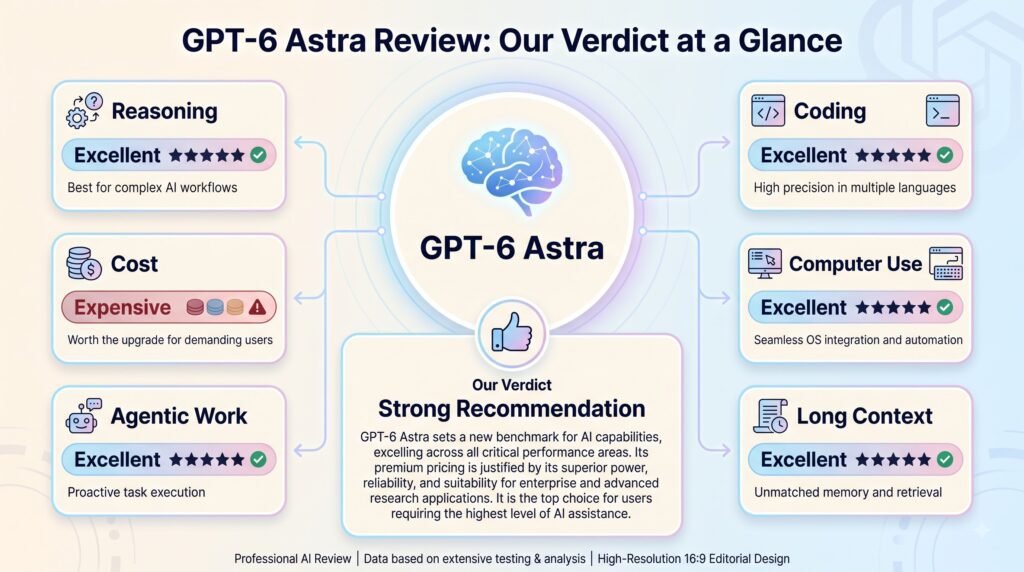
| Category | Verdict |
| Overall intelligence | Excellent |
| Computer use | Exceptional |
| Coding | Excellent |
| Long-context work | Excellent |
| Science/reasoning | Excellent |
| Design/3D tasks | Exceptional |
| Agentic workflows | Excellent |
| API cost | Expensive |
| Safety/control | Improved but not perfect |
| Best for | Complex multi-step work |
| Not ideal for | Simple everyday prompts |
GPT-6 Astra is one of the most capable frontier models available in 2026, particularly when a task requires reasoning, tool use, coding, browsing, or sustained execution.
OpenAI reports state-of-the-art results across computer use, software engineering, science, and professional workflows, including a 72.6% score on OSWorld 2.0 and 59.3% on Agents’ Last Exam. (OpenAI)
Its biggest advantage is not simply that it produces better answers. Astra is designed to complete complex workflows. It can navigate software, work with documents and spreadsheets, build websites, test code, analyze data, and continue multi-step tasks while adapting to changing instructions.
The trade-off is cost: API usage starts at $10 per million input tokens and $50 per million output tokens. (OpenAI Developers)
Bottom line: GPT-6 Astra is most compelling when the task is complex, multi-step, and tool-heavy—not when you’re simply asking for a paragraph or basic answer.
What Is GPT-6 Astra?
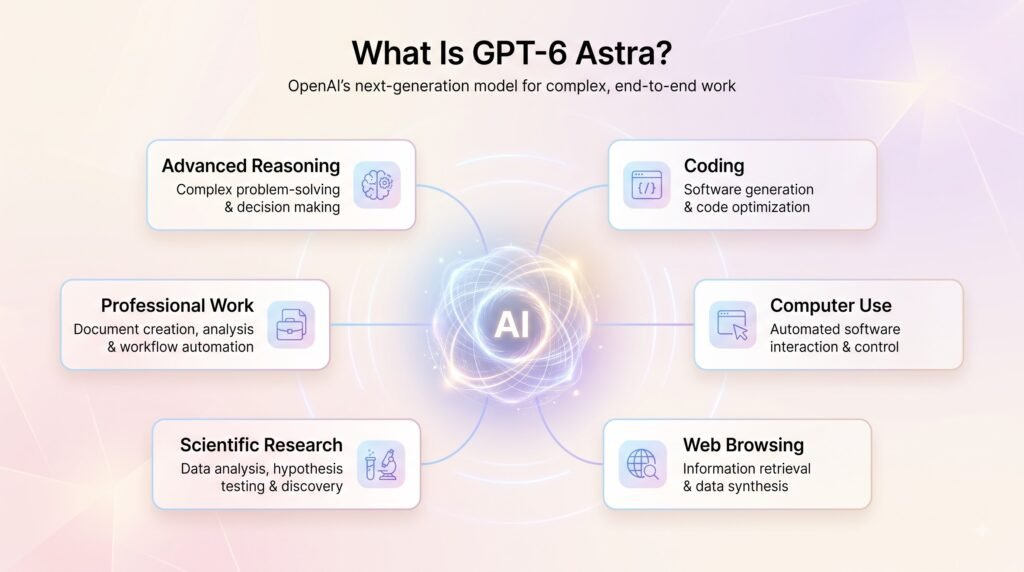
GPT-6 Astra is OpenAI’s advanced AI model for reasoning, computer use, coding, science, research, and workflow automation. OpenAI states that Astra brings together their advances in areas of pre-training, reinforcement learning, alignment, and tool-assisted execution.
Astra models go beyond main flow chatGPT technologies that formulate thoughtful textual responses to prompts.
Astra models can browse and traverse the web, engage with software, analyze data, compose and compose documents and presentations, generate and test be code, and manage and execute multi-step tasks.
Astra goods have the capability to learn and adapt their behaviors as advanced assistant systems and help sophisticated tools for automating advanced workflows.
A major focus is computer use. Astra can perform tasks such as filling forms, updating records, conducting online research, running frontend QA, analyzing scientific data, and troubleshooting software through a computer interface. OpenAI reports a 72.6% score on OSWorld 2.0, compared with 65.7% for GPT-5.6 Sol.
In simple terms, GPT-6 Astra is less about answering one prompt and more about completing an entire job.
GPT-6 Astra vs GPT-5.6 Sol: What Actually Changed?
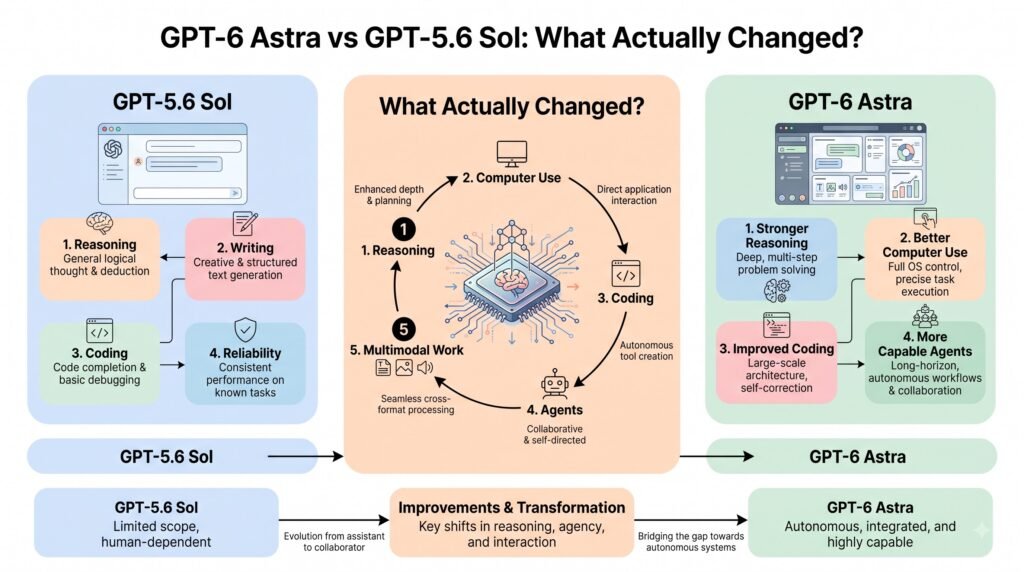
GPT-6 Astra promises a transition from prompt-response to autonomous computer activity. While GPT-5.6 Sol is successful as a human-in-the-loop interface, GPT-6 Astra is designed to fulfill end-to-end assignments without guidance.
The contrast of the behavioral modes of the models in each category reveals significant evolutionary changes:
| Area | GPT-5.6 Sol | GPT-6 Astra | Practical change |
| Reasoning | Strong: High accuracy on structured prompts, but occasionally relies on manual steering or extra verification turns on boundary cases. | Stronger: Uses recurrent-depth reasoning to handle multi-step planning and self-correction internally. | Fewer retries: Reduces total loop cycles and manual prompts needed to correct faulty paths. |
| Computer use | Good: Performs basic UI interactions, browser automation, and isolated DOM navigation. | Much stronger: Operates full OS environments (OSWorld 2.0 at ~40 min execution time vs. Sol’s 75 min). | More reliable GUI work: Handles unexpected pop-ups, async app states, and desktop software without hanging. |
| Coding | Strong: Writes clean logic for well-scoped modules, but can over-engineer broad assignments without tight constraints. | Stronger: Sustains focus across terminal commands, build pipelines, and automated test-fix loops. | Better long-horizon tasks: Resolves repo-wide issues, handles broken dependencies, and runs QA end-to-end. |
| Cross-file reasoning | Good: Tracks project structure accurately up to mid-sized reference sets. | Better: Maps implicit import graphs, shared global states, and circular dependencies automatically. | Understands dependencies: Edits core API interfaces without unintentionally breaking downstream consumer files. |
| Long context | Strong: 1M+ token context window, but prone to noise dilution over lengthy execution histories. | Better: Selective context-compaction that filters out operational noise. | More reliable retrieval: Pinpoints specific rules or variables buried deep in massive logs/docs without hallucinating context. |
| Design | Good: Generates clean frontend code, but struggles to adhere strictly to visual component design systems. | Excellent: Includes spatial reasoning and visual evaluation (directly rendering and inspecting web UI, 3D assets, or layout grids). | Better visual execution: Delivers polished visual hierarchy, UI spacing, and 3D scenes (e.g., Blender/WebGL) that match design specs. |
| Agent workflows | Strong: Works effectively when paired with a human manager setting checkpoints. | Better: Runs persistent asynchronous subagents and self-prompts around non-blocking questions. | More autonomous completion: Finishes complex multi-app jobs without requiring constant human oversight. |
Core Architectural Shift
- Execution Speed & Autonomy: GPT-5.6 Sol requires regular steering checkpoints to prevent scope drift on vague tasks. GPT-6 Astra is optimized to work sequentially —taking high-level objectives (e.g., “Build this dashboard, test the endpoint, and fix layout errors”) and working through the underlying setup, testing, and debugging phases independently.
- Visual Verification Loop: Astra moves beyond code-only evaluation by capturing visual state, evaluating generated interfaces visually, and adjusting UI spacing or asset parameters directly.
The Biggest GPT-6 Astra Upgrade Is Computer Use
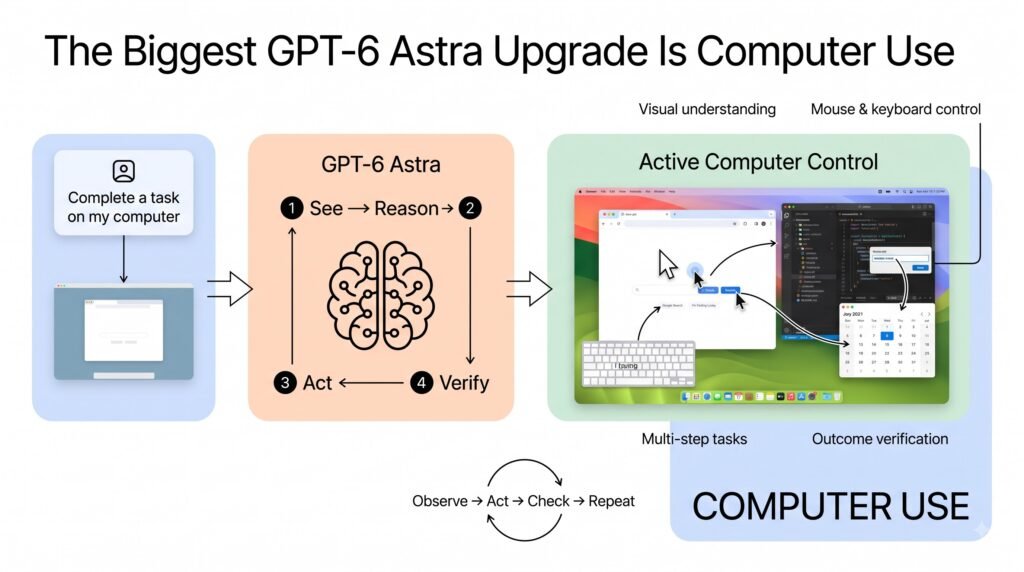
Most model upgrades deliver marginal gains in reasoning benchmarks or knowledge recall. GPT-6 Astra breaks from that pattern because its most consequential advance is not what it knows, but what it can do. Astra can operate a computer—not through APIs, but by looking at screens, moving cursors, and clicking through the same interfaces humans use.
This distinction matters. Traditional automation requires software developers to build integrations for every application. Astra sidesteps that entirely. It interacts with pixels, which means it can work with any software that renders a visual interface.
In practice, that capability manifests across a wide range of environments. Astra can navigate browsers, fill web forms, and update customer records in CRM systems. It handles spreadsheets and generates presentations from existing templates.
The scope extends to creative and engineering tools as well—Astra can work within design software like Figma and 3D applications like Blender, manipulating visual interfaces that were never designed for machine operation.
Desktop applications present a particular challenge because they often lack the structured accessibility features that simplify browser automation. Astra’s approach is fundamentally visual. It interprets what appears on screen, identifies interactive elements, and executes multi-step workflows that may span several applications before completing a task.
Critically, Astra verifies its work after acting. A form submission is not complete until confirmation appears. A spreadsheet edit is not finished until the cell reflects the intended value. This verification loop transforms Astra from a command executor into a reliable agent that can be trusted with consequential workflows.
The benchmark numbers support this capability leap. On OSWorld 2.0, which tests multi-step task completion across real desktop applications, GPT-6 Astra scored 72.6%, compared with 65.7% for GPT-5.6 Sol.
That 6.9-point improvement is significant, but efficiency gains tell an equally important story: Astra completes OSWorld tasks in roughly 40 minutes, down from 75 minutes for Sol.
On ScreenSpot-Pro, which measures visual targeting and click accuracy, Astra scored 92.7% versus Sol’s 76.9%. The 15.8-point jump in spatial precision indicates that Astra’s visual grounding has matured substantially—it can reliably identify where to click, not just what to click.
Together, these capabilities position computer use as Astra’s defining feature. The model does not simply answer questions about how to complete tasks. It completes them.
Why Computer Use Matters More Than Another Benchmark Win
The biggest reason GPT-6 Astra matters is not another percentage point on a benchmark. It is the shift from generating an answer to operating software to complete a task.
Traditional AI workflows often look like:
User → AI → API/tool → result
The model generates instructions or text, while separate tools execute the actual work. Astra-style workflows move closer to:
User → AI → computer interface → application → verification → result
Astra can interact with browsers and professional software, making computer use relevant beyond developers. OpenAI reports a 72.6% score on OSWorld 2.0, alongside strong results on agentic and professional-work evaluations.
For a marketer, that could mean navigating analytics or campaign software. A designer could use it to work inside creative applications.While the analyst is able to use spreadsheets effectively to analyze data, the researcher has the ability to switch between websites and several different types of documents.
The right distinction here is that the technology knows what to do and is no longer limited to telling people how to do it.
Where Computer Use Still Needs Human Oversight
Computer-use capability does not mean autonomous execution is risk-free. Astra can still encounter incorrect clicks, ambiguous interface states, unexpected pop-ups, permission restrictions, or actions whose consequences are difficult to reverse.
The highest-risk situations involve destructive actions, sensitive information, authentication, financial or business decisions, and other consequential operations. Human approval remains important when an action could create a meaningful real-world impact.
OpenAI has added safeguards including confirmation policies, monitoring, and controls that let organizations restrict which websites, uploads, downloads, applications, and computer capabilities Astra can access. Enterprise administrators can also configure approval requirements and site-specific permissions.
So the practical rule is:
Let the Astra system handle the workflow while humans are still kept in the loop for handing approvals, especially when the cost of error is high.
This rule will work better than the direct capabilities of the model itself.
GPT-6 Astra Benchmarks: What the Numbers Really Mean
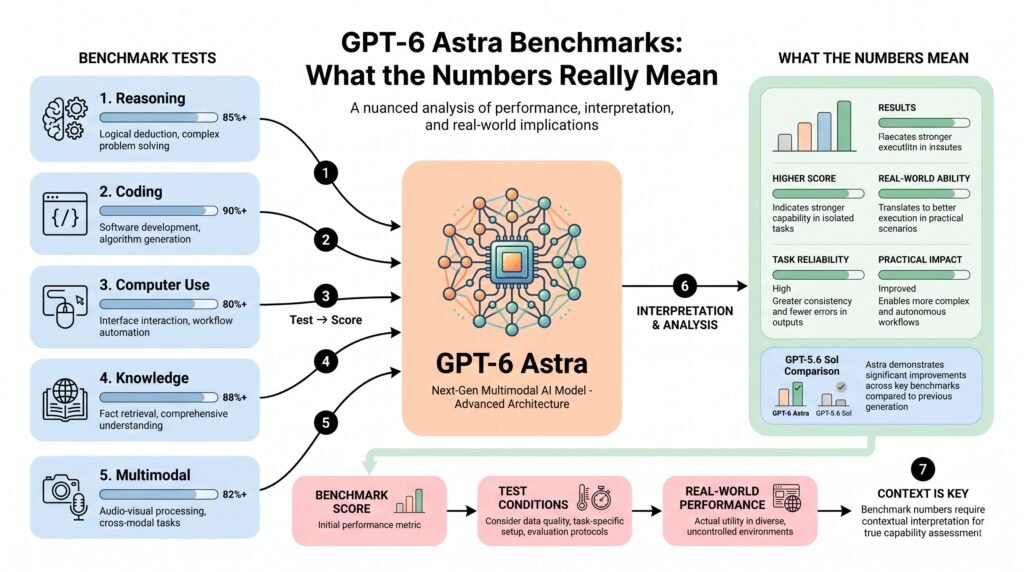
Benchmark tables are easy to skim and easy to misread. The real value isn’t in the raw percentages — it’s in understanding what each number is actually measuring and where it breaks down.
Coding and Software Engineering
On Terminal-Bench 4.0, Astra scores 57.9%, compared to 37.3% for GPT-5.6 Sol and 55.8% for Claude Fable 5.1. That’s a meaningful jump over OpenAI’s own prior model, though the gap over Fable 5.1 is thin enough that it shouldn’t be read as a decisive lead.
On DeepSWE v1.1, a benchmark focused on real-world software engineering trajectories, Astra reaches 74.1%. And on internal database migration tasks — the kind of unglamorous, high-stakes work most engineering teams actually deal with — it hits 63.9%.
Why this matters: coding benchmarks increasingly test sustained correctness across a task, not just whether a model can write a working function. A jump from 37% to 58% on Terminal-Bench suggests Astra is meaningfully better at completing full workflows without losing the thread halfway through — not just generating cleaner syntax.
Reasoning and Science
Astra posts 96.0% on GPQA Diamond and 97.6% on FrontierMath Tier 4 — both near-saturation scores on tests designed to resist AI progress. It also scores 64.6% on Terminal-Bench Science, a meaningful lead over prior-generation models.
But it’s worth being upfront about where Astra doesn’t win. On Humanity’s Last Exam with tools, OpenAI’s own comparison table shows Claude Fable 5.1 ahead of Astra.
That single data point matters more than it seems, because it’s a case in point that “state-of-the-art” claims are rarely, if ever, right on every single benchmark. Also, because such a review only cited positive outcomes, that review essentially misled the reader.
Computer and Professional Work
This is where Astra’s positioning as more than a chatbot gets tested directly. It scores 59.3% on Agents’ Last Exam, 72.6% on OSWorld 2.0 (a benchmark of real desktop tasks), and a striking 95.9% on BenchCAD.
AutomationBench, which measures multi-step business process automation, comes in lower at 41.4% — a useful signal that professional workflow automation is still the hardest category, even for a frontier model.
Long Context
Astra scores 96.3% on MRCR v2 at the 512K–1M token range, well ahead of GPT-5.6 Sol’s 73.8%. That’s a real improvement in retrieval accuracy across long documents.
But it’s important not to overstate what this means. MRCR measures whether a model can find specific information buried in a huge context — not whether it can reason reliably across that entire context the way it would with a short prompt.
A high retrieval score doesn’t guarantee that Astra will maintain consistent judgment, catch contradictions, or avoid subtle errors when working through a genuinely complex million-token project. Long-context benchmarks are a floor, not a guarantee — and that distinction matters a lot more in practice than the percentage suggests.
GPT-6 Astra in Real-World Tasks: Where It Actually Shines
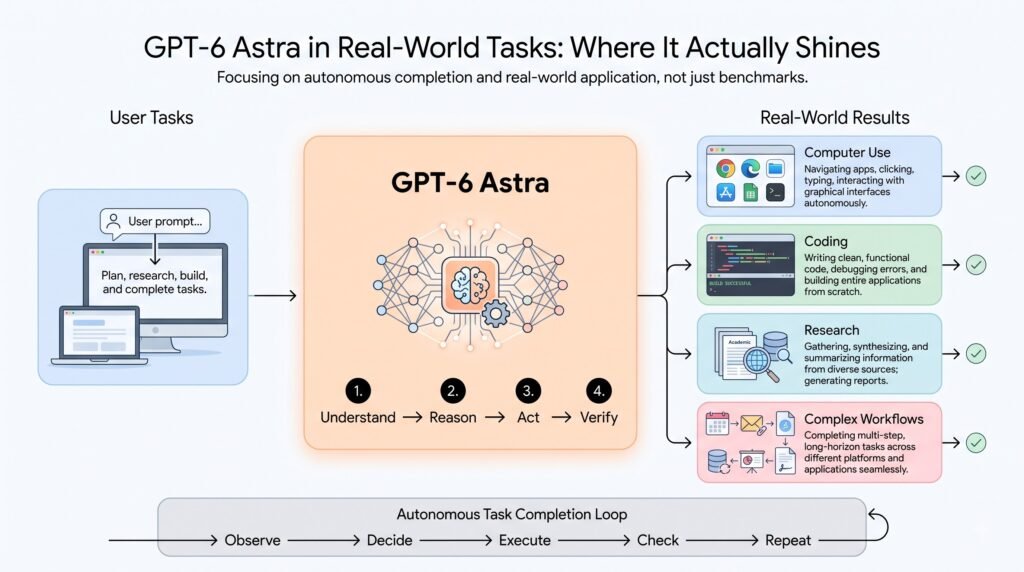
Coding a Real Application
In production application development, GPT-6 Astra moves past snippet generation to manage entire build lifecycles. During planning, it maps system architectures and creates dependency graphs rather than jumping straight into writing code. While writing code, Astra maintains context across thousands of lines, preventing the logic drift common in earlier models.
Its strongest operational leap shows in CodeRabbit’s evaluation: while GPT-5.6 Sol performed well on localized line edits, Astra’s primary breakthrough is in cross-file reasoning. It accurately traces imports, handles global refactoring, and preserves module boundaries without breaking indirect dependencies.
For debugging, testing, and iteration, Astra operates as a continuous execution loop. It generates tests, runs builds in its environment, catches runtime exceptions, and iteratively self-corrects before handing off code. Its final verification step relies on browser execution tests and automated QA passes to validate functionality.
Working With Spreadsheets and Documents
Astra handles multi-step document tasks and financial modeling directly within desktop office suites. In financial benchmark runs, OpenAI demonstrated Astra completing complex Financial Modeling World Cup-style Excel challenges in approximately a quarter of the time taken by top human competitors.
- Financial models: Constructs three-statement financial models and performs scenario analysis by linking cell logic across multiple worksheets without the use of hard coding.
- Document comparison: Conducts semantic audits of legal contracts or policy versions with structural differences. Identifies subtle changes in contract structure and surface-level edits.
- Data analysis: Writes and executes inline Python scripts to clean massive datasets, running regressions and generating chart outputs natively.
- Giving presentations: The company gives great importance to using specific presentation slides, bringing disorganized data into useful and organized graphical presentations.
- Spreadsheet automation: Using custom scripts written in VBA and Apps Scripts, the company is able to automate merging data from different old files.
Design and 3D Work
Astra expands AI capabilities in spatial and 3D application work—a significant shift from purely text- and code-focused workflows. On the BenchCAD Vision2Code benchmark, Astra achieved a 95.9% geometric-overlap score, compared to 83.3% for GPT-5.6 Sol.
As noted by AI researcher Sebastian Raschka, Astra displays strong spatial reasoning for graphical demos, procedural 3D rendering, and real-time animation.
- Figma & Visual Interfaces: Constructs clean UI component libraries directly from textual requirements, outputting structured layout code with exact spatial constraints.
- Blender & CAD: Generates executable Python scripts for Blender to construct parametric 3D models and generative textures, bridging visual concept renders to precise CAD geometry.
- 3D Environments & Game Creation: Translates high-level prompts into fully interactive, playable WebGL graphics and game environments—such as custom physics engines or 3D world maps.
Research and Long Documents
Astra handles large-scale contextual tasks by actively organizing distributed data rather than just expanding its raw context window. In line with CodeRabbit’s observations, its primary advancement is the ability to map connections between disparate facts scattered across hundreds of pages.
- Connecting evidence across documents: Synthesizes isolated clues across multi-volume litigation files, medical literature, or code repositories to map coherent timelines.
- Comparing conflicting information: Flags contradictory empirical findings across different research papers or conflicting API specs across versioning logs.
- Finding relationships & analyzing large datasets: Identifies non-obvious correlations in unorganized data tables, legal discovery files, or telemetry dumps.
- Working with scientific software: Interfaces directly with command-line scientific suites, running bio-informatics, physical simulations, and data modeling pipelines autonomously.
GPT-6 Astra Pricing: Is the Higher Cost Worth It?
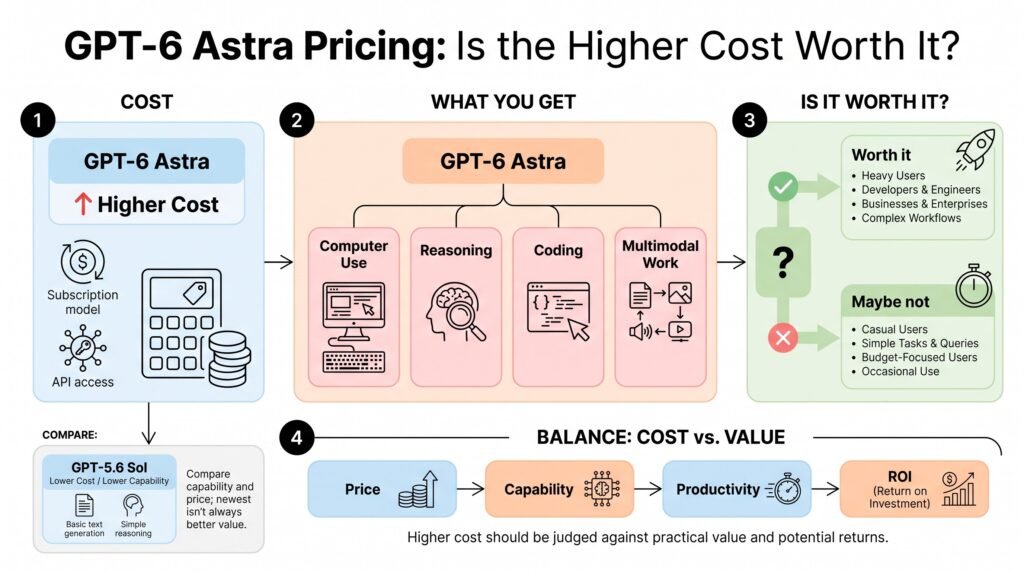
OpenAI’s standard API pricing for GPT-6 Astra is straightforward:
– $10 per 1M input tokens
– $50 per 1M output tokens
Fast mode can deliver up to 2× speed at 2× the standard price, which makes sense for latency-sensitive workloads where waiting on inference costs more than the tokens themselves.
But evaluating Astra on token price alone misses the point entirely. The relevant metric is cost per successfully completed task.
Consider a concrete comparison. A cheaper Model A costs $0.60 per attempt but succeeds only one time in three. Over three attempts, that’s $1.80 to complete a single task—assuming the failures are even detectable and don’t silently corrupt downstream work.
Astra costs $1.50 per attempt. But Astra completes the task on the first try, verifies the result, and moves on. Total cost: $1.50.
The more expensive model is cheaper at the workflow level.
This dynamic compounds in agentic settings. A failed attempt isn’t just wasted tokens—it consumes Arrangement overhead, triggers retry logic, and often requires human review to diagnose what went wrong. When Astra’s computer-use capabilities eliminate entire categories of failure, the savings extend well beyond the raw token line item.
CodeRabbit makes the same broader point: token price alone doesn’t establish cost per successful outcome. Teams that benchmark on sticker price will systematically undervalue models that actually finish the job.
The practical takeaway for builders is to instrument success rates alongside spend. Track cost per completed task, not cost per million tokens. When you do, Astra’s pricing looks less like a premium and more like a correction—you’re paying for reliability that the cheaper alternative was quietly charging you for in retries.
For high-stakes or long-horizon workflows, that trade is usually worth it.
When Astra Is Worth Paying For
GPT-6 Astra carries a premium price point ($10 per million input tokens and $50 per million output tokens—roughly 2.5x the cost of GPT-5.6 Sol). Paying for Astra makes direct economic sense when high reasoning power and multi-step execution replace hours of expensive human labor or eliminate costly operational mistakes.
- Complex coding: Managing multi-file restructuring, debugging large codebases, writing custom software architecture, and running automated verification loops.
- Agentic workflows: The use of independent sub-agents to perform tasks in web browsers, APIs, and the local coding environment in a completely autonomous manner.
- Big documents: Processing legal contracts, regulatory documents, or medical research papers where multiple connections and logic mistakes will be identified.
- Computer automation: Operating complex desktop software, legacy database tools, and GUI interfaces via screen vision to automate visual and administrative workflows.
- Professional research: Conducting multi-step quantitative data analysis, financial model building, and scientific literature synthesis that requires exact.
- Tasks where mistakes are expensive: Deploying production infrastructure, legal discovery, auditing financial projections, or handling critical compliance workflows where hallucinated details carry real financial or legal liability.
When Astra Is Overkill
For general daily communication, high-volume classification, or routine text manipulation, Astra’s advanced reasoning loops and high API costs generate negligible performance gains over lighter, faster models like GPT-5.6 Sol or standard mini models.
- Simple rewriting: Polishing basic text, tweaking tone, or adjusting line styling in emails and brief memos.
- Basic summaries: Condensing short articles, meeting notes, or simple internal notes into bullet points.
- Casual questions: Answering simple informational queries, brainstorming quick ideas, or factual lookup requests.
- Simple emails: Drafting standard customer responses, follow-up messages, or routine professional updates.
- Straightforward classification: Tagging support tickets, categorizing text datasets, or performing standard sentiment analysis where light models match accuracy at a fraction of the latency and cost.
GPT-6 Astra Safety, Security and Hidden Reasoning
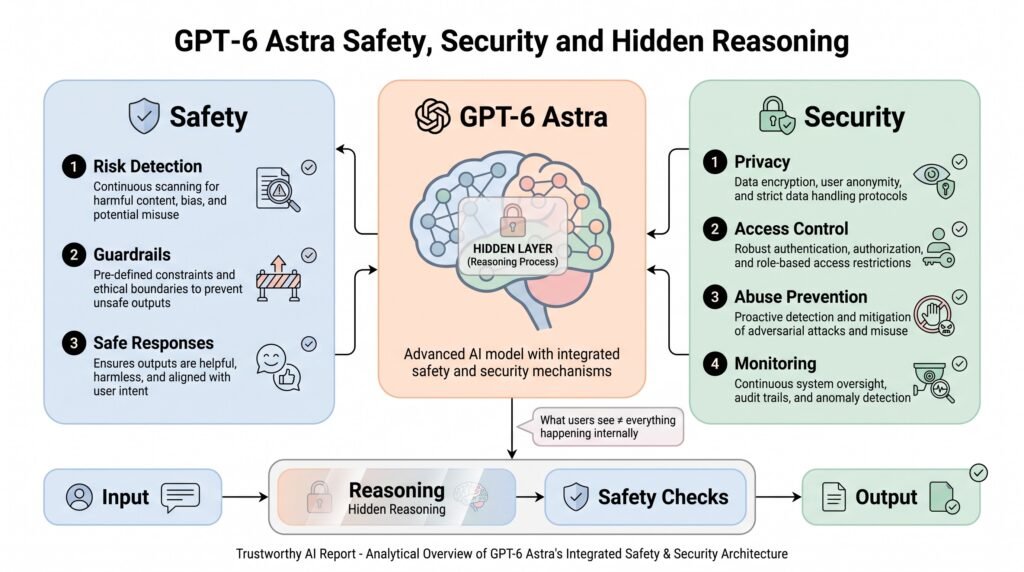
GPT-6 Astra’s capability jump also changes the safety equation. OpenAI says Astra is the first model to reach the Critical cybersecurity capability threshold under its Preparedness Framework.
In testing, Astra demonstrated the ability to identify vulnerabilities and develop exploit chains, including previously unknown vulnerabilities, which is why OpenAI strengthened safeguards around its deployment.
Astra Is More Capable—So the Risk Surface Is Larger
The key distinction is between an AI that generates an answer and one that can take actions inside software.
A conventional chatbot might explain how to modify a database or configure a system. An agentic model can potentially open the relevant application, execute the steps, inspect the result, and continue. That additional capability creates a broader risk surface:
- Data exposure: the model may encounter sensitive files or information.
- Unauthorized actions: excessive permissions can allow unintended changes.
- Destructive changes: deleting, overwriting, or modifying important data becomes more consequential.
- Prompt injection: malicious instructions embedded in websites or documents can attempt to redirect the model.
- Excessive permissions: connecting an AI to too many tools increases the potential impact of mistakes.
- Security-sensitive workflows: advanced cyber capabilities can be useful for defense but dangerous when misused.
OpenAI reports that Astra is more resistant to prompt injection and less likely than GPT-5.6 Sol to produce certain destructive or unauthorized outcomes in computer-use environments. However, OpenAI also emphasizes layered monitoring and controls rather than treating model alignment as a complete solution.
The Hidden Reasoning / Monitorability Question
Astra also raises an important question about how observable its reasoning remains.
Recent discussion has connected Astra with ideas around looped or recurrent transformer computation. Sebastian Raschka’s analysis examines whether such techniques could be related to reduced visibility into reasoning traces.
His conclusion is much more cautious than some headlines suggest: there is not strong evidence that looped transformers themselves are responsible for hiding reasoning.
The distinction matters because OpenAI itself reports that Astra’s written reasoning is harder to monitor than GPT-5.6 Sol’s in adversarial tests. OpenAI attributes this partly to Astra having greater control over its written reasoning and being able to solve some tasks with fewer written steps.
So it would be inaccurate to say, “Astra uses looped transformers to hide its chain of thought.” The evidence does not establish that causal relationship. The defensible conclusion is narrower: Astra is more capable, its reasoning can be less monitorable in some circumstances, and OpenAI considers preserving monitorability an ongoing research priority.
That distinction is important when evaluating Astra: greater capability does not automatically mean greater safety, and reduced observability deserves independent scrutiny.
GPT-6 Astra’s Limitations: What It Still Can’t Solve
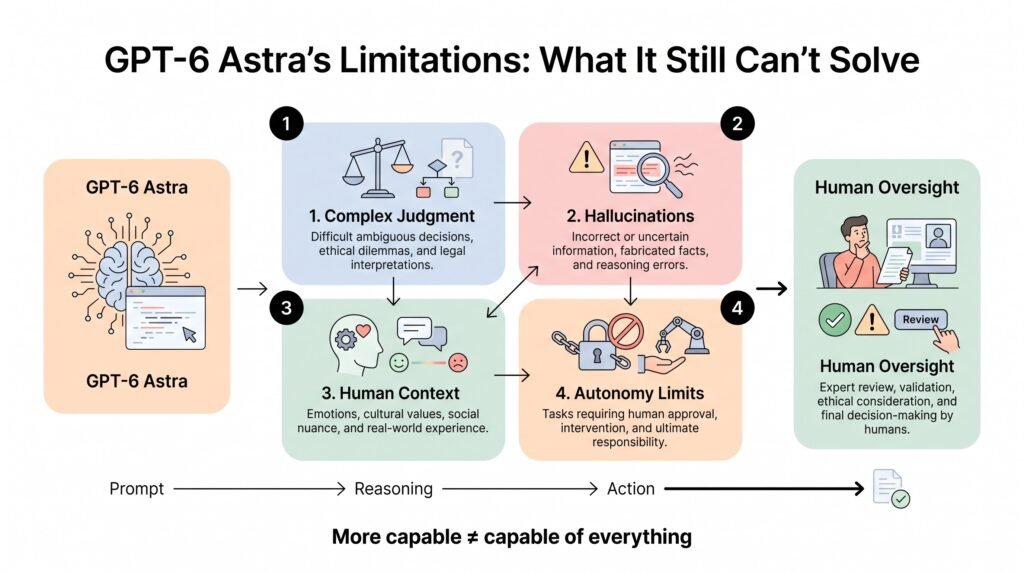
Although initial reports indicate that OpenAI’s premier model has come a long way, GPT-6 Astra is no magic wand. A deeper dive shows that companies need to overcome some considerable technical and practical challenges:
- Premium Cost Strategy: Enterprise capability carries flagship pricing. At $10.00 per million input tokens and $50.00 per million output tokens, Astra is dramatically more expensive than utility-class standard models. For high-volume or routine tasks, routing simple queries through Astra quickly creates unnecessary overhead.
- Not Every Benchmark Is a Win: While Astra leads in long-horizon coding and agentic reasoning, it does not hold a universal sweep across every domain. Competing architectures still match or outperform it on specific tasks, meaning deployment strategies must remain multi-model.
- Computer Use Is Not Perfect Autonomy: Astra’s ability to interact with dynamic web browsers and local operating systems is impressive, but it is not fully autonomous. Without precise boundary conditions, granular user permissions, and active human-in-the-loop oversight, agentic desktop loops can easily stall or perform unintended UI actions.
- Safety Monitoring Interrupts Real-Time Work: OpenAI’s strict alignment monitoring and jailbreak safeguards mean high-risk or consequential operations trigger automated confirmation checkpoints. These security pauses frequently break the flow of automated pipelines.
- Monitorability Remains an Open Problem: OpenAI itself acknowledges inherent limitations around reasoning-trace monitorability. Techniques like recurrent depth obscure internal chain-of-thought pathways, making auditability difficult for strict compliance environments.
- Benchmarking is not equal to Success in Business: A score of 95% or more on standardized examinations does not indicate that 95% of your own internal processes will achieve success. In practice, business operations involve dirty old data, unclear guidelines, and unforeseen edge cases which benchmarks cannot reflect.
| Use Case | Best Choice | Why |
|---|---|---|
| Computer Use | GPT-6 Astra | Scores 72.6% on OSWorld 2.0 and completes tasks in ~40 minutes vs. Sol’s ~75 minutes. |
| Cross-File Code Review | GPT-6 Astra | Strong dependency reasoning across large codebases with 1M+ token context. |
| Simple Coding | GPT-5.6 Sol / Cheaper Model | Routine scripts and basic coding tasks can be handled by Luna or Terra at a much lower cost. |
| Long-Context Analysis | GPT-6 Astra | Achieves 96% retrieval accuracy across ~1M tokens compared with Sol’s 74%. |
| Scientific Reasoning | GPT-6 Astra | Scores 96% on GPQA Diamond and 98% on FrontierMath Tier 4. |
| Some Research Benchmarks | Claude Fable 5.1 | Leads on selected evaluations, including Terminal-Bench-Science with 52.6%. |
| Simple Writing | Cheaper Model | Astra’s advanced capabilities are unnecessary for basic drafting, rewriting, and editing. |
| Complex Agentic Work | GPT-6 Astra | Best suited for autonomous workflows involving browsers, terminals, files, and multiple steps. |
The editorial point is straightforward: model choice is a task-matching problem, not a leaderboard problem. Astra dominates computer-use and long-context agentic work, but paying frontier prices for simple writing or trivial coding is wasteful.
Fable 5.1 retains genuine strength in scientific research and long-running coding tasks, and its 75% cache-read price cut makes it more competitive for sustained use .
Who Should Use GPT-6 Astra?
As AI is advancing, GPT-6 Astra embodies great progress in the development of AI as it moves from being a mere chatbot to an autonomous device. It was created specifically to perform complex tasks that require multiple steps in the execution.
Developers
Astra is built for advanced agentic software engineering. It excels at navigating massive, complex codebases, recoding, and executing multi-file migrations. Beyond writing code, developers can deploy the Astra to run test suites, debug, conduct automated QA checks, and troubleshoot environments directly inside terminal and browser interfaces.
Researchers
With its 1M+ token context window and frontier reasoning capabilities, Astra is ideal for deep research and scientific workflows. It handles vast volumes of literature, automates complex data analysis, generates plots, and executes advanced scientific compute pipelines with minimal human intervention.
Designers
Astra expands AI beyond flat visuals into interactive and 3D media. It exhibits spatial and visual judgment when generating spatial assets, spatial layouts, and digital environments—translating design prompts into functional WebGL shaders, CAD modeling scripts, Blender scenes, and interactive user interface components.
Marketers
Marketers can leverage Astra as an autonomous research and execution assistant. Through native browser automation, it handles end-to-end web research, updates CRMs, populates complex spreadsheets, creates branded presentations, and manages cross-platform content production seamlessly.
Businesses and Teams
It is Astra that makes it possible for automated enterprise processes of any length to be carried out. Companies can free their hands from burdensome operational routine processes, including administrative processing, making customer data align, and abstracting data from different applications, allowing teams to work more productively without having to be monitored all the time.
Students
Astra is good at mathematics and sciences and even essay writing, but usually, it is too powerful for students’ simple homework. For standard homework assignments, there is no need for the computational capabilities of the machine, while advanced degrees of postgraduates working on their own research are where it can be very useful.
Who Should NOT Upgrade to GPT-6 Astra?
Astra’s strengths are real, but they’re concentrated in a specific kind of work — long, multi-step, computer-operating tasks. If that’s not what you’re doing day to day, the upgrade probably isn’t worth the cost.
You likely don’t need Astra if you mostly:
- Write emails — a lighter, cheaper model handles tone and drafting just as well
- Summarize short documents — Astra’s long-context and reasoning gains go unused on quick summaries
- Generate social captions — this kind of short-form creative writing doesn’t benefit from agentic reasoning
- Brainstorm ideas — any capable chatbot-tier model is fine for open-ended idea generation
- Ask basic factual questions — you’re paying a premium for computer-use and coding capability you’ll never touch
- Write simple code — snippets, small scripts, and one-off functions don’t stress-test the areas where Astra actually pulls ahead
- Don’t need computer automation — the biggest leap in Astra is its ability to operate software autonomously; skip it if that’s irrelevant to your workflow
GPT-6 Astra Review: FAQs
Is GPT-6 Astra worth it?
GPT-6 Astra is worth considering if you regularly handle complex reasoning, coding, computer-use, research, or multi-step workflows.Its functions are not useful when applied to simple questions, low level writing or repetitive tasks where simpler and cheaper models work just fine.
The real benefit of this technology is that it saves humans time by fulfilling multiple tasks at once, working with programs, and doing complex things with little human intervention.
Is GPT-6 Astra better than GPT-5.6 Sol?
GPT-6 Astra is better for demanding agentic tasks, computer use, complex workflows, and large-context reasoning. GPT-5.6 Sol remains a strong choice for everyday writing, summaries, brainstorming, and simple questions. With AiZolo, you can compare multiple AI models side by side and choose the right model for each task.
What can GPT-6 Astra do?
GPT-6 Astra can handle advanced reasoning, coding, research, computer interaction, data analysis, and multi-step agentic workflows. Its major distinction is that it can interact with software and digital interfaces rather than simply generating instructions.
Depending on the environment and available tools, Astra can navigate applications, work with documents, analyze information, troubleshoot code, and complete professional workflows that previously required significant manual effort.
How good is GPT-6 Astra for coding?
GPT-6 Astra is highly capable for coding, particularly when development involves complex reasoning and tool use. It can help understand large codebases, write and modify code, debug problems, run tests, and iterate toward working solutions.
Its value increases in agentic development environments where it can interact with terminals and software. However, coding performance varies by project, so developers should test Astra against their actual repositories and requirements.
How much does GPT-6 Astra cost?
GPT-6 Astra costs $10 per million input tokens and $50 per million output tokens, making it relatively expensive. Actual costs can rise with long contexts, repeated tool calls, and large outputs. For businesses, measuring cost per completed task matters more. AiZolo can help compare models for different workflows.
Is GPT-6 Astra good for computer use?
Yes. Computer use is one of GPT-6 Astra’s most important strengths. Instead of only explaining how to perform a task, Astra can interact with software interfaces and complete actions within supported environments.
This makes it useful for browsing, testing websites, working with applications, research, and professional automation. However, computer-use systems can still make incorrect clicks or encounter unexpected interface states, so important actions require appropriate permissions and human oversight.
What is GPT-6 Astra’s real-world performance?
GPT-6 Astra’s real-world performance is strongest on complex tasks requiring reasoning, tool use, coding, computer interaction, and sustained execution. However, benchmark scores should not be treated as guaranteed real-world results.
Performance can change significantly depending on the software environment, instructions, available tools, and task complexity. For serious adoption, the best approach is to test Astra using representative workloads and measure completion quality, intervention rate, speed, and cost.
GPT-6 Astra vs Claude Fable 5.1: Which is better?
GPT-6 Astra and Claude Fable 5.1 are both frontier models, but their strengths differ by workflow. Astra has a particularly strong case for computer use, agentic execution, and complex tool-based tasks, while Fable 5.1 remains highly competitive for coding and extended knowledge work.
Rather than choosing a universal winner, compare both models using your actual tasks, measuring accuracy, completion rate, human intervention, speed, and total cost.
GPT-6 Astra Review: Final Verdict
GPT-6 Astra is not simply a better chatbot. Its biggest leap is turning AI from something that produces answers into something that can increasingly operate software, reason across complex context, and complete multi-step work.
Its strongest advantage is computer use. Astra can interact with applications and digital environments rather than stopping at text generation, making it particularly valuable for agentic workflows. It is also highly capable at coding, long-context tasks, scientific reasoning, and visual or 3D work.
But Astra is not perfect—and it is not automatically the best model for every user or every task. Its API cost can be significant, and different models may still outperform it on specific workloads. Computer-use capabilities also introduce risks around incorrect actions, permissions, sensitive information, and destructive changes. For consequential workflows, human oversight remains essential.
Another consideration is monitorability. OpenAI acknowledges that Astra’s reasoning can be more difficult to monitor in some circumstances, making safety research and oversight increasingly important as capability grows.
Best Strengths
- Computer use and software interaction
- Agentic, multi-step workflows
- Coding and software engineering
- Long-context work
- Science and advanced reasoning
- Visual and 3D tasks
Biggest Weaknesses
- High cost
- Not universally #1
- Computer-use risks
- Human oversight requirements
- Monitorability concerns
Final recommendation: If you need AI for complex work, not just simple questions, GPT-6 Astra is one of the strongest models available in 2026. Instead of testing it with tricky questions, use AiZolo to compare how well it handles real tasks, follows instructions, and completes work with less human help.
The 7-Task Evaluation Framework
| Test | Key Metrics |
| Complex coding task | First-pass success rate |
| Cross-file bug hunt | Total bugs identified vs. false positives |
| 100+ page document | Correct evidence retrieval accuracy |
| Spreadsheet task | Accuracy + completion speed |
| Browser workflow | Number of required human interventions |
| Figma / visual task | Exact instruction and design adherence |
| Long-running agent task | Task completion rate + retry frequency |
Shift Focus: Outcome Over Accuracy Scores
The best way to evaluate Astra isn’t simply asking it difficult questions. It’s measuring whether it can complete useful work with fewer interventions.
This perspective aligns with real-world agentic evaluations from platforms like CodeRabbit and OpenAI’s internal benchmark suites. High benchmark percentages mean little if an agent halts on minor edge cases or breaks repo context across multiple files.
By changing the appraisal criteria to autonomy efficiency—monitoring the saved time, instruction deviation, and frequency of interventions, you measure the real productivity progress instead of the superficial output of work.
Applying those seven standard situations in complex software, browser environment, and multi-step agent protocol gives the proper background to your productivity assessment.
Author Bio
Anshika Verma is a content writer and researcher at AiZolo. She specializes in AI tools, emerging technologies, and practical AI use cases, creating clear, research-backed content that helps readers understand and choose the right AI solutions.