
Introduction
Every AI lab claims its model is the smartest. That claim is rarely the whole story.
If you’ve ever tried to compare AI tools by opening five browser tabs and typing the same prompt into each one, you already know the problem: the answers all sound confident, and none of them tell you which model is actually right for your job.
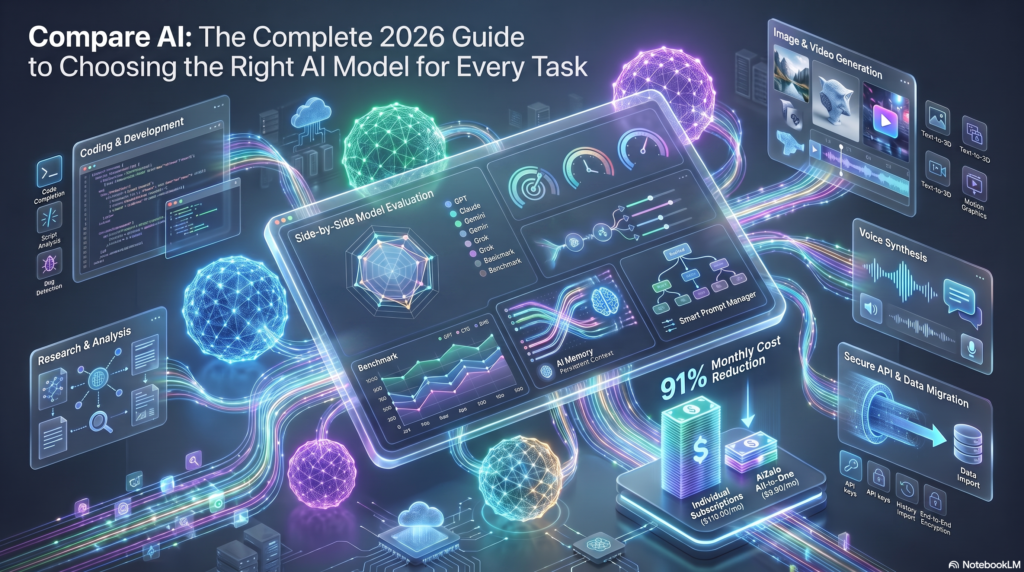
In 2026, there is no single “best” AI. ChatGPT, Claude, Gemini, Grok, Perplexity, and Mistral each optimize for different strengths—reasoning depth, coding accuracy, real-time search, multimodal creativity, or raw cost efficiency. Aizolo makes it easier to compare these leading AI models in one place, helping users choose the right tool for every task.
For the full side-by-side rankings across ten major models, see our AI Comparison Chart 2026.
Picking the wrong one doesn’t just waste a subscription fee. It wastes hours: a developer debugging code the model quietly hallucinated, a marketer publishing a fact an AI invented, a founder overpaying for API tokens a cheaper model could have handled just as well.
This guide breaks down how to compare AI models properly — using real pricing, real context windows, and real task-by-task performance instead of marketing claims. Platforms like Aizolo exist precisely because this comparison problem is real: most people don’t want to manage five subscriptions just to get five different strengths.
By the end, you’ll know exactly which AI to reach for — and why.
Table of Contents
What Does “Compare AI” Actually Mean?
“Compare AI” covers more ground than most searchers expect. It usually means one of three things.
Comparing AI models — putting ChatGPT, Claude, Gemini, Grok, and others side by side on the same prompt to see which produces better output.
Comparing AI tools or platforms — evaluating chatbots, coding assistants, image generators, or research tools built on top of these models.
Comparing AI pricing and infrastructure — API costs, context windows, rate limits, and enterprise terms for teams building products.
Most people searching “compare ai” are really asking a narrower question: which AI should I use for this specific task, at this price, right now? That’s the question this guide answers.
Why Comparing AI Models Matters in 2026
The AI landscape moves fast enough that a model that led benchmarks in January can trail by July. New releases arrive almost monthly — Claude Sonnet 5 launched June 30, GPT-5.6 went generally available July 9, Grok 4.5 shipped July 8. Loyalty to one brand is expensive.
Three forces make comparison non-negotiable right now.
Capability gaps are task-specific, not universal. A model can lead on coding benchmarks and still lag on hallucination rates. No lab currently wins every category.
Pricing has fragmented wildly. API rates for flagship models now range from roughly $0.50 per million tokens (Mistral Large 3) to $30 per million output tokens (GPT-5.5 and GPT-5.6 Sol) — a 60x spread for tasks that can overlap significantly.
Context windows now vary by 4x. Some flagship models cap out near 500K tokens; Grok 4.1 Fast offers 2 million. If your workflow involves long documents or entire codebases, this single spec can eliminate half the field.
Choosing the wrong model at scale compounds. A team running thousands of API calls a day on an oversized flagship model when a cheaper mid-tier model would do the same job can burn through budget fast enough to matter inside a single quarter.
Beyond avoiding a bad pick, there are compounding upsides to testing models regularly — see the benefits of comparing AI models.
How to Compare AI Models Properly
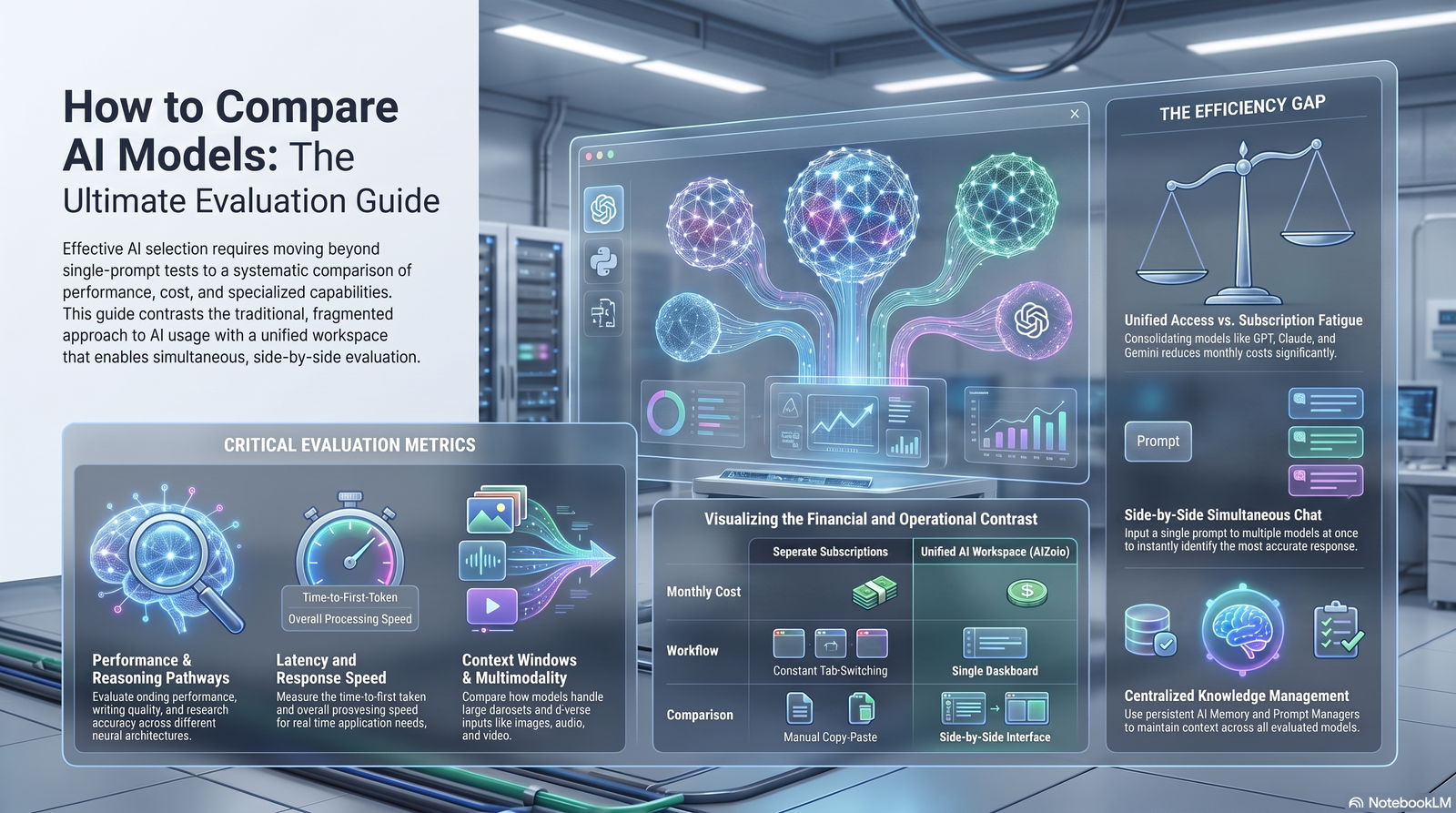
Most comparisons fail because they test one prompt, once, and generalize from it. A defensible comparison checks five things.
Task fit first. Define the actual job — coding, long-document research, creative writing, real-time information — before touching a benchmark chart.
Context window against your real input size. If you’re feeding in a 50-page contract, a model with a 128K window may truncate it silently.
Cost per completed task, not per token. A cheaper model that needs three retries to get a correct answer can cost more in practice than a pricier model that gets it right the first time.
Hallucination behavior on your domain. General benchmarks don’t always predict how a model performs on niche or recent information.
Update cadence and version stability. Some labs update model behavior mid-version without a name change, which matters for production reliability.
Compare ChatGPT vs Claude vs Gemini vs Grok vs Perplexity vs Mistral
Here’s the current flagship landscape as of mid-July 2026.
| Model | Latest Flagship | Context Window | API Pricing (Input/Output per 1M tokens) | Known For |
|---|---|---|---|---|
| ChatGPT (OpenAI) | GPT-5.6 Sol | 1.05M tokens | $5 / $30 | Balanced generalist, strong agentic tool use |
| Claude (Anthropic) | Claude Sonnet 5 / Opus 4.8 | 1M tokens | $2–$3 / $10–$15 (Sonnet 5); $5 / $25 (Opus 4.8) | Agentic coding, long-document reasoning, safety |
| Gemini (Google) | Gemini 3.1 Pro | 1M tokens | $2 / $12 | Multimodal reasoning, native Google ecosystem |
| Grok (xAI) | Grok 4.5 | 500K tokens (Grok 4.3 offers 1M) | $2 / $6 | Real-time X/web data, aggressive pricing tiers |
| Perplexity | Sonar / Sonar Pro (built on multiple models) | Varies by model | $1–$3 / $1–$15 (Sonar API) | Cited, real-time answer engine |
| Mistral | Mistral Large 3 | 256K tokens | $0.50 / $1.50 | Lowest cost, EU data residency, open-weight options |
This table changes fast — always confirm current pricing directly on each provider’s documentation page before budgeting a project around it.
For a head-to-head just between these two labs, see Google vs Anthropic: AI Model Comparison 2026.
Compare AI for Reasoning
Reasoning quality separates models most clearly on multi-step logic, math, and problems requiring the model to plan before answering.
Google’s Gemini 3.1 Pro currently leads several published reasoning benchmarks, including strong results on ARC-AGI-2 and GPQA Diamond.
Claude Opus 4.8 remains the stronger pick for long-horizon reasoning chains where a single wrong step compounds — Anthropic itself frames Sonnet 5 as “close to” but not exceeding Opus on the hardest reasoning tasks.
GPT-5.5 and GPT-5.6 Sol trade blows with both at the very top of independent leaderboards, though testers have flagged a higher hallucination rate on GPT-5.5 relative to its raw reasoning score.
For pure step-by-step math and theorem-style reasoning, specialized models sometimes outperform every generalist flagship — worth checking if your use case is narrowly mathematical.
That gap is narrower than it looks on paper — see how big the gap actually is between top AI models in 2026.
Compare AI for Coding
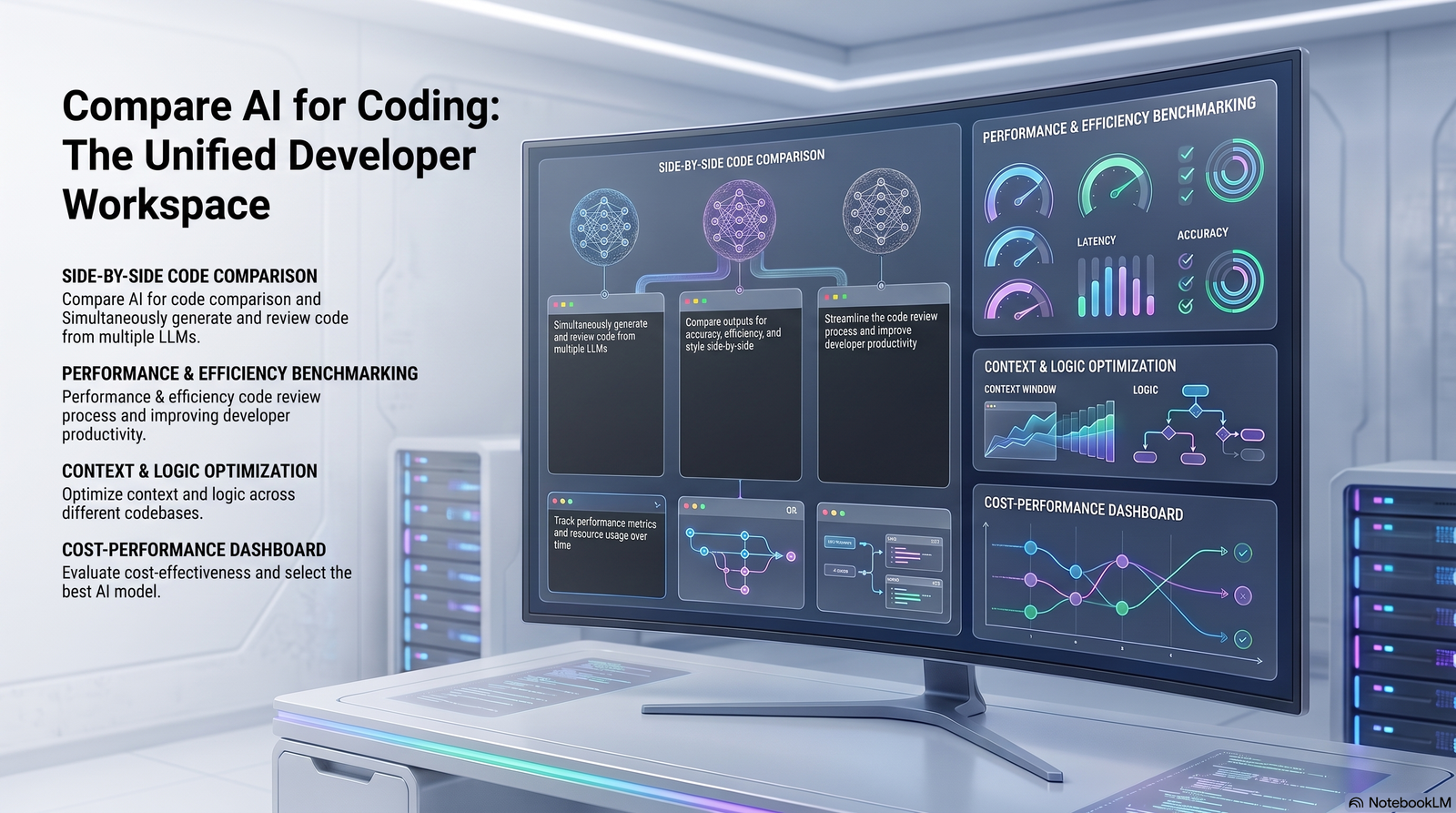
Coding is where the gap between models is currently most visible in production use.
Claude Sonnet 5 was built specifically around agentic coding: planning multi-file changes, using a terminal, and recovering from its own errors mid-task.
On Anthropic’s own agentic coding benchmark, Sonnet 5 scored 63.2% against Opus 4.8’s 69.2% — meaning Opus still leads on the hardest coding tasks, while Sonnet 5 offers most of that capability at roughly a third of the cost.
GPT-5.5 and GPT-5.6 Sol perform strongly on whole-repository refactors thanks to their 1M+ token context windows, letting them hold an entire codebase in view.
Gemini 3.1 Pro posts competitive numbers on SWE-Bench-style tasks and Terminal-bench, particularly through Gemini 3.5 Flash for lighter agentic coding work at a lower price point. Mistral’s Codestral remains a popular budget pick for in-editor autocomplete rather than full agentic coding.
| Coding Priority | Best Fit |
|---|---|
| Multi-file agentic refactors | Claude Sonnet 5 or Opus 4.8 |
| Whole-repo context (1M+ tokens) | GPT-5.6 Sol, Gemini 3.1 Pro |
| Low-cost autocomplete | Mistral Codestral |
| Fast, cheap agent loops | Grok 4.1 Fast, Gemini 3.5 Flash |
For a coding-only deep dive across benchmarks, see Best AI Coding Models 2026: Compared.
Compare AI for Writing
For long-form writing, tone control, and editorial nuance, differences show up in voice consistency across a long piece rather than any single output.
Claude models are widely regarded by writers and editors as producing the least “AI-sounding” prose by default, with fewer generic transitional phrases. GPT-5.6’s Terra and Luna variants are tuned for faster, more conversational output suited to drafts and social copy.
Gemini integrates tightly with Google Docs and Workspace, which matters more for workflow than raw prose quality. Mistral’s Le Chat, running on Large 3, is a capable but less polished option for long-form work, trading writing nuance for lower cost and EU data residency.
For a writing/language-tool-specific comparison, see AI Language Tools: The Honest 2026 Comparison.
Compare AI for Image Generation
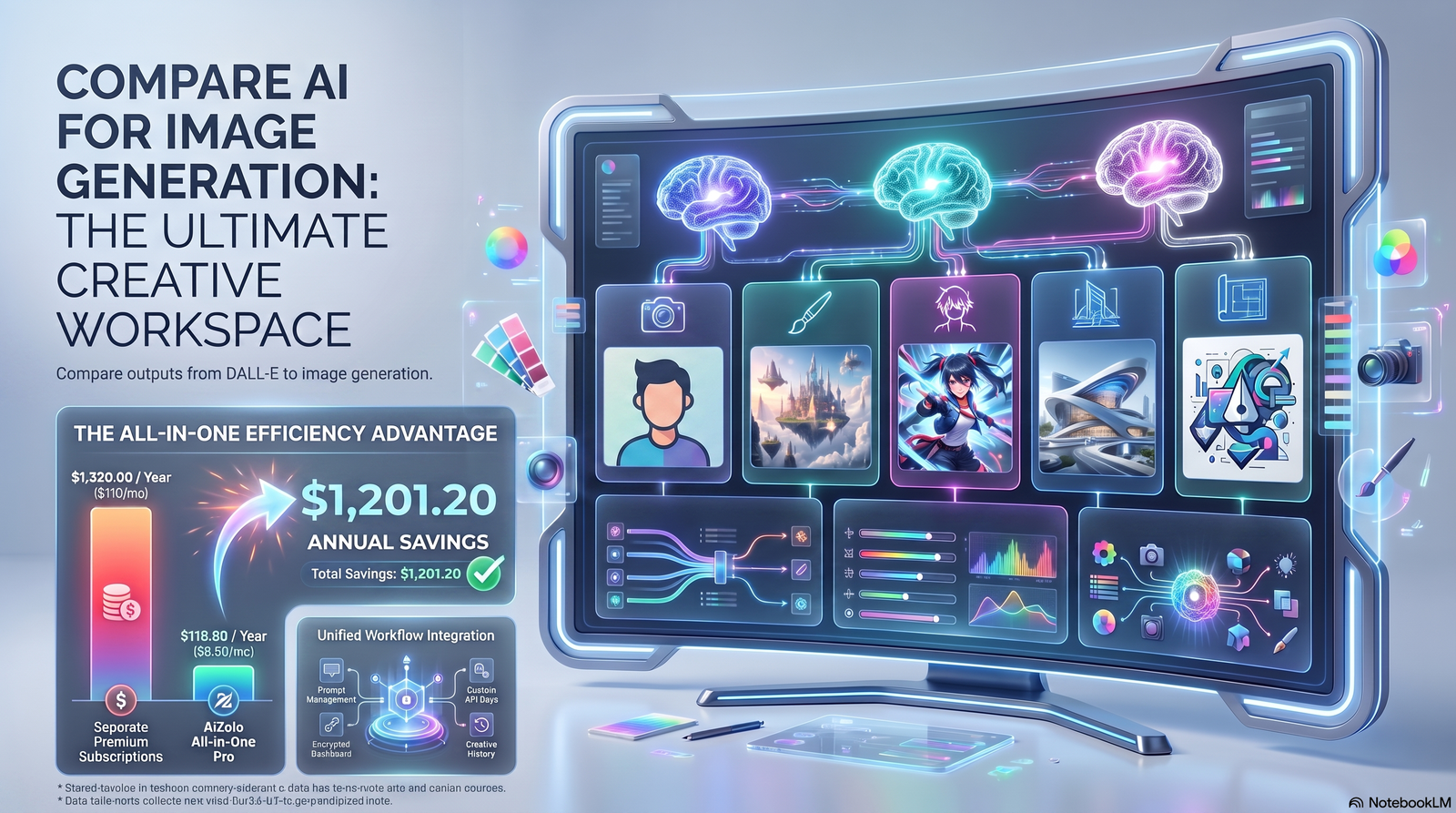
Image generation sits outside most labs’ primary language model — it’s usually a separate, paired system.
OpenAI keeps image generation in a dedicated model rather than folding it into GPT-5.5 or GPT-5.6 directly. Google’s Gemini ecosystem includes native image generation and editing through Gemini 3 Pro Image, with per-resolution token pricing.
Grok’s Imagine feature is bundled into SuperGrok subscriptions rather than sold as a standalone API product, and now includes short video generation. Claude and Mistral do not currently offer first-party image generation, focusing instead on text, reasoning, and document work.
If image generation is your primary need, this is the one category where “compare AI” should really mean comparing dedicated image models, not general chat assistants.
Compare AI for Research
This is Perplexity’s core strength. It pairs a language model with live web search and inline citations by default, which general chatbots don’t do unless explicitly told to search.
Perplexity’s Sonar API and consumer app cite sources for nearly every factual claim, which matters enormously for anyone who needs to verify information rather than take it on faith.
Grok’s DeepSearch mode offers a comparable cited-research workflow with real-time access to X data specifically, which is unique among the major labs. ChatGPT, Claude, and Gemini all support web search as a toggled feature rather than a default behavior, so citation quality depends on whether that mode is switched on.
Compare AI Pricing
Pricing splits into two very different products: consumer subscriptions and developer API access. Confusing the two is the single most common budgeting mistake teams make.
Consumer Subscription Pricing
| Platform | Free Tier | Mid Tier | Top Tier |
|---|---|---|---|
| ChatGPT | Yes, limited | Plus ~$20/mo | Pro ~$200/mo |
| Claude | Yes, limited | Pro (~$20/mo typical) | Max plans, higher usage |
| Gemini | Yes, limited | AI Pro $19.99/mo | AI Ultra $99.99–$200/mo |
| Grok | Yes, ~10 prompts/2hrs | SuperGrok Lite $10/mo | SuperGrok $30/mo |
| Perplexity | Yes, 5 Pro searches/day | Pro $20/mo | Max $200/mo |
| Mistral (Le Chat) | Yes, ~25 messages/day | Pro $14.99/mo | Team $24.99/user/mo |
API Pricing (per 1 million tokens, input/output)
| Model | Input | Output | Context Window |
|---|---|---|---|
| GPT-5.6 Sol | $5.00 | $30.00 | 1.05M |
| GPT-5.6 Terra | $2.50 | $15.00 | 1M |
| GPT-5.6 Luna | $1.00 | $6.00 | 1M |
| Claude Sonnet 5 (intro, through Aug 31, 2026) | $2.00 | $10.00 | 1M |
| Claude Sonnet 5 (standard) | $3.00 | $15.00 | 1M |
| Claude Opus 4.8 | $5.00 | $25.00 | 1M |
| Gemini 3.1 Pro | $2.00 | $12.00 | 1M |
| Gemini 3.5 Flash | $1.50 | $9.00 | — |
| Grok 4.5 | $2.00 | $6.00 | 500K |
| Grok 4.3 | $1.25 | $2.50 | 1M |
| Grok 4.1 Fast | $0.20 | $0.50 | 2M |
| Mistral Large 3 | $0.50 | $1.50 | 256K |
| Perplexity Sonar | $1.00 | $1.00 | — |
| Perplexity Sonar Pro | up to $3.00 | up to $15.00 | — |
Prices shift often — every lab in this table has changed pricing at least once in 2026 alone. Verify against the official pricing page before committing a production budget.
Compare AI Context Windows

Context window size decides whether a model can “see” your entire document, codebase, or conversation history at once, rather than losing earlier context.
| Model | Context Window |
|---|---|
| Grok 4.1 Fast | 2,000,000 tokens |
| GPT-5.6 (all tiers) | ~1,050,000 tokens |
| Claude Sonnet 5 / Opus 4.8 | 1,000,000 tokens |
| Gemini 3.1 Pro | 1,000,000 tokens |
| Grok 4.3 | 1,000,000 tokens |
| Grok 4.5 | 500,000 tokens |
| Mistral Large 3 | 256,000 tokens |
A larger window isn’t automatically better — retrieval accuracy inside a huge context can still degrade the deeper a relevant fact sits in that window. For most document-analysis tasks, 200K–1M tokens is plenty; 2M tokens matters mainly for entire-codebase or book-length workloads.
Compare AI Speed
Speed comparisons depend heavily on reasoning mode — a model set to “high” or “xhigh” reasoning effort will always be slower than the same model at “low” effort.
Grok 4.1 Fast and Gemini 3.5 Flash are both explicitly built for low-latency, high-throughput use, trading some reasoning depth for speed. Mistral’s models, run on Cerebras infrastructure in some deployments, post very high raw tokens-per-second figures.
Flagship reasoning models — GPT-5.5 Pro, Claude Opus 4.8, Gemini 3.1 Pro at high thinking levels — are meaningfully slower by design, since they spend more compute reasoning before answering.
Compare AI for Privacy and Enterprise Features

| Model | Notable Privacy/Enterprise Feature |
|---|---|
| Claude | Zero data retention (ZDR) agreements available for enterprise customers |
| Mistral | EU data residency, open-weight self-hosting options |
| Gemini | Deep Google Workspace and Google Cloud integration, enterprise admin controls |
| GPT (OpenAI) | Business/Enterprise plans with admin controls, data controls |
| Grok | Data-sharing opt-in program tied to free API credits |
| Perplexity | Enterprise Pro/Max tiers with SSO and admin controls |
For regulated industries or EU-based teams, data residency and retention policies often matter more than raw benchmark scores — this is frequently the deciding factor once two models are otherwise close in capability.
If you’re evaluating models for a SaaS product rather than personal use, see how to compare AI model performance for B2B SaaS workflows
Compare AI Multimodal Abilities
Every major flagship now accepts image input; fewer handle video, audio, and generation natively.
Gemini 3.1 Pro processes text, image, audio, and video natively, reflecting Google’s DeepMind multimodal research lineage. GPT-5.5 and GPT-5.6 handle text and image input with text output, keeping image and video generation in separate dedicated models. Claude Sonnet 5 supports high-resolution vision input alongside document and tool use. Grok pairs its language model with the Grok Imagine system for image and short video generation, tightly bundled into its consumer subscriptions.
Compare AI Tool Use and Agentic Workflows
Tool use — letting a model call APIs, browse the web, run code, or operate a computer — is the fastest-moving category in 2026.
Claude Sonnet 5 is explicitly marketed around agentic capability: planning, using browsers and terminals, and running with less human oversight than earlier models. GPT-5.6’s three-tier family (Sol, Terra, Luna) lets developers choose reasoning depth per task, with Sol handling the most complex agentic chains. Gemini 3.1 Pro scores strongly on MCP-based agentic benchmarks and computer-use tasks. Grok’s Live Search gives it a distinct real-time data advantage inside agentic loops that need current information rather than static training knowledge.
Which AI Is Best for Each Task
| Task | Recommended Model |
|---|---|
| Agentic coding, multi-file refactors | Claude Sonnet 5 or Opus 4.8 |
| Whole-codebase or book-length context | GPT-5.6 Sol, Grok 4.1 Fast |
| Cited, fact-checked research | Perplexity Sonar Pro |
| Real-time information / current events | Grok (Live Search / DeepSearch) |
| Long-form writing with natural voice | Claude |
| Google Workspace-integrated work | Gemini 3.1 Pro |
| High-volume, low-cost automation | Grok 4.1 Fast, Mistral Small |
| EU data residency / regulated industries | Mistral |
| Multimodal (text + image + video + audio) | Gemini 3.1 Pro |
| Budget-conscious general use | Mistral Large 3, Gemini 3.5 Flash |
For a deeper breakdown of each pick, see our top 5 AI models of 2026.
Compare AI Side by Side: A Practical Framework

Rather than trusting a single benchmark chart, run your own three-step comparison before committing to a model.
Step 1 — Run your actual task, not a generic prompt. Feed each model the real document, code snippet, or writing brief you’ll use in production.
Step 2 — Score on accuracy, not fluency. A confident, well-written wrong answer is worse than a hesitant correct one — check facts against a primary source.
Step 3 — Calculate cost per correct output. Divide token cost by the number of attempts needed to get a usable result, not by raw token price alone.
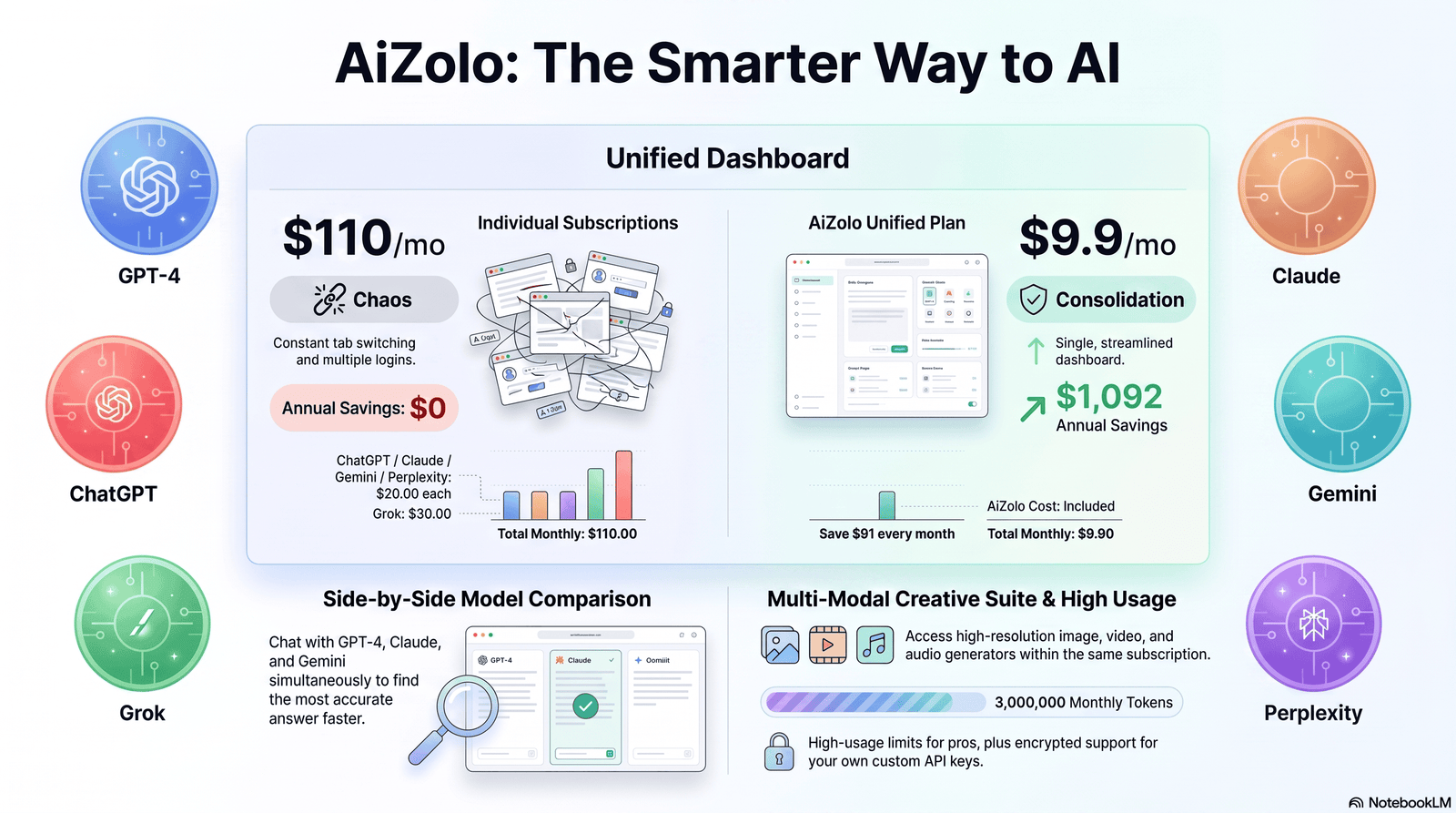
Tools and platforms built for exactly this kind of side-by-side testing — including Aizolo — exist because manually juggling five separate subscriptions and API keys to do this properly isn’t realistic for most people.
This is the exact workflow platforms like Aizolo are built around — see The World’s Smartest AI Side by Side.
Future Trends in AI Comparison
A few patterns are worth watching as 2026 progresses.
Release cadence is accelerating. Multiple labs now ship major updates monthly rather than quarterly, meaning any comparison — including this one — has a shelf life measured in weeks, not years.
Pricing is compressing at the low end. Sub-$1-per-million-token models with genuinely usable reasoning are becoming common, pushing more routine tasks toward cheaper tiers.
Context windows are converging near 1M tokens as a de facto standard for flagship models, with 2M-token windows emerging as the new differentiator at the top end.
Agentic capability is becoming the primary battleground, replacing raw benchmark scores as the metric labs compete on most visibly — the question is shifting from “which model answers best” to “which model completes the multi-step task correctly with the least supervision.”
Frequently Asked Questions
What does “compare AI” mean? It generally refers to evaluating different AI models or platforms — such as ChatGPT, Claude, and Gemini — against each other on pricing, capability, and task performance to decide which fits a specific need.
Which AI is best overall in 2026? There isn’t one universal winner. GPT-5.6 Sol, Claude Opus 4.8, and Gemini 3.1 Pro all lead different benchmark categories, and the right choice depends on the task, budget, and required context window.
Is Claude better than ChatGPT? Claude tends to lead on agentic coding and long-document reasoning with lower hallucination rates in independent testing, while ChatGPT’s GPT-5.6 family offers a slightly larger context window and strong general-purpose versatility. Neither is universally “better.”
Which AI has the largest context window? As of July 2026, Grok 4.1 Fast offers the largest publicly available context window at 2 million tokens, followed by GPT-5.6 and Claude Sonnet 5 at roughly 1 million to 1.05 million tokens.
Which AI model is cheapest? Mistral Large 3 is currently the least expensive flagship-class model at $0.50 per million input tokens and $1.50 per million output tokens, with Grok 4.1 Fast close behind for high-volume use.
Which AI is best for coding? Claude Sonnet 5 and Opus 4.8 currently lead on agentic, multi-file coding tasks, while GPT-5.6 Sol and Gemini 3.1 Pro are strong choices when an entire large codebase needs to fit in context.
Which AI gives the most accurate, cited answers? Perplexity is built specifically around cited, source-linked answers by default, making it the strongest choice when factual verification matters most.
Does any AI have real-time internet access? Grok’s Live Search and DeepSearch modes, along with Perplexity’s default search behavior, provide the most consistent real-time data access. ChatGPT, Claude, and Gemini support web search as an optional toggle.
Which AI model hallucinates the least? Independent testing has flagged GPT-5.5 as having a comparatively higher hallucination rate relative to its reasoning score, while Claude models have generally scored better on hallucination-focused evaluations — though this changes with every new release and should be re-verified regularly.
Is there a free way to compare AI models? Yes — most major labs (OpenAI, Anthropic, Google, xAI, Mistral) offer free tiers with usage limits, which is often enough to run a basic side-by-side test before committing to a paid plan.
What’s the difference between an AI’s consumer app and its API? The consumer app (like ChatGPT Plus or Claude Pro) is a flat monthly subscription for chat access; the API is billed per token and used by developers to build the model into their own products. Pricing and usage limits differ significantly between the two.
Which AI is best for enterprise use? This depends heavily on existing infrastructure — Gemini integrates deeply with Google Workspace and Cloud, Claude offers zero data retention agreements, and Mistral appeals to EU-regulated industries needing data residency guarantees.
How often do AI model rankings change? Frequently. Major labs now ship significant updates roughly monthly, and a model leading a benchmark category in one month can be surpassed within weeks.
Can I use multiple AI models without managing separate subscriptions? Yes — several platforms, including Aizolo, are built to give access to multiple models through a single interface, which is useful for anyone who doesn’t want to manage five separate accounts and billing relationships.
Which AI is best for image generation? Gemini’s native image generation and Grok Imagine are currently the most tightly integrated options; OpenAI keeps image generation in a separate dedicated model rather than folding it into GPT-5.6 directly.
Do smaller or cheaper AI models perform worse? Not always. Cheaper tiers like Gemini 3.5 Flash, Grok 4.1 Fast, and Mistral Small are specifically optimized for cost-sensitive, high-volume tasks and often perform comparably to flagship models on simpler jobs.
How do I know which context window I actually need? Estimate your typical input size in tokens (roughly 0.75 words per token) and choose a model with meaningful headroom above that figure — going in exactly at the limit can degrade retrieval accuracy.
Conclusion
There is no single “best” AI in 2026 — only the AI that best fits a specific task, budget, and workflow.
If your priority is agentic coding and careful long-document reasoning, Claude currently leads. If you need the largest possible context window or the most balanced generalist, GPT-5.6 and Gemini 3.1 Pro are strong picks. If real-time information and aggressive pricing matter most, Grok stands out. If cited research accuracy is non-negotiable, Perplexity remains purpose-built for that job. And if cost and EU data residency top your list, Mistral is hard to beat.
The fastest way to stop guessing is to test your real task against two or three models directly, rather than relying on a single benchmark screenshot. Platforms like Aizolo make that side-by-side comparison practical without juggling five separate logins and billing accounts.
Whichever model you choose, revisit the comparison regularly — this category changes fast enough that “best” rarely holds for more than a season.
Ready to compare AI models for your own workflow? Start with the task-by-task table above, shortlist two candidates, and run your actual work through both before committing to a subscription.
Author Bio
Jeevesh Tripathi AI Researcher & SEO Content Strategist Email: jeevesh@aizolo.com
Jeevesh Tripathi researches and evaluates large language models and AI platforms for a living, tracking pricing changes, benchmark shifts, and real-world capability gaps across the major labs. His work combines hands-on testing of AI tools with technical SEO strategy, built around Google’s EEAT and Helpful Content principles — every comparison in his writing is checked against primary sources, official documentation, and independent benchmarks rather than repeated secondhand claims.
Pingback: Who Compares Enterprise AI Language Tools Side-by-Side 2026