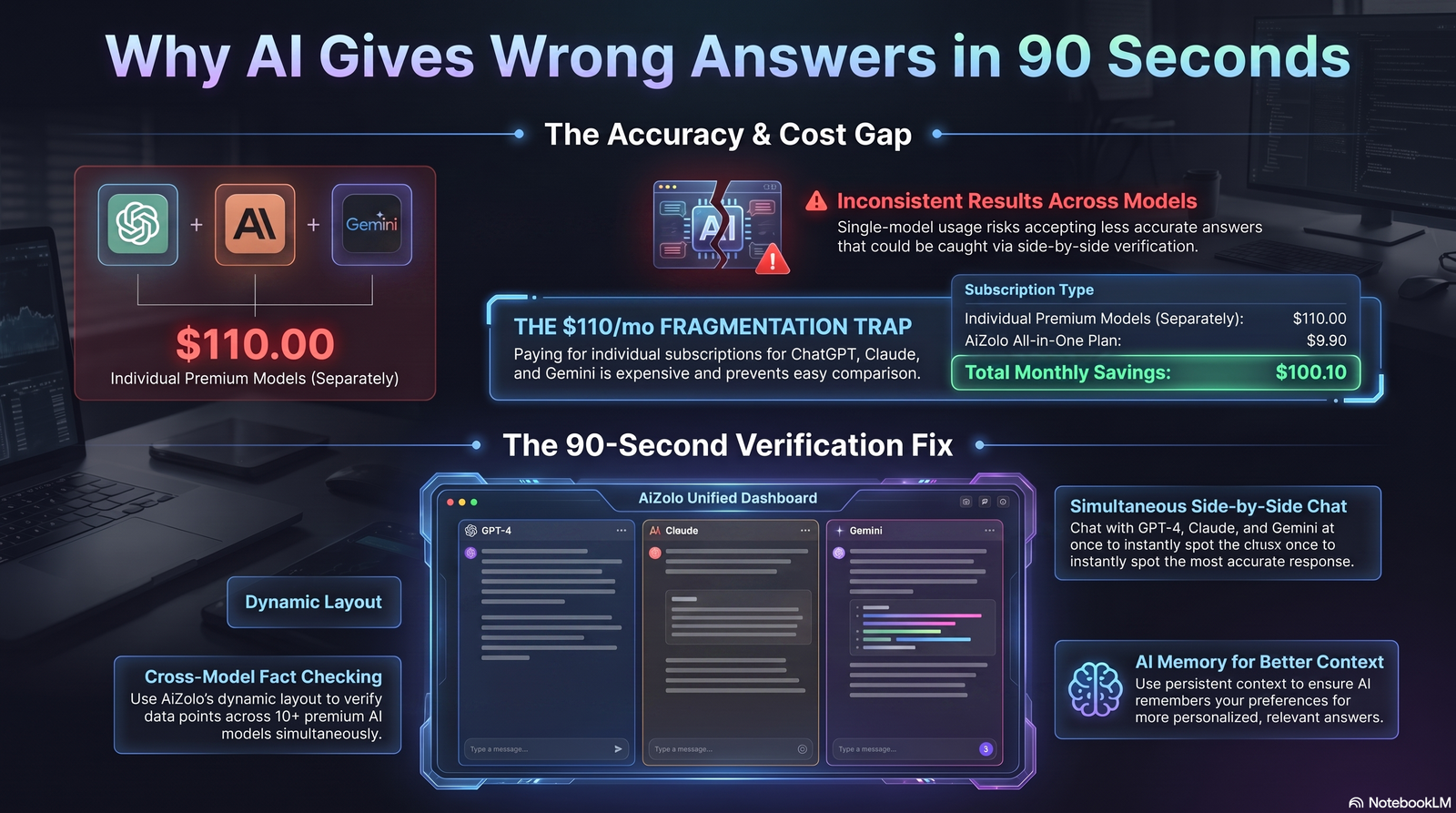
AI can give wrong answers because it predicts likely responses rather than verifying every fact. Hallucinations, outdated information, weak prompts, limited context, biased training data, and reasoning errors can all affect accuracy. This guide explains why these mistakes happen, where they commonly appear, and how to reduce them through better prompting, source verification, and cross-checking. For an easier verification workflow, AiZolo lets you compare responses from multiple AI models side by side, helping you spot inconsistencies before trusting an answer.
Introduction
Ask an AI chatbot a question, and it will almost always answer confidently — even when the answer is wrong.
That’s the strange part. Understanding why AI gives wrong answers isn’t about finding a single bug to fix. It’s about understanding how these systems actually work under the hood, and where that design creates room for error. Platforms like Aizolo also help users compare responses from multiple AI models, making it easier to spot inconsistencies.
Millions of people now use tools like ChatGPT, Claude, Gemini, and Perplexity every day for research, writing, coding, and decision-making. Most of the time, the answers are genuinely useful. But sometimes they’re subtly wrong, and sometimes they’re confidently, completely wrong — a phenomenon commonly called an AI hallucination.
This guide breaks down exactly why AI models make mistakes, walks through real examples across medicine, law, code, and business, and gives you a practical framework for catching errors before they cost you time, money, or credibility.
Key Takeaway: AI models don’t “know” facts the way humans do. They predict the most statistically likely next word based on patterns in training data — which means fluent, confident-sounding text can still be factually wrong.
Table of Contents
What Does “Why AI Gives Wrong Answers” Mean?
When people search for why AI gives wrong answers, they’re usually running into one of a few situations:
- An AI chatbot invented a fact, quote, citation, or statistic that doesn’t exist.
- An AI gave outdated information about a fast-changing topic.
- An AI misunderstood a vague or poorly worded prompt.
- An AI applied logic incorrectly to a math, legal, or technical problem.
- An AI gave an answer that sounded right but couldn’t be verified.
All of these fall under a broader category researchers call AI reasoning errors or, more specifically, AI hallucinations. Understanding the difference matters, because each type has different causes — and different fixes.
How AI Actually Generates Answers
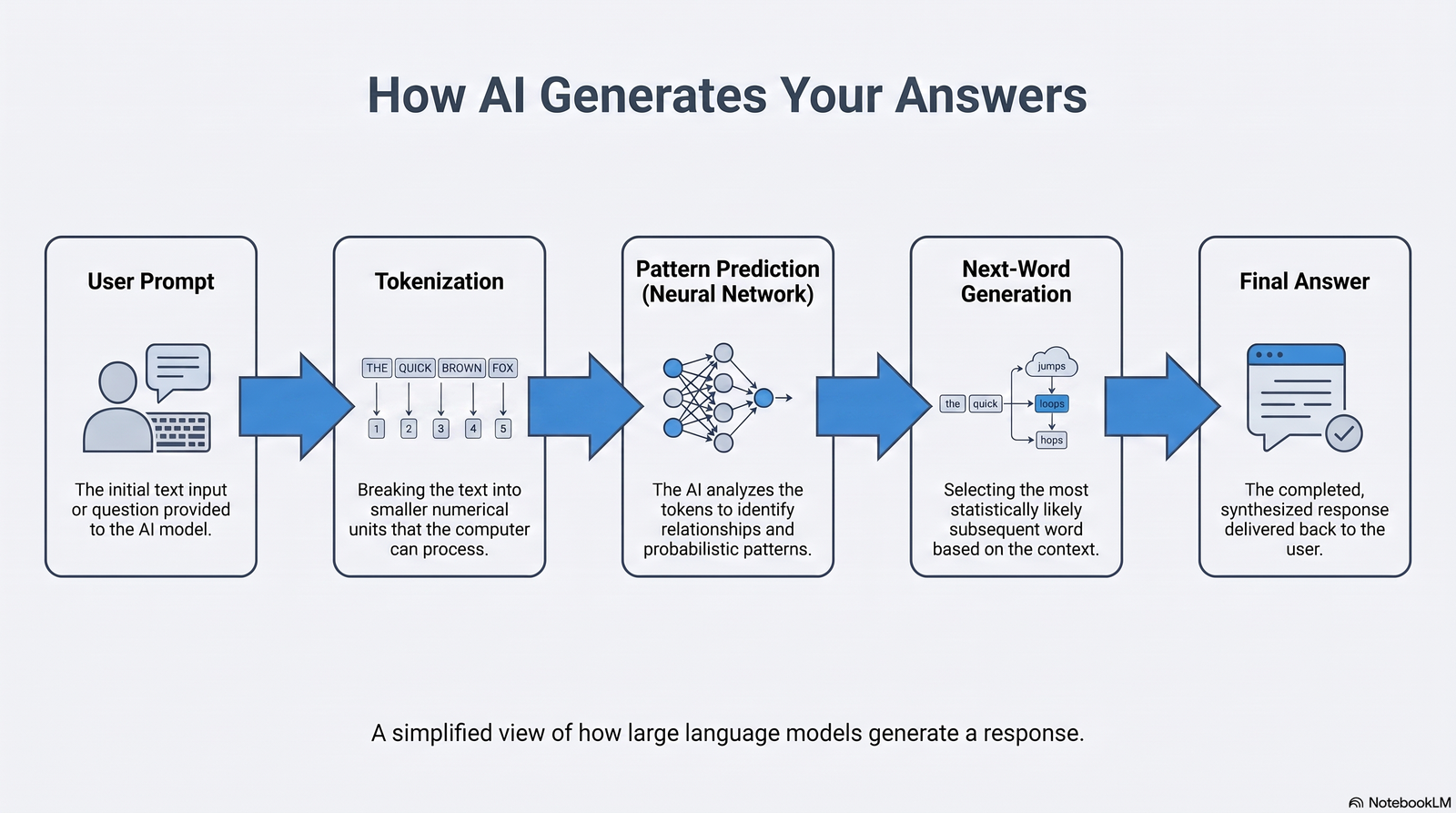
To understand why AI sometimes fails, it helps to understand what it’s actually doing when it “answers” a question.
Modern chatbots are built on large language models (LLMs) — neural networks trained on enormous volumes of text scraped from books, websites, code repositories, and other public sources.
During training, the model learns statistical relationships between words, phrases, and concepts. It doesn’t store facts in a database the way a search engine or spreadsheet does.
When you type a prompt, the model doesn’t “look up” an answer. Instead, it predicts the next most probable token (a word or word-fragment), one at a time, based on everything it learned during training and everything currently in the conversation.
This process is often described as generative AI because the model is generating new text, not retrieving stored facts.
Pro Tip: Think of an LLM less like a librarian pulling a book off a shelf, and more like an extremely well-read writer improvising a response from memory — impressively often correct, but never guaranteed to be.
This distinction — prediction versus retrieval — is the single biggest reason why AI gives wrong answers, and it underlies almost every cause discussed below.
Why AI Gives Wrong Answers: The Short Explanation
In short, AI gives wrong answers because:
- It generates text based on probability, not verified fact.
- Its training data has gaps, errors, and biases.
- Its knowledge has a cutoff date and may be outdated.
- It can misinterpret ambiguous or poorly written prompts.
- It has limited working memory (the context window).
- It often lacks access to real-time, verified data.
- It has no built-in mechanism to “know that it doesn’t know.”
Each of these deserves a deeper look, because they don’t operate independently — they often compound each other.
Top Causes of AI Errors
Hallucinations Explained
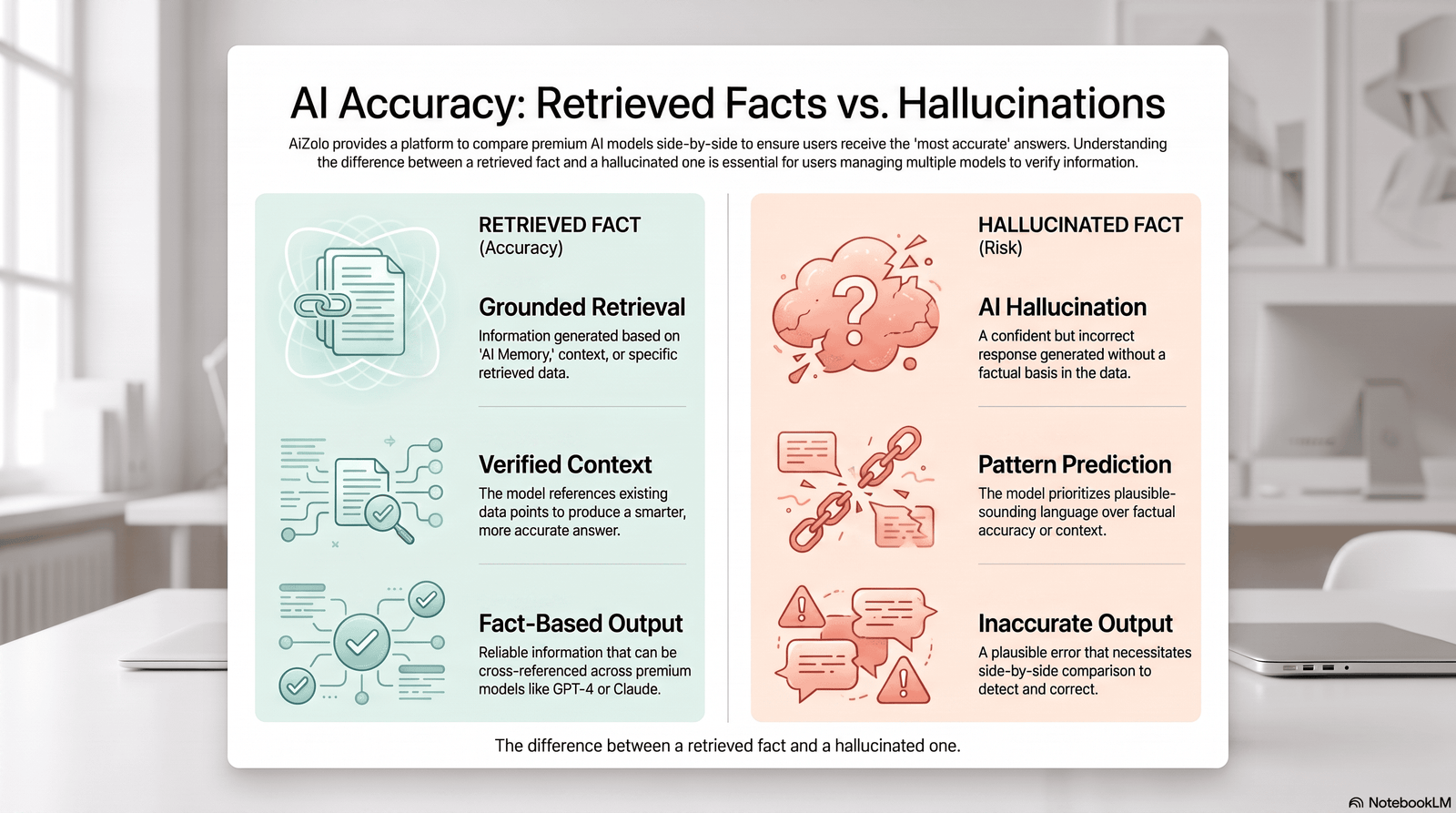
An AI hallucination happens when a model generates information that sounds plausible but is factually incorrect or entirely fabricated — a fake citation, a nonexistent legal case, an invented statistic, a made-up product feature.
Hallucinations happen because the model is optimized to produce fluent, coherent text — not necessarily true text. When the model doesn’t have strong training signal on a topic, it fills the gap with the most statistically plausible continuation, which can look convincing while being wrong.
| Hallucination Type | Example |
|---|---|
| Fabricated citation | Inventing a research paper or author that doesn’t exist |
| False factual claim | Stating an incorrect date, name, or number confidently |
| Nonexistent feature | Describing a software feature that was never released |
| Fake legal precedent | Citing a court case that was never decided |
| Invented quote | Attributing words to a person who never said them |
Poor or Incomplete Training Data
AI models learn from the data they’re trained on. If that data contains errors, gaps, low-quality content, or contradictory information, the model can absorb and reproduce those flaws.
Niche topics, non-English languages, and recently emerged subjects are often underrepresented in training data, which increases the risk of incorrect AI responses in those areas.
Outdated Information and Knowledge Cutoff
Every AI model has a knowledge cutoff — the point in time after which it has no training data. Ask about something that happened after that date, and the model may either say it doesn’t know, or worse, guess based on outdated patterns.
This is one of the most common and easiest-to-understand reasons for outdated information in AI answers, and it’s why many platforms now pair models with live web search or retrieval tools.
Prompt Quality
Vague, ambiguous, or poorly structured prompts are a major source of wrong answers — and this cause is entirely within the user’s control.
| Prompt Type | Typical Result |
|---|---|
| “Tell me about tax law” | Vague, generic, possibly outdated answer |
| “Summarize the 2024 US federal tax brackets for a single filer” | More specific, more accurate answer |
| “Is this code correct?” (no code pasted) | Model guesses or asks for clarification |
| “Review this Python function for bugs: [code]” | Focused, useful, checkable answer |
Good prompt engineering doesn’t just improve style — it directly reduces error rates by narrowing the space of possible (and incorrect) interpretations.
Context Window Limits
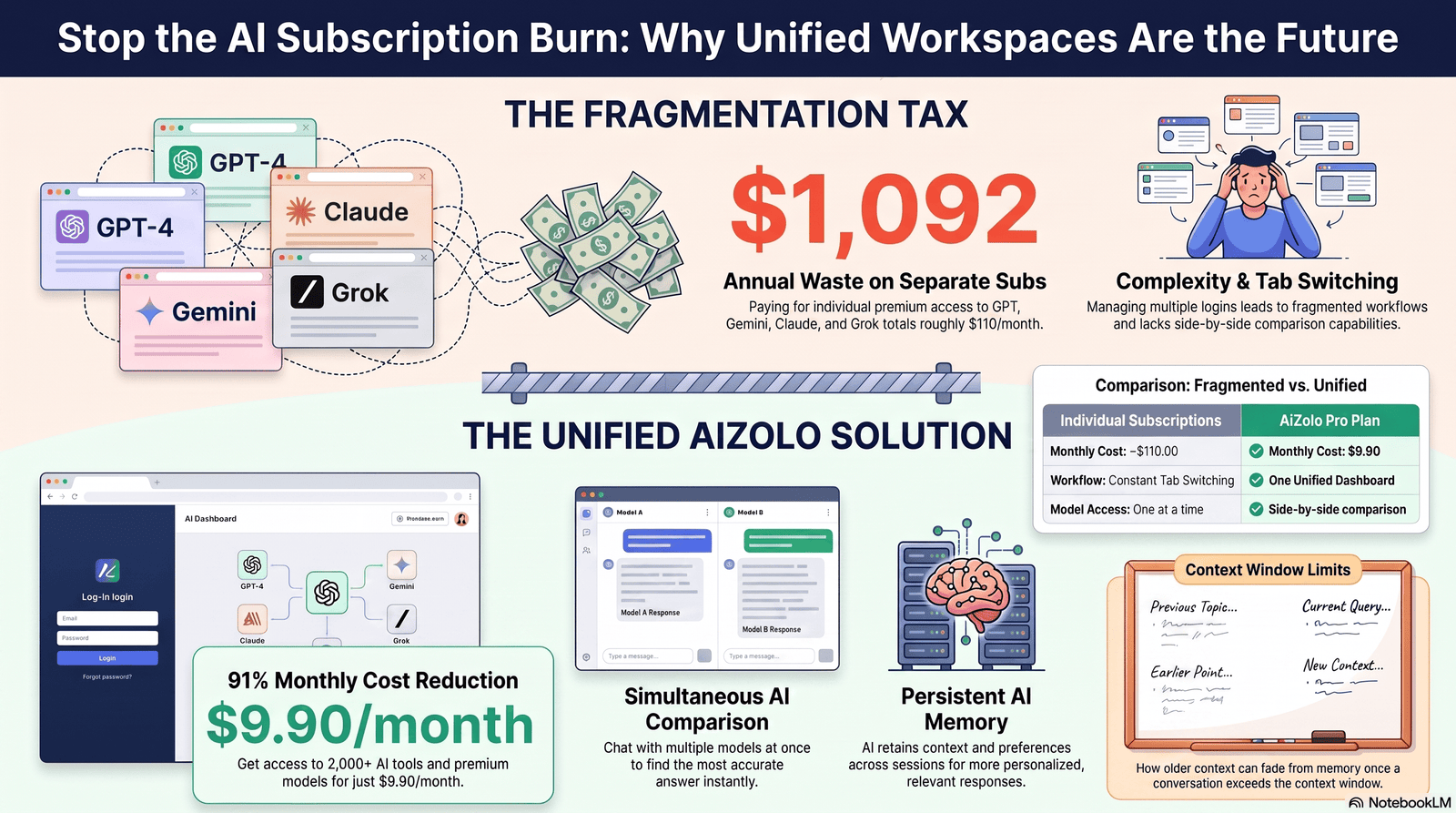
The context window is the amount of text (measured in tokens) a model can “see” and reason over at one time — the current prompt, any attached documents, and the recent conversation history.
When a conversation or document exceeds that window, older information gets pushed out or compressed, and the model can lose track of earlier details, contradict itself, or miss important context entirely.
This is especially common in long research sessions, large document analysis, or extended back-and-forth conversations.
Missing Domain Knowledge
General-purpose AI models are trained broadly across many subjects, but they aren’t specialists. In highly technical fields — medicine, law, engineering, tax code — the model may lack the depth of a trained professional, even if it sounds confident.
This is why generic AI answers in specialized fields should always be treated as a starting point, not a final authority.
Bias in AI Models
AI bias occurs when training data reflects historical, cultural, or systemic imbalances, and the model reproduces those patterns in its output.
This can show up as skewed assumptions about gender, geography, profession, or culture — and it’s an active area of research at organizations like Stanford HAI and NIST, which have published frameworks for measuring and mitigating bias in AI systems.
Retrieval Failures
Many modern AI systems use retrieval augmented generation (RAG) — pulling in external documents or search results to ground answers in real data instead of relying purely on memorized training patterns.
When retrieval fails — the wrong document is pulled, a search returns irrelevant results, or the retrieved text is misread — the model can still generate a fluent answer, just one based on faulty source material.
Lack of Real-Time Data
Without live internet access or a connected data source, an AI model can’t know about breaking news, current prices, live scores, or anything that changed after its training data was collected.
Tools like Perplexity and search-enabled modes in ChatGPT, Claude, and Gemini were built specifically to address this gap by combining generative AI with live web retrieval.
Token Prediction vs. Reasoning
It’s worth repeating: LLMs generate text one token at a time based on probability, not by running verified logical proofs the way a calculator or theorem-prover does.
For many tasks — writing, summarizing, brainstorming — this works extremely well. For tasks requiring strict logical or mathematical precision, it can introduce AI reasoning errors, especially in multi-step problems where an early mistake compounds.
Confidence Without Accuracy
Perhaps the most misleading aspect of AI errors is tone. Models are trained to produce fluent, well-structured, confident-sounding language regardless of whether the underlying content is correct.
This is often called the AI confidence problem — there’s no built-in “uncertainty meter” reliably communicating how sure the model actually is, which makes wrong answers harder for users to catch.
Warning: A confident tone is not evidence of accuracy. Always separate how an AI sounds from whether its claim can be verified.
Examples of Wrong AI Answers
Real-world mistakes tend to cluster around a few high-stakes categories.
Medical Examples
AI models have been shown to occasionally invent drug interactions, misstate dosages, or describe symptoms inaccurately when asked open-ended medical questions — a serious risk given how confidently these answers can be phrased. Health organizations and AI developers consistently recommend using AI as a starting point for medical questions, never a replacement for a licensed professional.
Legal Examples
Several widely reported cases have involved lawyers submitting court filings that included AI-fabricated case citations — legal precedents that sounded real but did not exist. Courts in multiple jurisdictions have since issued guidance requiring human verification of AI-assisted legal research.
Programming Examples
AI coding assistants can generate code that looks syntactically correct but calls a function that doesn’t exist in a given library, uses a deprecated method, or introduces a subtle logic bug — a category developers often call “hallucinated APIs.”
Business Examples
In business contexts, wrong answers often appear as outdated market statistics, incorrect competitor claims, or fabricated case studies — all of which can seriously mislead a business decision if left unverified.
Research Examples
Academic and research users have reported AI tools generating citations to papers that were never published, or misattributing findings to the wrong study — a well-documented hallucination pattern that underscores why source-checking remains essential in research work.
Can AI Detect Its Own Mistakes?
Generally, no — not reliably. AI models don’t have genuine self-awareness or a built-in fact-checking layer running independently of their text generation process.
Some newer models are trained to express uncertainty (“I’m not fully certain about this”) or to flag when a question falls outside reliable knowledge. This helps, but it isn’t foolproof — a model can express high confidence in a wrong answer just as easily as in a correct one.
Techniques like self-consistency checking (having a model generate multiple answers and compare them) and external verification layers are active areas of research aimed at closing this gap.
How Companies Reduce AI Errors
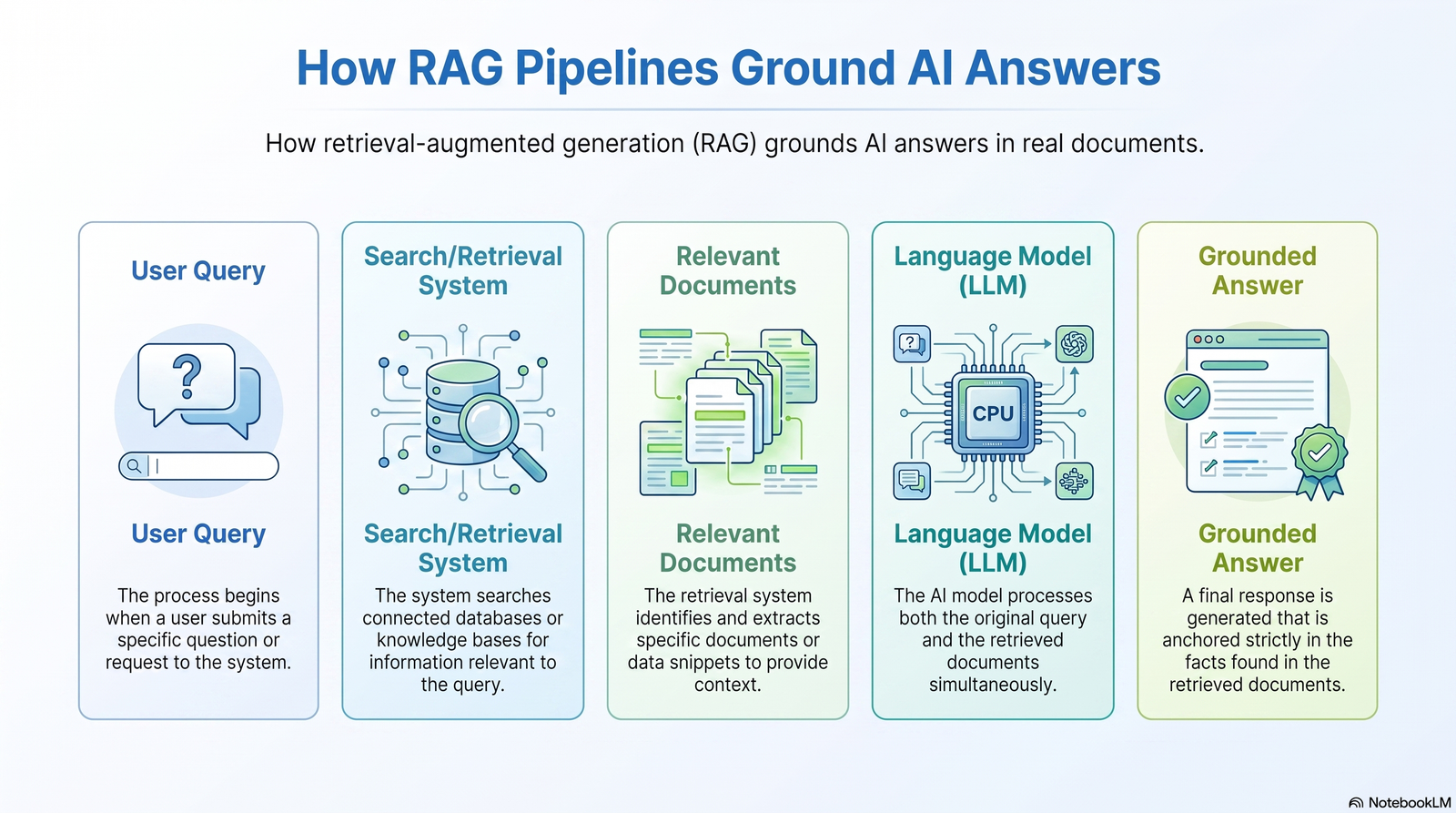
AI developers use several overlapping strategies to reduce error rates in production systems.
Human-in-the-Loop Systems
Human reviewers evaluate and rate model outputs, feeding that judgment back into training. This is a core part of how companies like OpenAI and Anthropic refine model behavior after initial training.
Retrieval-Augmented Generation (RAG)
By connecting a model to a verified external knowledge source — a document library, database, or live search index — RAG grounds answers in retrievable text instead of relying purely on memorized patterns.
Fine-Tuning
Fine-tuning adjusts a pre-trained model on a narrower, curated dataset to improve performance and accuracy on a specific domain or task.
Prompt Engineering (System-Level)
Beyond what individual users type, companies build structured system prompts and guardrails that shape how a model responds, reducing ambiguity before the user ever sees an answer.
Fact Checking Layers
Some platforms add automated or human fact-checking steps after generation, particularly for high-stakes categories like health, finance, or legal content.
Model Comparison
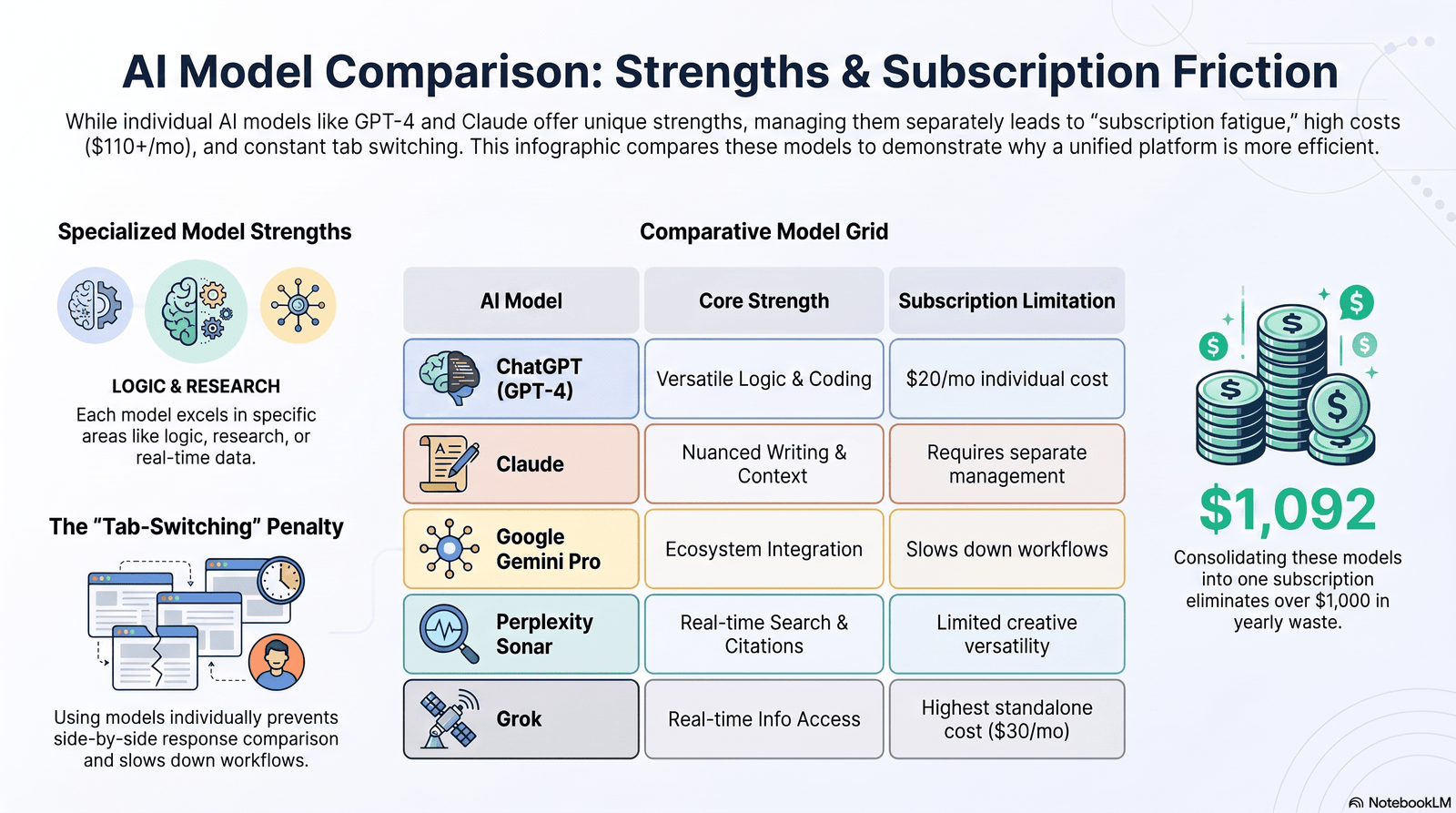
| Model | Known Strength | Known Limitation |
|---|---|---|
| ChatGPT (OpenAI) | Strong general reasoning, wide plugin/tool ecosystem | Can hallucinate confidently on niche topics |
| Claude (Anthropic) | Strong at careful, nuanced writing and long documents | Knowledge cutoff limits without search enabled |
| Gemini (Google) | Deep integration with Google Search and Workspace | Accuracy varies by task complexity |
| Perplexity | Built around live citations and web retrieval | Answer quality depends on source quality |
| Grok (xAI) | Real-time access to X (Twitter) data | Newer model lineage, less long-track-record data |
| Copilot (Microsoft) | Strong coding and Microsoft 365 integration | Inherits underlying model limitations |
| Mistral | Efficient open-weight models | Smaller models can trade accuracy for speed |
| DeepSeek | Competitive reasoning performance, open research | Newer entrant, evolving track record |
Expert Insight: No single model is immune to hallucinations. The safest workflow for high-stakes tasks is comparing outputs across more than one AI model rather than trusting a single source. This is one reason platforms like Aizolo, which let users run the same prompt across multiple AI models side by side, have become useful for spotting inconsistencies and verifying answers before relying on them.
How Users Can Reduce Wrong Answers
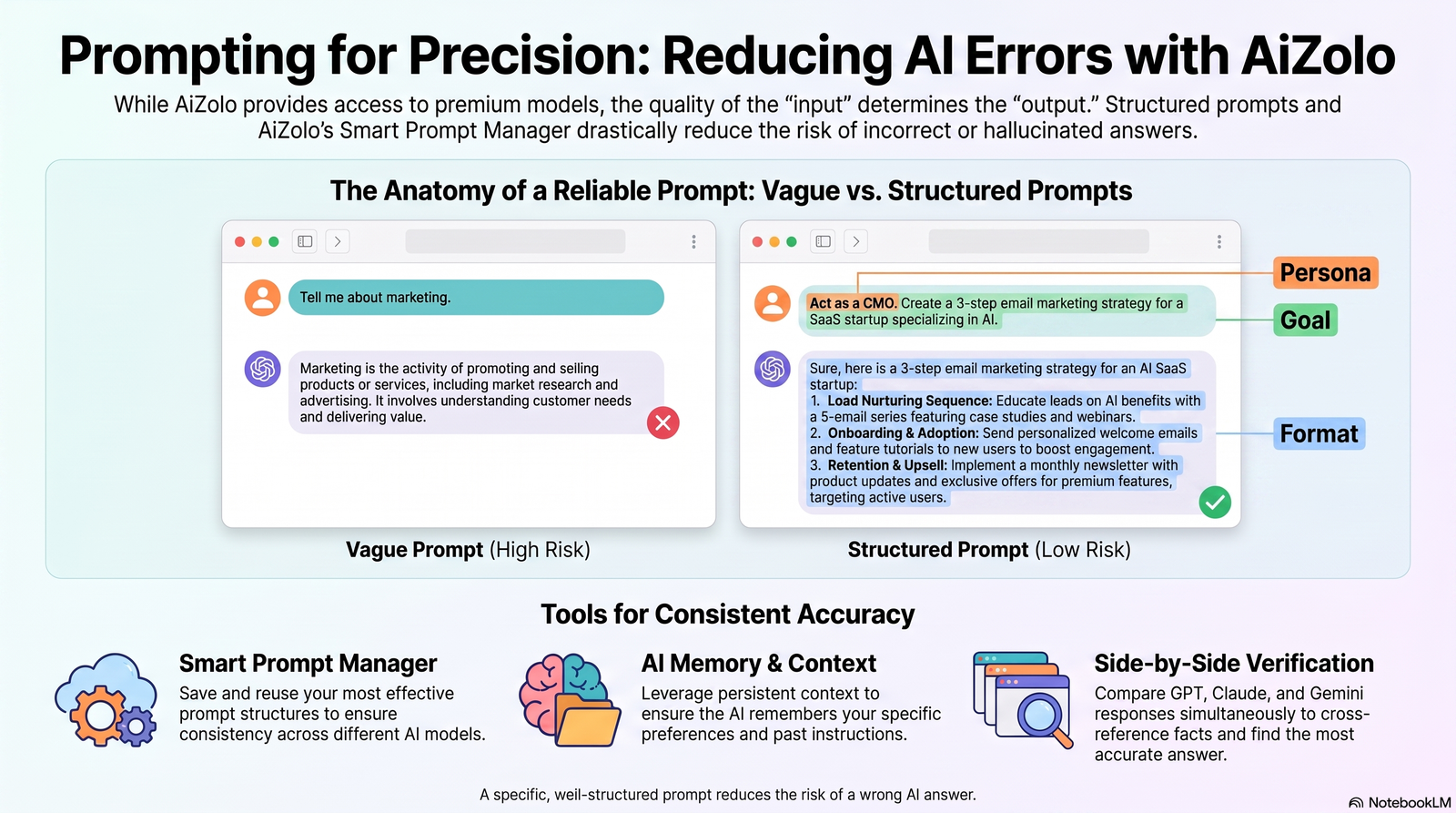
You can’t eliminate AI errors completely, but you can significantly reduce how often you encounter them.
- Be specific. Vague prompts invite vague, error-prone answers.
- Provide context. Paste the document, data, or code you’re asking about instead of describing it from memory.
- Ask for sources. Request citations, and independently verify them.
- Cross-check with search. Use search-enabled AI modes for time-sensitive questions.
- Compare multiple models. Run the same question through more than one AI tool to catch inconsistencies — this is exactly the kind of verification workflow platforms like Aizolo are designed to support.
- Break down complex questions. Multi-step reasoning tasks are less error-prone when broken into smaller steps.
- Watch for overconfidence. Treat unusually specific numbers, quotes, or citations with extra scrutiny.
- Use domain experts for high-stakes decisions. Medical, legal, and financial answers should always be reviewed by a qualified professional.
Checklist: Verifying AI Answers
- [ ] Did I give the AI enough context and specificity?
- [ ] Does the answer include names, numbers, or citations I haven’t verified?
- [ ] Is this a time-sensitive topic that requires current data?
- [ ] Have I cross-checked this with a second AI model or a trusted source?
- [ ] Is this a high-stakes decision (medical, legal, financial) that needs expert review?
- [ ] Does the tone sound more confident than the evidence actually supports?
Common Myths About AI Accuracy
Myth: “AI hallucinations only happen with cheap or older models.” Even the most advanced frontier models can hallucinate, particularly on niche topics or when asked to recall precise details like citations.
Myth: “If AI says it’s sure, it’s probably right.” Confidence in tone is a language pattern, not a measure of underlying certainty.
Myth: “AI is basically a search engine.” Without retrieval tools enabled, most AI models are generating answers from learned patterns, not looking anything up in real time.
Myth: “More training data always fixes hallucinations.” More data helps, but it doesn’t eliminate the fundamental prediction-based nature of how these models generate text.
The Future of AI Accuracy
Researchers at organizations including DeepMind, Stanford HAI, MIT, and groups publishing through arXiv are actively working on techniques to reduce hallucinations — including better retrieval systems, improved uncertainty estimation, and stronger fact-verification layers built directly into model training.
Government and standards bodies, including NIST through its AI Risk Management Framework and the OECD’s AI policy work, are also pushing for more transparent reporting on model reliability and limitations.
The likely near-term trajectory isn’t a single fix, but a combination of better retrieval, better training methods, and better tools for users to independently verify AI-generated claims — including multi-model comparison platforms that make discrepancies easier to spot.
Final Thoughts
AI gives wrong answers because it’s fundamentally a prediction system, not a fact database — and every cause covered here, from training data gaps to context window limits, traces back to that core design.
That doesn’t make AI unreliable for everyday use. It means treating AI output the way you’d treat a knowledgeable but fallible colleague: genuinely useful, worth listening to, but always worth double-checking on anything that matters.
The most reliable AI workflows combine good prompting, healthy skepticism, and — especially for important decisions — verification across more than one source or model.
FAQ
1. Why does AI give wrong answers? AI generates answers by predicting likely word sequences based on training data, not by verifying facts, which can lead to confident but incorrect responses.
2. What is an AI hallucination? An AI hallucination is when a model generates information — a fact, quote, or citation — that sounds plausible but is false or doesn’t exist.
3. Can AI lie on purpose? No. AI models don’t have intent. Hallucinations are unintentional byproducts of how the model generates text, not deliberate deception.
4. Is ChatGPT accurate? ChatGPT is generally accurate for common knowledge and well-documented topics but can make mistakes on niche facts, recent events, or precise citations.
5. Why does AI give different answers to the same question? Language models generate text probabilistically, so slight variation between runs is normal, especially for open-ended questions.
6. Does Claude hallucinate? Yes, like all large language models, Claude can occasionally produce incorrect information, particularly on topics outside its training data or knowledge cutoff.
7. How can I check if an AI answer is correct? Cross-check with a trusted source, ask the AI for citations and verify them, or compare the answer across more than one AI model.
8. Why does AI get math wrong? Because models predict text patterns rather than performing guaranteed step-by-step calculations, errors can compound in multi-step math problems.
9. Can AI fix its own mistakes? AI can sometimes catch inconsistencies when asked to double-check itself, but it lacks a reliable built-in fact-verification system.
10. What is retrieval-augmented generation (RAG)? RAG is a technique where an AI model pulls in real, external documents or search results to ground its answer, reducing reliance on memorized patterns.
11. Why does AI give outdated information? Every model has a knowledge cutoff date; without live search or retrieval tools, it can’t know about events after that date.
12. Is AI bias a real problem? Yes. AI models can reflect biases present in their training data, an issue actively studied by research groups including Stanford HAI and NIST.
13. Which AI model is the most accurate? No single model is consistently most accurate across all tasks; accuracy varies by topic, and comparing multiple models is the most reliable verification method.
14. Should I trust AI for medical or legal advice? No. AI can provide general information, but medical and legal decisions should always be reviewed by a licensed professional.
15. Will AI hallucinations ever be completely solved? Researchers are making steady progress through better retrieval and training methods, but most experts agree occasional errors will remain a factor for the foreseeable future.
Author Bio
Author: Jeevesh Tripathi Email: jeevesh@aizolo.com
Jeevesh is an AI research writer specializing in generative AI, prompt engineering, and emerging technology trends. With a background in analyzing large language models and AI productivity tools, Jeevesh focuses on translating complex technical concepts — from hallucinations to retrieval-augmented generation — into clear, practical guidance for everyday users and professionals. Jeevesh regularly researches how leading AI platforms like ChatGPT, Claude, Gemini, and Perplexity behave in real-world use cases, with a particular interest in AI accuracy, verification workflows, and multi-model comparison. At Aizolo, Jeevesh writes to help readers use AI tools more effectively and responsibly.